
In This Article
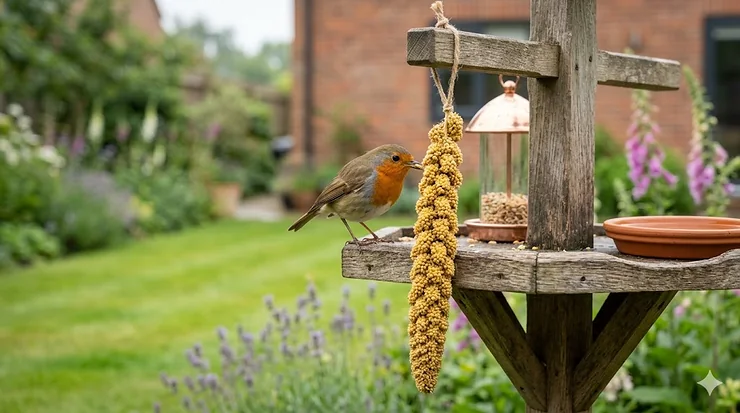
If you’ve ever watched a budgie enthusiastically strip seeds from a spray of golden millet, you’ll understand why this humble treat has become indispensable to British bird keepers. Millet spray for birds isn’t just another seed mix—it’s a natural foraging tool that satisfies your feathered friend’s instinctive need to work for their food whilst delivering a nutritional punch that supports everything from healthy plumage to stress reduction. According to the Royal Society for the Protection of Birds (RSPB), providing natural foraging opportunities is essential for captive bird welfare.

What most UK bird owners overlook about millet spray is its dual purpose: it’s both a training reward and a mental health tool. During the long, grey British winter when your budgie, cockatiel, or canary might spend more time indoors, the simple act of pecking seeds from a spray provides crucial mental stimulation that prevents boredom-related behavioural issues. The spray format—seeds still attached to their natural stalk—encourages birds to dehull and harvest their own food, mimicking wild foraging behaviour in a way that loose seed mixes simply can’t match.
The British market has seen a surge in quality millet options over the past few years, with everything from budget-friendly bulk bags to premium organic sprays now readily available on Amazon.co.uk. Whether you’re based in a London flat with a single budgie or managing an aviary in the Scottish Highlands, finding the right millet spray involves understanding your bird’s species, life stage, and dietary needs. In this comprehensive guide, I’ll walk you through the best products currently available to UK buyers, decode the nutritional science behind millet’s benefits, and share practical tips that’ll help you avoid the common pitfalls that turn millet from a healthy treat into a dietary crutch.
Quick Comparison: Top Millet Spray Products Available in the UK
| Product | Type | Pack Size | Price Range | Best For |
|---|---|---|---|---|
| SkyGold Finest Millet Spray | Yellow/Golden | 1kg | £6-£8 | Budget-conscious owners |
| RIO Spray Millet | Yellow | 100g | £3-£5 | Small households |
| Maltby’s Stores Standard | Yellow | 1kg | £6-£9 | Value seekers |
| Pet Ting Millet Spray | Yellow | 1kg | £7-£10 | Multi-bird aviaries |
| Haith’s Chinese Millet | Premium Chinese | 500g-1kg | £8-£12 | Show birds & weaning |
| Vitakraft Vita Nature | Yellow Fox | 300g | £4-£6 | Occasional treats |
| Natural Red Millet Sprays | Red | 250g | £5-£8 | Dietary variety |
💬 Just one click — help others make better buying decisions too! 😊
Top 7 Millet Spray for Birds: Expert Analysis
1. SkyGold Finest Millet Spray
SkyGold is part of the Copdock Mill family, a British company with over 40 years of experience in avian nutrition, and their 1kg millet spray pack represents exceptional value for money. The sprays are naturally grown, handpicked, and arrive in foil-sealed packaging that maintains freshness—crucial in our damp British climate where moisture can quickly turn millet musty.
What sets this apart from cheaper alternatives is the spray quality: you get thick, bushy stalks packed with plump seeds rather than the sparse, underdeveloped sprays sometimes found in budget options. The seeds contain magnesium, phosphorus, protein, and calcium, which support bill health, bone density, and feather quality. For UK budgie owners dealing with the stress of indoor living during our extended winters, this millet provides both nutritional support and mental stimulation through natural foraging behaviour.
UK customers consistently report receiving 35-45 sprays per 1kg bag, meaning you’re paying roughly 15-20p per spray—compare that to high street pet shops where three small sprays can cost £1 or more. The long stalks make it easy to secure the millet to cage bars, even in compact cages typical of British flats and terraced houses. One limitation: some batches have been reported as slightly pale, suggesting they may have been harvested early or stored longer, though this doesn’t seem to affect palatability.
Pros:
✅ Exceptional value—35-45 sprays per bag
✅ Fresh, foil-sealed packaging resists British humidity
✅ Long stalks perfect for cage mounting
Cons:
❌ Occasional batch colour variation
❌ Some sprays may have sparse seed coverage
Price: Around £6-£8 per 1kg | Best for: Budget-conscious UK owners with multiple birds

2. RIO Spray Millet
The RIO brand has built its reputation on careful sourcing and controlled storage, and their spray millet delivers consistency that busy bird owners appreciate. Each spray is handpicked and dried in a controlled environment—a process that matters in the UK market where cheap imports can arrive with mould issues or pesticide residues.
What most buyers don’t realise about RIO’s smaller 100g packs is that they’re ideal for testing palatability before committing to bulk purchases. Birds can be surprisingly picky, and whilst one budgie might devour golden millet, another might prefer red varieties. The compact packaging also suits urban UK dwellers with limited storage—a 100g pack fits easily in a kitchen cupboard and stays fresh for months when kept dry.
The millet itself provides B vitamins, vitamin E, magnesium, and calcium, supporting energy levels and skeletal health. It’s particularly valuable during moulting season when British birds face the double stress of feather regrowth and reduced daylight hours. The thin husk makes it easy for young or weak birds to digest, though this also means energetic budgies can strip a spray in just hours.
UK customers note the sprays arrive fresh-smelling and plump, with good seed density. However, at £3-£5 for just 100g, you’re paying a premium for the convenience and brand reliability. For a single budgie household, one pack might last 2-3 weeks; for aviaries, you’ll want to look at larger options.
Pros:
✅ Controlled storage guarantees freshness
✅ Perfect sizing for testing bird preferences
✅ Suitable for young or weak birds
Cons:
❌ Higher per-gram cost than bulk options
❌ Small pack size unsuitable for multiple birds
Price: Around £3-£5 per 100g | Best for: New bird owners testing millet varieties
3. Maltby’s Stores Standard Millet Sprays
Maltby’s Stores offers a no-nonsense approach that British bird keepers have trusted for years. Their 1kg bags deliver consistently thick, long-stalked sprays that make securing them to cage bars effortless—a small detail that matters when you’re dealing with the fiddly clips and ties common in UK cage designs.
The standout feature here is quality control: UK reviewers consistently report receiving fresh, plump sprays with no musty smell—a common issue with imported millet that’s been stored in damp conditions during shipping. The sprays come in a heat-sealed polythene bag inside a sturdy box, protecting them from the British weather during delivery. I particularly appreciate the spray length; at 25-30cm, they’re among the longest available, giving birds more foraging time and better value.
Nutritionally, these sprays provide the standard millet profile: high in easily digestible carbohydrates, moderate protein (around 11%), and rich in phosphorus and magnesium. During breeding season or whilst weaning chicks, the soft seeds are gentle on developing bills whilst providing the calories young birds need. The low fat content (under 4%) makes it a safer daily treat than sunflower seeds, which can quickly lead to obesity in sedentary cage birds.
One consideration for UK buyers: Maltby’s tends to sell out quickly, reflecting their popularity but occasionally leaving you scrambling for alternatives. Some customers report the sprays can be quite dry, though this actually extends shelf life in our humid climate.
Pros:
✅ Consistently long stalks (25-30cm)
✅ Excellent quality control—no musty batches
✅ Fresh arrival guaranteed with heat-sealed packaging
Cons:
❌ Frequently out of stock
❌ Can be quite dry (though this aids storage)
Price: Around £6-£9 per 1kg | Best for: Reliability-focused bird owners
4. Pet Ting Millet Spray
Pet Ting’s 1kg offering caters specifically to the UK market with Prime-eligible delivery and packaging designed for our climate. The brand has carved out a niche among British bird keepers who value freshness over rock-bottom pricing, and their millet delivers on that promise with plump, golden sprays that arrive with a subtle sweet scent—a sign of proper drying and storage.
What sets Pet Ting apart is spray density: you’re getting thick, bushy stalks where every inch is packed with seeds rather than the sparse coverage that characterises budget brands. This matters during British winters when your budgie might spend 16 hours a day in their cage; a dense spray provides hours of entertainment and prevents the boredom that leads to feather-plucking and screaming.
The nutritional profile supports healthy digestion thanks to millet’s highly alkaline nature, which helps birds with sensitive crops or those recovering from illness. The protein content (approximately 11-13%) supports feather development during annual moults, whilst the calcium and phosphorus ratio aids bone density—particularly important for egg-laying females.
UK customers consistently praise the value, with most receiving 38-42 sprays per bag. However, some batches have included broken sprays or loose seeds at the bottom of the bag, likely from rough handling during delivery. The sprays work brilliantly for training; their palatability makes them ideal rewards when teaching budgies to step up or targeting cockatiels to whistle on cue.
Pros:
✅ Dense, bushy sprays with excellent seed coverage
✅ Prime-eligible for next-day UK delivery
✅ Ideal palatability for training purposes
Cons:
❌ Occasional broken sprays from delivery handling
❌ Mid-range pricing without premium quality guarantees
Price: Around £7-£10 per 1kg | Best for: Training and multi-bird households
5. Haith’s Chinese Millet Sprays
When British budgie breeders need the absolute best, they turn to Haith’s Chinese millet sprays. Shipped directly from China to Haith’s UK facility, these represent the premium end of the millet spectrum—and the difference is immediately visible. The sprays are notably plumper than standard varieties, with tightly packed seeds that have a distinctive shine indicating freshness and high oil content.
What justifies the premium price (£8-£12 per kilogram) is versatility during critical life stages. When weaning baby budgies, cockatiels, or finches, many British breeders soak these sprays in warm water mixed with aviary disinfectant, then offer them to chicks who haven’t yet discovered seed pots. The soft texture and concentrated nutrition help young birds transition to solid food whilst minimising weaning stress—a technique endorsed by champion budgie breeder Chris Snell, who personally approves Haith’s quality.
The sprays also shine during show season. After the stress of judging, birds often refuse normal seed, but the familiar taste and easy digestibility of premium millet encourages them to eat, helping maintain condition. The Chinese variety has a slightly sweeter taste than standard yellow millet, which birds seem to find irresistible even when stressed.
For UK buyers, the main consideration is cost versus usage. If you’re maintaining an aviary or breeding, the quality justifies the investment. For pet owners with one or two budgies, standard varieties will suffice for daily treats, with Haith’s reserved for special situations.
Pros:
✅ Premium plumpness ideal for weaning chicks
✅ Endorsed by champion British breeders
✅ Slightly sweeter taste encourages stressed birds to eat
Cons:
❌ Higher cost than standard varieties
❌ Overkill for casual pet bird owners
Price: Around £8-£12 per 500g-1kg | Best for: Breeders and show bird owners

6. Vitakraft Vita Nature Millet Sprays
Vitakraft brings German engineering precision to millet production, and their Vita Nature range reflects that attention to detail. The 300g packs contain approximately 20 individual sprays of yellow fox millet—a variety prized for its slightly softer seeds and mild flavour that even picky eaters typically accept.
What most UK buyers don’t realise is that fox millet’s silica content specifically supports nervous system health, tendon strength, and nail condition—benefits that matter for indoor British birds who don’t get the natural wear and tear of outdoor living. The sprays come with a plastic hanger included, though frankly, most experienced bird owners will use their preferred securing method rather than rely on the somewhat flimsy clip.
The 100% natural composition means no additives or artificial ingredients—important for birds with sensitivities or those on restricted diets due to health conditions. The gentle drying process preserves natural flavour and nutritional value better than sun-drying, which can degrade B vitamins. During the British spring when birds are most active and breeding, the natural vitamins support increased energy demands.
The main limitation is value: at £4-£6 for just 300g, you’re paying roughly 20-25p per spray, which adds up quickly if you’re offering millet daily. The sprays are also slightly shorter than bulk options, giving less foraging time. However, for occasional treats or for bird owners prioritising German quality standards, Vitakraft delivers reliability.
Pros:
✅ High silica content supports nervous system and nails
✅ Gentle drying preserves nutritional value
✅ German quality standards and consistency
Cons:
❌ Higher per-spray cost than bulk alternatives
❌ Shorter sprays mean less foraging time
Price: Around £4-£6 per 300g | Best for: Occasional treats and quality-focused owners
7. Natural Red Millet Sprays
Whilst yellow millet dominates UK sales, red millet sprays offer valuable dietary variety that can prevent palatability fatigue—yes, birds can get bored of the same flavour. The red variety (actually a deep burgundy colour) comes from a different millet species with marginally higher protein content (around 12-14%) and a slightly nuttier taste that some birds strongly prefer.
What makes red millet particularly valuable for British bird owners is its appeal during moulting season. The higher protein supports feather regrowth, whilst the B vitamin content aids the metabolic demands of producing new plumage—a process that coincides with our autumn months when birds are already stressed by shortening daylight. The seeds are also slightly larger than yellow millet, providing more substantial pecking work that keeps energetic cockatiels and small conures engaged.
The sprays promote natural foraging behaviour just like yellow varieties, with the added benefit of visual variety in the cage. Birds have excellent colour vision, and rotating between yellow and red sprays adds environmental enrichment. The cultivation under strict chemical-free conditions makes them suitable for organic-focused households, though this isn’t certified organic under UK standards.
UK availability can be patchy—red millet is less common than yellow on Amazon.co.uk, and you’ll often find smaller pack sizes (250g) at £5-£8. This works out more expensive than bulk yellow millet, positioning red varieties as a rotational treat rather than a daily staple. Some birds show no preference between colours, so test a small pack before committing to regular purchases.
Pros:
✅ Higher protein content supports moulting birds
✅ Provides dietary variety and prevents flavour fatigue
✅ Cultivated without harmful chemicals
Cons:
❌ Less readily available than yellow varieties in UK
❌ Higher cost per gram limits daily use
Price: Around £5-£8 per 250g | Best for: Dietary rotation and moulting support
How Millet Spray Transforms Indoor Bird Keeping in the UK
The British climate presents unique challenges for cage bird welfare. Our long winters mean reduced daylight, limited outdoor time, and birds spending 15-17 hours daily in cages—conditions that can trigger stress, boredom, and behavioural problems like excessive screaming or feather destruction. Millet spray addresses these issues through a mechanism that most bird food simply can’t: active foraging.
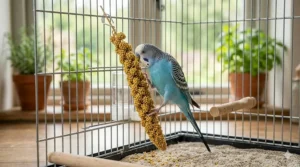
When you hang a millet spray in your budgie’s cage, you’re not just offering food—you’re providing work. Birds in the wild spend 60-70% of their waking hours foraging, using complex problem-solving to locate and access food. A budgie in a Birmingham flat with a seed dish doesn’t need to think; the millet spray forces them to position themselves, grip the spray, and systematically work along the stalk extracting seeds. This mirrors wild behaviour and provides the mental stimulation that prevents the psychological decline common in understimulated cage birds.
The physical benefits are equally important. Gripping and manipulating a swaying spray strengthens leg muscles and improves balance—crucial for birds who don’t get free flight time in small British homes. The dehulling action keeps the bill properly worn and shaped; bills grow continuously, and without appropriate wear, they can become overgrown and require veterinary intervention. During the damp British autumn and winter, when respiratory issues spike due to central heating and poor ventilation, the gentle exercise of working through a millet spray keeps birds active without overtaxing them.
Perhaps most importantly, millet spray serves as a training bridge. British bird behaviourists consistently recommend millet as the gold standard reward for target training, step-up training, and recall work. Its high palatability means even nervous birds will overcome fear to access it, whilst its natural presentation (still on the stalk) feels less threatening than hand-feeding loose seeds. If you’re working with a rescue budgie from a Birmingham shelter or a hand-shy cockatiel from Scotland, a strategically placed millet spray can be the tool that finally builds trust.

Understanding Millet Nutrition: What the Science Actually Tells Us
Millet’s reputation as “bird candy” oversimplifies its nutritional profile. Whilst it’s true that millet is relatively high in carbohydrates (around 65-72% by dry weight), this isn’t inherently problematic for small, active birds with fast metabolisms. The key is understanding what those carbohydrates deliver: quick-release energy that fuels the constant activity of species like budgies, canaries, and finches.
The protein content (10-14% depending on variety) sits in a sweet spot for maintenance nutrition. It’s sufficient to support feather health and immune function without the excess that can stress kidneys in birds with underlying health issues. According to research published by the University of Edinburgh’s Veterinary School, the fat content is genuinely low—typically 3-5%—making millet one of the safest seeds for birds prone to obesity, particularly British pet budgies who don’t get the flight exercise their wild cousins enjoy in the Australian outback.
Where millet truly shines nutritionally is its mineral profile. The phosphorus content (around 280-300mg per 100g) supports skeletal health and aids in calcium absorption—critical for egg-laying females who can rapidly deplete calcium stores during breeding. The magnesium (roughly 120-140mg per 100g) plays a vital role in muscle function and nervous system health. For birds living in the artificial light cycles of British homes, where seasonal cues are disrupted, these minerals help maintain normal physiological function.
The B vitamin complex in millet deserves special mention. Thiamine (B1) supports carbohydrate metabolism, niacin (B3) aids digestive health, and riboflavin (B2) is essential for energy production. During the British winter when natural food sources would be scarce in the wild, these vitamins help captive birds maintain condition despite the stress of indoor living and artificial heating.
One legitimate nutritional concern is millet’s calcium-to-phosphorus ratio. At roughly 1:8, it’s phosphorus-heavy, which can theoretically interfere with calcium absorption if millet dominates the diet. This is why millet should remain a supplementary food (10-15% of total intake) alongside a quality seed mix that includes calcium-rich components like hemp or chia. For breeding females or birds recovering from egg-binding, pairing millet with cuttlebone access ensures adequate calcium despite the phosphorus content.
Common Mistakes British Bird Owners Make with Millet Spray
The most frequent error I see among UK bird keepers is treating millet spray as unlimited free food rather than a managed treat. The scenario plays out predictably: a well-meaning owner hangs a fresh spray in the cage, the budgie devours it within hours, and soon the bird refuses their balanced seed mix in favour of demanding more millet. Within weeks, you have a millet addict who’s missing out on essential nutrients from other seeds, vegetables, and pellets.
The solution isn’t eliminating millet—it’s implementing smart management. Offer millet spray every second or third day rather than continuously, and remove it after 30-60 minutes rather than leaving it available all day. Use it strategically: as a training reward, as stress relief during thunderstorms (common in British summers), or as encouragement for birds who are off their food due to illness. This approach maintains millet’s value as a high-reward treat whilst preventing dependency.
Another common pitfall is ignoring storage conditions. British homes are notoriously damp, especially in coastal areas and during our wet autumn and winter months. Millet spray stored in the original unsealed bag will absorb moisture, leading to mould growth that can cause serious respiratory illness in birds. Transfer your bulk millet to an airtight container immediately upon arrival, and store it in a cool, dry location—not in the garage or shed where temperature and humidity fluctuate wildly.
Many UK bird owners also fail to inspect millet before offering it. Check each spray for signs of mould (fuzzy growth, musty smell, discolouration), insect infestation (tiny holes in seeds, webbing, moving specks), or staleness (very dry, brittle stems, seeds that crumble rather than pop when pressed). Compromised millet isn’t just unpalatable—it’s dangerous. Aspergillosis, a serious fungal respiratory infection, often traces back to mouldy seed, and treatment is lengthy and expensive. The UK Government’s Animal and Plant Health Agency (APHA) provides guidance on preventing fungal contamination in bird feed.
The final mistake is offering millet spray to overweight birds without accounting for the calories. A typical 15-20cm spray contains roughly 120-150 calories—a significant portion of a small budgie’s daily energy needs (approximately 200-250 calories). If your bird is already chunky and you add millet on top of their regular diet without reducing something else, you’re setting them up for obesity-related health issues like fatty liver disease and reduced lifespan. For portly budgies, use small spray sections (5-7cm) as training rewards rather than whole sprays as daily treats.
Millet Spray vs. Other Bird Treats: An Honest Comparison
When you walk into a British pet shop or browse Amazon.co.uk, the treat options can feel overwhelming: seed bells, honey sticks, mineral blocks, fruit-flavoured cuttlebones, and conditioning foods. Understanding where millet spray sits in this landscape helps you build a balanced enrichment strategy.
Compared to seed bells and honey sticks, millet spray offers superior nutritional value. Most commercial bells and sticks use honey, molasses, or other binding agents to hold seeds together—adding empty calories and refined sugars that birds don’t need. Millet spray is just millet: no binders, no additives, no refined sugars. The seeds remain in their natural state with the husk intact, providing fibre that supports digestive health. If your British blue budgie has a sensitive crop (common in the breed), millet spray is far gentler than sticky honey treats that can cause impaction.
Mineral blocks and cuttlebones serve a different nutritional purpose—calcium and mineral supplementation—making them complementary to millet rather than alternatives. A well-rounded cage should have both: cuttlebone for calcium and beak conditioning, millet spray for energy and enrichment. Wikipedia’s comprehensive article on avian nutrition provides detailed information on balanced diets for cage birds. However, unlike mineral blocks which birds nibble intermittently, millet spray tends to be consumed enthusiastically in one session, requiring more careful portion control.
Fruit and vegetable treats offer vitamins and moisture that millet spray can’t provide. Whilst millet delivers B vitamins and minerals, it lacks vitamin A (crucial for vision and immune function) and vitamin C (important for stress response). The ideal British bird diet combines millet spray 2-3 times weekly with daily fresh vegetables like spinach, kale, or broccoli. In practice, many budgies are vegetable-resistant, making millet spray a useful training tool: place a small piece of kale next to the millet spray, and curious birds will often sample the vegetable whilst accessing their favourite treat.
Egg food and conditioning supplements become important during breeding and moulting—periods when protein needs spike. Millet spray’s 11-13% protein content can’t compete with egg food’s 20-25%, making it an inadequate sole food during these high-demand phases. However, millet’s palatability makes it valuable for enticing stressed or ill birds to eat, after which you can gradually reintroduce higher-protein foods.
Seasonal Considerations for UK Bird Owners
British seasons create distinct challenges and opportunities for millet spray usage. During spring (March-May), when daylight extends and birds enter breeding condition, millet spray serves dual purposes: it provides the energy boost that breeding pairs need, and it encourages parent birds to demonstrate feeding behaviour to watching chicks. Soaking sprays briefly in warm water makes seeds easier for newly weaned chicks to manage, smoothing the transition from parent-fed to independent eating.
Summer (June-August) brings longer days and warmer temperatures, though British summers rarely get hot enough to spoil millet spray the way they might in southern Europe. This is your window for introducing new foods whilst birds are naturally more active and exploratory. Use millet as a bridge: offer new vegetables or fruits alongside a familiar millet spray, and curious birds will often sample the novel foods. Summer is also ideal for outdoor aviary time if you have the space—hanging millet sprays in outdoor enclosures encourages flying and climbing that indoor cages can’t match.
Autumn (September-November) triggers moulting in most cage birds, and this is when millet spray truly proves its worth. Moulting is metabolically expensive; growing new feathers requires significant protein and energy, and birds often feel under the weather during heavy moults. The easily digestible carbohydrates in millet provide quick energy, whilst the B vitamins support the metabolic demands. However, remember that moulting birds need more protein than millet alone provides—supplement with egg food or increase their pellet ration whilst using millet spray as a comfort food rather than a nutritional mainstay.
Winter (December-February) is the most challenging season for British cage birds. Short daylight hours (as little as 7-8 hours in Scotland), central heating that dries the air, and reduced owner interaction due to holiday busy-ness all contribute to stress and boredom. This is when millet spray transitions from occasional treat to essential mental health tool. A strategically hung spray can occupy a bored budgie for 20-30 minutes, providing both entertainment and comfort during the long dark evenings. However, winter is also when obesity risk peaks due to reduced activity, so monitor body condition closely and adjust portions if you notice weight gain.
The British spring equinox (late March) often triggers hormonal behaviour—increased vocalisations, aggression, nest-seeking—even in birds not intended for breeding. During these periods, reduce millet spray frequency rather than increasing it; the extra calories can exacerbate hormonal behaviour by signalling abundant food resources and optimal breeding conditions. Once breeding season passes (typically late May), you can resume normal millet supplementation.
Training Your Bird with Millet Spray: A Practical UK Perspective
British bird behaviourists consistently rank millet spray as the single most effective training reward for small parrots and softbills. Its effectiveness stems from three key factors: high palatability that overcomes fear, visible presentation that telegraphs reward availability, and natural texture that feels non-threatening to nervous birds.
For step-up training—teaching your budgie or cockatiel to perch on your finger—millet spray provides the motivation that turns abstract requests into concrete, rewarding experiences. Start by simply being present whilst your bird eats millet spray in their cage; this builds positive association with your proximity. Over 3-5 days, gradually move the spray outside the cage whilst keeping the door open, encouraging your bird to venture out for their reward. Once they’re comfortable eating from a spray you’re holding, you can introduce the step-up cue: hold the spray just beyond comfortable reaching distance so they must step onto your finger to access it.
Target training works beautifully with millet spray segments. Cut a 5cm piece and attach it to the end of a chopstick or wooden dowel. When your bird touches the stick with their beak, immediately allow them to nibble the millet. Over repeated sessions, you can move the target around the cage, teaching your bird to follow it—a foundation skill for recall training and trick work. This is particularly valuable for British flats where free-flight space is limited; target training provides mental stimulation that compensates for lack of physical space.
Recall training—teaching your bird to fly to you on cue—requires millet spray at peak freshness and appeal. In a safe, bird-proofed room (windows covered, ceiling fan off, doors closed), perch your budgie on a play stand and position yourself 1-2 metres away with a millet spray visibly displayed. Call your bird’s name and show the millet; most will fly over after 2-3 repetitions. Gradually increase distance over weeks, always ensuring success outweighs failures to maintain motivation.
One critical mistake UK trainers make is using stale or less-preferred millet for training. Your training treat must be more desirable than any distraction, and if your budgie got bored of that yellow millet spray last month, it won’t motivate them to overcome fear of your hand or leave the safety of their cage. Reserve the freshest, plumpest sprays for training sessions, and consider using premium varieties like Haith’s Chinese millet when working through training challenges.
For problem behaviours like screaming or biting, millet spray works best as a redirection tool rather than a silencing bribe. If your cockatiel starts screaming for attention, don’t immediately offer millet—that rewards the screaming. Instead, wait for 10 seconds of silence, then promptly present the millet whilst praising calmly. This teaches that quiet behaviour earns rewards whilst screaming is ignored. The Parrot Society UK offers excellent resources on positive reinforcement training techniques. Similarly with biting: if your budgie nips whilst stepping up, immediately withdraw your hand for 30 seconds (gentle time-out), then try again. When they step up without biting, instantly reward with a millet nibble.
Frequently Asked Questions
❓ How often should I give my budgie millet spray in the UK climate?
❓ Is millet spray safe for young birds being weaned in the UK?
❓ Can I grow my own millet spray in the UK climate?
❓ Does millet spray go mouldy in British homes?
❓ What's the difference between yellow and red millet spray for UK birds?
Conclusion: Making Millet Spray Work for Your British Bird
The evidence is rather compelling: millet spray for birds offers more than simple nutrition. It addresses the fundamental challenge British bird owners face—providing adequate mental and physical stimulation for active species confined to small indoor spaces for much of the year. When integrated thoughtfully into a balanced diet and training programme, millet spray becomes an invaluable tool that supports everything from weaning chicks to easing winter boredom to building trust with nervous rescues.
The products available on Amazon.co.uk in 2026 represent a mature market where quality has largely won out over rock-bottom pricing. Whether you choose the budget-friendly reliability of SkyGold, the premium assurance of Haith’s Chinese variety, or the everyday convenience of RIO’s smaller packs, you’re accessing supply chains that understand British birds’ needs and British homes’ storage limitations.
Success with millet spray isn’t about finding the single “best” brand—it’s about understanding your bird’s life stage, your household situation, and your bird’s individual preferences. A single budgie in a London flat has different needs from an aviary of breeding pairs in rural Scotland, and your millet strategy should reflect that. Use the guidance in this article to inform your choices, but remain flexible and observant. If your cockatiel suddenly refuses their favourite yellow millet, try red. If your canary gets pudgy, reduce frequency rather than eliminating the enrichment entirely.
The British climate will continue presenting challenges: long winters, high humidity, limited outdoor time. Millet spray won’t solve these challenges alone, but as part of a comprehensive care strategy that includes varied diet, appropriate cage enrichment, and regular interaction, it contributes meaningfully to your bird’s quality of life. That’s worth a few quid per month and a bit of storage space.
Recommended for You
- 7 Best Bird Training Treats UK: Expert Reviews & Guide 2026
- 7 Best Fruit Flavoured Pellets for Birds UK 2026
- How to Convert Bird to Pellets: 7 Best Methods UK (2026)
Disclaimer: This article contains affiliate links. As an Amazon Associate, I earn from qualifying purchases. If you purchase products through these links, we may earn a small commission at no additional cost to you.
✨ Found this helpful? Share it with your mates! 💬🤗
