In This Article
If you’ve ever watched a parrot demolish what you thought was a perfectly good toy in roughly fourteen minutes flat, you’ll understand why choosing the right material matters enormously. And if your bird has ever taken one look at an expensive hardwood block and turned away with the air of a food critic who’s found a hair in the soup, then balsa wood bird toys might just change your life — or at least your parrot’s afternoon.
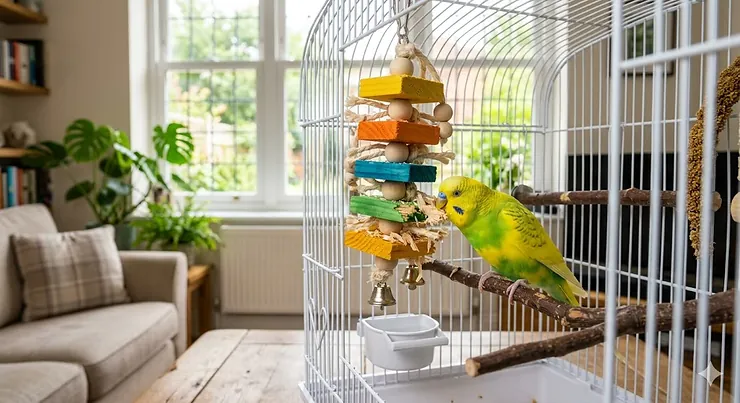
Balsa wood is, in essence, the gateway drug of bird enrichment. Lightweight, soft, and satisfyingly destructible, it lets your bird engage in one of the most instinctually powerful behaviours they possess: chewing and shredding. In the wild, parrots spend a significant chunk of their day gnawing on branches, excavating nest cavities, and generally treating trees with considerably less respect than arborists would approve of. Replicating this in the living room of a terraced house in Leeds or a flat in South London isn’t exactly straightforward — but balsa wood bird toys get surprisingly close.
What distinguishes balsa from other toy materials is its unique cellular structure, which makes it one of the lightest hardwoods in the world while remaining genuinely safe and digestible for birds. Unlike dense hardwoods that can splinter into sharp shards, balsa shreds into soft fibrous pieces that even smaller parrots can manage with ease. It’s also completely untreated in quality products — no varnish, no stain, no preservatives — which matters rather a lot when you have an animal that treats its toys like a three-course meal.
This guide covers the seven best balsa wood bird toys currently available on Amazon.co.uk in 2026, with honest analysis of who each product suits, what British bird owners should watch for, and why the material itself deserves a permanent spot in your parrot’s toy rotation.
Quick Comparison Table: Balsa Wood Bird Toys at a Glance
| Product | Best For | Bird Size | Approx. Price | Key Feature |
|---|---|---|---|---|
| Super Bird Creations SB50017 Balsa Blocks (6pk) | DIY toy makers & starters | Small birds | Under £10 | Pure unfinished balsa, 2×2×4″ |
| Super Bird Creations SB50016 Balsa Blocks (12pk) | Bulk buyers & large cages | All sizes | Under £12 | Cube format, 12-pack value |
| Super Bird Creations SB50012 Balsa Lovers Assortment | Small bird owners | Parakeets, cockatiels | £10–£18 range | Variety pack, cotton rope included |
| Super Bird Creations SB1183 Balsa Bot | Interactive play lovers | Medium birds | £15–£22 range | Novelty character design |
| MQUPIN Upgraded Chewing Blocks (22″) | Large parrot owners | African Grey, Macaw | £12–£20 range | 22″ multi-block hanging toy |
| MQUPIN Hanging Wooden Block Toy (Colourful) | Budget buyers, smaller parrots | Small–Medium | Under £12 | Food-grade dyes, colourful design |
| RANYPET Wooden Block Tearing Toy | Multi-species households | Small–Large | Under £15 | Cotton rope + natural wood combo |
The table above reveals an interesting split: if you have a smaller bird — a budgie, cockatiel, or lovebird — you’re spoilt for choice at the budget end. But if you’re living with a large African Grey or a macaw that could strip a kitchen cabinet bare in a weekend, the MQUPIN 22″ option stands out for sheer scale and value. Prime members on Amazon.co.uk can expect next-day delivery on most of these.
💬 Just one click — help others make better buying decisions too! 😊
✨ Don’t Miss These Exclusive Deals!
🔍 Take your parrot’s playtime to the next level with these carefully selected balsa wood bird toys. Click on any highlighted item to check current pricing and availability on Amazon.co.uk. Your feathered friend will thank you for it — or at least, they won’t bite you quite as hard.
Top 7 Balsa Wood Bird Toys for UK Parrots: Expert Analysis
1. Super Bird Creations SB50017 Balsa Wood Blocks – 6 Pack, Small Bird Size
If you’re new to offering natural wood toys, this six-pack of unfinished balsa blocks is quite possibly the most sensible starting point on Amazon.co.uk. Each block measures approximately 5 × 5 × 10 cm (2×2×4 inches) — generous enough to give a cockatiel or small conure a proper workout without being so enormous it dominates a compact cage in a flat.
What makes these genuinely good rather than merely adequate is the sourcing. Responsibly harvested in Ecuador (where the vast majority of the world’s balsa supply originates), these blocks arrive with a clean, smooth, knot-free texture. That detail matters more than it sounds: knots in wood can sometimes trap bacteria and humidity in UK conditions, where our damp, mild climate means cage environments can harbour moisture more readily than drier continental climates. No knots means fewer hidden problem spots.
These are ideal for UK bird owners who want to create their own enrichment toys — hang a block from some bird-safe rope or thread it onto a skewer alongside cork pieces, and you’ve made a foraging toy that costs pennies per session. They’re also brilliant for owners whose birds are “toy-shy” and need a gentle, non-threatening introduction to chewing.
UK customers report their cockatiels and parakeets took to these within a day, though a few noted that particularly enthusiastic chewers go through them quickly — which is, arguably, the entire point.
✅ Sustainably sourced from Ecuador
✅ Perfect starter material for first-time wood toy buyers
✅ Ideal for DIY toy construction
❌ Small pack size (6 blocks) runs out quickly for devoted chewers
❌ No colourful accessories included — purely raw material
In the under-£10 range, this is about as good as it gets for clean, single-species balsa. A solid choice for small UK birds and cautious beginners alike.
2. Super Bird Creations SB50016 Balsa Blocks 2×2×2″ – 12 Pack
Same trusted sourcing, more blocks, slightly different shape. The 5 × 5 × 5 cm (2×2×2 inch) cubes in this twelve-pack are the better option if you’re a UK bird owner who likes to build a small stockpile, or if you have multiple birds sharing a room — which, in a smaller British home, is a very common situation.
The cube format is particularly well-suited for foot toys. You can offer these directly in the cage for birds to pick up, grip, and chew without hanging — a welcome bit of variety from the standard hanging toy format. African greys and cockatiels, both of whom are notoriously fussy about interacting with new objects, sometimes respond better to a stationary floor-level block than something swinging above their heads.
Value-per-block is meaningfully better than the six-pack, which matters if your bird is a devoted chewer. There’s something quietly satisfying about buying in bulk for a parrot — you feel prepared, organised, and faintly smug when you can replace a demolished toy the same day without placing an Amazon order.
UK reviews note they’re consistently good quality with the trademark knot-free texture. One buyer noted that their parrot “loves these but they are expensive to have destroyed quickly” — which I suspect tells you everything you need to know about how much the bird enjoyed them.
✅ Better value per block than the six-pack
✅ Versatile cube format — works as foot toy or hanging
✅ Reliably consistent quality across batches
❌ Purely raw balsa — you’ll need to construct or combine with other materials
❌ Not ideal for very large parrots who need something more substantial
Brilliant for the resourceful UK bird owner who enjoys DIY enrichment. In the under-£12 bracket, this twelve-pack earns its place in any parrot household.
3. Super Bird Creations SB50012 Balsa Lovers Bird Toy Assortment
This is where Super Bird Creations moves from raw material into proper toy design — and for small bird owners in the UK, it’s rather a pleasing step up. The Balsa Lovers Assortment combines soft balsa pieces threaded onto cotton rope with vibrant wiggle rings and wooden beads, creating a textured, multi-material experience that keeps curious beaks busy for considerably longer than a plain block.
The psychology behind variety packs like this is worth understanding. Birds, particularly cockatiels, parakeets, and lovebirds, are attracted by both colour and texture variation. The wiggle rings provide a tactile element entirely different from the wood, the cotton rope gives something to preen and unravel, and the balsa itself remains the primary shredding target. Boredom is a genuine welfare concern for captive parrots — according to avian welfare guidance from the RSPB, mental stimulation and environmental enrichment are crucial for birds’ wellbeing, whether wild or domestic.
For British bird owners in smaller homes where cage space is at a premium, this toy’s relatively modest footprint is a genuine practical advantage. You can hang it in a standard-sized cage without it overwhelming the space or preventing your bird from moving around comfortably.
UK buyers with cockatiels report high engagement immediately upon introduction — one reviewer noted their cockatiel “Cheddar The Shredder” worked through the balsa pieces enthusiastically and the cotton rope provided additional entertainment afterwards. Assembled in the USA, with Prime-eligible delivery on Amazon.co.uk.
✅ Multi-material stimulation in one product
✅ Cotton rope element for preening and unravelling
✅ Immediately engaging — vibrant colours attract small birds quickly
❌ Balsa pieces consumed quickly by enthusiastic chewers
❌ Designed specifically for small birds — not suitable for medium or large parrots
In the £10–£18 range, this represents strong value for small bird households. The variety-pack format means you get a taste of what your bird responds to before committing to larger quantities.
4. Super Bird Creations SB1183 Balsa Bot Bird Toy – Medium Bird Size
Now we’re talking. The Balsa Bot is Super Bird Creations doing what they do best: combining genuinely useful chewing material with a design that looks entertaining and engages a parrot’s intelligence as well as its beak. The central balsa wood block — about 30 × 16.5 cm (12×6.5 inches) — forms the “body” of the character, adorned with wooden ripple bead legs, flower feet, cork buttons, and lollipop stick arms threaded with plastic coil bead sleeves.
It sounds faintly ridiculous. It works brilliantly. The variety of materials, shapes, and textures means there’s always something new to investigate, and the different removal challenges — the cork buttons pop off differently from the bead legs, for instance — serve as a form of foraging enrichment that keeps medium-sized parrots mentally occupied. For a ringneck, medium conure, or senegal parrot, that mental engagement matters as much as the physical chewing.
The Balsa Bot is designed specifically for medium birds — ringnecks, medium conures, quakers, caiques, pionus, and senegals — which is actually a somewhat underserved category in the UK parrot toy market. Many products are either too small (budgie-scale) or enormous (macaw-grade), leaving medium bird owners trawling through listings. This fills that gap rather well.
UK Amazon reviewers rate the build quality highly and note that medium parrots engage immediately with the novel character shape. Prime-eligible with standard Amazon.co.uk fulfilment.
✅ Multi-material design provides layered enrichment
✅ Ideal size for the underserved medium parrot category
✅ Novel character shape holds attention longer than plain blocks
❌ Cork and bead components consumed or removed quickly by determined chewers
❌ Sits in the mid-range price bracket — may feel expensive when a bird dismantles it in a week
At the £15–£22 price range, this is well worth it for medium parrot owners who want something more sophisticated than a plain block. Worth the investment if you’ve a caique or a particularly destructive ringneck.
5. MQUPIN Large Parrot Toy Upgraded Chewing Blocks (22″)
Right. If you share your home with an African Grey, a macaw, or a cockatoo — birds whose beaks can apply genuinely alarming force to almost any material — then the modest balsa blocks above will last approximately as long as a chocolate teapot. The MQUPIN Upgraded Chewing Blocks, at roughly 56 cm (22 inches) long, are designed with large birds firmly in mind.
The hanging toy features multiple colourful natural wooden blocks of varying shapes, strung with bright knotted rope and sturdy metal hardware. The blocks themselves are made from 100% food-grade natural materials with no toxic dyes — important because large parrots don’t just chew; they ingest significant amounts of whatever they’re demolishing. The food-grade colouring is the key differentiator from cheaper alternatives on Amazon.co.uk, where poorly dyed blocks from unverified sources can contain pigments that accumulate harmfully.
What most UK buyers overlook about this particular model is the 22-inch length — it gives even a large macaw something to really get stuck into over multiple sessions, rather than being demolished in one go. That’s not just a selling point; it’s a legitimate welfare consideration. A bird that exhausts its enrichment toy in twenty minutes is a bored bird for the remaining twenty-three hours and forty minutes of the day.
Amazon.co.uk customers note it’s well-made and robust, with good durability for larger birds. Sold by Little Memory Store through Amazon Fulfillment, ensuring UK-standard delivery and return rights under the Consumer Rights Act 2015.
✅ 22-inch length provides extended enrichment for large parrots
✅ Food-grade materials — safe for birds that ingest wood during chewing
✅ Suitable for African Grey, Macaw, Cockatoo, Amazon Parrot
❌ Colourful design not suited to birds who prefer natural-look toys
❌ Metal hook hardware should be inspected regularly for wear
In the £12–£20 range, this is exceptional value for large parrot owners. A large macaw consuming this over a week or two is money genuinely well spent on welfare.
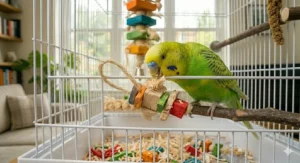
6. MQUPIN Hanging Wooden Block Chewing Parrot Toy (Colourful) – Small/Medium
The smaller sibling in the MQUPIN family, this hanging toy is targeted at budgies, parakeets, cockatiels, and small-to-medium parrots — and at under £12, it undercuts most comparable products on Amazon.co.uk while maintaining the brand’s commitment to non-toxic food-grade materials.
The colourful wooden blocks come in different shapes, threaded onto cotton rope with a steel hook for easy cage attachment. The bright colour palette — genuinely vivid, not the faded approximation of “colourful” you sometimes see on budget bird toys — is a practical feature rather than mere aesthetics. Parrots are trichromats with UV vision, meaning they perceive a broader colour spectrum than humans. Bright, varied colouring genuinely attracts and holds their attention in ways a monochrome toy simply cannot.
For UK bird owners in smaller flats or terraced houses where keeping the cage environment engaging on a budget is a daily exercise, this product hits a sweet spot. It’s compact enough not to dominate a cage, brightly interesting, and the varied block shapes give a range of chewing textures. It’s also easy to swap out and replace — which matters when you’re living in a home where the cage is in the main living space and a half-demolished toy looks rather more chaotic than you’d ideally like.
UK customer feedback notes the blocks are well-coloured and durable enough to last a meaningful amount of time, even with enthusiastic chewers.
✅ Under-£12 price point — excellent budget option
✅ Food-grade non-toxic dyes — safe for birds who chew and ingest
✅ Compact and appropriate for smaller UK cage setups
❌ Cotton rope threading can fray over time — inspect regularly
❌ Less stimulating than multi-material varieties for highly intelligent birds
An easy recommendation for budget-conscious UK bird owners with small to medium parrots. Practical, safe, and cheerfully colourful.
7. RANYPET Large and Small Parrot Chewing Toy – Cage Bite Wooden Block
The RANYPET offering on Amazon.co.uk takes a slightly different design philosophy from the MQUPIN products: pure natural wood blocks combined with cotton rope, dyed with edible pigments, with a genuinely wide species suitability range spanning budgies through to African Greys and macaws. The “large and small” designation in the name is slightly unusual — it means the toy suits a broad spectrum of bird sizes rather than targeting one category exclusively.
What I find worth highlighting about this product is the material transparency. The specification explicitly states pure natural wood, cotton rope, and edible dye pigments — the sort of sourcing clarity that should be non-negotiable when buying toys for birds, yet isn’t always provided. As the Animal Welfare Act 2006 makes clear, UK pet owners have a legal obligation to provide appropriate environmental enrichment for their animals, which implicitly includes ensuring that enrichment items are safe. Products from unverified sources with ambiguous material descriptions create genuine risk.
The bright colouring and varied block shapes give this toy immediate visual appeal. Sold by Rypet-UK through Amazon Fulfillment — an important note, because Rypet is a UK-registered seller, meaning returns and consumer protection under the Consumer Rights Act 2015 are straightforward, with no cross-border complications.
UK buyers report their birds engage enthusiastically with these, noting the cotton rope component provides secondary entertainment once the blocks are chewed down.
✅ Sold by UK-registered seller (Rypet-UK) — straightforward returns
✅ Transparent material sourcing (edible dyes, natural wood, cotton rope)
✅ Broad species suitability from budgie to macaw
❌ Block density may be slightly too hard for very small birds compared to pure balsa
❌ Occasional batch variation in dye intensity reported by UK buyers
In the under-£15 bracket, this is a well-rounded option for multi-species households or owners who want material confidence alongside good design.
How Balsa Wood Shredding Benefits Your Parrot: The Science Behind the Sawdust
Let’s talk about why balsa wood bird toys aren’t merely nice to have — they’re genuinely important for your parrot’s physical and psychological health. This is the bit the Amazon product listings don’t tell you, and it’s rather more interesting than a bullet-point list of dimensions.
Parrots in the wild spend between 40% and 75% of their active time foraging, depending on species and habitat conditions. A significant portion of that foraging involves gnawing: excavating nest holes, stripping bark to expose insects, and simply exploring their environment with their beaks. The beak is, effectively, a parrot’s primary tool, and a beak that doesn’t work is a parrot in serious trouble.
In captivity, most UK parrots receive a reliable supply of food without effort, which removes the primary motivation for foraging behaviour. The result — if enrichment isn’t provided — is the avian equivalent of a highly intelligent person locked in a room with nothing to do. Feather destructive behaviour, excessive screaming, aggression, and repetitive stereotypies are all well-documented consequences of insufficient enrichment in captive parrots. British avian vets see this regularly.
Balsa wood specifically addresses this in ways harder materials can’t. The softness means birds get immediate, satisfying feedback from their chewing — fibre breaks away cleanly, the texture changes as they work, and the progressively altered shape keeps the toy novel over multiple sessions. It’s the chewing equivalent of a satisfying meal rather than a disappointing one, and it matters enormously for psychological wellbeing.
Additionally, regular chewing on appropriate wood materials helps maintain beak shape and length. Overgrown beaks are a common problem in UK captive parrots that don’t have adequate chewing opportunities — they require veterinary intervention that could largely be prevented with proper enrichment. Think of balsa toys as maintenance, not luxury.
Soft Wood vs Hard Wood Bird Toys: Which Should You Actually Buy?
This is where it gets genuinely interesting, because the soft vs hard wood debate in parrot toy circles can get quite heated — and both camps have legitimate points.
Soft woods — balsa, pine, and sola (technically not wood but similar in texture) — are ideal for:
- Birds new to chewing who haven’t developed the beak technique for harder materials
- Smaller species (budgies, parrotlets, cockatiels) whose beaks aren’t built for hardwood
- Older birds or those recovering from beak injury
- Introducing variety to toy-shy birds who find hard surfaces off-putting
- Rapid enrichment replacement when you want the bird to consume the toy quickly
Hard woods — manzanita, java, and various fruit woods — are better suited to:
- Large parrots (macaws, cockatoos) whose powerful beaks need genuine resistance
- Perch-grade materials where durability is the priority
- Long-term structural toys that combine chewing elements with climbing components
The practical answer for most UK parrot owners is both, in rotation. A cage that offers nothing but soft balsa doesn’t provide the beak resistance a strong chewer needs. A cage stocked exclusively with hardwood doesn’t give the deeply satisfying shredding experience that balsa uniquely provides.
A useful rule of thumb: if your bird can pierce or dent the wood with light beak pressure, it’s appropriate softness for that bird. If they pick it up once and then ignore it, it’s probably too hard. And if they demolish it before you’ve even left the room, consider supplementing with a few harder elements alongside.
Bird-safe wood types to look for in any product include balsa, pine (untreated), willow, apple, pear, hawthorn, and birch. Woods to absolutely avoid include oak (tannins), cherry, plum (contains cyanogenic compounds), and any wood that has been treated with preservatives, paints, or chemical stains — which is why “untreated” and “food-grade dye only” are the two phrases you want to see on any listing.
Buying Balsa Wood Bird Toys in the UK: What to Look For (and What to Ignore)
Choosing well from Amazon.co.uk’s increasingly crowded bird toy market requires a bit of scepticism and a clear priority list. Here’s an expert breakdown of what actually matters.
1. Material Transparency
Any listing that doesn’t specify what the wood is, how it’s coloured, or whether it’s been treated should be approached with considerable caution. Balsa should be unfinished or coloured exclusively with food-grade, edible-safe dyes. If a product says “non-toxic paint” rather than “food-grade” or “edible pigment,” that’s a meaningful distinction — non-toxic to humans and non-toxic to a bird that’s ingesting fragments are not the same standard.
2. Appropriate Size Matching
The single most common mistake UK parrot owners make is buying toys sized for a bird category rather than for their specific bird’s beak strength. A toy labelled “for conures” suits a bird with a conure-strength beak — but individual variation is significant. An aggressive-chewing green cheek conure will demolish a toy faster than a gentle-natured African Grey. Know your bird.
3. Hardware Safety
Metal quick-links, hooks, and chains should be stainless steel or similar non-reactive metal. Zinc and lead are the two most dangerous metals for parrots — zinc especially, since it’s commonly found in cheap hardware and causes zinc toxicosis, a potentially fatal condition. UK-based sellers with UK Amazon Fulfillment tend to meet higher hardware standards than unverified international dropshippers, though this isn’t guaranteed.
4. Dye Practices
Balsa is naturally pale — any colourful toy has been dyed. Food-grade dyes are harmless. Synthetic chemical dyes designed for wood finishing or craft use may not be, particularly when a bird is chewing and ingesting the material. The products reviewed here that specify food-grade colouring earn a meaningful point of differentiation over competitors that don’t.
5. What to Safely Ignore
Certain marketing claims on bird toy listings are largely meaningless: “vet-approved” without a named veterinary body or standard is unverifiable. “Premium quality” is not a standard. And the phrase “suitable for all parrots” should always be mentally translated as “we haven’t tested it specifically but it probably won’t cause immediate harm” — use your own judgement about your specific bird.
UK Parrot Owners’ Guide: Practical Tips for Getting the Most from Balsa Toys
Introducing New Toys Without a Six-Week Sulk
British Grey owners will be particularly familiar with this scenario: you spend £15 on a beautifully crafted toy, hang it in the cage with enormous optimism, and your parrot reacts as if you’ve installed a small but menacing predator. Then ignores it for six weeks. Then one Tuesday, for no discernible reason, destroys it completely.
This is normal parrot behaviour, not product failure. The trick is a technique called “gradual introduction.” Rather than hanging a new toy directly inside the cage, start by placing it on top of the cage, or nearby in the room. Let the bird observe it without feeling territorial pressure. After a few days, move it closer. Then to the cage door. Then — finally — inside. This process, while deeply testing of a British person’s patience, dramatically increases the probability of engagement and reduces the sulking window from six weeks to approximately three.
Rotation Is the Real Secret
A cage with six toys all hanging simultaneously is, from your parrot’s perspective, boring. Six toys that rotate — with two or three displayed at any one time, changing every few days — is a constantly novel environment. Balsa toys are particularly well-suited to rotation because they’re inexpensive enough to stock in multiples. Buy three or four different styles, cycle them through, and watch engagement increase substantially.
Storage in a Typical UK Home
Balsa blocks and unused toy components store best in a dry, ventilated location — a kitchen cupboard or dedicated bird-supply box. British homes have more moisture in the air than many manufacturers’ storage guidance assumes, particularly in older terraced houses, ground-floor flats, and anywhere in the North West of England between September and April. A small desiccant sachet in your toy storage box is a sensible precaution; damp balsa can develop mould if stored improperly, and mouldy wood should never be given to any bird.
Toy Safety Checks — Weekly Minimum
Any toy with rope, chain, or metal components should be inspected at least weekly. Frayed rope threads are an entrapment hazard — a bird can get a foot or a ring caught and panic-injure itself. Metal components should be checked for corrosion or deformation. Partially chewed balsa with structural compromise (where the block is cracked rather than shredded) should be replaced rather than left in the cage.
Balsa Wood Bird Toys for Different UK Parrot Species: A Practical Guide
Not all parrots are created equal — a point so obvious it barely needs stating, yet one that the bird toy market frequently ignores in favour of broad-spectrum “suitable for all birds” labelling.
Budgies and Parrotlets: These small birds are genuinely well-served by pure balsa. Their beaks are light and the softness of the wood means they get immediate, satisfying feedback. The MQUPIN Colourful Hanging Toy and the Super Bird Creations SB50017 blocks are both well-matched. Focus on small pieces — anything too large risks being ignored rather than engaged with.
Cockatiels: Probably the UK’s most popular companion parrot species, cockatiels are enthusiastic but not destructive chewers. Balsa is essentially ideal for them. The Super Bird Creations SB50012 Balsa Lovers Assortment is a particularly strong match because the cotton rope element appeals to their preening instincts alongside the chewing.
Conures and Ringnecks (Indian/African): Medium beak strength means balsa works well but gets consumed relatively quickly. These birds benefit from the Balsa Bot’s varied component structure, which slows the destruction process and maintains engagement. Ringnecks — deeply popular in the UK — are highly intelligent and need the mental challenge of varied textures.
African Greys: A special case. Greys are famously cautious about new objects, meaning toy introduction requires patience. However, once they accept a toy, their manipulation intelligence means they derive genuine enrichment from multi-component designs. The MQUPIN 22″ option provides enough variety to hold a Grey’s interest. According to research published on avian cognition by the University of Cambridge’s comparative cognition group, African Greys demonstrate tool use and problem-solving comparable to great apes — which is useful context for understanding why a hanging balsa block isn’t quite enough mental engagement on its own.
Macaws and Cockatoos: These are the parrots that could, with some effort, open a small business as woodchippers. For macaws in particular, balsa should be treated as supplementary rather than primary enrichment — they’ll consume it too quickly for it to provide sustained benefit. Mix the MQUPIN 22″ hanging toy with harder wood components in a diverse cage environment.
Common Mistakes UK Bird Owners Make When Buying Wooden Block Chew Toys
A few patterns emerge with remarkable consistency in UK parrot communities, and addressing them directly might save you some wasted money and a frustrated bird.
Buying the wrong size. As mentioned above, this is the most frequent error. A toy sized for “conures” hung in a macaw’s cage will be reduced to confetti in one session. Not enrichment; just snacking. Check dimensions carefully and match to your bird’s known chewing power.
Prioritising price over material verification. There’s no shortage of extremely cheap wooden bird toys on Amazon.co.uk from marketplace sellers with limited traceability. The balsa wood used in quality products is sustainably sourced, untreated, and tested. The wood used in a £3.99 mystery listing from an unverified overseas seller may have been treated, stained, or sprayed with agricultural chemicals during growth or processing. Given that your bird is going to eat it, this is not a corner worth cutting.
Ignoring the hardware. The wood gets all the attention, but the metal hook, chain, or quick-link connecting the toy to the cage deserves equal scrutiny. Zinc toxicosis from ingested cage hardware is well-documented in avian veterinary literature. If a toy listing doesn’t specify stainless steel or equivalently safe metal for its hardware, contact the seller before purchase.
Buying once and never rotating. A parrot presented with the same toy for three months will stop engaging with it long before three months are up. The toy isn’t bad; novelty has worn off. The solution is stocking multiple designs and cycling them. This matters particularly in the UK’s longer, greyer winters, when birds spend more time indoors and benefit more from environmental variety.
Over-supplying the cage. More toys isn’t always better. A cage crammed with eight hanging toys creates a cluttered, overstimulating environment and also prevents proper movement. Two to three toys at a time, rotated regularly, is consistently more effective than a warehouse aesthetic.
Frequently Asked Questions About Balsa Wood Bird Toys
❓ Is balsa wood safe for parrots to chew and eat?
❓ How often should I replace balsa wood bird toys in my parrot's cage?
❓ Can I buy balsa wood blocks on Amazon.co.uk and make my own bird toys?
❓ Are there UK regulations or safety standards for bird toys sold on Amazon.co.uk?
❓ Do balsa wood toys help prevent feather plucking in UK parrots?
Conclusion: The Case for Keeping Balsa in Your Toy Rotation
The thing about balsa wood bird toys is that they’re not glamorous. They don’t blink, they don’t make sounds (until your bird starts hammering them against the cage bars, which is a different kind of sound), and they’re gone within days. That ephemerality is precisely the point.
A consumable toy is a toy that works. Every shredded block is enrichment successfully delivered. Every pile of balsa dust on the cage floor is evidence of natural behaviour expressed in a safe, appropriate context. In the UK, where we’re increasingly thoughtful about the welfare conditions of companion animals — and where the Animal Welfare Act 2006 requires us to provide for animals’ behavioural needs, not merely their physical ones — choosing the right enrichment is part of responsible ownership, full stop.
The Super Bird Creations range offers clean, sustainably sourced balsa in formats to suit every size of bird and every level of DIY ambition. The MQUPIN toys deliver excellent multi-block enrichment for both small and large parrots at genuinely accessible price points. And the RANYPET option brings material transparency and a UK-registered seller into the mix for added peace of mind.
Add one or two to your next Amazon.co.uk order — Prime members will have them tomorrow morning — and watch what happens when your parrot discovers something genuinely worth destroying.
✨ Don’t Miss These Exclusive Deals!
🔍 Browse these carefully selected balsa wood bird toys on Amazon.co.uk and click any highlighted product to check current pricing and availability. Your parrot’s beak health, psychological wellbeing, and general outlook on life will thank you.
Recommended for You 📚
- 7 Best Chew Toys for Parrots UK 2026
- Best Rope Ladder for Budgies: 7 Top Picks UK 2026
- 7 Best Platform Swing for Cockatiels UK 2026
Disclaimer: This article contains affiliate links. As an Amazon Associate, I earn from qualifying purchases. If you purchase products through these links, we may earn a small commission at no additional cost to you.
✨ Found this helpful? Share it with your mates! 💬🤗
