In This Article
Your parrot’s feathers are talking to you, whether you’re listening or not. A healthy bird grows tight, glossy, evenly barbed feathers after every moult. A stressed or nutritionally short-changed one grows feathers with stress bars, frayed edges, or worse — no feathers at all, because they’ve been chewed off at the shaft. That’s usually the moment owners start typing “feather health supplement for parrots” into a search bar at eleven o’clock at night, equal parts worried and hopeful.
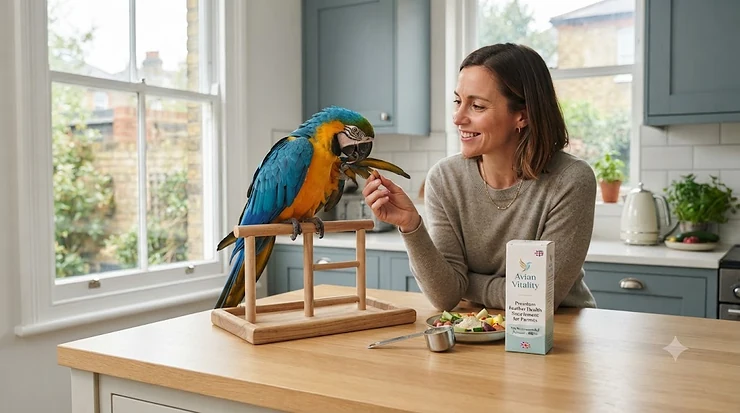
Here’s the honest, unglamorous truth up front: a feather health supplement for parrots is a dietary aid — typically a vitamin, mineral, amino acid or fatty-acid formula, given as a powder, liquid or oil — designed to support feather structure, moult recovery and skin condition alongside (not instead of) a balanced diet and, where relevant, a vet-led investigation into feather-destructive behaviour. It’s a support tool, not a magic fix, and the best ones are honest about that limitation too.
This guide walks through seven real, currently available products spanning budget vitamin drops to specialist behavioural formulas, all sourced from amazon.co.uk listings and UK avicultural suppliers rather than invented for the occasion. We’ll look at what each one actually contains, what the aggregated customer feedback says (clearly flagged as such, never fabricated), and — critically — when a supplement is genuinely the right tool and when your money and effort are better spent elsewhere, like an avian vet appointment or a diet overhaul. According to the PDSA’s five welfare needs framework, diet is only one pillar of a captive bird’s wellbeing, and feathers reflect the whole picture, not just what’s in the bowl.ou.
Quick Comparison Table
| Product | Best For | Format | Price Range |
|---|---|---|---|
| The Birdcare Company Feather-Up | Moult support & regrowth | Powder | £10-£15 range |
| Beaphar Multi-Vit for Parrots & Parakeets | Budget all-rounder | Liquid | under £10 |
| Nekton-BIOTIN | Dedicated plumage condition | Powder | £15-£25 range |
| Nekton-E | Breeding-season feather quality | Powder | around £10-£15 |
| Vetark Avipro Avian | Gut health behind good preening | Powder | £10-£15 range |
| Casozen | Feather-destructive behaviour support | Liquid | £15-£25 range |
| Avigold Advance | All-in-one liquid tonic | Liquid | £15-£25 range |
Looking across the table, there’s a clear pattern worth noticing before you buy anything: the cheaper options (Beaphar Multi-Vit for Parrots & Parakeets) lean toward broad-spectrum vitamin coverage, while the pricier specialists (Nekton-BIOTIN, Casozen) narrow in on one specific job — plumage density or behavioural plucking respectively. Neither approach is “better” in the abstract; it depends entirely on whether you’re managing a routine moult or an active feather-destructive problem. If you’re not sure which camp your bird falls into, the “How to Choose” section further down walks through the diagnostic questions worth asking before you spend a penny.
💬 Just one click — help others make better buying decisions too!😊
Top 7 Feather Health Supplements for Parrots: Expert Analysis
1. The Birdcare Company Feather-Up — built specifically around the moult cycle
Rather than being a general multivitamin with feathers mentioned on the label, Feather-Up is formulated around what a bird’s body actually needs while it’s actively growing new plumage. It’s a powder you sprinkle over fruit or eggfood daily, and the manufacturer recommends pairing it with their Calcivet and Potent Brew products for a fuller moult-support routine.
The formula combines thirteen vitamins including A, D3 and E with what the brand calls “Rapisorb” trace minerals — selenium, zinc, manganese, copper, iodine and others — plus limiting amino acids and protein. In practice, that mineral spread matters more than it sounds: zinc and selenium are cofactors in keratin synthesis, and keratin is literally what a feather is made of, so a shortfall here can show up as brittle or poorly barbed plumage months later. Based on the ingredient panel, this reads as a formula built by someone who understands feather biology rather than a generic “bird vitamin” repackaged with a feather photo on the tub.
Reviewers on Amazon consistently report noticeable improvement in moult quality, with several specifically mentioning African grey parrots and macaws responding well; one recurring theme is that owners dealing with stress-related picking still recommend a vet check alongside the supplement rather than treating it as a standalone cure — a sensible caveat that lines up with the clinical consensus on feather-destructive behaviour.
Pros:
- ✅ Feather-specific formula, not a repurposed general vitamin
- ✅ Trace minerals support keratin synthesis directly
- ✅ Strong, consistent moult-quality feedback from UK owners
Cons:
- ❌ Best results reportedly need pairing with sister products
- ❌ Not marketed as a behavioural plucking solution
At around £10-£15 for a 100g tub that lasts a typical breeding pair or single large parrot several weeks, Feather-Up sits in accessible mid-range territory for what is a fairly targeted formula.

2. Beaphar Multi-Vit for Parrots & Parakeets — the sensible budget entry point
Beaphar Multi-Vit for Parrots & Parakeets is a liquid multivitamin you mix straight into food, and it’s explicitly marketed around promoting a rapid, complete moult while helping prevent feather plucking. It packs twelve vitamins into a 20ml bottle, which sounds small until you realise these products are dosed in drops, not spoonfuls.
What this buys you, in practical terms, is broad nutritional insurance rather than a laser-targeted feather formula. If your parrot’s diet is already reasonably varied — fresh veg, quality pellets, the occasional seed treat — a general multivitamin like this one is closing small gaps rather than fixing a major deficiency, and that’s exactly the use case it suits best: routine maintenance, not crisis intervention. Budget-conscious owners with a single companion bird and no specific feather complaint tend to get the most sensible value here, since you’re not paying a premium for concentrated single-nutrient dosing you don’t necessarily need.
Amazon customer feedback for Beaphar’s bird range tends to be positive on ease of use — the liquid mixes cleanly and birds don’t seem to reject food dosed with it — though, as with any broad multivitamin, owners managing a confirmed feather-destructive behaviour case report needing to combine it with more targeted support.
Pros:
- ✅ Genuinely affordable entry point under £10
- ✅ Twelve vitamins in one easy liquid dose
- ✅ Explicitly positioned for moult support and plucking prevention
Cons:
- ❌ Broad-spectrum rather than feather-specific in its nutrient profile
- ❌ Small 20ml bottle needs frequent reordering for larger collections
If you want one low-risk product to start with before investing in anything more specialised, Beaphar Multi-Vit for Parrots & Parakeets is the logical first step.
3. Nekton-BIOTIN — the premium plumage specialist
German manufacturer Nekton has been supplying zoos and bird parks since 1967, and Nekton-BIOTIN is their answer to a very specific question: what does a feather actually need to grow well? Biotin (vitamin B7) is directly involved in keratin production and fatty-acid metabolism, both of which show up in feather structure and sheen.
This is a concentrated powder, so daily doses are genuinely tiny, which somewhat offsets the higher upfront price when you calculate cost-per-use over a moult cycle. Based on the spec sheet, this formula makes the most sense for birds with a confirmed or suspected feather-quality issue rather than as routine daily supplementation for a bird already thriving — think dull, stress-barred, or slow-regrowing feathers after a hard moult, or breeding pairs where feather condition in chicks matters for later flight development. What most buyers overlook about biotin specifically is that it works over weeks, not days; a single moult cycle is usually the minimum timeframe to judge whether it’s making a visible difference.
Nekton’s long institutional track record with zoological collections lends it credibility that newer, less-established brands simply haven’t had time to earn, and that reputation shows up in consistently favourable feedback from serious aviculturists rather than casual pet-store browsers.
Pros:
- ✅ Biotin directly supports keratin and feather-fatty-acid metabolism
- ✅ Concentrated formula means small, economical daily doses
- ✅ Decades of use in professional zoological collections
Cons:
- ❌ Among the pricier options per gram in this comparison
- ❌ Single-nutrient focus means it won’t cover broader vitamin gaps alone
Expect to pay in the £15-£25 range for a 35g tub, which — given the small daily dose — often works out cheaper per week than it first appears.
4. Nekton-E — vitamin E support for feather quality through breeding condition
Nekton-E delivers vitamin E as alpha-tocopherol acetate, a form the manufacturer notes supports metabolism, protects against muscular and cardiac degeneration, and — critically for this article’s purposes — acts as an antioxidant that protects other nutrients and cell membranes from oxidative damage. It’s traditionally positioned as a breeding-season product, best started a few weeks ahead of the season and often paired with Nekton-S multivitamin.
Here’s the honest analytical angle: vitamin E’s feather benefit is indirect rather than headline. It’s not building keratin the way biotin does; it’s protecting the cellular machinery that builds keratin from oxidative stress, particularly relevant during the high-metabolic-demand periods of breeding and heavy moult that often overlap in captive parrots kept on a natural-ish light cycle. On paper, this means Nekton-E works best as a supporting cast member in a wider supplement routine rather than a stand-alone feather fix — which is exactly how the manufacturer frames it, to their credit.
Owners breeding parrots or conditioning show birds ahead of a season are the clearest use case; a companion parrot with no breeding activity and no specific antioxidant deficiency is unlikely to see it as their highest-priority purchase from this list.
Pros:
- ✅ Strong antioxidant support protecting cellular feather-growth machinery
- ✅ Well-documented breeding-season conditioning role
- ✅ Combines cleanly with other Nekton products for a fuller regimen
Cons:
- ❌ Feather benefit is supportive rather than directly structural
- ❌ Most valuable alongside other supplements, raising total spend
At around £10-£15 for a 35g tub, it’s reasonably priced, but budget for it as part of a routine rather than a single silver-bullet purchase.
5. Vetark Avipro Avian — the gut-health angle most owners skip
Vetark Avipro Avian is a prebiotic and probiotic powder, not a vitamin or oil, and its inclusion here is deliberately unconventional — because feather condition is downstream of digestive and immune health far more often than owners assume. This UK veterinary-formulated brand supports digestive health and stress resilience, both of which affect nutrient absorption, and a bird that isn’t absorbing its diet properly will show it in feather quality eventually, no matter how good the supplement on top of that diet is.
What the spec sheet won’t tell you, but avian vets routinely note, is that a compromised gut microbiome can undermine even a well-designed feather supplement, because the nutrients simply aren’t being taken up efficiently. Reviewers on retailer sites tend to mention this product in the context of stress recovery — post-travel, post-vet-visit, post-house-move — rather than as a direct feather-shine product, which is an honest reflection of what it actually does.
This is best suited to birds recovering from illness, antibiotic courses, or a recent stressful change, where gut support is the missing piece rather than raw vitamin content. It’s a less obvious pick on a “feather supplement” list, but arguably one of the more scientifically defensible ones for a specific subset of cases.
Pros:
- ✅ Addresses nutrient absorption, the root cause behind many feather issues
- ✅ Veterinary-formulated by a respected UK brand
- ✅ Doubles as post-illness and post-stress digestive support
Cons:
- ❌ Indirect route to feather improvement, not a direct feather nutrient
- ❌ Won’t produce visible results as quickly as a targeted feather powder
Priced in the £10-£15 range for a 100g pack, it’s a sensible complement to — not a replacement for — the more direct feather formulas above.
6. Casozen — for feather-destructive behaviour specifically
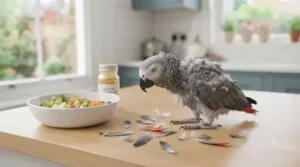
Every other product on this list assumes a nutritional gap. Casozen is different: it’s positioned by UK parrot specialists specifically for feather-destructive behaviour (FDB) — the plucking, barbering and picking that, per the peer-reviewed literature on the condition affects an estimated one in ten captive parrots and is only partly nutritional in origin.
Based on how it’s marketed and stocked alongside products like Pluck No More by specialist retailers, Casozen is designed to support birds where stress, anxiety or compulsive behaviour is a suspected driver, working alongside — never instead of — the environmental and behavioural changes that avian behaviourists consistently identify as the actual root cause in most cases. Here’s what most buyers overlook: no supplement on the market, this one included, resolves FDB in isolation. The current clinical consensus is that a vet visit to rule out physical causes (skin disease, parasites, hormonal issues) always comes first, with supplements and environmental enrichment working in parallel afterward.
Retailer and owner feedback around Casozen is generally cautiously positive, with the most credible reports coming from owners who paired it with cage enrichment, increased out-of-cage time, and a vet-confirmed absence of underlying illness — rather than owners expecting it to work as a stand-alone fix straight out of the bottle.
Pros:
- ✅ Purpose-built for feather-destructive behaviour, not general nutrition
- ✅ Trusted by UK specialist parrot retailers as a behavioural-support option
- ✅ Works well alongside environmental enrichment strategies
Cons:
- ❌ Premium price point among the products compared here
- ❌ Ineffective without addressing underlying behavioural or medical causes
At £15-£25 for a typical bottle, this is a considered purchase for a confirmed plucking case, not an impulse buy for a bird with slightly scruffy moult feathers.
7. Avigold Advance — the all-in-one liquid for owners who want fewer bottles
Avigold Advance takes a different formulation approach entirely: it’s a liquid all-in-one tonic combining vitamins, minerals, essential oils, amino acids, electrolytes and prebiotics in a single 1000ml bottle designed for cage and aviary birds. Rather than juggling three or four separate powders, you’re dosing one product into drinking water.
The essential-oil and amino-acid combination is where the feather relevance comes in — oils contribute fatty acids that feed into the same feather-lipid pathways that dedicated omega supplements target, though at a lower relative concentration than a standalone oil product, since it’s spread across a broader nutritional job list. For owners managing multiple birds or a small aviary, the convenience factor of one large bottle covering general health, feather condition and hydration support simultaneously is a genuine practical advantage, not just marketing language — fewer products to store, dose and remember reduces the real-world error rate in supplement routines, which matters more than people admit.
Feedback from aviary keepers tends to focus on convenience and general vitality improvements rather than dramatic feather transformations specifically, which is a reasonably honest reflection of what a broad-spectrum liquid tonic can realistically deliver compared to a concentrated single-nutrient powder.
Pros:
- ✅ Combines vitamins, minerals, oils and aminos in one bottle
- ✅ Large 1000ml size suits multi-bird households and aviaries
- ✅ Simplifies dosing compared to running several separate products
Cons:
- ❌ Lower concentration of any single nutrient than a targeted formula
- ❌ Liquid needs fresh daily water changes to remain effective
Expect to pay in the £15-£25 range for the full-size bottle, which is competitive once you account for it replacing what would otherwise be two or three separate purchases.
Full Spec Comparison: All 7 Products Side by Side
| Product | Key Ingredients | Format | Rating Sentiment | Price Range |
|---|---|---|---|---|
| The Birdcare Company Feather-Up | 13 vitamins, Rapisorb minerals, amino acids | Powder | Strongly positive on moult quality | £10-£15 |
| Beaphar Multi-Vit for Parrots & Parakeets | 12 vitamins | Liquid | Positive on ease of use | under £10 |
| Nekton-BIOTIN | Concentrated biotin | Powder | Positive among serious aviculturists | £15-£25 |
| Nekton-E | Vitamin E (alpha-tocopherol acetate) | Powder | Positive, breeding-season focus | £10-£15 |
| Vetark Avipro Avian | Pre/probiotics | Powder | Positive on stress-recovery cases | £10-£15 |
| Casozen | Behavioural-support formula | Liquid | Cautiously positive with enrichment | £15-£25 |
| Avigold Advance | Vitamins, minerals, oils, aminos, electrolytes | Liquid | Positive on convenience & vitality | £15-£25 |
The pattern that jumps out here is that price correlates more closely with formula specificity than with sheer ingredient count — the broad multivitamins (Beaphar Multi-Vit for Parrots & Parakeets, Avigold Advance) sit at the accessible end, while the narrowly targeted formulas (Nekton-BIOTIN, Casozen) command a premium for solving one problem precisely. If your bird’s feather issue is genuinely specific — confirmed plucking, or a diagnosed biotin-responsive moult problem — paying that premium is usually justified; if you’re supplementing a healthy bird as routine insurance, the broader, cheaper formulas do the job without overspending.
✨ Don’t Miss These Exclusive Deals!
🔍 Take your parrot’s feather condition to the next level with these carefully selected supplements. Click on any highlighted item to check current pricing and availability. These formulas will help support authentic, healthy plumage your feathered family member will thrive with!

Practical Usage Guide: Getting a New Feather Supplement Right in the First 30 Days
Introducing any new supplement to a parrot’s routine is a slower process than the packaging tends to suggest, and rushing it is one of the most common ways owners end up disappointed. Start at half the recommended dose for the first three to five days, watching droppings and appetite for any change — parrots can be surprisingly sensitive to sudden dietary additions, even beneficial ones. Powders mixed into soft food (eggfood, mashed veg, soaked pellets) tend to see better uptake than powders dusted onto dry seed, since loose seed simply falls to the cage floor rather than being eaten with the coating intact.
A common first-30-days mistake is switching two supplements at once — say, a multivitamin and a probiotic — because it becomes impossible to tell which one caused a positive or negative change if something shifts. Introduce one product, give it a full week minimum, then layer in the next if needed. For liquid supplements added to drinking water, freshness matters more than owners expect: most oils and vitamin blends degrade within 12-24 hours once mixed with water, especially in a warm room, so daily fresh mixing isn’t optional if you want the stated nutrient levels to actually reach your bird.
Track visible change against the moult calendar, not the calendar on your wall. Feathers already growing when you start a supplement were largely formed nutritionally before you began, so genuine structural improvement typically shows up in the following moult cycle, not the current one — expecting overnight transformation is the single biggest source of “this doesn’t work” reviews online, when in reality the timeline was simply unrealistic.
Real-World Scenarios: Which Supplement Suits Which Bird
Consider three fairly typical UK parrot households. First, a first-time cockatiel owner whose bird is going through its first proper moult and looking a little patchy — nothing alarming, just normal adolescent feather turnover. For this profile, a budget, broad-spectrum product like Beaphar Multi-Vit for Parrots & Parakeets covers the nutritional bases without overcomplicating a situation that’s almost certainly just normal development.
Second, an African grey owner whose bird has started chewing at its chest feathers over the past month, following a house move. Here, the sensible order of operations is a vet visit first to rule out skin disease or parasites, then — if the cause looks behavioural or stress-related — layering in something like Casozen alongside genuine environmental changes: more foraging opportunities, a consistent routine, and increased supervised out-of-cage time. Reaching straight for a supplement without the vet step, or without the enrichment changes, is where owners in this situation most often waste money.
Third, a small aviary keeper with six to eight budgerigars and limited time for multi-product dosing routines. Avigold Advance‘s all-in-one liquid format solves the practical problem here — one bottle in the water supply covers general vitamins, oils and minerals across the whole flock, rather than needing to individually dose seven different birds with seven different powders. Different birds, different problems, genuinely different right answers — which is really the whole argument against treating “best feather supplement” as a single, universal question.
How to Choose a Feather Health Supplement for Parrots
- Identify whether it’s a nutrition problem or a behaviour problem. Dull, brittle or slow-regrowing feathers point toward nutrition; feathers being actively chewed or pulled points toward feather-destructive behaviour, which needs a different approach entirely.
- Book a vet check before spending on anything specialist. Skin disease, parasites, hormonal imbalance and liver issues can all masquerade as a “feather problem” that no supplement will fix.
- Match the format to your routine. Powders on soft food suit single-bird households with time to prepare fresh food daily; liquids in water suit aviaries and busier owners.
- Check whether the formula is targeted or broad-spectrum. A confirmed deficiency or diagnosed issue justifies a concentrated single-nutrient product; general maintenance is better served by a broader multivitamin.
- Read aggregated review sentiment, not star ratings alone. A 4.5-star average tells you little; specific, repeated mentions of moult quality or behaviour change across many reviews tell you far more.
- Budget for the full moult cycle, not a single tub. Feather structural change takes weeks to months, so calculate cost-per-month rather than cost-per-purchase.
- Never treat a supplement as a substitute for enrichment or vet care. The products that perform best in real-world use are consistently the ones used alongside — not instead of — the basics.
Feather Plucking Supplement vs Plumage Condition Supplement: What’s the Difference
These two phrases get used almost interchangeably by shoppers, but they describe genuinely different products with different jobs. A feather plucking supplement, like Casozen, is generally formulated to support birds exhibiting active feather-destructive behaviour — the compulsive chewing or pulling covered above — and is typically positioned as part of a wider behavioural-management plan. A plumage condition supplement, by contrast — think Nekton-BIOTIN or The Birdcare Company Feather-Up — is aimed at improving the structural quality of feathers as they grow, addressing dullness, poor barbing or slow regrowth after a moult, with no assumption of a behavioural component at all.
The practical mistake owners make is reaching for a plucking-specific formula when the actual issue is nutritional, or vice versa — buying a plumage conditioner for a bird that’s actively pulling feathers out, which the conditioner was never designed to address. Getting this distinction right before purchasing saves both money and, more importantly, time your bird spends without the support it actually needs. If you’re genuinely unsure which category your situation falls into, that uncertainty is itself a strong signal to get a vet opinion before buying either type.
Omega-3 Fatty Acids and Feather Structure: The Science Bit
Omega-3 fatty acids — principally ALA from plant sources and EPA/DHA from fish oils — are polyunsaturated fats that a parrot’s body cannot synthesise on its own, meaning they must come from diet or supplementation. Their relevance to feathers comes down to cell membrane composition and anti-inflammatory activity: feather follicles are metabolically active tissue during growth, and adequate essential fatty acid supply supports the lipid layer that keeps individual barbules flexible rather than brittle.
Reviewers and specialist retailers consistently frame omega-3 deficiency as showing up in dry, brittle plumage and, in some cases, flaky skin, though it’s worth being honest that the research base specifically in companion parrots (as opposed to poultry, where preen gland and feather-lipid studies are more extensive) remains thinner than owners might expect from how confidently it’s marketed. Among the products compared here, Avigold Advance‘s essential-oil content is the closest to a direct omega source, while the more vitamin-focused formulas support feather health through entirely different mechanisms — worth remembering before assuming every “feather supplement” is delivering the same nutrient class.
The ideal omega-6 to omega-3 ratio commonly cited for birds sits close to 1:1, and most standard seed-based diets skew heavily toward omega-6, which is part of why fatty-acid supplementation gets recommended so often for seed-heavy diets specifically, rather than as a universal add-on regardless of what a bird already eats.
Preening Gland Health: The Overlooked Piece of the Feather Puzzle
Here’s a detail most feather-supplement marketing skips entirely: not all parrots even have a functioning uropygial (preen) gland in the way most other bird species do. According to research on avian preen gland anatomy, some parrot species rely instead on specialised powder-down feathers that break down into a fine, waterproofing dust, rather than the oily secretion other birds spread across their plumage by preening. This matters because it means “preening gland health” isn’t a single universal concept across every parrot species — a cockatoo’s powder-down system and a macaw’s more conventional preen gland serve a broadly similar purpose through genuinely different biological routes.
Where a bird does have a functioning preen gland, its oil contributes to waterproofing, feather flexibility and even antimicrobial defence against feather-degrading bacteria, a function explored in detail by the British Ornithologists’ Union’s research on preen oil. Supporting this system isn’t usually about a dedicated “preen gland supplement” — there isn’t really such a product category — but about general nutritional adequacy plus regular bathing opportunities, which stimulate natural preening behaviour far more reliably than anything added to food. A bird that never gets to bathe or mist regularly often shows poorer feather condition regardless of how good its supplement routine is, simply because preening itself — the physical act, not just the nutrients behind it — isn’t happening as often as it should.
Feather Destructive Behaviour: When Diet Isn’t the Whole Story
It’s worth stating plainly, because it’s the single most common misunderstanding in this entire product category: feather-destructive behaviour is not primarily a nutritional deficiency in most documented cases. Roughly half of parrots exhibiting the behaviour show inflammatory skin disease on biopsy, and the causes span medical, environmental and genuinely psychological territory, often overlapping in ways that resist a single, tidy explanation.
This is precisely why every specialist product in this comparison — Casozen especially — is marketed as a support tool rather than a cure. The realistic path for an owner facing active plucking looks like this: veterinary examination first, to rule out or treat physical causes; environmental review second, covering cage size, foraging opportunity, light exposure, and social interaction; and supplementation third, as one supporting element among several, not the headline fix. Owners who skip straight to buying a supplement without the first two steps are, based on the pattern in specialist retailer feedback, consistently the ones reporting disappointing results — not because the product failed, but because it was never designed to solve a problem it was one piece of, on its own.
Common Mistakes When Buying Feather Health Supplements
The most frequent mistake is buying based on packaging language alone — “feather formula” printed on a label doesn’t guarantee a concentrated, targeted nutrient profile, and reading the actual ingredient panel matters more than the marketing copy above it. A close second is under-dosing out of caution and then judging the product a failure after a week, when most feather-structural changes genuinely need a full moult cycle to become visible. Owners also frequently stack multiple overlapping products — say, two separate multivitamins — without realising they’re risking over-supplementation of fat-soluble vitamins like A and D3, which, unlike water-soluble vitamins, can build up to harmful levels rather than simply being excreted.
Another recurring error is assuming price signals effectiveness in a linear way; as the full comparison table above shows, a £10 broad-spectrum liquid and a £20 concentrated powder solve genuinely different problems, and paying more doesn’t help if you’ve bought the wrong category of product for your bird’s actual issue. Finally, plenty of owners supplement diligently while leaving the underlying diet unchanged — seed-heavy, vegetable-light — effectively adding a small nutritional patch on top of a much larger gap that no supplement, however good, is designed to close alone.
Long-Term Cost & Maintenance
Thinking in cost-per-month rather than cost-per-tub changes the value picture considerably. Beaphar Multi-Vit for Parrots & Parakeets, despite its low upfront price under £10, needs reordering fairly often given its 20ml size for regular use, while Nekton-BIOTIN‘s higher £15-£25 price tag is offset by its concentrated dosing, often working out to a comparable or even lower weekly cost for a single companion bird. Liquid all-in-ones like Avigold Advance scale well for multi-bird households specifically because the per-bird cost drops sharply once you’re dosing a shared water source rather than individual food portions.
The maintenance side matters just as much as the raw cost. Powders generally have a longer shelf life once opened, provided they’re kept dry and sealed, while liquids — particularly oil-based ones — are more prone to degradation once opened and need cooler, darker storage to preserve nutrient content through their use-by date. Factor storage conditions into your buying decision as seriously as price: a supplement that’s degraded past its effective nutrient level by month two of a three-month tub isn’t actually the bargain its per-gram price suggests.
Safety, Regulations & Vet Guidance
Bird supplements sold in the UK sit under general animal feed and welfare regulations rather than a bespoke licensing regime specific to pet-bird vitamins, which places responsibility on owners to read dosing guidance carefully rather than assuming a “more is better” approach with any vitamin product, fat-soluble vitamins especially. The Animal Welfare Act 2006 places a legal duty of care on keepers to meet an animal’s welfare needs, and — as the PDSA’s welfare needs guidance makes clear — diet is one of five needs assessed together with health, behaviour, environment and companionship, meaning a supplement alone was never going to satisfy that legal duty in isolation, whatever a product label implies.
Practically, this means: always follow stated dosing on the specific product you buy rather than a general rule of thumb across brands, since concentration varies considerably between a dilute liquid and a concentrated powder; introduce new supplements gradually as covered in the usage guide above; and treat any sudden feather change — especially active plucking, bleeding feathers, or feather loss without regrowth — as a reason to see an avian vet promptly rather than trying a supplement first and waiting to see what happens.

Frequently Asked Questions
❓ What is the best feather health supplement for parrots?
❓ Can a feather supplement stop feather plucking on its own?
❓ How long does it take to see results from a feather supplement?
❓ Are omega-3 supplements safe for parrots every day?
❓ Do all parrots have a preen gland?
Conclusion
There’s no single product on this list that deserves the label “the” feather health supplement for parrots, and any article claiming otherwise is oversimplifying a genuinely nuanced picture. What the comparison does show is a clear split by purpose: broad, affordable maintenance products like Beaphar Multi-Vit for Parrots & Parakeets and Avigold Advance suit routine support and multi-bird households, targeted structural formulas like Nekton-BIOTIN, Nekton-E and The Birdcare Company Feather-Up suit confirmed moult or plumage-quality issues, and specialist behavioural support like Casozen — alongside the often-overlooked gut-health angle from Vetark Avipro Avian — belongs specifically in feather-destructive behaviour cases managed together with a vet and environmental changes.
The through-line across every honest review of this product category is the same: supplements support a good diet and good husbandry, they don’t replace either. Read the ingredient panel, match the format to your bird’s actual issue rather than the marketing on the tub, and give any formula a full moult cycle before judging results. Get those fundamentals right first, and whichever product from this list you choose becomes a genuinely useful addition rather than an expensive shot in the dark.
Recommended for You
- Vitamin supplement for moulting birds: 7 Real UK Picks for 2026
- 7 Best Bird Probiotic Supplement Review Picks for 2026 (UK)
- Cockatiel Calcium Supplement Buy Guide: 7 Best Picks 2026
Disclaimer: This article contains affiliate links. As an Amazon Associate, I earn from qualifying purchases. If you purchase products through these links, we may earn a small commission at no additional cost to you.
✨ Found this helpful? Share it with your friends! 💬🤗
