
In This Article
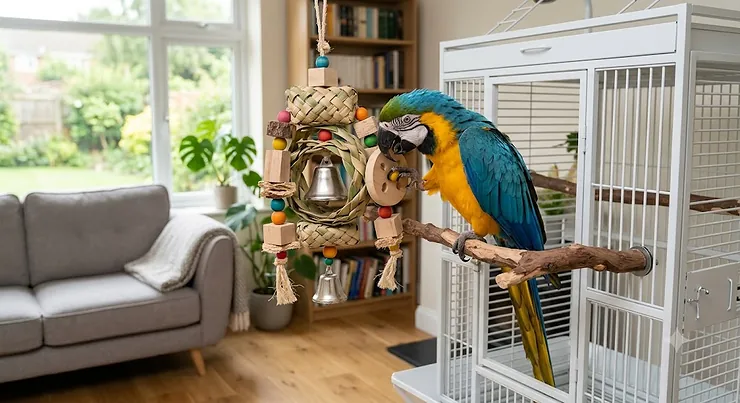
There’s a particular sound every macaw owner learns to dread: the soft, splintering crunch of a “heavy duty” toy meeting its end approximately four minutes after unboxing. If you’re hunting for genuinely durable toys for macaws, you’ve probably already binned a small graveyard of pastel plastic rings that were, generously speaking, designed for a cockatiel. Toys for macaws are large-format enrichment items — chew blocks, foraging puzzles, swings and beak-conditioning toys — engineered from thick hardwood, stainless steel, or heavy cotton rope specifically to withstand a bite force that can exceed 500 PSI in big macaw species. That’s not a typo, and it’s exactly why “large parrot” toys sold for African greys or Amazons routinely fail within a macaw’s beak.
This guide exists because the enrichment aisle is genuinely confusing at macaw scale. You’re not just buying a toy; you’re buying against a bird that can crack a Brazil nut like it’s a crisp. We’ve researched seven real, currently available products spanning budget, mid-range and premium price points, broken down what their specs actually mean for your bird’s daily wear-and-tear, and built in the practical guides — setup, troubleshooting, sizing — that most product listings skip entirely. Whether you’ve got a Blue and Gold, a Hyacinth, or a mini macaw testing the waters of destructive play, there’s a route through this that won’t leave you reordering weekly.
Quick Comparison Table
| Product | Type | Price Range | Best For |
|---|---|---|---|
| Super Bird Creations SB439 Beakasaurus | Chew/beak toy | £20-£30 | Daily beak conditioning |
| Bonka Bird Toys 1394 Huge Jumble | Foraging/chew | Under £20 | Budget-conscious first-timers |
| Super Bird Creations SB440 4 Way Play | Multi-activity | £25-£35 | XXL cage all-rounder |
| Bonka Bird Toys 1750 Clacker | Stainless steel | £15-£25 | Serious beak-strength testers |
| Bonka Bird Toys 1411 Huge Globe Rope Swing | Preening/climbing | £25-£40 | Premium exercise and preening |
| A1 Extra Large Bird Macaw Chew Toys | Multi-pack forager | Under £20 | Rotating variety on a budget |
| Bonka Bird Toys 1116 Gigantor | XXL activity centre | £30-£45 | Premium long-term chewers |
Looking at the spread above, the pattern that jumps out is how price correlates less with size and more with material — stainless steel and thick hardwood push costs up, while rope and cardboard-based designs stay cheaper but wear faster under a macaw’s beak. If you’re outfitting a cage for the first time, the Bonka 1394 or the A1 multi-pack give you room to learn your bird’s chewing style before committing to pricier hardware. Owners of committed demolition experts, meanwhile, tend to gravitate toward the stainless steel and dense-wood options further down this list, where the extra spend buys weeks rather than days of use.
💬 Just one click — help others make better buying decisions too!😊
Top 7 Toys for Macaws: Expert Analysis
1. Super Bird Creations SB439 Beakasaurus — best for daily beak conditioning
The Beakasaurus earns its slightly ridiculous name honestly: it’s a chunky, 20 x 7 x 6 inch chew toy built specifically to give large and extra-large birds something worthy of their bite. Made from a mix of pine, birch and other bird-safe hardwoods threaded with colourful accents, it’s constructed to be gradually destroyed rather than instantly demolished, which is precisely the point — a chew toy that lasts thirty seconds isn’t conditioning anything. Based on the spec comparison with smaller “large bird” toys on the market, the Beakasaurus uses thicker wood stock throughout, which is the detail that actually determines longevity, not the toy’s overall footprint. This is a toy for macaw owners who want a genuine daily-use chew station rather than an occasional novelty, and it slots in well for birds transitioning from smaller cockatoo-rated toys who are outgrowing everything else in the cage. Reviewers consistently report that Super Bird Creations toys hold up noticeably better than generic alternatives at a similar price, though a determined Hyacinth or Green-Winged macaw will still work through one over several weeks rather than months. If you can’t verify individual review counts at the time of purchase, that’s worth checking directly on the listing, since stock and review data shift.
Pros:
- ✅ Genuinely thick hardwood built for large and XL birds
- ✅ Colourful design keeps visual enrichment alongside chewing
- ✅ Quick-link attachment makes cage rotation simple
Cons:
- ❌ Determined macaws will still work through it in weeks, not months
- ❌ Some smaller mini macaws may find it initially oversized
Priced in the £20-£30 range at the time of research, this sits firmly in the mid-tier and represents solid value for a toy that’s purpose-built rather than generically “large bird” labelled — check current price before buying, as availability shifts.
2. Bonka Bird Toys 1394 Huge Jumble — best budget-friendly heavy chewer starter
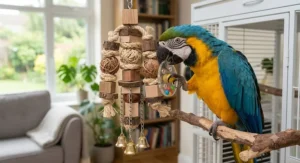
The 1394 Huge Jumble is an 18-inch by 8-inch tangle of natural wood blocks, thick rope, and durable plastic elements, hand-assembled by a small US manufacturer that’s built its whole catalogue around large parrot enrichment. What that combination means in practice is layered texture: your macaw gets wood to crunch, rope to fray and pull, and plastic components that resist splintering in ways raw wood alone doesn’t. What most buyers overlook about jumble-style toys is that the variety of materials actually slows total destruction down compared to single-material toys of the same size, because your bird’s attention (and beak) is divided across textures rather than concentrated on one weak point. It’s aimed squarely at owners who want to test what their macaw actually prefers — chewing, pulling, or foraging through layers — before spending more on a specialised toy. Aggregated review sentiment for Bonka’s large-bird range tends to highlight good value against tougher competitors, though as with most rope-inclusive toys, the cotton elements fray faster than the wood blocks survive.
Pros:
- ✅ Mixed materials suit birds with varied play preferences
- ✅ Heavy-duty metal hanging attachment feels genuinely secure
- ✅ Strong value entry point for first heavy-duty purchase
Cons:
- ❌ Rope sections wear out well before the wood blocks do
- ❌ Not the toy to reach for with the most destructive chewers
At under £20 at the time of research, this is one of the more accessible entries in this list, making it a sensible starting point if you’re still mapping your bird’s chewing habits.
3. Super Bird Creations SB440 4 Way Play Bird Toy — best all-rounder for XXL cages
Measuring a genuinely large 24 x 7 x 7 inches, the SB440 packs colourful wooden blocks, a ringing bell, and a small swing element into one hanging unit, explicitly marketed for mini macaws, Amazons and African greys and scaled up further in an XL variant for full-size macaws. Here’s what the spec sheet won’t tell you outright: the multi-activity design matters because macaws are cognitively demanding birds, and a single-function toy — pure chew, pure swing — tends to get ignored faster than one offering several behaviours in one place. The bell and swing add auditory and physical stimulation on top of the chewing surface, which according to RSPCA enrichment guidance is exactly the kind of layered activity captive parrots need to replace the natural foraging and exploring behaviours they’d otherwise spend most of their day on in the wild. This one suits owners with a large cage or aviary section who want a centrepiece toy rather than a rotating cast of small items. Based on the spec comparison with single-activity chew blocks, this earns its slightly higher price through genuine functional variety rather than just size.
Pros:
- ✅ Combines chewing, swinging and auditory stimulation in one toy
- ✅ Sized appropriately for full macaws, not just mini macaws
- ✅ Colour variety supports visual enrichment too
Cons:
- ❌ Bell mechanism is the first part to fail under heavy play
- ❌ Bulkier design needs a genuinely spacious cage to hang well
Expect to pay in the £25-£35 range at the time of research; given the multi-activity design, this represents fair value against single-function toys of similar size.
4. Bonka Bird Toys 1750 Clacker (Stainless Steel) — best stainless steel beak-strength tester
The Clacker takes a genuinely different approach: instead of wood or rope as the primary target, it centres four heavy-duty stainless steel measuring cups hanging from chains off a central plastic joint, with acrylic pacifiers threaded above each one. Stainless steel matters enormously here — it’s one of the only materials that doesn’t yield to a macaw’s bite the way wood eventually does, which makes this less a chew toy and more a genuine beak-strength and manipulation toy. What most buyers overlook is that the appeal isn’t destruction at all; it’s the clattering, pullable, twistable interaction, which is a different kind of enrichment entirely — closer to a foot toy scaled up for beak use. For macaw owners already burning through wooden toys weekly, adding one steel-based item into the rotation gives the beak something to grip and pull without contributing to the pile of splinters on the cage floor. Reviewers of Bonka’s stainless steel range generally note the toy survives far longer than wood or rope equivalents, with the acrylic pacifiers being the first component to show wear.
Pros:
- ✅ Stainless steel cups resist destruction almost entirely
- ✅ Encourages pulling and manipulation, not just chewing
- ✅ Genuinely different sensory experience from wood-based toys
Cons:
- ❌ Acrylic pacifiers can crack under sustained heavy biting
- ❌ Less satisfying for birds whose main drive is destructive chewing
Priced around £15-£25 at the time of research, this is genuinely good long-term value precisely because the core material doesn’t wear out.
5. Bonka Bird Toys 1411 Huge Globe Rope Swing — best premium preening and climbing swing
This is a 32-inch tall, 19-inch wide swing built from two large rings tightly wound in colourful cotton rope, with frayed rope knots at top and bottom specifically left loose for preening, plus four moving plastic shapes and two bells threaded through for extra stimulation. On paper this means something quite specific: unlike the chew-focused toys elsewhere on this list, the Globe Swing is designed around movement and grooming rather than destruction, giving your macaw a large stable perch to climb, swing, and use its beak on rope fibres in a way that supports feather condition rather than working against it. According to the RSPCA’s guidance on captive bird welfare, climbing and preening opportunities are core to preventing the abnormal, repetitive behaviours that under-stimulated large parrots can develop, and a stable, appropriately-sized swing is one of the more effective tools for that. At 79 ounces with a heavy-duty link and swivel-capable hanging chain, it’s rated for the weight and grip strength of full-size macaws and cockatoos, not just smaller large parrots. This is the pick for owners who’ve got the toy-chewing side covered and want to invest in exercise and grooming enrichment specifically.
Pros:
- ✅ Genuinely large, stable swing rated for full macaw weight
- ✅ Frayed rope sections designed specifically for preening
- ✅ Bells and moving shapes add sensory variety beyond swinging
Cons:
- ❌ Rope will fray and eventually need replacing with heavy daily use
- ❌ Requires a cage or stand tall enough to hang it properly
At £25-£40 in the price range at the time of research, this sits at the premium end of this list, and the size justifies it for anyone with the vertical cage space to use it properly.
6. A1 Extra Large Bird Macaw Chew Toys (Heavy Duty Foraging Multi-Pack) — best value multi-pack forager
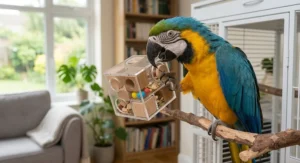
Sold specifically under the extra-large banner for macaws, cockatoos and African greys, this multi-pack pairs several chunky, sturdy chew pieces with an easily attachable design for mounting to the top or side of a cage, creating a dedicated chewing zone rather than a single hanging item. The multi-pack format is the standout feature here — where the other entries on this list are single units, buying several smaller pieces at once lets you rotate fresh toys into the cage regularly, which behavioural research consistently flags as one of the simplest ways to keep enrichment effective, since even a macaw’s favourite toy stops being novel after a while. What the listing calls “heavy duty foraging” translates in practice to firm wood pieces sized generously enough that they aren’t swallowed or splintered into hazardous shards immediately, aimed at satisfying the natural drive to mimic wild foraging behaviour. Because this is a newer listing without an extensive independent review history at the time of writing, it’s worth checking the seller’s current rating and photos before ordering rather than assuming durability claims apply equally to every unit in the multi-pack.
Pros:
- ✅ Multi-pack format supports toy rotation for novelty
- ✅ Purpose-sized for macaws rather than generic “large bird” labelling
- ✅ Simple attachment suits both cage tops and sides
Cons:
- ❌ Limited independent review history to verify long-term durability
- ❌ Individual pieces are smaller than single premium chew blocks
At under £20 for the pack at the time of research, this is one of the more cost-effective ways to build variety into a rotation without committing heavily to any single toy.
7. Bonka Bird Toys 1116 Gigantor — best premium XXL activity centre
The Gigantor lives up to its name at 32 inches high by 14 inches wide, built from bird-safe coloured wooden blocks of assorted sizes strung on soft cotton rope from top to bottom, with additional rope pieces threaded through the blocks themselves and a heavy-duty hanging link at the top. What the size actually buys you is surface area — more total wood volume means more chewing capacity before the toy needs replacing, which for a macaw-scale beak is the single biggest factor in cost-per-week rather than upfront price. Here’s what most spec sheets skip: bigger toys don’t just last longer in absolute terms, they also reduce how often you’re handling replacement toys inside the cage, which matters for owners managing a bird that’s wary of new objects being introduced. This is squarely a toy for owners of the largest macaw species — Hyacinths, Buffon’s, Green-Winged — who’ve already found that mid-sized “large parrot” toys disappear within days. Aggregated feedback on Bonka’s large-format wood-block toys tends to note that the assorted block sizes hold up reasonably evenly, rather than one weak section failing far ahead of the rest.
Pros:
- ✅ Genuinely XXL scale suited to the largest macaw species
- ✅ Assorted wood block sizes wear down evenly rather than at one point
- ✅ Heavy-duty top link rated for the toy’s own substantial weight
Cons:
- ❌ Premium price reflects the larger amount of material used
- ❌ Needs serious vertical cage clearance to hang without dragging
Expect £30-£45 at the time of research; for owners of the biggest macaw species specifically, the cost-per-week of use tends to work out favourably against buying several smaller toys in sequence.
Setting Up Heavy Duty Toys for Macaws Without Losing a Finger
Getting a new heavy duty toy into a macaw’s cage isn’t quite as simple as clipping it on and walking away — not if you want your bird actually engaging with it rather than eyeing it with suspicion for a week. Start by introducing any new toy outside the cage first, letting your macaw investigate it on a stand or table where it can retreat if the object seems threatening; birds that get a toy dropped directly into their territory unannounced often ignore it out of caution rather than disinterest. Once it’s cage-bound, position larger chew toys and swings away from food and water stations, since falling wood splinters and rope fibres will otherwise end up in your bird’s bowl within days.
For the first thirty days, expect a slower destruction rate than the toy’s eventual pace, simply because your macaw is still exploring rather than committing fully — don’t mistake early caution for the toy being “too tough” and swap it out prematurely. A common mistake is over-tightening quick-link attachments to the point that swinging toys can’t move naturally; leave enough play in the link for genuine swing or spin motion, which is usually exactly what triggers sustained interest in items like the Globe Rope Swing. Rotate at least one toy every ten to fourteen days rather than leaving the same three items in place indefinitely — even the toughest stainless steel toy becomes background furniture to a bird as sharp as a macaw if it never changes. Finally, check quick-links and chains weekly for wear from the swinging motion itself, not just from chewing; metal fatigue at a hanging point is a far more serious hazard than a half-chewed wood block.
Which Toy Fits Your Macaw? Three Real-World Scenarios
Picture a first-time Blue and Gold macaw owner working with a modest budget and a bird that’s still finding its confidence around new objects. Here, the smart move is starting with the A1 Extra Large multi-pack alongside the Bonka 1394 Huge Jumble — both sit under £20, and having several smaller pieces to introduce gradually suits a nervous or newly homed bird far better than one large, intimidating swing dropped in on day one.
Now picture a household with a mature, highly destructive Green-Winged macaw that’s already chewed through every “large bird” toy from the local pet shop within a week. This is exactly the profile the Bonka 1116 Gigantor and the stainless steel 1750 Clacker were built for — the Gigantor’s sheer wood volume buys weeks rather than days, while the Clacker adds a near-indestructible steel option into rotation so the chewing budget isn’t entirely spent on wood that needs constant replacing.
Finally, consider an owner with a spacious aviary section and a macaw showing early signs of over-preening or feather stress, where the priority shifts from pure destruction toward genuine movement and grooming enrichment. The Bonka 1411 Huge Globe Rope Swing earns its premium price here specifically because it’s built for climbing and preening rather than chewing, and pairing it with the multi-activity SB440 4 Way Play toy covers both physical exercise and cognitive stimulation without leaning entirely on destructible chew items.
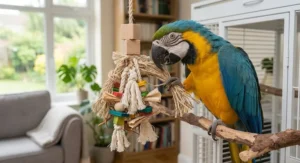
Common Problems With Toys for Macaws (And How to Actually Fix Them)
Problem: the toy is destroyed within 24 hours. This almost always means the toy was undersized or under-built for the specific bird, rather than a fluke. Move to genuinely XXL-rated products like the Gigantor or the Beakasaurus, and consider adding a stainless steel item like the Clacker into rotation so at least one toy in the cage isn’t consumable at all.
Problem: your macaw ignores a brand-new toy entirely. Rather than assuming the toy has failed, try the outside-the-cage introduction method described above, and consider hiding a small treat within the toy’s structure to spark initial investigation — foraging instinct often overrides caution once food is involved.
Problem: rope-based toys fray dangerously fast, leaving loose threads. Loose cotton fibres are genuinely a foot-entanglement risk once they fray past a certain point. Inspect rope toys like the Globe Swing every few days, and trim or remove any strand that’s separated enough to loop around a toe.
Problem: hanging hardware is loosening or showing rust. Heavy-duty quick-links are rated for weight but not for indefinite outdoor humidity exposure. Swap to stainless-rated hardware where possible, and inspect chain links monthly if your cage lives anywhere near a bathroom, kitchen, or conservatory.
Problem: your bird seems bored despite having several “durable” toys. Durability and stimulation aren’t the same thing. A toy that survives six months but offers only one activity type will still get ignored. Mix material types — wood, rope, steel — and rotate placement within the cage, not just the toys themselves.
How to Choose Toys for Macaws
Picking the right toy isn’t really about finding “the best” single product — it’s about matching material, size and activity type to your specific bird. Here’s a practical framework:
- Start with your bird’s actual size, not just “macaw” as a category. A mini macaw and a Hyacinth macaw have wildly different bite forces and grip spans, so check the toy’s stated size range rather than assuming every macaw-labelled toy fits every macaw species.
- Identify your bird’s dominant play style. Chewers need dense wood or thick chew blocks; climbers and preeners need rope-based swings; foragers need multi-piece or hideable designs.
- Budget for rotation, not a single purchase. Two or three mid-priced toys swapped regularly beat one expensive toy left in place indefinitely, since novelty drives engagement as much as durability does.
- Weight-check the hanging hardware against the toy’s own mass. A heavy wood block on a flimsy link is a falling hazard, not just a durability issue.
- Favour mixed-material designs where possible. Jumble-style toys that combine wood, rope and plastic tend to hold attention longer than single-material equivalents of the same size.
- Read aggregated review sentiment, not star ratings alone. A 4.5-star average tells you little about how a toy performs specifically against a macaw’s beak versus a cockatiel’s — look for reviews explicitly mentioning macaws or large parrots.
- Budget realistically for replacement frequency. Heavy chewers will need new chew-focused items every few weeks regardless of quality; factor that into ongoing cost rather than expecting a single “forever toy.”
Common Mistakes When Buying Heavy Duty Toys for Macaws
The single most frequent mistake is buying based on the word “large” in a product title without checking actual dimensions — plenty of toys marketed as suitable for large parrots are genuinely sized for Amazons or African greys, not the substantially bigger beak and grip span of a full macaw. A second common error is buying only chew-focused toys and neglecting swings, foot toys, or foraging puzzles entirely, which leaves cognitive and physical needs unmet even if the beak is kept busy. Owners also frequently underestimate how quickly rope-based components wear relative to wood, buying a single rope swing and expecting the same lifespan as a hardwood chew block, when the two materials degrade at very different rates under identical use.
Another mistake worth flagging: assuming a higher price automatically means a tougher toy. As the comparison table above shows, material matters more than overall cost — a modestly priced stainless steel item can outlast a pricier wood-and-rope combination toy purely because steel doesn’t yield to a beak the way organic material does. Finally, many first-time macaw owners skip the introduction step entirely, hanging an unfamiliar toy directly into the cage and then concluding the bird “doesn’t like toys” when actually it just needed a slower, supervised introduction.
Extra Large Toys vs Standard Parrot Toys
The gap between extra large macaw toys and standard-sized parrot toys isn’t cosmetic — it’s structural. Standard parrot toys, generally sized for birds up to cockatiel or conure scale, use thinner wood dowels, lighter cotton rope, and smaller connective hardware, all of which a macaw’s beak can compromise in minutes rather than weeks. XXL parrot toy sizing typically means wood stock at least double the thickness, rope rated for substantially higher tensile pull, and connector hardware built to hold weight several times greater than a standard toy’s rated load. The practical result is that a macaw given a standard-sized toy isn’t just going to destroy it faster — the smaller components can actually pose a choking or entanglement hazard once broken down into macaw-sized bite pieces, since they weren’t engineered with that bite force in mind at all.
This is where the products in this guide differentiate themselves clearly: items like the Gigantor and the Beakasaurus are explicitly built at extra-large scale from the outset, not simply relabelled standard toys. If you’re currently working through standard parrot toys with a macaw and finding they disappear almost instantly, that’s a strong signal to size up entirely rather than simply buying more of the same product — the fix is category, not quantity.
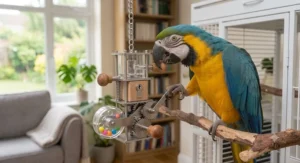
Macaw Proof Construction: What Actually Survives a Macaw Beak
“Macaw proof” gets used loosely in product listings, so it’s worth being specific about what actually holds up. Stainless steel, as seen in the Bonka Clacker, is genuinely close to indestructible against a beak, though it offers a different kind of enrichment (manipulation and pulling) rather than satisfying destructive chewing drives. Dense hardwoods — pine, birch, maple — used at sufficient thickness, as in the Beakasaurus and Gigantor, are designed to be destroyed gradually rather than resist destruction entirely; “proof” here means weeks of use rather than permanent survival. Thick cotton rope, seen in the Globe Rope Swing, isn’t designed for beak resistance at all — its job is grip and preening texture, and expecting it to survive like wood or steel misunderstands its purpose.
What most buyers overlook is that genuinely macaw proof construction usually means accepting a toy will still be consumed eventually — the goal is controlled, gradual destruction that satisfies natural chewing behaviour safely, not permanent indestructibility. A toy that truly never wears down at all, in most cases, also isn’t giving your bird anything to actually chew on, which defeats a large part of the enrichment purpose in the first place.
What to Expect: Real-World Performance
On paper, spec sheets promise “heavy duty” and “extra large” freely, but real-world performance against an actual macaw beak looks different depending on the bird. A moderately destructive Blue and Gold might work through a mid-tier chew toy like the SB439 Beakasaurus over four to six weeks of regular use, while a highly destructive Hyacinth or Green-Winged macaw could reduce the same toy to fragments within one to two weeks. Multi-material jumble toys tend to show uneven wear — the rope sections fraying noticeably before the wood blocks show significant damage — while single-material toys like the Gigantor wear more evenly across the whole structure.
Stainless steel items are the outlier here: expect the metal components themselves to essentially never fail, with acrylic or plastic accessory pieces being the actual point of eventual wear. Swings and rope-based climbing toys perform differently again, since their “failure” isn’t chewing-related destruction but gradual fraying and stretching from repeated weight-bearing use, meaning their practical lifespan is measured in months of structural wear rather than weeks of beak damage.
Long-Term Cost & Maintenance
Thinking in cost-per-week rather than upfront price changes the calculation on toys for macaws considerably. A £15 rope toy replaced every two weeks costs roughly £7.50 weekly across a month; a £40 premium wood-and-steel activity centre lasting six weeks works out closer to £6.70 weekly — cheaper in the long run despite the higher sticker price. This is precisely why heavier, denser, more expensive items like the Gigantor or premium stainless steel toys often represent better long-term value for genuinely destructive chewers, even though the upfront outlay looks steeper.
Maintenance itself is minimal but non-negotiable: wipe down wood components periodically with a bird-safe cloth (no household cleaning chemicals), inspect rope for fraying weekly, and replace any hanging hardware showing rust or metal fatigue immediately rather than waiting for full failure. Budgeting realistically means accepting that heavy chewers will need one to two new chew-focused toys monthly regardless of quality, while swings, steel items, and rope-based preening toys typically need replacement on a much longer, seasonal cycle rather than a weekly one.
✨ Ready to build a rotation that actually survives?
🔍 Explore the full range of extra large macaw toys above and check current pricing before your next cage refresh!
Safety, Regulations & Compliance Guide
Under the Animal Welfare Act 2006, anyone responsible for a pet macaw in England and Wales has a legal duty to meet five welfare needs, one of which explicitly covers the ability to exhibit normal behaviour — a category that environmental enrichment and appropriate toys fall squarely under. Practically speaking, that means providing genuinely appropriate chewing, foraging, and exercise opportunities isn’t just good practice; it’s part of a legal responsibility for anyone keeping a companion bird in the UK. Beyond legislation, safety-focused buying comes down to a few concrete checks: avoid toys using zinc-plated or galvanised metal components, which can be toxic if ingested in chewed fragments; check that any dyes or paints used are explicitly labelled non-toxic and bird-safe; and size every toy component so it can’t be swallowed whole or wedge a beak or toe.
Supervise any brand-new toy for the first few sessions regardless of how “safe” the listing claims it is, since individual birds interact with novel objects unpredictably. Finally, dispose of any toy showing sharp splintered edges, exposed wire, or frayed rope loops promptly rather than leaving a partially destroyed toy in the cage “until it’s fully used up” — that’s exactly the state in which most enrichment-related injuries occur.
FAQ
❓ What are the best toys for macaws that survive more than a week?
❓ Do macaws need special extra large toys, or will large parrot toys work?
❓ How often should I replace heavy duty macaw toys?
❓ Is it normal for a macaw to destroy a toy within days?
❓ What materials should I avoid in macaw toys?
Conclusion
There’s no single perfect toy for macaws, and honestly, chasing one misses the point — the owners who report the least frustration and the happiest, most engaged birds are the ones running a genuine rotation across material types rather than betting everything on one “indestructible” product. Start with something proportionate to your budget and your bird’s current destructiveness, whether that’s the accessible A1 multi-pack or the more committed investment of a Bonka Gigantor, and build outward from there as you learn your macaw’s specific habits.
What matters most, based on everything covered here, is matching size, material and activity type to the actual bird in front of you rather than the marketing on the box. A £15 stainless steel Clacker and a £40 premium wood centre can both be the “right” toy — for different birds, different budgets, and different stages of a macaw’s chewing career. Keep checking current prices before you buy, since availability and cost shift regularly, and don’t be afraid to retire a toy the moment its hardware starts showing wear rather than waiting for full failure.
✨ Don’t Miss These Exclusive Deals!
🔍 Take your macaw’s enrichment routine to the next level with these carefully selected picks. Click on any highlighted item to check current pricing and availability — a well-stocked toy rotation is one of the simplest upgrades you can make to your bird’s daily life!
Recommended for You
- Destructible Toys for Cockatoos: 7 Best Picks That Survive 2026
- Toys for Cockatoos: 7 Heavy Duty Picks That Actually Survive (2026)
- 7 Best Toys for Amazon Parrots in 2026: Durable Picks Reviewed
Disclaimer: This article contains affiliate links. As an Amazon Associate, I earn from qualifying purchases. If you purchase products through these links, we may earn a small commission at no additional cost to you.
✨ Found this helpful? Share it with your friends! 💬🤗
