
In This Article
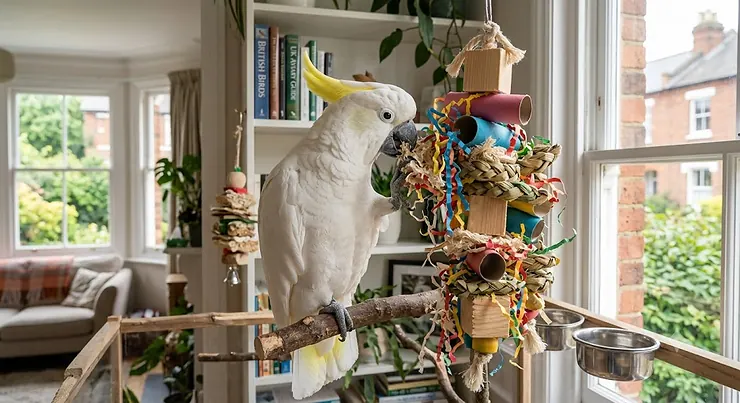
Somewhere in your house right now, a small feathery dinosaur is eyeing up the nearest wooden object with the calm, unhurried menace of a demolition contractor who’s just clocked in. That’s a cockatoo for you. Give one a toy and you’re not really giving them entertainment — you’re negotiating a truce, and the currency is wood, rope and the occasional sacrificial piece of cardboard. Destructible toys for cockatoos aren’t an indulgence or a gimmick; they’re the single best thing standing between your bird’s beak and your bannisters, your bookshelf, and quite possibly your patience.
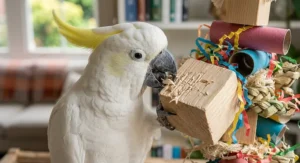
Here’s the thing nobody tells new cockatoo owners: a toy that survives more than a fortnight probably isn’t doing its job. These birds are built, quite literally, to chew things to pieces — their beaks grow continuously and need friction and resistance to stay in trim, and in the wild that job falls to bark, nuts, and unlucky tree branches. Take that outlet away and, as the RSPCA notes in its bird behaviour guidance, parrots kept without the chance to satisfy their natural urge to chew and destroy things can develop real behavioural problems, from screaming to feather plucking. So this guide isn’t about finding the toughest toy that’ll outlast your cockatoo’s patience. It’s about finding the right kind of destructible — safe, satisfying, and cheap enough that watching it get shredded doesn’t make you wince.
What are destructible toys for cockatoos? They’re bird-safe toys — typically wood, natural fibre, cardboard, or thin plastic — deliberately engineered to be pulled apart, chewed through, and reduced to confetti, satisfying a cockatoo’s instinctive need to gnaw and forage rather than resisting it.
Quick Comparison Table
| Product | Material | Style | Approx. Lifespan | Best For |
|---|---|---|---|---|
| Bird Kabob Standard | Cactus wood on sisal rope | Natural chew | Days to a few weeks | Budget natural chewing |
| Happy Pet Shred It | Acrylic shell + rolled paper | Refillable shredder | Ongoing (refillable) | Long-term cost control |
| KTCWPAW Large Parrot Chew Toy | Wood blocks, cotton rope | Hanging chew | 1-3 weeks | Budget beak workout |
| Bonka Bird Toys Huge Jumble | Wood, rope, plastic | Multi-texture chew | 2-4 weeks | Varied destruction |
| Super Bird Creations PVC Forager | PVC, plastic beads | Refillable forager | Ongoing (refillable) | Foraging plus chewing |
| Planet Pleasures Spiked Piñata XL | Woven palm leaf | Natural shredder | 1-4 weeks | Serious natural shredders |
| JW Pet Activitoy NutCase | Natural rubber | Stretchy forager | Minutes to days | Gentler chewers, treat games |
What jumps out here is how wildly “destructible” can vary in practice. A £4 rubber forager might survive an afternoon with a determined umbrella cockatoo, while a £12 woven piñata can realistically stretch to a month of steady demolition. The lesson isn’t that cheaper is worse — it’s that material and construction, not price alone, decide how long a toy lasts, and honestly, how long it lasts isn’t even always the point.
💬 Just one click — help others make better buying decisions too!😊
Top 7 Destructible Toys for Cockatoos: Expert Analysis
1. Bird Kabob Standard Natural Parrot Toy — best cheap natural chew starter
There’s something almost meditative about the Bird Kabob’s design: chunks of dried cactus wood threaded onto a length of sisal rope, nothing more, nothing less. What most buyers overlook about a toy this simple is that the simplicity is the whole point — cactus wood fibres are naturally soft and slightly crumbly, which means even a moderate chewer can make visible progress within a single play session rather than staring blankly at an indestructible lump of hardwood.
Based on the spec comparison with other natural-wood toys in this list, the Bird Kabob sits at the gentler end of the destruction scale — it’s marketed as suitable for birds who “prefer to play more gently or who aren’t big chewers,” which for a determined cockatoo might mean it disappears faster than tougher options rather than slower. That’s not necessarily a flaw; for owners easing a nervous or inexperienced bird into destructive play, a toy that yields quickly builds confidence. The rope threading is also designed to be untied and restocked with your own materials, so the toy’s “life” doesn’t have to end when the wood runs out.
Pros:
- ✅ Genuinely natural, single-material construction
- ✅ Soft texture is approachable for cautious chewers
- ✅ Rope can be re-threaded with fresh material
Cons:
- ❌ Softer wood means faster destruction for strong chewers
- ❌ Not sized generously for the largest cockatoo species
At around £4-£8 depending on size, this is about as cheap destructible parrot toys get without dipping into homemade territory, and it’s a sensible first purchase for testing how your particular bird likes to destroy things.
2. Happy Pet Shred It (Medium/Large) — best for genuinely replaceable, low-waste shredding
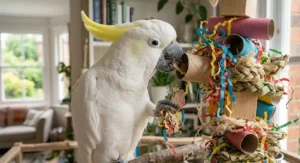
If you’ve ever balked at buying a whole new toy every few days, the Shred It solves the maths problem rather neatly. Instead of a toy that dies once, you get a tough acrylic shell that survives indefinitely, paired with a roll of paper inside that your bird tears to bits — and when that’s gone, you simply buy a refill roll rather than the whole unit again. Aggregated customer feedback on Amazon UK is broadly enthusiastic, with owners of African Greys and cockatoos alike describing birds kept genuinely busy for hours; one recurring theme, though, is that a determined bird can strip the entire paper roll in well under an hour, so don’t expect all-day silence from a single load.
Here’s what the spec sheet doesn’t quite capture: the acrylic housing itself is the clever part of this design, not the paper. Because the shell doesn’t need replacing, the ongoing cost per session drops sharply after the first purchase, which is exactly what makes this one of the more genuinely cost effective shredding toys on the market rather than something that only looks cheap upfront. A minority of reviewers mentioned dye run when the toy got wet during cleaning, which is worth a rinse-and-check before reuse rather than a soak.
Pros:
- ✅ Refillable design keeps ongoing costs low
- ✅ Acrylic housing survives long past the paper inside
- ✅ Strong, substantial hanging chain and clasp
Cons:
- ❌ Determined birds can empty the paper roll quickly
- ❌ A few reports of dye bleeding when washed
Typically priced around £6-£10 for the toy and under £5 for refill rolls, the Happy Pet Shred It earns its place as the go-to answer for anyone specifically after replaceable cockatoo toys rather than a constant stream of new purchases.
3. KTCWPAW Large Parrot Chew Toy — best budget multi-layer wood hanger
Stacked, colourful wooden blocks threaded onto cotton rope with a sturdy metal hook — the KTCWPAW toy reads like the platonic ideal of a budget bird toy, and mostly it delivers on that promise. At roughly 45cm from hook to base, it’s a genuinely large piece, which matters more than people expect: a toy that’s too small simply doesn’t give a cockatoo enough material to sink into, and they lose interest faster than they would with something that offers real volume to work through.
What stands out on the spec comparison is the layered construction: solid wood blocks paired with woven corn husk bits and tightly knotted rope, giving three distinct textures to chew rather than one repetitive surface. Reviewers consistently note that the rope holds up better than the wood, which checks out structurally — cotton rope has more give and resists snapping under sustained beak pressure, while the wood blocks are, as intended, the part that actually gets ground down and replaced by your bird’s own chewing.
Pros:
- ✅ Large size gives plenty of material to work through
- ✅ Three distinct textures in one hanging toy
- ✅ Metal hook attachment is genuinely secure
Cons:
- ❌ Wood blocks are the first component to wear out
- ❌ Colour dye durability varies between batches
Usually available for around £10-£15, this sits comfortably in the budget bracket while still offering enough bulk to keep a medium-to-large cockatoo occupied for a reasonable stretch.
4. Bonka Bird Toys Huge Jumble — best mixed-material chew for variety seekers
Some birds get bored of one texture fast, and that’s exactly the gap the Huge Jumble is built to fill. At roughly 18 inches long and 8 inches wide, it layers natural wood blocks, thick rope and durable plastic components into a single hanging structure, giving a cockatoo several different chewing challenges within reach of one perch. What most buyers overlook about mixed-material toys like this is that variety isn’t just about keeping a bird entertained for longer — different textures also engage different parts of the beak and foot, which is closer to the kind of varied foraging behaviour birds would encounter in the wild.
The heavy-duty metal attachment deserves a specific mention, because it’s a detail that separates toys built for genuine cockatoo-strength chewing from toys borrowed from smaller-bird ranges and relabelled. Reviewers consistently describe the toy as handling aggressive chewing well across its first few weeks, with the plastic components typically outlasting the wood and rope sections, which is exactly the order of wear you’d expect and want from a well-designed jumble toy.
Pros:
- ✅ Three material types in a single large toy
- ✅ Heavy-duty metal hanging attachment
- ✅ Handmade construction with bird-safe materials
Cons:
- ❌ Larger size needs a cage with real hanging space
- ❌ Plastic components can outlast the “destructible” appeal for some birds
Priced generally in the £15-£22 range, the Bonka jumble represents solid mid-tier value for owners who want one toy doing the work of three.
5. Super Bird Creations PVC Forager — best for combining chewing with foraging
Not every destructible toy has to be pure demolition — some of the cleverest ones make your bird work for a reward before they get to the satisfying part of ripping something apart. The PVC Forager hides treats behind small plastic covers on a food-grade PVC pipe, and the honest truth, based on aggregated buyer feedback, is that cockatoos in particular tend to solve it embarrassingly fast. One widely echoed comment sums it up neatly: a cockatoo owner reported the toy’s protective cover was removed on the very first day, which says less about the toy’s durability and more about how quickly this species treats “puzzle” as a synonym for “obstacle.”
That’s actually the toy’s real strength rather than a weakness. Because the PVC body itself is tougher than the plastic covers, you get a genuinely long-lasting foraging base that keeps offering fresh challenge every time you refill it with treats, even after the flimsier decorative covers have been dispatched. Reviewers with smaller or gentler parrots report the covers lasting considerably longer, which lines up with the manufacturer’s own medium/large sizing guidance rather than a cockatoo-specific rating.
Pros:
- ✅ Refillable design means repeat use, not one-off destruction
- ✅ Dishwasher-safe PVC body is genuinely durable
- ✅ Combines foraging challenge with chewing satisfaction
Cons:
- ❌ Plastic covers are removed quickly by strong-beaked cockatoos
- ❌ Best value comes from ongoing treat refills, not the toy alone
At around £8-£14, this is a smart pick for owners who specifically want their bird working for enrichment rather than just shredding on autopilot.
6. Planet Pleasures Spiked Piñata (X-Large) — best natural shredder for serious destroyers
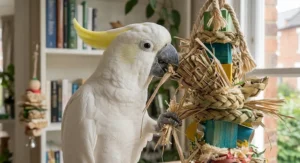
If your cockatoo treats every toy as a personal challenge to be defeated within the hour, the Spiked Piñata in its extra-large size is built with exactly that bird in mind. Hand-woven from natural palm leaf with layers of colourful streamers and internal fronds to dig out, it’s designed from the ground up to be pulled apart rather than merely chewed on, which makes it one of the most convincing natural destruction outlets on this list. What the spec sheet won’t tell you, but aggregated owner reports consistently do, is that lifespan varies enormously by bird — some owners report a medium-sized piñata lasting six months of steady chewing before looking rough, while others describe a large-format version reduced to fragments within a single determined week.
That range isn’t inconsistency in the product; it’s a genuine reflection of how differently individual cockatoos approach destruction. One particularly striking piece of aggregated feedback came from an owner using the toy as part of a broader feather-plucking management plan for their sulphur-crested cockatoo, describing hours of engaged pulling and picking at the internal layers — a good illustration of how a well-designed shredder can double as a redirection tool for birds prone to over-preening, alongside proper veterinary guidance.
Pros:
- ✅ Genuinely built to be pulled apart, not just chewed
- ✅ Multiple internal layers extend engagement time
- ✅ 100% natural, hand-made materials
Cons:
- ❌ Lifespan is unpredictable and bird-dependent
- ❌ Vibrant dyes occasionally draw mixed feedback on colourfastness
Typically priced around £12-£20 for the extra-large size, the Planet Pleasures piñata is the closest thing on this list to a toy purpose-built for the phrase “destroy this, please.”
7. JW Pet Activitoy NutCase — best low-cost stretchy forager for lighter chewers
Rounding out the list is the humble NutCase — a stretchy, natural rubber pouch shaped roughly like a rugby ball, designed to be stuffed with nuts or treats and stretched apart to release them. It’s worth including here precisely because the honest aggregated review picture is mixed rather than glowing: one commonly cited piece of feedback states plainly that it wasn’t practical for a cockatoo and only lasted a few minutes, which is a useful, unvarnished data point rather than marketing spin. For a Timneh African Grey or similarly sized bird, by contrast, owners report months of steady use.
On paper this makes sense once you understand the material: natural rubber flexes and stretches rather than splintering, which is brilliant for smaller or moderate-strength beaks that enjoy the tug-of-war sensation, but it simply isn’t matched to the raw bite force of a large cockatoo determined to open it the fast way. Reviewers consistently praise the value-for-money on the smaller end of the parrot spectrum, which is exactly why this one belongs in a “budget experiment” category rather than a serious long-term destructible for bigger birds.
Pros:
- ✅ Very low price point for testing your bird’s preferences
- ✅ Natural rubber is a genuinely different texture to wood
- ✅ Ideal size and give for smaller to medium parrots
Cons:
- ❌ Large cockatoos can destroy it in minutes, not days
- ❌ Not a cost-effective choice for consistently strong chewers
At roughly £4-£7, the JW Pet NutCase is cheap enough to be a low-stakes experiment, but go in expecting a short lifespan if your cockatoo is on the stronger end of the beak-strength spectrum.
How Cockatoos Actually Destroy Toys (And Why That’s the Point)
Watch a cockatoo work through a new toy and you’ll notice it’s rarely random. There’s a method to it — testing weak points with a gentle nibble first, then committing the full weight of that beak once a seam or joint gives way. Parrots in the wild spend a huge portion of their day chewing bark, leaves and twigs, and captivity doesn’t switch that instinct off — it just removes the natural outlet unless you deliberately provide one. That’s precisely why RSPCA guidance for pet bird owners is blunt on this point: birds need to be able to chew things to destruction, and the job of a responsible owner is to redirect that energy onto their own toys rather than the furniture.
Cockatoos in particular are disproportionately good at this compared with many other parrot species, which is worth knowing before you assume a product has failed just because it didn’t last as advertised. Recent research into Goffin’s cockatoos published through the University of Vienna’s Comparative Cognition research group has documented genuinely innovative problem-solving behaviour in this species — birds working out food preparation techniques that hadn’t previously been observed in parrots at all. That same intelligence, applied to a toy rather than a snack, is exactly why a “medium/large” rated toy built with African Greys or Amazons in mind can be solved or shredded by a cockatoo in a fraction of the expected time.
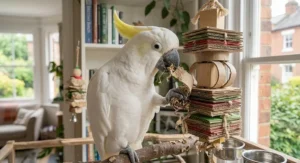
Replaceable Cockatoo Toys: Why Refill Systems Change the Maths
Buying a brand-new toy every time your bird finishes one is expensive, and it’s also slightly wasteful when half the toy — the sturdy hook, the frame, the chain — was still perfectly fine. Products like the Happy Pet Shred It and the Super Bird Creations PVC Forager solve this by splitting a toy into a durable “chassis” and a consumable “fuel” that gets replaced on its own, usually for a fraction of the price of the whole unit.
The practical upshot for a cockatoo household, where destruction happens fast and often, is a meaningfully lower cost per week of enrichment even though the headline price of the toy itself might look similar to a one-shot alternative. It’s worth building a small rotation of two or three refillable bases specifically so you’re never caught without a spare while a refill is on order — a genuinely empty cage, even for a day, tends to be when the RSPCA’s warnings about boredom-driven behaviour start to bite.
Cheap Destructible Parrot Toys: Getting Real Value Without the Guilt
There’s a particular flavour of guilt that comes with watching a £15 toy vanish in an afternoon, and honestly, it’s worth letting go of. A toy’s job is to be destroyed — that’s not a design failure, it’s success. The trick to feeling good about cheap destructible parrot toys isn’t finding something indestructible, it’s understanding what you’re actually paying for at each price point.
At the very budget end — the Bird Kabob, the KTCWPAW hanger, the JW Pet NutCase — you’re largely paying for raw material and basic assembly, which is exactly why these options land under £10-£15. What you sacrifice isn’t safety, it’s consistency: cheaper materials wear unevenly, and a batch of cactus wood or cotton rope can vary noticeably from one order to the next. That’s a fair trade for most owners who’d rather buy three cheap toys a month than one expensive one, particularly while you’re still working out what textures and destruction styles your individual bird actually enjoys.
Natural Destruction Outlet: Why Material Choice Matters More Than You’d Think
There’s a meaningful difference between a toy that merely survives chewing and one that’s actually designed to become a natural destruction outlet, and it comes down to what the material was doing before it became a toy. Cactus wood, palm leaf, sisal rope and untreated pine all share a property that manufactured plastics can’t fully replicate: they fracture and fray unpredictably, in a way that mimics bark, twigs and plant fibre in the wild rather than snapping cleanly along a moulded seam.
This matters because a natural material gives constant, varying feedback to a chewing bird — a slightly different resistance with every bite — which keeps the activity mentally engaging rather than repetitive. The RSPCA’s own enrichment guidance leans heavily on this idea, recommending untreated wood, natural fibre rope, pine cones and unsprayed branches as some of the best homemade and bought enrichment options precisely because they replicate what a cockatoo would encounter foraging in the wild. Of the seven products here, the Bird Kabob, the Bonka Huge Jumble and especially the Planet Pleasures Spiked Piñata lean hardest into this natural-material approach, and it shows in how consistently owners describe genuine, sustained engagement rather than a five-minute novelty.
Cost Effective Shredding Toys: Working Out the Real Cost Per Week
The sticker price on a bird toy tells you almost nothing useful on its own. What actually matters is cost per week of engagement, and that number can flip the value ranking on its head. A £20 piñata that lasts a month works out to roughly £5 a week. A £6 rubber forager that a determined cockatoo destroys in an afternoon, bought twice a week to keep up, quietly costs more over a month than the piñata did — while delivering far less enrichment time per pound spent.
| Toy | Approx. Price | Typical Lifespan | Rough Cost Per Week |
|---|---|---|---|
| Bird Kabob Standard | £4-£8 | 1-2 weeks | £3-£4 |
| Happy Pet Shred It (with refills) | ~£6-£10 toy + ~£3-£5 refill | Ongoing | £2-£3 |
| KTCWPAW Chew Toy | £10-£15 | 1-3 weeks | £4-£7 |
| Bonka Huge Jumble | £15-£22 | 2-4 weeks | £4-£6 |
| SBC PVC Forager (refillable) | £8-£14 + treats | Ongoing | £2-£4 |
| Planet Pleasures Spiked Piñata XL | £12-£20 | 1-4 weeks | £4-£8 |
| JW Pet NutCase | £4-£7 | Minutes to days (cockatoo) | Highly variable |
This table makes the refillable options look considerably smarter over a full month, which lines up with what most experienced cockatoo owners eventually discover through trial and error rather than spreadsheets. The genuinely one-shot toys aren’t bad value exactly, but they reward buying in small multiples and rotating stock rather than relying on a single toy to carry a whole week’s worth of chewing on its own.
Disposable Enrichment Cockatoos Actually Benefit From
Not every toy needs to be built to last, and there’s a specific category worth calling out on its own merits: genuinely disposable enrichment. Cardboard boxes stuffed with crumpled paper, cheap paper-roll refills, and the internal fronds of a piñata all fall into this bucket, and dismissing them as “not real toys” misses why they’re valuable. A disposable item removes any pressure around destruction speed entirely — there’s no sense of a purchase being wasted when a toy was only ever meant to last one enthusiastic session.
This category also solves a specific practical problem for cockatoo owners: novelty. Rotating in a cheap, disposable item two or three times a week costs very little and keeps the cage genuinely interesting, which matters because even the best-built durable toy becomes background furniture to an intelligent bird after enough repeated exposure. The RSPCA specifically recommends rotating toys in and out and making your own from cardboard boxes, unwanted books and paper as part of a healthy enrichment routine, which is really just a formal way of saying: don’t be precious about the disposable stuff, that’s exactly what it’s for.
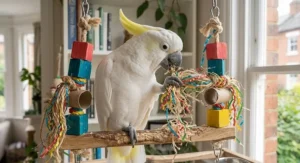
Practical Usage Guide: Introducing a New Destructible Toy Safely
Getting a new toy into the cage isn’t always as simple as hanging it up and walking away, particularly with a nervous or unfamiliar bird. Start by placing the toy somewhere near the cage, outside it, for a day or two before introducing it inside — cockatoos can be surprisingly wary of novel objects despite their reputation for fearless demolition, and rushing this step is one of the most common reasons a perfectly good toy gets ignored for weeks. Once it’s inside the cage, resist the urge to hover; birds often engage more confidently with a new object when their owner isn’t staring at them expectantly.
In the first month of ownership, keep a light rotation going rather than cramming the cage with everything at once — two to three toys at a time is a sensible RSPCA-aligned guideline, swapped out every week or so to keep things fresh without overwhelming the space. Watch for early signs a toy isn’t suited to your bird: if a cockatoo shows no interest after several genuine attempts across a couple of weeks, it’s more efficient to swap textures entirely than to keep offering variations on the same theme. For maintenance, inspect hanging hardware regularly on refillable or reusable toys like the Happy Pet Shred It and the SBC Forager, since metal clasps and hooks take repeated stress even after the destructible components have been swapped out several times.
Common Mistakes When Buying Destructible Toys for Cockatoos
The single most frequent mistake is buying a toy sized and rated for a smaller parrot species and expecting cockatoo-level durability from it — as the JW Pet NutCase example shows clearly, a toy built for a conure or a small Amazon can be solved by a cockatoo in minutes rather than days, and that’s not a manufacturing fault, it’s a sizing mismatch. A second common error is treating a toy’s destruction as a sign something went wrong; as covered earlier, rapid destruction is frequently the toy working exactly as intended, particularly for natural-material shredders.
A third mistake worth flagging is over-cluttering the cage in an attempt to prevent boredom. More toys doesn’t automatically mean more enrichment — a cage crowded with objects can actually reduce a cockatoo’s confidence to move and fly within it, which runs against the RSPCA’s own guidance on keeping cages appropriately uncluttered. Finally, many owners underestimate how much cheaper refillable systems become over time compared with buying single-use toys repeatedly, simply because the maths only becomes obvious after a few months of receipts.
What to Expect: Real-World Destruction Timelines
Numbers help set realistic expectations, so here’s roughly what aggregated owner experience suggests across this list, allowing for the fact that individual birds vary enormously. Budget natural chews like the Bird Kabob and mid-range wood-and-rope hangers like the KTCWPAW toy typically survive somewhere between a few days and two to three weeks with a moderately strong chewer, with genuinely powerful cockatoo beaks pushing toward the shorter end of that range. Woven natural shredders like the Planet Pleasures piñata show the widest spread of all, from under a week for the most determined destroyers to several months for gentler or more distractible birds.
Refillable systems behave differently because the “destruction” and “toy lifespan” clocks are separate — the Happy Pet Shred It’s paper insert might vanish within a single session for a determined bird, while the acrylic housing itself can realistically last years with occasional refills. The honest takeaway across all seven products: if your cockatoo demolishes something faster than the packaging suggested, that’s very likely a reflection of a strong, healthy, engaged bird rather than a toy that let you down.
Real-World Scenarios: Matching the Toy to Your Bird
The seasoned demolition expert: A confident, older cockatoo who’s seen it all and treats every new object as a personal challenge. This bird needs volume and variety over raw toughness — rotate the Bonka Huge Jumble, the Planet Pleasures Spiked Piñata and a couple of cheap Bird Kabobs so there’s always fresh material on hand, since nothing this bird meets survives long regardless of price.
The budget-conscious multi-bird household: Several cockatoos or a mixed flock where toy spend adds up fast across the month. Lean hard into refillable systems here — the Happy Pet Shred It and SBC PVC Forager, bought in twos or threes with a stock of cheap refills, keep the ongoing cost manageable compared with restocking single-use toys for every bird individually.
The nervous or recently rehomed cockatoo: A bird still building confidence, possibly with a history of stress or under-stimulation. Start gentle and predictable — the JW Pet NutCase or a soft Bird Kabob gives an approachable entry point, introduced slowly outside the cage first, before working up to tougher natural shredders once the bird is reliably engaging rather than avoiding new objects.
Problem → Solution Guide
Problem: My cockatoo destroys every toy within a day. Solution: this is very likely normal for the species rather than a product failure — lean into cheap, natural, high-volume options like the Bird Kabob or rotate in disposable cardboard between purchases rather than chasing an “indestructible” toy that doesn’t really exist for this bird.
Problem: My bird completely ignores new toys. Solution: introduce anything new outside the cage first for a day or two before hanging it inside, and try switching material entirely — a bird bored of wood might light up for natural palm fibre or rubber instead.
Problem: I’m spending far too much replacing toys constantly. Solution: switch at least part of your rotation to refillable systems like the Happy Pet Shred It or SBC PVC Forager, where only the consumable insert needs replacing rather than the whole unit.
Problem: My cockatoo solved a “puzzle” toy almost instantly. Solution: that’s a genuine sign of the species’ intelligence rather than a faulty toy — as the research into Goffin’s cockatoos shows, this species is a remarkably fast problem-solver, so size up to genuinely large-format or natural-material toys rather than smaller puzzle-style products built with less inventive species in mind.
Problem: I’m worried destructive chewing means something’s wrong. Solution: destructive chewing is a normal, healthy instinct that needs an outlet rather than suppression — the concern only arises if a bird has no appropriate toys to redirect that instinct onto, which is exactly the gap this whole category exists to fill.
Buyer’s Decision Framework
If your cockatoo is a fast, confident destroyer, prioritise volume and cost-per-week over any single toy’s individual toughness, since nothing on this list will meaningfully outlast a determined bird for long. If your household budget is the main constraint, build your rotation around refillable systems first and treat single-use natural toys as an occasional top-up rather than the core of your spending. If your bird is nervous, young, or newly rehomed, start with gentler, more approachable materials and slower introductions before investing in the toughest natural shredders. And if you’re simply not sure yet what your particular bird enjoys destroying, the cheapest possible approach — a Bird Kabob here, a JW Pet NutCase there — genuinely is the smart first move, since a few pounds spent on experimentation beats a single expensive guess.
Safety Guide for Destructible Cockatoo Toys
Destructible doesn’t mean unsafe, but it does mean paying closer attention than you would with a purely decorative toy. Always supervise a bird with any new toy for the first few sessions, watching specifically for small parts working loose — metal clasps, bells, or plastic components that could present a choking risk once separated from the main structure. The RSPCA’s guidance on pet bird enrichment is clear that toys should always be made from non-toxic materials and paints, and that’s especially relevant for destructible toys, since chewed and swallowed fragments are inherently more likely with this category than with toys designed to be looked at rather than eaten through.
Inspect reusable hardware — hooks, chains, clasps — regularly for wear, since these components see repeated stress across multiple toy refills and are exactly the kind of detail that’s easy to overlook once you’re focused on the destructible material itself. If a toy’s paint or dye ever seems to be transferring onto your bird’s feathers or beak in unusual amounts, stop using it and check with an avian vet, even though the vast majority of dyed natural-fibre toys use bird-safe, food-grade colourants as standard.
Features That Actually Matter (And Those That Don’t)
Cutting through the marketing noise, a handful of features genuinely predict how well a destructible toy performs: material variety (multiple textures generally means longer engagement than a single repeated surface), attachment quality (a weak hook undermines even the best toy body), and whether the design allows for refilling or restocking rather than total replacement. Natural materials consistently earn their reputation here too — the unpredictable way wood, palm leaf and rope fracture genuinely does seem to hold attention longer than uniform plastic.
Features that matter far less than their listings suggest include exact size measurements taken in isolation (a toy’s real capacity depends heavily on how densely it’s constructed, not just its length) and bright, elaborate colour schemes, which have no real bearing on how satisfying a toy is to destroy despite being the most heavily marketed visual detail on most listings. Bells and jingling add-ons are a pleasant bonus for some birds but aren’t a meaningful predictor of engagement with the destructible portion of a toy.
Frequently Asked Questions
❓ Why does my cockatoo destroy toys so quickly?
❓ What's the cheapest destructible toy for a cockatoo?
❓ Are refillable bird toys actually cheaper long term?
❓ Is it bad if my cockatoo destroys a toy in one day?
❓ How many toys should a cockatoo have in their cage at once?
Conclusion
Choosing destructible toys for cockatoos really comes down to accepting a slightly unusual mindset shift: the “best” toy isn’t the one that survives the longest, it’s the one your bird genuinely enjoys taking apart. Budget natural chews like the Bird Kabob and KTCWPAW hanger are brilliant for experimentation and won’t sting your wallet when they vanish in a week. Refillable systems like the Happy Pet Shred It and Super Bird Creations PVC Forager quietly solve the long-term cost problem that catches so many owners off guard. And for the serious, dedicated destroyers among the cockatoo world, the Planet Pleasures piñata and Bonka jumble give a genuinely satisfying, natural outlet for an instinct that isn’t going anywhere.
Whatever you land on, the underlying principle holds: a bird with something appropriate to destroy is a bird who’s far less likely to redirect that energy toward your furniture, your skirting boards, or the arm of your favourite chair. Rotate often, lean on refillable options where the budget matters, and don’t mourn a toy that only lasted a day — that, more often than not, is exactly what it was built for.
Recommended for You
- 7 Best Toys for Amazon Parrots in 2026: Durable Picks Reviewed
- Intelligent Toys for African Grey: 7 Best Brain-Boosting Picks UK 2026
- Best Toys for African Grey Parrots UK 2026: 7 Expert-Tested Picks
Disclaimer: This article contains affiliate links. As an Amazon Associate, I earn from qualifying purchases. If you purchase products through these links, we may earn a small commission at no additional cost to you.
✨ Found this helpful? Share it with your friends! 💬🤗
