
In This Article
If you’ve noticed your cockatiel pacing restlessly or plucking at its feathers, the issue might not be temperament—it’s boredom. Wild cockatiels spend up to 70% of their waking hours foraging for seeds, nuts, and vegetation across the Australian outback, manipulating their environment and problem-solving to survive. Your domesticated companion, however, polishes off their daily ration in roughly 20 minutes from a stationary bowl. That’s a staggering mental and physical void that food hiding toys for cockatiels are specifically designed to fill.
These aren’t mere playthings—they’re essential enrichment tools that replicate natural ground-feeding behaviours, challenge your bird’s intelligence, and prevent the destructive patterns that emerge from understimulation. From foraging balls with adjustable difficulty levels to shreddable puzzle boxes, the right food hiding toys transform mealtime from a mundane task into an engaging treasure hunt. What most UK bird owners overlook, though, is that not all foraging toys suit cockatiels’ unique beak strength, size constraints, and problem-solving preferences. A toy designed for African Greys will frustrate a cockatiel; one meant for budgies won’t provide enough challenge.
In this guide, we’ll examine seven tried-and-tested treat hiding bird toys available on Amazon.co.uk, compare foraging toys cockatiel size requirements, and show you how to match foraging challenge levels to your bird’s experience. Whether you’re addressing anxiety issues in a rescue bird or simply want to enrich your feathered companion’s daily routine, you’ll find concrete recommendations backed by both avian behaviour research and real-world UK customer feedback.
Quick Comparison: Top Food Hiding Toys for Cockatiels
| Toy Type | Difficulty Level | Price Range (£) | Best For | Durability |
|---|---|---|---|---|
| Foraging Ball Set | Beginner | £8-£12 | First-time foragers | Medium (3-6 months) |
| Rotating Wheel Feeder | Intermediate | £14-£18 | Active problem-solvers | High (6-12 months) |
| Seagrass Foraging Wall | Beginner-Intermediate | £10-£15 | Shredding enthusiasts | Low (1-3 months) |
| Acrylic Puzzle Box | Advanced | £16-£22 | Experienced foragers | Very High (12+ months) |
| Natural Woven Basket | Beginner | £6-£10 | Gentle chewers | Medium (4-6 months) |
| Hanging Sneaker Toy | Beginner | £7-£11 | Curious explorers | Medium (2-5 months) |
| Stainless Steel Skewers | All Levels | £9-£13 | Fresh food presentation | Very High (years) |
From the table above, it’s clear that pricing doesn’t always correlate with difficulty level—the acrylic puzzle box commands a premium for its durability and reusability, whilst natural options like seagrass walls offer better value per entertainment hour despite shorter lifespans. What’s particularly interesting for UK buyers is that metal construction (like the skewers) offers superior longevity in our damp climate; woven materials can harbour mould if not rotated regularly, especially during the six months of drizzle most of us endure.
If you’re new to foraging toys, start with the ball set or natural basket—they’re forgiving enough that your cockatiel won’t abandon them in frustration, yet engaging enough to spark curiosity. Experienced foragers who’ve mastered simpler toys will appreciate the rotating wheel’s mechanical challenge or the puzzle box’s multi-step problem-solving requirements. The key insight: match difficulty to current skill level, then gradually increase complexity as your bird masters each stage.
💬 Just one click — help others make better buying decisions too!😊
Top 7 Food Hiding Toys for Cockatiels: Expert Analysis
1. ERKOON Budgie Foraging Wall with Seagrass
This colourful foraging wall combines natural seagrass mat construction with multiple hanging toys—bamboo finger traps, crinkly paper, rattan stars, wooden blocks, and acrylic charms. The design encourages both vertical climbing and horizontal shredding, making it ideal for cockatiels who enjoy manipulating different textures.
At around £10-£15 on Amazon.co.uk, this represents solid value for the sheer variety of foraging opportunities packed into one unit. The 30cm height fits standard cockatiel cages without monopolising space, and the dual plastic hooks make installation straightforward. What UK customers particularly appreciate is how the seagrass withstands enthusiastic beaks better than paper-based alternatives—though in our experience, expect 1-3 months of active use before you’ll need a replacement, which is typical for natural-fibre toys.
The real strength here is versatility. Hide millet sprays behind the seagrass mat, stuff pellets into the bamboo traps, or wedge vegetable pieces between the rattan stars—your cockatiel faces a different puzzle each time. This prevents the toy fatigue that occurs when birds memorise a single foraging pattern. One caution: UK customers with particularly destructive birds report the acrylic attachments occasionally detaching; if your cockatiel’s a determined chewer, inspect the toy weekly and remove any loose parts.
Pros:
✅ Multiple textures engage different foraging instincts
✅ Natural materials satisfy chewing urges safely
✅ Compact footprint suits typical UK cage sizes
Cons:
❌ Shorter lifespan than synthetic alternatives
❌ Some attachments may require re-securing
Customer Feedback: UK buyers consistently mention this toy’s ability to occupy anxious birds for extended periods. Several reviewers note it helped reduce screaming in newly adopted rescue cockatiels—the focused foraging activity seems to have a genuinely calming effect.
Verdict: Best for cockatiels who love shredding and need a variety of foraging challenges in one space-efficient package. The £10-£15 price point makes it risk-free for UK owners testing whether their bird enjoys natural-fibre toys.
2. Bird Creative Foraging Wheel Feeder
This transparent polycarbonate wheel features six compartments that spin when the bird manipulates it, revealing treats through small openings. The rotating mechanism adds a mechanical puzzle element that static foraging toys can’t match—your cockatiel must learn to align the compartment with the access point through trial and error.
Pricing sits in the £14-£18 range on Amazon.co.uk, which reflects the durable construction and intermediate difficulty level. The clear material lets you monitor treat levels without disassembly, and the wheel’s 15cm diameter accommodates everything from pellets to chopped vegetables. What makes this particularly suitable for UK homes is the enclosed design—no scattered food debris ending up on your carpet or getting kicked under furniture, which is rather handy in our typically compact living spaces.
The learning curve here is real. Expect your cockatiel to ignore this for the first few days whilst figuring out the rotation mechanic. Once they grasp it, though, the wheel becomes a daily obsession. UK customers report their birds spend 20-40 minutes per session actively working the wheel, which is exactly the extended foraging duration you’re aiming for. The polycarbonate construction survives both beak attacks and our humid British climate without degrading—one reviewer mentioned theirs lasting 18 months of daily use.
Pros:
✅ Mechanical challenge prevents quick mastery
✅ Enclosed design minimises mess
✅ Dishwasher-safe for easy UK household cleaning
Cons:
❌ Steeper learning curve may frustrate beginners
❌ Larger footprint than hanging toys
Customer Feedback: Several UK owners mention this transformed their cockatiel’s cage time from passive sitting to active problem-solving. The audible clicking as the wheel rotates seems to provide additional satisfaction.
Verdict: Ideal for cockatiels who’ve mastered basic foraging and need progression to intermediate challenges. The £14-£18 investment pays off through longevity and sustained engagement—works out to mere pence per entertainment hour over its lifetime.
3. Psiriol 6-Piece Foraging Ball Set
Six colourful hollow balls with internal bells and openable compartments designed for treat hiding. Each ball features different access mechanisms—some with wide openings for easy retrieval, others with narrow slits requiring dexterity—creating a graduated difficulty system within one purchase.
At £8-£12 on Amazon.co.uk, this represents exceptional value for UK buyers wanting to introduce foraging. The 3.8cm diameter suits cockatiel foot size perfectly—small enough to manipulate but not so tiny they’re swallowed. The internal bells add auditory feedback that seems to motivate continued interaction; UK customers consistently mention how the jingling draws their birds back to the toys throughout the day.
What’s clever about this set is how it accommodates mixed skill levels. Use the wide-opening balls for nervous beginners, then graduate to the challenge balls as confidence builds. Hide different treats in each—millet in one, pellets in another, dried fruit in a third—and your cockatiel must learn which ball contains their preferred reward. Several UK reviewers mention using these during work hours to prevent separation anxiety, reporting noticeably calmer birds upon returning home.
Pros:
✅ Six toys provide variety and backup rotation
✅ Graduated difficulty suits beginner to intermediate birds
✅ Compact storage between use sessions
Cons:
❌ Plastic construction may not satisfy aggressive chewers
❌ Some balls easier than others—bird may ignore difficult ones
Customer Feedback: UK owners appreciate how lightweight these are—easy to hang from any cage position without requiring heavy-duty hardware. The bright colours seem to attract curious cockatiels more readily than neutral-toned alternatives.
Verdict: Perfect starter set for UK owners unsure whether their cockatiel will engage with treat hiding bird toys. The low price point (around £1.50 per ball) removes financial barrier to experimentation.
4. Foraging Treasure Chest with Refillable Cups
An acrylic box with multiple removable cups and a hinged lid, allowing you to create complex layered foraging challenges. The transparent construction lets you observe your cockatiel’s problem-solving approach whilst they work to access treats hidden inside the cups.
Expect to pay £16-£22 on Amazon.co.uk for this premium option. The higher price reflects the multi-layered complexity and extreme durability—the acrylic withstands even determined beaks for years of daily use. What UK customers find particularly valuable is the modular design: start with all cups easily accessible, then progressively hide them under shredded paper, wood pieces, or other safe materials as your bird’s skills advance.
This toy genuinely replicates the effort wild cockatiels invest in ground foraging. They must dig, lift, manipulate, and remember which cup contained their preferred reward—mental exercise that noticeably reduces destructive behaviours like excessive screaming or furniture chewing during out-of-cage time. Several UK reviewers mention their avian vet recommended this specific design for birds displaying anxiety-related feather plucking.
Pros:
✅ Adjustable difficulty grows with bird’s abilities
✅ Extreme durability justifies higher UK price
✅ Easy cleaning maintains hygiene standards
Cons:
❌ Requires active participation from owner to reset
❌ Too challenging for complete foraging novices
Customer Feedback: UK owners report this became their cockatiel’s preferred activity, often choosing foraging over traditional play toys. The ability to swap out filler materials keeps the challenge fresh.
Verdict: Best investment for experienced foragers or UK owners committed to providing advanced enrichment. The £16-£22 cost averages to remarkable value when amortised over years of use.
5. Natural Woven Willow Basket with Lid
A human-grade foraging container made from woven willow with a removable lid, designed to hold a mix of treats, wood pieces, and shredding materials. The natural texture satisfies preening instincts whilst the lifting mechanism provides a simple foraging challenge.
Available for £6-£10 on Amazon.co.uk, this offers the most affordable entry into natural-material foraging. The 10cm diameter fits perfectly in cockatiel cages without overwhelming smaller spaces—rather important in typical UK flats and terraced houses where every centimetre of cage real estate matters. UK customers appreciate how the willow provides safe chewing satisfaction; unlike synthetic toys, your cockatiel can destroy this guilt-free.
The beauty of baskets is their versatility. Fill with shredded paper and hide millet, or layer pellets between willow leaves torn from old toys. Some UK owners report stuffing these with fresh herbs (parsley, coriander, basil) for a fragrant foraging experience their cockatiels adore. The downside? Expect 4-6 months of use before the basket’s too demolished to function—but at under £10, that’s acceptable cost-per-entertainment-hour.
Pros:
✅ Natural material safe for destructive chewing
✅ Lightweight design hangs from any cage position
✅ Budget-friendly for UK trial purposes
Cons:
❌ Shorter lifespan requires regular replacement
❌ Can harbour moisture in damp UK climate—rotate frequently
Customer Feedback: UK buyers mention how quietly this toy operates compared to metal options—valuable in shared living spaces or flats with thin walls. The gradual destruction seems to provide satisfaction beyond just the foraging aspect.
Verdict: Ideal for gentle foragers who enjoy shredding and UK budgets prioritising affordability over longevity. Consider buying two for rotation whilst one dries after cleaning.
6. Hanging Sneaker Foraging Toy
A fabric sneaker with laces adorned with colourful plastic shapes, designed to hide treats inside the shoe body. The crinkle material provides auditory feedback, whilst the laces offer climbing opportunities and the shoe interior creates a cave-like hiding spot.
Pricing around £7-£11 on Amazon.co.uk makes this an affordable curiosity-driver. The 15cm length suits small-to-medium birds perfectly, and critically for UK safety standards, this version contains no metal grommets that could injure beaks or tongues. UK customers report the sneaker shape itself intrigues cockatiels—the novelty factor seems to overcome initial wariness faster than traditional foraging designs.
What makes this effective is combining multiple foraging techniques in one toy. Hide millet in the toe, stuff pellets in the heel, thread vegetable pieces through the laces—your cockatiel must explore every angle to claim all rewards. Several UK reviewers mention using this as a “special occasion” toy, bringing it out weekly rather than leaving it permanently available, which maintains the novelty factor.
Pros:
✅ Unique design sparks curiosity effectively
✅ Multiple hiding spots in compact package
✅ Soft construction won’t damage cage bars
Cons:
❌ Fabric can absorb moisture—check for mould in UK climate
❌ Some cockatiels intimidated by unusual shape initially
Customer Feedback: UK owners appreciate how this travels well—several mention packing it for bird-boarding or holiday cages. The lightweight construction makes it suitable for weaker cage clips.
Verdict: Best for cockatiels who’ve mastered basic foraging and UK owners seeking novelty to reignite interest. The £7-£11 price point makes it low-risk experimentation.
7. Stainless Steel Fruit and Vegetable Skewers (12-Pack)
Metal kabob-style holders that attach to cage bars, designed to present fresh foods as foraging challenges. The skewers allow you to create vertical food arrangements that cockatiels must manipulate to access each piece.
At £9-£13 for a 12-pack on Amazon.co.uk, these offer extraordinary value and virtually infinite lifespan. Stainless steel construction resists both corrosion from wet foods and damage from determined beaks—particularly valuable in our damp British climate where metal toys often succumb to rust. UK customers report using the same set for years without degradation.
Whilst not puzzle toys in the traditional sense, skewers transform fresh food presentation into a foraging activity. Thread broccoli, carrot, pepper, and apple pieces in varying orders, forcing your cockatiel to work through less-preferred items to reach favourites. This encourages dietary variety whilst providing the mental engagement of problem-solving. Several UK vets recommend these for birds reluctant to try new foods—the presentation novelty often overcomes neophobia.
Pros:
✅ Exceptional durability justifies UK investment
✅ Encourages fresh food consumption
✅ Easy cleaning maintains hygiene between uses
Cons:
❌ Requires daily fresh food preparation effort
❌ Less challenging than enclosed foraging toys
Customer Feedback: UK buyers mention how these transformed picky eaters into adventurous foragers. The vertical presentation seems more engaging than bowl feeding for many cockatiels.
Verdict: Essential supplement to any food hiding toys for cockatiels collection. The £9-£13 cost for 12 units (under £1 each) makes this the UK market’s best value-per-use ratio.
Understanding Foraging Challenge Levels: Matching Toys to Your Cockatiel’s Ability
One of the most common mistakes UK bird owners make is purchasing advanced foraging toys for complete beginners—or conversely, boring experienced foragers with overly simple designs. Your cockatiel’s frustration tolerance and problem-solving confidence determine which toys will engage versus overwhelm them.
Beginner Level (New to Foraging)
Birds at this stage need immediate success to build confidence. Choose toys where treats remain partially visible and require minimal manipulation to access. The woven basket, ball set (using wide-opening balls only), and sneaker toy all suit beginners because rewards come quickly—within 30-60 seconds of investigation. This creates positive associations with foraging behaviour.
UK owners introducing foraging to older birds should expect a learning period. Your cockatiel may ignore new toys for 2-3 days whilst assessing whether they’re safe. Place the toy near familiar perches, demonstrate interaction yourself (birds learn through observation), and use high-value rewards initially—millet for most cockatiels—to create motivation.
Intermediate Level (Some Foraging Experience)
Once your bird consistently engages with beginner toys and empties them within 5-10 minutes, progression time has arrived. Intermediate toys introduce mechanical elements (the rotating wheel), multiple steps (seagrass wall requiring digging through layers), or problem-solving (identifying which ball contains treats). These extend foraging sessions to 20-40 minutes, which better approximates wild time investment.
A key indicator your cockatiel’s ready for intermediate challenges: they begin exploring toys even after treats are exhausted, suggesting enjoyment of the puzzle itself rather than just the food reward. This intrinsic motivation signals readiness for complexity.
Advanced Level (Experienced Foragers)
The acrylic treasure chest represents advanced difficulty—multiple cups to investigate, lids to lift, filler material to dig through before accessing rewards. These toys can occupy experienced foragers for an hour or more per session. UK owners report advanced foragers often prefer challenging toys to simple ones, actively ignoring beginner options in favour of complex problem-solving.
One crucial point UK avian behaviourists emphasise: never jump difficulty levels. Graduating from beginner to intermediate to advanced prevents the frustration-induced toy abandonment that occurs when birds face insurmountable challenges. If your cockatiel ignores a new toy for more than 3-4 days, it’s likely too difficult—step back to an easier version and build confidence before trying again.
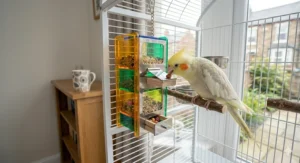
How to Choose Food Hiding Toys for Cockatiels: UK Buyer’s Framework
Size Considerations for Cockatiel Beaks and Feet
Cockatiels possess medium-strength beaks and relatively small feet compared to larger parrots, which dictates appropriate toy sizing. According to The Parrot Society UK, these adaptable birds have been successfully kept in Britain for many years, with their domesticated breeding producing hardier individuals suited to captive enrichment activities. Foraging openings between 2-4cm work well—large enough that treats fit comfortably but small enough that retrieval requires dexterity. UK products often list dimensions in inches rather than centimetres; a useful conversion: 1.5-2 inches equals ideal cockatiel sizing.
Avoid toys designed for macaws or African Greys, which feature heavy acrylic and wide spacing unsuitable for cockatiel manipulation. Conversely, toys marketed for budgies or finches may prove too fragile or simple. The sweet spot sits in the parakeet-to-conure size range, which aligns perfectly with cockatiel dimensions.
Material Safety in the UK Climate
Our persistently damp weather creates unique challenges for natural-fibre toys. Seagrass, willow, and paper-based foraging toys can develop mould if they absorb moisture, particularly problematic in unheated spare rooms where many UK owners position cages. Rotate natural toys weekly, allowing each to dry thoroughly before reuse. Inspect regularly for fuzzy growth or musty odours—both indicators of mould contamination that poses respiratory risks.
Stainless steel and acrylic options resist UK humidity beautifully. These materials justify higher upfront costs through their multi-year lifespans and zero mould risk. If your home tends toward dampness (a common affliction in Victorian terraces and older flats), prioritising synthetic materials over natural ones reduces health hazards.
Noise Levels for Shared Spaces
Flats, semi-detached houses, and terraced properties—typical UK housing stock—mean your neighbours might hear your cockatiel’s foraging activities. Metal toys that clang against cage bars, bells inside foraging balls, and rotating wheels create varying noise levels. UK customers in shared-wall situations often mention choosing quieter options like fabric sneakers or willow baskets to maintain peace with neighbours.
If noise concerns apply, test new toys during daytime hours before committing to permanent cage placement. Some UK owners report strategic toy selection based on their work-from-home schedules—quieter toys during Zoom calls, noisier options when the house is empty.
Budget Planning for UK Households
Quality foraging toys range from £6 to £22 on Amazon.co.uk, and cockatiels benefit from rotating selection rather than permanent fixture. A sensible UK budget allocates £25-£40 initially for 4-5 toys spanning difficulty levels, then £10-£15 monthly for replacements and new additions. This ensures constant novelty without financial strain.
Consider natural toys as consumables with 1-6 month lifespans, whilst synthetic options represent semi-permanent investments lasting 12+ months. UK owners on tighter budgets might prioritise one premium acrylic toy (£16-£22) supplemented by rotating natural options (£6-£10 each), balancing longevity with variety.
Creating the Perfect Foraging Setup: A UK Case Study
Meet Sarah from Manchester—a cockatiel owner who transformed her rescue bird Pip’s anxiety-driven screaming through strategic foraging implementation. When Pip arrived, he spent 6-8 hours daily in a standard cage with one perch, two bowls, and zero mental stimulation. Screaming episodes occurred hourly, particularly when Sarah left for work.
Sarah’s approach combined multiple food hiding toys for cockatiels with timed rotation:
Week 1-2: Introduction phase using the woven willow basket filled with Pip’s favourite millet. Sarah placed it near his preferred perch and demonstrated digging behaviour herself. By day 4, Pip began investigating; by day 7, he’d learned to lift the lid.
Week 3-4: Added the foraging ball set, using only the three easiest balls initially. Pip mastered these within 10 days. Sarah noticed screaming reduced to 2-3 episodes daily—a significant improvement.
Week 5-6: Introduced the rotating wheel feeder with familiar pellets. This proved challenging; Pip ignored it for 5 days. Sarah moved it to Pip’s favourite corner and reduced food in his bowl slightly (ensuring adequate nutrition whilst increasing foraging motivation). Breakthrough arrived day 6 when Pip accidentally rotated the wheel whilst climbing, discovered a treat, and made the connection.
Week 7+: Established a rotation system—three toys available simultaneously, swapped weekly from a collection of seven. By month three, Pip’s screaming had dropped to 0-1 episodes daily, occurring only during genuine distress (like unexpected loud noises). His feather condition improved noticeably from the reduced stress.
Sarah’s key insight? “I’d been treating foraging toys like optional extras rather than essential mental health tools. Once I approached them with the same seriousness as diet and vet care, Pip’s quality of life transformed. The £80 I’ve spent on toys over six months has saved easily £200+ in potential vet bills for stress-related issues.”
This case illustrates how UK owners can systematically build foraging programmes matched to individual bird needs, gradually increasing complexity whilst monitoring behavioural changes.
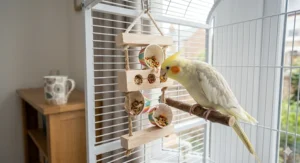
Common Mistakes When Buying Foraging Toys for Cockatiels
Purchasing Without Size Verification
Amazon.co.uk listings often feature birds of various sizes using the same toy, creating confusion about appropriate dimensions. The RSPCA’s bird housing guidelines emphasise providing environments where birds can safely express natural behaviours—including foraging—which requires properly sized enrichment tools matched to species dimensions. A toy showcased with a macaw might technically fit a cockatiel cage but prove too large for comfortable manipulation. Always check stated dimensions (not just the promotional photos) and cross-reference with your cockatiel’s beak and foot size.
UK customers frequently mention receiving toys larger than expected because they relied on images rather than measurements. Remember: our cockatiel companions stand roughly 30-33cm tall; toys approaching half that size will overwhelm them rather than engage them.
Ignoring UKCA Certification for Imported Toys
Post-Brexit regulations require UKCA marking on many products, though enforcement varies. Whilst bird toys aren’t currently subject to strict UKCA requirements, purchasing from sellers explicitly stating UK compliance offers peace of mind regarding materials safety. Several UK customers report cheaper alternatives from non-UK sellers containing toxic dyes or heavy metals—laboratory testing revealed lead in some budget options.
Stick with Amazon.co.uk sellers who’ve established UK presence and clearly state materials safety. Yes, you’ll pay £2-£5 more than direct imports, but you’re buying confidence your cockatiel won’t ingest harmful substances.
Buying Too Many Advanced Toys Too Quickly
Enthusiastic new owners often purchase an entire collection of complex foraging toys simultaneously, overwhelming birds who’ve never encountered such enrichment. UK behaviourists recommend the “rule of three”—introduce maximum three new toys per fortnight, starting with one beginner, one beginner-intermediate, and one wildcard option to gauge preference.
This gradual approach prevents the toy-ignoring behaviour that occurs when birds face too much novelty simultaneously. It also lets you identify which toy types your specific cockatiel prefers (some favour mechanical challenges, others prefer shredding, some love both) before investing heavily in similar designs.
Neglecting British Weather Impact on Materials
Those lovely natural vine toys from Amazon? Marvellous in dry climates, potential mould factories in Manchester’s drizzle or Edinburgh’s mist. UK owners must account for our 150+ annual rainfall days when selecting materials. Natural options absolutely have their place—the satisfaction cockatiels derive from destroying willow or seagrass is genuine—but require more vigilant rotation and inspection than synthetic alternatives.
Consider your home’s specific humidity levels. Newer builds with mechanical ventilation handle moisture better than Victorian conversions with single-pane windows. Match toy materials to your environment’s moisture reality, not idealised conditions.
Practical Foraging Implementation Guide for UK Homes
Starting Fresh: First Foraging Toys for Nervous Birds
UK rescue organisations report many cockatiels arrive from situations offering zero enrichment. These birds often display neophobia—fear of new objects—requiring patient introduction to foraging concepts. Begin with semi-visible rewards: place millet spray next to a simple toy (like the woven basket) rather than inside it. Let your bird associate the toy with positive rewards through proximity before requiring interaction.
After 2-3 days, position millet partially hidden—half visible, half concealed. Most cockatiels’ curiosity will overcome caution within 24-48 hours. Only when your bird confidently investigates the toy should you progress to fully hidden treats. This scaffolding approach prevents the learned helplessness that emerges when birds repeatedly fail at tasks beyond their current capacity.
Daily Routine Integration
UK working professionals often ask how to maintain foraging enrichment given their away-from-home schedules. The solution: morning preparation becomes part of your routine, like making tea or checking emails. Whilst your kettle boils, stuff three foraging toys with varied treats—5 minutes of effort yields 2-3 hours of your cockatiel’s engaged time.
Several UK owners mention preparing toys the evening prior, storing them in sealed containers to maintain freshness, then simply hanging them before departure. This advance prep eliminates morning rush stress whilst ensuring your bird’s enrichment needs are met throughout your work day.
Seasonal Adjustments for UK Climate
British seasons dramatically affect both your cockatiel’s energy levels and appropriate toy selection. During our dark winters (November-February), when daylight stretches barely 7-8 hours, cockatiels often display reduced activity. This isn’t laziness—it’s biological adaptation to photoperiod. Winter foraging setups should offer easier access to high-energy foods, compensating for their decreased foraging motivation.
Conversely, summer’s extended daylight (16+ hours in Scotland, 14+ in England) creates natural activity peaks. This seasonal window suits introducing challenging new toys or rotating in more complex options—your bird’s elevated energy levels translate to greater frustration tolerance and problem-solving stamina.
UK centrally heated homes create another consideration: dry winter air versus humid summer conditions. Natural-fibre toys degrade faster in humid months; synthetic options maintain consistency year-round. Several experienced UK owners report doubling their natural toy replacement budget for June-September versus October-May.
Space Optimisation for Compact UK Cages
The average UK cockatiel cage (60-75cm width) offers less space than American or Australian equivalents, where larger homes accommodate oversized enclosures. This necessitates vertical thinking—literally. Hanging toys from the cage top maximises floor space for perches and bowls, whilst clippable toys attach to side bars without obstructing movement paths.
UK owners of smaller cages (the legal minimum) should prioritise multi-function toys like the seagrass wall, which combines climbing, foraging, and chewing in one compact unit. Avoid the temptation to cram multiple large toys into limited space—this creates cluttered environments that stress birds rather than enrich them. Better to rotate three well-chosen toys weekly than permanently display seven that limit your cockatiel’s movement.
Advanced Foraging Techniques: Elevating Your UK Setup
Creating Foraging Stations Around Your Home
For cockatiels who enjoy supervised out-of-cage time, UK owners can establish multiple foraging zones throughout bird-safe rooms. Place a natural basket on the mantelpiece, hang a foraging ball from a floor lamp, position skewers with fresh veg on a designated perch—your bird navigates between stations, extending activity duration beyond cage boundaries.
This approach particularly suits UK weekends when you’re home for extended periods. Several owners report their cockatiels spend 3-4 hours actively moving between foraging stations, interspersed with perching and preening—a near-perfect replication of wild activity patterns. The mental mapping required to remember multiple food locations adds cognitive complexity beyond simple puzzle-solving.
Difficulty Progression Systems
Once your cockatiel masters basic foraging, UK behaviourists recommend systematic difficulty increases. Research published in Applied Animal Behaviour Science demonstrates that appropriate foraging enrichment can both prevent and reduce feather-damaging behaviours in parrots—evidence that proper environmental complexity genuinely improves welfare outcomes. For the rotating wheel: start with treats visible through openings, progress to covering openings with paper, advance to mixed pellet/treat combinations requiring selective foraging. For puzzle boxes: begin with lid open, progress to lid barely closed, advance to fully latched.
This gradual scaffolding—borrowed from dog training methodologies—prevents the frustration plateaus where birds abandon challenging toys. UK owner Jessica from Bristol documented her cockatiel’s progression through five difficulty levels over eight months, noting each advancement corresponded with reduced anxious vocalisations and increased independent play.
Seasonal Foraging Challenges
British seasons offer natural variation opportunities. Summer allows outdoor foraging stations (under strict supervision in secure gardens)—hide millet in herb pots, attach vegetable skewers to fence posts, scatter pellets in shallow trays filled with bird-safe leaves. Autumn’s falling leaves create textural variety for indoor foraging boxes. Winter’s limited outdoor time shifts focus to complex indoor puzzles that occupy longer durations.
These seasonal rotations prevent habituation—the enemy of enrichment. UK cockatiels who encounter the same seven toys year-round gradually lose interest; those experiencing seasonal variations maintain engagement indefinitely.
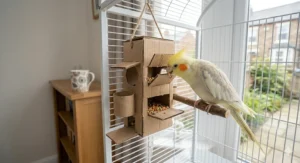
Frequently Asked Questions
❓ Are foraging toys safe for cockatiels who've never used them before?
❓ How many food hiding toys should I keep in my cockatiel's cage simultaneously?
❓ Can foraging toys help reduce screaming in cockatiels?
❓ Do foraging toys work for older cockatiels or only young birds?
❓ Are natural or synthetic foraging toys better for cockatiels in UK homes?
Conclusion: Transforming Your Cockatiel’s Daily Life Through Foraging
The difference between a bored cockatiel pacing restlessly and an engaged bird problem-solving their way through food hiding toys for cockatiels isn’t luck—it’s intentional environmental enrichment matched to natural behavioural needs. We’ve examined seven proven options available on Amazon.co.uk, from the budget-friendly £6-£10 natural baskets perfect for testing your bird’s foraging interest, to the premium £16-£22 acrylic puzzle boxes that challenge experienced foragers for years.
What unites successful foraging implementation across UK households isn’t spending more money or buying the newest trendy toy—it’s understanding progression principles, matching difficulty to ability, and maintaining consistent rotation schedules. Start with beginner-level options like the ball set or woven basket, observe which manipulation styles your cockatiel prefers (mechanical puzzles versus shredding challenges), then gradually increase complexity whilst rotating toys to prevent habituation.
For UK buyers navigating Amazon.co.uk’s vast selection, remember these key points: verify dimensions match cockatiel sizing (not larger parrot products), prioritise sellers explicitly stating materials safety, account for our damp climate’s impact on natural materials, and budget for rotation rather than one-time purchase. The £25-£40 initial investment in 4-5 toys across difficulty levels, supplemented by £10-£15 monthly for replacements, provides comprehensive enrichment without financial strain.
Most importantly, treat hiding bird toys and foraging toys cockatiel size requirements aren’t optional luxuries—they’re fundamental welfare necessities that prevent the anxiety, screaming, and destructive patterns emerging from chronic understimulation. Your cockatiel’s wild ancestors evolved spending 70% of waking hours foraging; replicating even a fraction of that mental and physical investment through thoughtful toy selection transforms cage time from mere confinement into engaging, enriching activity that honours their biological needs.
Recommended for You
- 7 Best Bird Puzzle Toys for Intelligence UK 2026
- 7 Best Shreddable Toys for Parrots UK 2026
- 7 Best Wooden Foraging Box for Birds UK 2026
Disclaimer: This article contains affiliate links. As an Amazon Associate, I earn from qualifying purchases. If you purchase products through these links, we may earn a small commission at no additional cost to you.
✨ Found this helpful? Share it with your mates! 💬🤗
