
In This Article
There’s a moment every parrot keeper knows. You’ve just spent a small fortune on a brightly coloured plastic contraption, hung it proudly in the cage, and your bird stares at it with the blank contempt of a cat ignoring an expensive bed. Then, two days later, it’s on the cage floor, utterly ignored. Sound familiar?
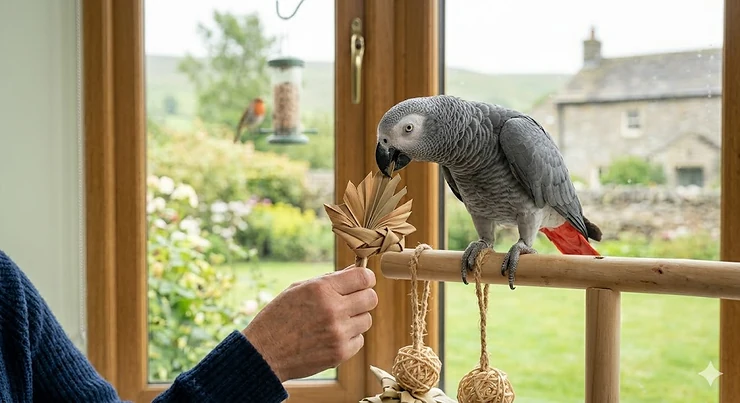
Natural palm bird toys are a different story entirely. These are the toys that get shredded with gusto, foraged through obsessively, and — if you’re lucky — dragged around the cage like a trophy. Made from dried palm leaf, palm fronds, and related tropical fibres, they tap into something deeply wired in your bird’s brain: the need to work for its living.
And that’s not just a nice idea. According to the RSPCA’s enrichment guidance for pet birds, wild birds spend up to 80% of their day foraging and feeding — and foraging is one of the most severely constrained behaviours in captive parrots. Natural palm bird toys help plug that gap. They give beaks something meaningful to do, brains something to puzzle over, and feathers something to preen against rather than each other.
So whether you’ve got a budgie in a Bristol flat or an African Grey in a Shropshire farmhouse, this guide covers the best natural palm bird toys available on Amazon.co.uk right now — with honest expert commentary on who each one actually suits.
Quick Comparison: Natural Palm Bird Toys at a Glance
| Product | Bird Size | Key Material | Best For | Price Range |
|---|---|---|---|---|
| Bonka Bird Toys 1271 Woven Palm Leaf Flowers (Pk3) | Small–Medium | Palm leaf | Cockatiels, conures | Under £10 |
| Planet Pleasures Bird Candy Woven Palm Toy | XSmall–Small | Woven palm leaf | Shy/nervous birds | Under £8 |
| Bonka Bird Toys 3428 Palm Leaf Mats (Pk4) | All sizes | Woven palm fibre | DIY builders, foraging | Around £10 |
| Planet Pleasures Pineapple Foraging Toy | Small–Large | Palm leaf & fibres | Foragers, anti-plucker | £8–£15 |
| Bonka Bird Toys 1256 Mini Palm Leaf Boxes (Pk3) | Medium | Palm leaf | African Greys, conures | Under £12 |
| Super Bird Creations Seagrass Foraging Mat | Small–Large | Seagrass/tropical fibre | Multi-use enrichment | £10–£18 |
| Planet Pleasures Pom Pom Palm Pinata | XSmall–Medium | Palm strands, bamboo | Feather-prone birds | £10–£16 |
The table above makes one thing immediately clear: natural palm bird toys span a wide range of use cases and bird sizes, yet cluster tightly in price — most fall comfortably under £15, making them one of the most affordable forms of genuine enrichment. Budget buyers won’t be shortchanged here. But the real differentiator isn’t price — it’s purpose. A shy rescue cockatiel and a destructive African Grey have completely different enrichment needs, and choosing the wrong toy just means another addition to the cage-floor graveyard.
💬 Just one click — help others make better buying decisions too! 😊
✨ Don’t Miss These Exclusive Deals!
🔍 Take your bird’s enrichment to the next level with these carefully chosen natural palm toys. Click any highlighted product to check current pricing and availability on Amazon.co.uk — and find exactly what your feathered companion needs!
Top 7 Natural Palm Bird Toys: Expert Analysis
1. Bonka Bird Toys 1271 Woven Palm Leaf Flowers (Pack of 3)
Three hand-woven palm leaf flowers, each approximately 7.5 cm across, made without dyes, glues, or metals — and that last point matters more than you might think.
The “no adhesive” construction means there’s no risk of your cockatiel accidentally ingesting synthetic bonding agents mid-shred, which is a genuine concern with many cheaper imports. Each flower can serve as a hanging cage toy or a foot toy — the latter being particularly brilliant for conures, who treat foot toys like a personal snack they never have to share. The texture is satisfying without being so tough that smaller beaks struggle.
In my experience, this is one of the better starter palm toys for cockatiels and small conures who are new to shreddable enrichment. The flower shape is familiar and non-threatening — useful if your bird has a history of ignoring new objects for six weeks out of sheer spite. UK buyers report the pack arrives well-packaged and without the musty smell that occasionally plagues poorly-stored natural fibre toys.
Pros:
- No dyes, glues, or metals — genuinely bird-safe construction
- Dual-purpose as hanging or foot toy
- Good value multi-pack for regular rotation
Cons:
- Consumed quite quickly by determined chewers
- Slightly small for medium-large birds like Amazons
Best for: Cockatiels, parakeets, small conures, lovebirds. Excellent entry-level choice. Price range: Under £10 | Check current price on Amazon.co.uk
2. Planet Pleasures Bird Candy Woven Palm Toy
A compact, colourfully woven palm leaf toy that doubles as both a hanging cage enrichment item and a foot toy — making it surprisingly versatile for its modest size.
Planet Pleasures is a brand that has earned genuine respect in the avian enrichment world, and this little toy demonstrates why. The construction uses sustainably harvested palm leaf woven into a dense, satisfying shape that small birds find irresistible. Crucially, it is non-threatening in appearance — smaller and softer than many hanging toys, which makes it ideal for rescue birds or shy individuals that tend to treat new objects as incoming threats rather than entertainment. There are no sharp attachment points or dangling bells that might startle an anxious budgie.
What most UK buyers overlook about this toy is how well it works as a “gateway” item for birds learning to interact with enrichment for the first time. If your bird has previously ignored everything you’ve bought, start here.
Pros:
- Ideal for nervous or rescue birds as a first enrichment item
- Sustainably sourced palm leaf — eco-conscious choice
- Genuinely multi-use (foot or hanging)
Cons:
- Not enough material for larger birds
- Goes quickly for enthusiastic shredders
Best for: Budgies, parrotlets, lovebirds, shy cockatiels. Perfect first toy. Price range: Under £8 | Check current price on Amazon.co.uk
3. Bonka Bird Toys 3428 Palm Leaf Mats (Pack of 4)
Four woven palm fibre mats, each approximately 10 x 10 cm, available in a pack designed for foraging, shredding, and DIY toy construction.
Here is where things get interesting for the creative bird keeper. These mats are not a finished toy — they’re a canvas. You fold one into a pouch, stuff it with pellets or treats, and hang it in the cage. Your bird has to tear it apart to get to the food inside. That’s foraging enrichment in its purest form, and research published in peer-reviewed journals consistently shows it’s one of the most effective ways to reduce stereotypies and abnormal behaviour in captive parrots.
The mats are also genuinely useful for larger birds that demolish a finished toy in under ten minutes. Rather than buying finished products constantly, you get raw material you can combine with other elements — vine balls, wooden beads, paper strips — to create endlessly variable foraging stations. That variability matters: birds habituate quickly, and rotating novel configurations keeps engagement levels high.
Pros:
- Excellent DIY foraging base — endlessly configurable
- Works for birds of all sizes from budgie to macaw
- Strong value per mat in the pack
Cons:
- Requires a little creativity to use at full potential
- Not a turnkey solution for beginners
Best for: Experienced bird keepers, foraging-focused setups, African Greys, Amazons, macaws. Price range: Around £10 | Check current price on Amazon.co.uk
4. Planet Pleasures Pineapple Foraging Toy
A pineapple-shaped foraging toy made from palm leaves and natural fibres, stuffed with shreddable materials and designed with an opening that birds must work to access.
This is probably the most famous design in the palm toy category, and it has earned that reputation properly. The pineapple shape houses a foraging challenge — treats or food can be wedged inside, forcing the bird to manipulate and shred its way to the reward. For over-preening birds or those prone to feather-plucking, this kind of directed, beak-occupying activity is exactly what avian behaviourists recommend. A 2023 study from Utrecht University found that birds will actively choose to work for food even when the same food is freely available — the act of foraging is intrinsically motivating.
The toy scales surprisingly well across bird sizes. A cockatiel will peck delicately at the outer fibres; an Amazon will dismantle the whole thing with cheerful efficiency. Either way, you’re getting real enrichment value. UK customers note the toy arrives in good condition via Amazon.co.uk fulfilment, and Prime delivery makes it easy to keep a stock rotation going.
Pros:
- Scientifically supported foraging mechanism
- Scales across a wide range of bird sizes
- Excellent for over-preeners and feather-pluckers
Cons:
- Medium-to-large birds may finish it faster than expected
- Shape can put off some very nervous birds initially
Best for: Conures, cockatiels, Amazons, African Greys, macaws. A top pick for welfare-focused owners. Price range: £8–£15 | Check current price on Amazon.co.uk
5. Bonka Bird Toys 1256 Mini Palm Leaf Boxes (Pack of 3)
Three miniature square boxes (approximately 3.8 cm across) hand-woven from natural palm leaf — functioning as foot toys, foraging puzzles, and beak-exercise items simultaneously.
The clever thing about the box format is that it creates a problem to solve. A bird picks it up, turns it in its foot, investigates the opening, and realises there might be something inside. That moment of investigation — even if the box is empty — engages cognitive circuits that a simple shred toy never reaches. For African Greys, Pionus parrots, and conures in particular, this kind of manual manipulation is almost compulsive; you’ll often find the box being carried from perch to perch like a prized possession.
These are unapologetically medium-bird toys. Too small for Amazons or macaws to engage with meaningfully, but absolutely right for the middle tier. They’re also excellent cage enrichment add-ons for birds in smaller living spaces — relevant for UK owners in flats or terraced houses where large aviaries aren’t practical, and enrichment has to do more work within a compact cage.
Pros:
- Cognitive manipulation toy — not just a shredder
- Ideal for cage-bound birds with limited space to roam
- No synthetic dyes or adhesives
Cons:
- Too small for large parrots
- May not hold a nervous bird’s interest without treat stuffing initially
Best for: African Greys (young birds), conures, Pionus, Senegals, ringnecks. Price range: Under £12 | Check current price on Amazon.co.uk
6. Super Bird Creations Seagrass Foraging Mat (SB50008)
A flat 18 x 30 cm seagrass mat — technically seagrass rather than palm leaf, but sharing the same tropical fibre family and enrichment profile — designed as a versatile cage enrichment base.
Seagrass and palm leaf sit in the same category for practical purposes: both are natural, sustainable, non-toxic tropical fibres that birds love to investigate, chew, and unravel. The distinction matters in one specific way: seagrass has a denser weave and a slightly coarser texture, which makes it noticeably more durable. Where a palm leaf toy might last two sessions with a determined conure, a good seagrass mat often survives longer — a relevant consideration for UK buyers watching the household budget in 2026.
This mat format is particularly useful hung vertically on cage bars, where birds can climb, grip, and forage across the whole surface. It also stuffs beautifully with foraging material. Super Bird Creations is a well-regarded US brand with solid UK availability through Amazon.co.uk, and customer feedback consistently praises the material quality and durability over cheaper alternatives.
Pros:
- Superior durability compared to pure palm leaf toys
- Works vertically as a climbing enrichment surface
- Excellent base for DIY foraging stations
Cons:
- Slightly pricier than basic palm leaf alternatives
- Seagrass texture less immediately attractive to some sensitive birds
Best for: All bird sizes — particularly medium to large parrots who demolish everything too fast. Price range: £10–£18 | Check current price on Amazon.co.uk
7. Planet Pleasures Pom Pom Palm Pinata
A natural palm-strand toy featuring bamboo eyes and a palm-leaf hat — designed specifically for birds prone to over-preening, with its shreddy, fringed texture giving beaks something irresistible to work on.
The Pom Pom Pinata occupies a clever niche: it’s part foraging toy, part anti-plucking intervention, and part cage decoration. The fringed palm strands invite preening-like behaviour, which is precisely the point. Birds that over-preen often benefit enormously from having an external object that satisfies the same tactile urge — redirecting the behaviour away from their own feathers.
The toy is made entirely from natural materials (no plastics, no synthetics), which aligns with the RSPCA’s recommendation to use natural fibre in homemade and bought cage enrichment. At its price point, it represents strong value as a specialist welfare tool. UK bird owners dealing with feather-damaging behaviour might consider this alongside veterinary advice — and the RSPCA’s enrichment page is a solid starting point for anyone trying to build a broader behavioural plan.
Pros:
- Specialist design for over-preening and feather-plucking issues
- 100% natural materials — no synthetic components
- Doubles as attractive cage décor
Cons:
- Less suitable as a primary foraging toy
- Very light; may not engage larger birds
Best for: Lovebirds, budgies, cockatiels, nervous birds. Particularly valuable for feather-prone individuals. Price range: £10–£16 | Check current price on Amazon.co.uk
How to Use Natural Palm Bird Toys for Maximum Enrichment
Start with Placement, Not Just Purchase
The single biggest mistake UK bird keepers make with new toys is hanging them directly in front of the food bowl or favourite perch. Your bird will avoid them. Start by placing the new toy near something familiar — an existing favourite perch or the side of the cage where your bird typically spends time — and let curiosity do the work over two to three days.
The Foraging Upgrade: Stuff Everything
Every palm leaf toy becomes five times more engaging the moment you stuff it with food. Push a few pellets, a slice of grape, or a couple of sunflower seeds into the woven gaps. The bird now has a reason to investigate, and the reward reinforces the behaviour. Over time, most birds will forage enthusiastically with empty toys once the habit is established — but the food is the catalyst, especially in the first few weeks.
Rotate Weekly, Not Monthly
Research on environmental enrichment in parrots consistently shows that novelty is a key driver of engagement. A toy your bird ignored last week will often be treated as brand new after ten days in a box. Keep three or four palm toys in rotation and swap them out every seven to ten days. This is especially practical in the UK context: you don’t need a giant aviary to provide variety, just a small stash of inexpensive palm items and the discipline to rotate them.
UK Storage Tip: Keep Them Dry
Natural palm fibre is, in the main, quite moisture-resistant — but British homes in autumn and winter can be damp in ways that eventually affect any organic material. Store unused palm toys in a dry cupboard rather than a garage or shed. If a toy smells musty when you retrieve it, bin it rather than risk introducing mould spores into the cage environment.
Matching the Toy to the Bird: A UK Owner’s Decision Guide
Different birds have dramatically different enrichment needs, and pretending otherwise wastes your money and your bird’s mental energy.
If you have a cockatiel or budgie in a flat: Go for the Planet Pleasures Bird Candy Toy or the Bonka 1271 Palm Flowers. Both are appropriately sized, non-threatening, and won’t clutter a compact cage. The smaller footprint matters in a typical UK flat where cage placement is already a creative exercise.
If you have a conure or ringneck: The Bonka 1256 Palm Leaf Boxes are a near-perfect match. Conures treat foot toys like a personal mission, and the manipulative challenge of the box format suits their investigative, slightly manic energy beautifully.
If you have an African Grey or Amazon: Go straight for the Planet Pleasures Pineapple Foraging Toy or the Bonka 3428 Palm Mats. African Greys in particular need cognitive challenge, not just something to chew — the foraging mechanism in these toys provides that. Research from the University of Bristol published in the Proceedings of the Royal Society B found that more intelligent species with wider natural foraging ranges suffer most in impoverished captive environments, so enrichment is genuinely a welfare priority for Grey owners.
If your bird over-preens or feather-plucks: Start with the Planet Pleasures Pom Pom Pinata and consult your avian vet alongside the RSPCA’s enrichment guidance. Toys are supportive — not a replacement for veterinary assessment.
If you’re on a budget: The Bonka 3428 Palm Mats offer the best long-term value because you control how much material you deploy. One pack can generate weeks of foraging variety with a bit of creativity.
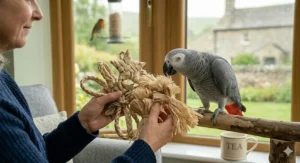
Palm Leaf vs Seagrass Toys: Which is Better for UK Birds?
This is one of the most common questions British parrot owners ask, and the honest answer is: it depends on your bird’s chewing style.
Palm leaf is softer, lighter, and easier for smaller beaks. It shreds in a deeply satisfying way that most birds respond to immediately. The downsides are durability — a determined medium-sized parrot can strip a palm leaf toy in one enthusiastic session — and the fact that very damp storage conditions can degrade it faster.
Seagrass, by contrast, has more structural integrity. The fibres are denser, slightly coarser in texture, and more resistant to moisture — which has obvious relevance in a British climate where sheds and garages are not always the driest storage environments. Birds that tend to bite through toys in one go rather than methodically shredding them often last longer with seagrass.
| Feature | Palm Leaf | Seagrass |
|---|---|---|
| Texture | Soft, light, easily shredded | Denser, coarser, woven |
| Durability | Moderate | Higher |
| Moisture resistance | Moderate | Better (naturally non-porous) |
| Best bird size | Small to medium | All sizes |
| UK damp climate suitability | Good | Very good |
| Price range | Under £15 | £10–£18 |
The verdict? For smaller birds and first-time buyers, start with palm leaf. For larger, more destructive birds or UK keepers in damper homes, seagrass is the more sensible long-term investment. Many experienced owners — quite rightly — use both in rotation, exploiting the different textures to maintain novelty.
Common Mistakes UK Bird Owners Make When Buying Natural Toys
Buying too big, too soon. A giant foraging tower designed for a macaw will terrify a cockatiel. Match toy dimensions to bird size honestly — if a toy is larger than your bird’s body, start with something smaller.
Ignoring material provenance. Not all “natural” toys are equal. Cheap imports occasionally use undisclosed dyes or bleaching agents on the fibres. Stick to established brands — Bonka, Planet Pleasures, Super Bird Creations — that are transparent about their materials. The RSPCA recommends untreated, unsprayed natural materials for homemade toys; the same principle applies to bought ones.
Buying once and never rotating. One palm toy left in the cage indefinitely will be ignored within a week. Build a small rotation of three to four items and swap them out regularly. It costs very little extra and makes a dramatic difference to engagement levels.
Expecting instant results. Some birds — particularly rescues or birds that have never had enrichment toys — can take weeks to engage with a new item. This is entirely normal. Patience, treat-stuffing, and gradual introduction beat forced interaction every time.
Confusing “natural” with “indestructible.” Palm leaf toys are meant to be destroyed. That’s the point. If your bird shreds a toy to pieces in a session, that’s a success, not a waste of money — buy another one.
Long-Term Value: What Natural Palm Bird Toys Actually Cost You
The economics of natural palm toys are, frankly, rather good compared to the alternatives.
A typical plastic or metal enrichment toy in the £15–£25 range often outlasts its usefulness after a few weeks, either because the bird has lost interest or because it simply sits untouched. A palm leaf toy at under £10 that gets properly shredded and destroyed has delivered genuine behavioural value for its entire lifespan.
The smarter investment is buying in multi-packs (the Bonka three-packs and four-packs are excellent here) and budgeting for regular repurchasing as part of a rotation. Across a year, even for a medium-sized parrot, maintaining a good enrichment rotation using palm toys is likely to cost you in the low-to-mid £30–£50 range annually — less than a single vet consultation for stress-related behavioural issues that poor enrichment can contribute to.
Prime-eligible products on Amazon.co.uk make restocking straightforward, with next-day delivery available across most UK postcodes — a genuine quality-of-life improvement when you’ve run out of foraging material mid-rotation.
✨ Don’t Miss These Exclusive Deals!
🔍 Ready to enrich your bird’s world? Click any highlighted product name in this article to check current pricing and availability on Amazon.co.uk. These picks represent the best of natural palm enrichment — find your perfect match today!
FAQ: Natural Palm Bird Toys UK
❓ Are natural palm bird toys safe for all species of parrots?
❓ How long do natural palm leaf toys typically last?
❓ Can I buy natural palm bird toys on Amazon.co.uk with Prime delivery?
❓ Are there any UK regulations on bird toy safety I should know about?
❓ Do palm bird toys help with feather-plucking behaviour?
Conclusion
Natural palm bird toys are not a luxury. They’re arguably one of the most important things you can put into your bird’s environment, addressing the foraging deficit that nearly every captive parrot lives with. The evidence for enrichment’s role in bird welfare is robust — from the RSPCA’s own guidance to peer-reviewed science — and palm leaf toys sit squarely at the affordable, accessible end of the enrichment spectrum.
The seven products in this guide cover every price point, every bird size, and every enrichment need from basic shredding pleasure to sophisticated foraging challenge. Start with one or two, observe how your bird responds, and build from there. Rotate regularly. Stuff them with treats. Accept that destruction is success.
Your bird’s beak will thank you. Possibly while making a considerable mess.
✨ Don’t Miss These Exclusive Deals!
🔍 Ready to transform your bird’s cage into an enrichment haven? Check out our top-rated natural palm bird toys on Amazon.co.uk — click any highlighted product above to see current prices and availability. Fast Prime delivery to most UK addresses!
Recommended for You
- Best Paper Shredding Toys for Budgies UK 2026: 7 Expert Picks
- 7 Best Balsa Wood Bird Toys for Parrots in the UK (2026)
- 7 Best Chew Toys for Parrots UK 2026
Disclaimer: This article contains affiliate links. As an Amazon Associate, I earn from qualifying purchases. If you purchase products through these links, we may earn a small commission at no additional cost to you.
✨ Found this helpful? Share it with your mates! 💬🤗
