
In This Article
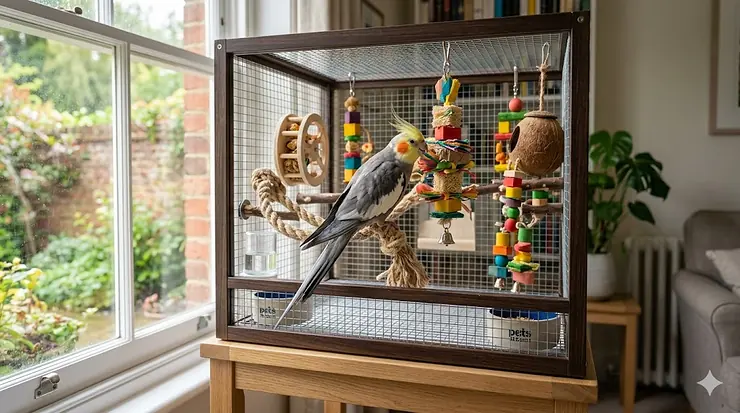
There’s a particular sound that every cockatiel owner learns to dread. It starts as a chirp, climbs into a shriek, and ends with your neighbour texting to ask if everything’s alright. Nine times out of ten, the answer isn’t “he’s hurt” or “the cat’s got in” — it’s “he’s bored out of his tiny, walnut-sized mind.” Cockatiel boredom toys aren’t a luxury add-on for the indulgent bird parent; they’re the difference between a calm, chatty companion and a feathered alarm clock that’s permanently stuck on snooze.
This isn’t a niche problem, either. Birds are among the most popular pets in the UK, with cockatiels consistently ranking just behind budgies as the nation’s favourite. In the wild, a cockatiel spends roughly four-fifths of its waking hours foraging, gnawing, and generally interfering with its environment. Strip that out and replace it with a cage, two perches and a millet spray, and you’ve essentially handed a sharp-witted toddler an empty room and told them to entertain themselves. Below is a research-backed shortlist of what’s actually worth buying on Amazon.co.uk, plus the rotation habits that make the toys work rather than gather dust.
Quick Comparison Table
| Toy | Type | Price Range | Best For |
|---|---|---|---|
| Rosewood Boredom Breaker Foraging Cylinder | Foraging/shredding | £8–£13 | Treat-hunting, mental stimulation |
| Rosewood Boredom Breaker Bamboozlers Climbing Net | Climbing/chewing | £8–£13 | Physical exercise, beak workout |
| Living World Bird Swing with Wooden Perch | Swing/perch | £4–£8 | Movement, low-budget staple |
| TRIXIE Swing Arc | Swing/perch | £6–£11 | Compact cages, daily use |
| Rosewood Boredom Breaker Life Size Budgie | Companion/mirror | £6–£10 | Solo birds, separation anxiety |
| Living World Bird Toy Value Pack (Assortment 2) | Mixed value pack | £6–£12 | First-time buyers, variety |
| MYMULIKE 6-Pack Foraging Shredder Toys | Foraging/shredding bundle | £12–£17 | Rotation stockpiling |
A glance down that “Best For” column tells you most of what you need to know: no single toy does everything, which is precisely why the rotation habit further down this article matters more than any individual purchase. Budget-conscious owners can build a genuinely effective toy box for under £25 by pairing one foraging toy with one swing and one chew item — the kind of spread a cockatiel’s brain actually wants, rather than five variations on the same bell-on-a-string.
💬 Just one click — help others make better buying decisions too! 😊
✨ Don’t Miss These Exclusive Deals!
🔍 Take your cockatiel’s playtime to the next level with these carefully selected picks. Click through to check current pricing and availability on Amazon.co.uk — stock and prices shift daily, so it’s worth a look.
Top 7 Cockatiel Boredom Toys: Expert Analysis
1. Rosewood Boredom Breaker Foraging Cylinder
The Rosewood Boredom Breaker Foraging Cylinder is woven palm leaf and abaca fibre stuffed with filler your bird has to physically dismantle to reach anything interesting — which, conveniently, is the entire point. The medium size is sized for cockatiels and similar small parrots, and there’s genuinely no glue, wire or plastic in the construction, so what gets shredded can simply go in the bin rather than the vet’s chart of “things my bird swallowed.”
What most buyers overlook is that this isn’t a toy you hang and forget — it earns its keep when you tuck a few sunflower seeds or a sprig of millet into the weave first, turning a chew toy into a proper foraging puzzle. In Britain’s centrally heated winter flats, natural fibre toys like this dry out and become even more satisfyingly shreddable, which your bird will treat as a bonus, not a flaw.
✅ Genuinely destructible (which is the goal)
✅ No synthetic materials to ingest
✅ Doubles as a foraging puzzle with treats hidden inside
❌ Won’t survive a determined cockatiel more than 1–3 weeks
❌ Needs treats added by you to reach its full potential
Price & verdict: around £8–£13 — solid value once you factor in how much enrichment a single toy delivers per pound spent.
2. Rosewood Boredom Breaker Bamboozlers Climbing Net
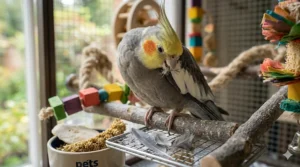
Where the Foraging Cylinder is about food, the Rosewood Boredom Breaker Bamboozlers Climbing Net is about movement. Tough abaca rope strung between bamboo rings, it can be rigged vertically or flat across a corner of the cage, giving a cockatiel somewhere to clamber that isn’t simply “up and down the same two perches it’s used since March.”
The real-world payoff here is physical rather than mental: cockatiels kept in smaller UK flats and terraced houses, where cages tend to be more compact than the sprawling aviary setups common in larger homes, benefit hugely from anything that adds vertical play space without adding floor space. It’s a clever use of a cage’s unused corners.
✅ Adds climbing without eating up cage footprint
✅ Bamboo rings hold up better than rope alone
✅ Can be repositioned to keep things novel
❌ Some birds ignore it entirely for the first week
❌ Needs secure attachment points — check your cage bar spacing first
Price & verdict: around £8–£13, broadly comparable to the Foraging Cylinder — pairing the two gives you both a mental and a physical outlet for one modest outlay.
3. Living World Bird Swing with Wooden Perch for Cockatiels
This is the toy equivalent of a reliable cup of tea: not flashy, but it does the job every single time. The Living World Bird Swing with Wooden Perch is built specifically with cockatiels in mind, mimicking the gentle sway of a tree branch rather than the jerky bounce cheaper plastic swings tend to produce.
What the spec sheet won’t tell you is how much a swing changes a cockatiel’s relationship with its cage. Birds that spend all day on a static perch tend to develop tight, stressed body language; a swaying perch encourages constant micro-balancing, which is genuinely good exercise disguised as lounging about. It’s also one of the cheapest entries on this list, making it an easy first purchase for anyone setting up a cage from scratch.
✅ Designed specifically for cockatiel-sized birds
✅ Natural wood perch is kinder on feet than plastic dowel
✅ Among the most affordable options here
❌ Basic — won’t hold a bird’s attention solo for long
❌ Wood will need occasional replacing as it’s chewed down
Price & verdict: around £4–£8 — arguably the best value-for-money single item on this list.
4. TRIXIE Swing Arc (Coloured Studs, 20 x 29cm)
German manufacturer TRIXIE has quietly become one of the more dependable bird-accessory brands stocked on Amazon.co.uk, and the TRIXIE Swing Arc is a fair example of why. It’s a curved wooden arc fitted with coloured wooden studs along its length, giving a cockatiel both a perch to swing from and a row of chewable knobs to gnaw at while it’s there.
The studs are the clever bit — they give a bored beak something specific to focus on rather than the cage bars or, worse, its own feathers. UK owners dealing with damp British winters and shorter daylight hours, both of which tend to nudge captive birds towards more sedentary, indoor-bound behaviour, often find a stud-and-swing combo like this keeps a bird occupied during the long stretch between November and February when outdoor time and natural light are both in short supply.
✅ Combines a swing with a built-in chew feature
✅ Compact 20 x 29cm footprint suits smaller cages
✅ Sturdy construction from a long-established brand
❌ Coloured dye on studs can fade with heavy chewing
❌ Not a foraging toy — pair with one for full enrichment
Price & verdict: around £6–£11, depending on the seller — well-judged at the mid-range end of the comparison table.
5. Rosewood Boredom Breaker Life Size Budgie
This one needs a slightly longer explanation, because on paper it sounds faintly ridiculous: a plastic, life-sized budgie that perches in your cockatiel’s cage as a stand-in companion. In practice, the Rosewood Boredom Breaker Life Size Budgie is aimed at solo birds — and plenty of cockatiel owners, not just budgie owners, report their bird taking an interest in it, chattering at it, or simply tolerating it as a roost-mate.
Here’s the honest caveat: bird response to this toy is genuinely unpredictable. Some cockatiels treat it as a comforting presence; others ignore it completely or, occasionally, seem mildly perturbed by it. It’s worth treating as a low-stakes experiment rather than a guaranteed fix for a lonely single bird, and it’s not a substitute for the RSPCA’s general advice that birds do best with company, daily interaction, or both.
✅ Cheap way to test whether your bird wants “company”
✅ Sturdy build compared with some flimsier mirror toys
✅ Easy to remove if your bird shows no interest or distress
❌ Reaction is hit-or-miss — can’t be guaranteed to work
❌ Some clip attachments are reported as fragile under heavy use
Price & verdict: around £6–£10 — a reasonable gamble given the low entry price, but go in with tempered expectations.
6. Living World Bird Toy Value Pack, Assortment 2
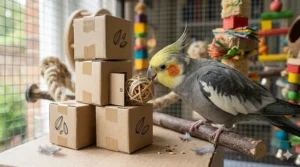
For anyone setting up a first cage, the Living World Bird Toy Value Pack, Assortment 2 is the sensible starting point: a multi-coloured ladder, a separate play toy, and a double-sided glass mirror, bundled at a single, low price. It’s less about any one toy being exceptional and more about instantly giving a new bird three completely different types of stimulation — climbing, chewing, and visual — on day one.
The practical advantage for UK buyers is storage and cost efficiency: rather than placing three separate orders (and paying three separate delivery charges if you’re under the free-delivery threshold), one parcel covers the basics while you work out what your particular bird actually likes.
✅ Three toy types in one purchase
✅ Efficient way to hit Amazon’s free-delivery threshold
✅ Good entry point before investing in pricier individual toys
❌ Individual pieces are basic rather than premium
❌ Mirror element should be monitored — not every bird does well with one
Price & verdict: around £6–£12 for three toys — hard to beat on a pure cost-per-item basis.
7. MYMULIKE 6-Pack Foraging Shredder Toys
Once you’ve worked out that your cockatiel is, in fact, a tiny demolition contractor, the smart move is buying in bulk — which is exactly what the MYMULIKE 6-Pack Foraging Shredder Toys lets you do. Six individual foraging and shredding toys arrive in one box, designed to be hung, rotated, and replaced as each one gets reduced to confetti.
This is the toy for owners who’ve already identified that shredding is their bird’s preferred activity (you’ll know — there’ll be paper and fibre confetti across the cage floor within hours) and simply need volume rather than variety. Buying six at once also works out cheaper per toy than buying single foraging items repeatedly, which matters if your cockatiel treats every new toy as a 48-hour project.
✅ Six toys means weeks of rotation without re-ordering
✅ Strong value per toy versus buying singly
✅ Ideal once you know shredding is your bird’s preferred outlet
❌ Higher upfront cost than single-toy purchases
❌ Less variety than mixing toy types from other brands
Price & verdict: around £12–£17 for the full pack — the best-value option here if your bird is a committed shredder.
From the table and the seven picks above, a pattern emerges: the foraging and shredding toys (Rosewood Cylinder, MYMULIKE pack) earn their price through mental stimulation, the swings (Living World, TRIXIE) earn theirs through cheap, reliable movement, and the companion and value-pack options are best treated as low-cost experiments rather than centrepiece purchases. No single toy on this list claims to be a complete solution — and any product that did would be worth treating with suspicion.
A Rotation Schedule That Actually Prevents Cockatiel Boredom
Buying toys is the easy 20%; the remaining 80% is rotation, and it’s the part most owners skip. This isn’t just folk wisdom — a recent peer-reviewed study on captive cockatiels found that structured environmental enrichment measurably reduced feather-damaging behaviour, and that the improvements held up even after the enrichment was withdrawn, suggesting that even a temporary, well-planned toy rotation has lasting benefit. A cockatiel that sees the same three toys every day for six months stops registering them as anything worth investigating — much like how you stop noticing a picture on your own hallway wall.
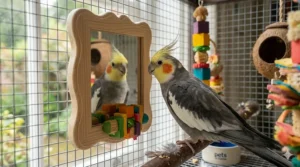
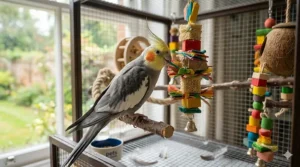
A simple system: keep a “library” of five or six toys, but only ever 2–3 in the cage at once. Every 7–10 days, swap one out for something from the library and put the removed toy aside for a couple of weeks before it returns — by which point it’ll register as novel again. Stagger toy types too: one foraging toy, one chew or shred toy, one swing or climbing piece, rather than three variations on the same theme. Introduce anything genuinely new outside the cage first, letting your bird inspect it on a play stand or your hand, since cockatiels can be cautiously suspicious of sudden additions to their home territory.
Real-World Scenarios: Which Toy Suits Your Cockatiel?
The London flat-dweller with one cockatiel and limited cage space: prioritise the Bamboozlers Climbing Net and the TRIXIE Swing Arc — both add activity without demanding extra floor space, which matters when the cage itself is already squeezed into a corner of a one-bed flat.
The Manchester or Birmingham household with kids and a budget to match: the Living World Value Pack plus the MYMULIKE 6-pack covers variety and volume for under £25 combined, which suits families working out their bird’s preferences without overcommitting early.
The single-bird owner worried about loneliness: start with the Life Size Budgie companion toy as a low-cost trial, but treat daily out-of-cage time with you as the non-negotiable centrepiece. According to RSPCA guidance on housing pet birds, birds kept in an indoor cage for too long without enough time outside it can become bored and frustrated, which tends to lead to problem behaviour — no toy fully substitutes for that.
How to Choose Cockatiel Boredom Toys in the UK
- Match size to bird, not just species name. “Small parrot” toys can still be oversized for a cockatiel’s beak and feet — check the sizing guide rather than the headline product title.
- Mix toy categories, not just toy colours. One foraging, one chew, one movement-based toy beats three near-identical bell toys.
- Favour natural fibres for shred toys, plastic for longevity items. Rope, palm leaf and bamboo satisfy the urge to destroy; sturdier wood or hard plastic suits swings and ladders meant to last.
- Budget for replacement, not just the first purchase. A genuinely used foraging toy may not survive a fortnight — factor that into your monthly pet spend rather than treating it as a one-off cost.
- Watch your bird’s actual reaction, not the marketing copy. Some cockatiels are fearless shredders; others are cautious and need slow introductions. Buy accordingly rather than chasing five-star review averages.
Common Mistakes When Buying Cockatiel Toys
The single biggest mistake is overcrowding the cage — cramming in every toy at once leaves no room for your bird to stretch or flap, and turns the cage into an obstacle course rather than a home. RSPCA enrichment advice is consistent on this point: toys should stimulate, not clutter. A close second is buying toys sized for larger parrots because they look more impressive — a toy built for an African grey is often simply too heavy or too large for a cockatiel to engage with safely. And a quieter, easily missed mistake: introducing a mirror toy without monitoring how your bird responds to it, since some birds treat a mirror as welcome company while others become upset or aggressive around one.
Cockatiel Screaming Prevention: The Boredom Connection
Excessive screaming is one of the most common reasons cockatiel owners go searching for boredom toys in the first place, and the link is real, if not absolute. A bird with nothing to do tends to default to the loudest tool in its kit: its voice. Under UK law, this isn’t merely an annoyance to manage — the Animal Welfare Act 2006 places a legal duty on owners to meet an animal’s welfare needs, including the need to exhibit normal behaviour patterns, which for a cockatiel means foraging, chewing, climbing and flying. That doesn’t mean every scream is a toy-shaped problem — illness, fear, and simple attention-seeking can all sound identical to boredom-driven calling — but a consistent toy rotation, paired with daily out-of-cage time, is one of the most reliable non-medical interventions available. If screaming persists despite a properly enriched cage, it’s worth ruling out a health issue with an exotics-experienced vet before assuming it’s purely behavioural.
FAQ
❓ What toys are best for a bored cockatiel?
❓ How many toys should a cockatiel have in its cage?
❓ Are cockatiel toys available with fast delivery on Amazon UK?
❓ Why does my cockatiel ignore new toys?
❓ Can cockatiel boredom toys stop screaming completely?
Conclusion
A cockatiel’s brain doesn’t switch off just because its body is living in a cage rather than an Australian scrubland. In the wild, the vast majority of a bird’s day goes on finding food, with the remainder spent on grooming, socialising and play, and in captivity that searching time has to be replaced with something — or behaviour and health problems tend to follow. The seven toys above aren’t a magic fix, and no single product on this list claims to be — but a rotating mix of foraging, chewing and movement toys, refreshed every week or so and paired with proper out-of-cage time, addresses the root cause rather than papering over the symptom. For broader day-to-day care beyond toys, PDSA’s bird care advice is a solid free starting point. Start small, watch how your particular bird responds, and build the toy box from there.
Recommended for You
- 7 Best Toys for Cockatiels UK 2026 — Happy, Stimulated Birds
- Best Toys for Medium Parrots UK 2026: 7 Expert Picks
- Toys for Lovebirds: 7 UK Picks That Earn Their Keep in 2026
Disclaimer: This article contains affiliate links. As an Amazon Associate, I earn from qualifying purchases. If you purchase products through these links, we may earn a small commission at no additional cost to you.
✨ Found this helpful? Share it with your mates! 💬🤗
