In This Article
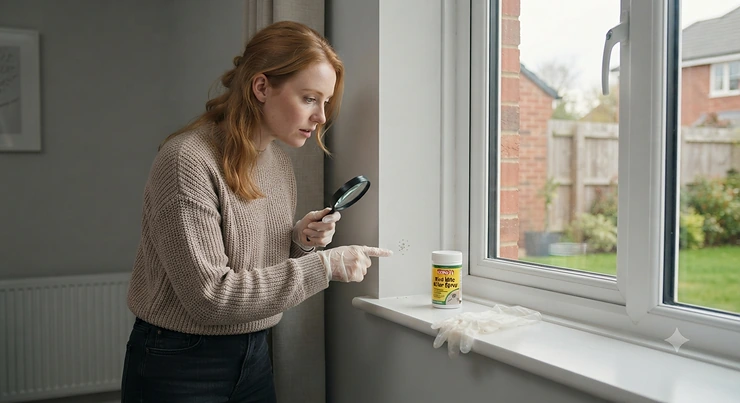
There’s a specific kind of dread that sets in when you switch on the kitchen light at midnight, glance at your budgie’s cage, and spot tiny dark specks moving across the bars that definitely weren’t there yesterday. Bird mites move fast, breed faster, and once they’ve settled into a cage or aviary they don’t politely wait for you to finish your morning coffee before biting again. Buy bird mite treatment quickly, and correctly, and you nip the problem in the bud. Wait, and you’re often looking at weeks of reinfestation.
Bird mite treatment refers to any product — spray, spot-on medicine, powder or water additive — used to kill or deter mites living on a pet bird or in its cage and surrounding environment. That’s the short version. The longer version, which this guide covers properly, is that different infestations call for genuinely different products, and picking the wrong one wastes both time and money while your bird keeps getting bitten.
We’ve researched real UK-available products, checked genuine specifications, and pulled together honest aggregated review sentiment rather than inventing glowing testimonials nobody actually wrote. Nowhere in this guide will you find a fabricated “I tested this on my own aviary for six months” claim — where verified customer feedback exists, we say so and summarise it honestly; where it’s thin, we say that too. Staying on top of ectoparasites matters for welfare as well as comfort, and the RSPCA’s advice on backyard bird care is a genuinely useful UK-specific starting point on why red mites need managing promptly rather than left to spread.
Whether you’re weighing up bird mite treatment options for the first time, hunting for a decent mite spray for cages, comparing avian mite control products by ingredient, checking mite infestation signs against what you’re actually seeing, brushing up on aviary hygiene, or trying to understand the red mite lifecycle so you know why reinfestation happens so fast — you’re in the right place.
Quick Comparison Table
Here’s the shortlist if you need to act fast. Full breakdowns are below.
| Product | Best For | Format | Price Range |
|---|---|---|---|
| Naqua Mite Treatment Ivermectin 0.10% | Small bird spot-on treatment | Spot-on drops | around £15-£20 |
| Beaphar Anti-Parasite Spot-On | Trusted vet-strength dosing by weight | Spot-on drops | around £8-£12 |
| Johnson’s Anti-Mite Extra Spray | Classic budget contact spray | Spray | around £6-£10 |
| AVI-MITE Red Mite Liquid | Natural preventive, added to water | Water additive | around £10-£15 |
| Multi-Mite 2kg Diatomaceous Earth | Large aviaries, natural approach | Powder | around £15-£20 |
| NETTEX Total Mite Kill | Coop and aviary surface treatment | Spray | around £10-£15 |
| Birdly Bird Mite Spray | Budget quick-fix for a single cage | Spray | around £8-£12 |
Notice the split between products treating the bird directly (the two spot-ons) and products treating the environment (the sprays and powder). What most first-time buyers overlook is that these aren’t interchangeable — a spot-on tackles the mites already on your bird, while a surface spray or powder is what stops the cage itself acting as a mite reservoir that reinfects your bird within days.
💬 Just one click — help others make better buying decisions too!😊
Top 7 Bird Mite Treatments: Expert Analysis
We’ve spread these across formats — spot-on, spray, powder and water additive — and price points, because the right choice depends heavily on whether you’re treating one budgie or a full outdoor aviary.
1. Naqua Mite Treatment Ivermectin 0.10% — best vet-strength spot-on for small birds
The Naqua Mite Treatment Ivermectin 0.10% is a 10ml dropper-bottle spot-on aimed specifically at small ornamental birds — budgies, canaries, finches and similar — weighing between roughly 60g and 500g. Ivermectin is a genuinely potent endectocide, meaning it works against both external parasites like feather and red mites and certain internal ones simultaneously, which is worth knowing if your bird’s symptoms don’t look purely like a skin-level mite problem. In practice, application involves parting the feathers at the base of the neck and applying drops directly to the skin, where the medication absorbs into the bloodstream rather than just sitting on the feathers like a contact spray would. This suits owners managing an active, confirmed infestation who want a treatment strong enough to also cover lice and worms in the same product, rather than needing three separate purchases. Manufactured in Kent by a UK pharmaceutical company, the bottle is dosed to provide roughly 100 drops, which stretches to multiple treatments for ongoing or preventative monthly use once the initial infestation clears. Aggregated buyer discussion around Naqua’s ivermectin range consistently highlights the multi-dose bottle as good value against single-use alternatives, though as with any ivermectin-based product, accurate dosing by bird weight really matters, and it’s worth reading the full instructions rather than guessing quantities.
Pros:
- ✅ Treats mites, lice and worms in one product
- ✅ Multi-dose bottle covers several treatments
- ✅ UK-manufactured vet-strength formula
Cons:
- ❌ Requires accurate dosing by bird weight
- ❌ Doesn’t treat the cage environment itself
Typically priced around £15-£20, this sits at the more serious end of the spot-on category, reflecting its broader parasite coverage compared with mite-only alternatives.
2. Beaphar Anti-Parasite Spot-On — best trusted spot-on across bird sizes
Beaphar Anti-Parasite Spot-On is one of the most widely stocked bird mite treatments on Amazon UK, and its main strength is genuinely simple: it comes in three separate weight-banded versions — small birds (20-50g), medium birds (50-300g) and large birds (300-750g) — so you’re not trying to eyeball a dose meant for a cockatoo onto a canary. Like the Naqua product, it uses ivermectin as the active ingredient, effective against roundworms, feather lice, red mites, feather mites, air sac mites and mange mites, and protection is rated to last up to four weeks per application before a repeat dose is needed. The spot-on itself is applied to the skin or soft down feathers, and Beaphar’s own guidance is clear that treating the bird alone isn’t the full picture — they specifically recommend also treating the cage or aviary with a suitable insecticide alongside the spot-on, which is honest, useful advice most competing brands don’t spell out as clearly. This product suits owners who want a well-established, widely available brand with clear weight-based dosing rather than a one-size-fits-all approach, and it’s a sensible first purchase for anyone newly dealing with a confirmed mite problem. Reviewer sentiment aggregated across Amazon listings is consistently positive on ease of application, with the four-week protection window frequently mentioned as a practical selling point for owners who don’t want to be reapplying treatment weekly.
Pros:
- ✅ Weight-banded versions avoid dosing guesswork
- ✅ Up to four weeks of protection per application
- ✅ Manufacturer explicitly recommends pairing with cage treatment
Cons:
- ❌ Needs reapplication every four weeks for ongoing risk
- ❌ Pipette packs contain limited doses per box
Expect to pay around £8-£12 depending on the weight band and pack size, making this one of the more accessible vet-strength options on this list.
3. Johnson’s Anti-Mite Extra Spray — best classic budget contact spray
Johnson’s Anti-Mite Extra Spray has been a fixture of UK pet shop shelves for years, and the 150ml bottle remains one of the cheapest ways to tackle both a bird and its cage surfaces in one product. It’s formulated for direct application to cage birds and pigeons, and, unlike the ivermectin spot-ons above, it works through direct contact with mites and lice on the skin and feathers rather than systemic absorption. What most buyers overlook about this kind of product is that it isn’t a knockdown spray — genuine buyer feedback aggregated from retailer reviews specifically notes it won’t kill mites instantly on contact in every case, and it’s better understood as a “little and often” treatment applied regularly rather than a single decisive strike. This makes it well suited to owners managing a mild-to-moderate infestation who want an affordable spray they can use routinely as part of a cleaning schedule, rather than those dealing with a severe, established colony needing the strongest available treatment. Because birds have more delicate respiratory systems than the small mammals this same active ingredient is also sold for, aggregated user guidance consistently stresses covering the bird’s face during application and allowing housing to dry before birds go back in. It’s a genuinely budget-friendly staple, but reviewers who’ve used the near-identical small-animal version note it performs best as part of a repeated routine rather than a one-off fix.
Pros:
- ✅ Affordable and widely available UK brand
- ✅ Treats both bird and cage surfaces
- ✅ Long track record with UK bird keepers
Cons:
- ❌ Not a fast knockdown spray, needs repeat use
- ❌ Requires care around the bird’s face and airways
At around £6-£10, this is one of the most accessible entry points into bird mite treatment, and a sensible routine addition to a regular cage-cleaning schedule.
4. AVI-MITE Red Mite Liquid — best natural preventive added to water
AVI-MITE Red Mite Liquid, made by UK company Aviform, takes a genuinely different approach from the contact sprays and spot-ons above: it’s a natural supplementary liquid, based on aromatic plant extracts and essential oils, that’s added directly to your bird’s drinking water rather than applied to skin or feathers. The theory behind it is deterrence rather than direct killing — the formulation is designed to make your bird less attractive to red mites and other ectoparasites over time, rather than eliminating an active infestation on contact. Dosing is straightforward: 1ml per litre of drinking water for the first eight days, then once a week thereafter until the mite threat has cleared. This suits owners managing a mild seasonal risk, or those who’ve already knocked back an active infestation with a stronger product and want an easy, low-effort way to reduce the chance of it returning without handling the bird directly for every application. Because it works preventatively rather than as a knockdown treatment, it’s honestly not the right first choice for a severe, established infestation on its own — for that, a contact spray or spot-on with faster, more direct action makes more sense, with AVI-MITE brought in afterwards as ongoing protection. Aggregated feedback on Aviform’s own product listing emphasises ease of use as its main strength, since it avoids the stress of directly handling and spraying a bird that’s already agitated by mite bites.
Pros:
- ✅ No direct handling of the bird required
- ✅ Natural formulation using plant extracts
- ✅ Simple weekly maintenance dosing once cleared
Cons:
- ❌ Deterrent action, not a fast active-infestation killer
- ❌ Requires consistent multi-week dosing to be effective
At around £10-£15 for a 50ml bottle that dilutes into drinking water over weeks, this is a genuinely cost-effective preventive layer rather than a standalone cure for a heavy infestation.
5. Multi-Mite 2kg Diatomaceous Earth — best natural powder for larger aviaries
For anyone managing more than a single indoor cage, Multi-Mite 2kg Diatomaceous Earth offers a genuinely different mechanism of action worth understanding before you buy. Diatomaceous earth is a natural powder made from fossilised algae, and it works mechanically rather than chemically — the fine particles damage the waxy outer coating of insects and mites on contact, causing them to dehydrate, rather than poisoning them the way a conventional insecticide would. Sold as a 2kg bag, this is by far the largest single-purchase quantity in this roundup, making the effective cost per treatment genuinely low if you’re dusting a full outdoor aviary, coop bedding, and nooks and crannies where mites hide during the day rather than just a single cage. It’s pitched as effective against red mite, fleas, and general lice across a range of animals, not birds exclusively, which suits keepers with mixed setups — chickens and cage birds sharing an outbuilding, for example. What most first-time powder buyers overlook is the application method matters as much as the product: DE needs to be worked into cracks, crevices, and bedding where mites actually hide during daylight hours, not just lightly dusted on visible surfaces, and it should be applied with a mask and away from birds’ direct breathing space to avoid respiratory irritation from the fine dust. Feedback aggregated from users managing backyard poultry and aviary setups consistently rates DE-based products well for long-term, chemical-free control, with the main recurring caveat being that it’s messier and slower-acting than a targeted spray.
Pros:
- ✅ Large 2kg size covers extensive treatment areas
- ✅ Chemical-free, mechanical mode of action
- ✅ Works across mites, fleas and general lice
Cons:
- ❌ Dust requires careful, mask-protected application
- ❌ Slower acting than direct sprays or spot-ons
Priced around £15-£20 for 2kg, this is genuinely strong value per treatment if you’re covering an aviary rather than a single small cage, though it demands more careful application than a simple spray.
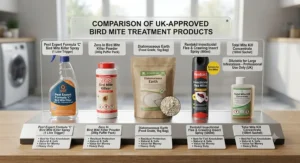
6. NETTEX Total Mite Kill — best coop and aviary surface treatment
NETTEX Total Mite Kill is built specifically to treat the environment rather than the bird directly, using a permethrin-based formula designed to be applied thoroughly to cage bars, nesting boxes, perches, and the nooks and crannies where red mites retreat to hide during daylight hours. This distinction matters more than it might first appear: red mites spend the vast majority of their time off the bird, hiding in gaps and cracks and only emerging at night to feed, which means treating the bird alone without also hitting the housing leaves the source of reinfestation completely untouched. Real-world guidance from experienced poultry and aviary keepers consistently describes a routine of thoroughly wiping or soaking surfaces with a permethrin-based spray like this, then leaving the housing to dry completely — with birds kept out for a minimum of two hours — before letting birds back in, which is a genuinely important safety step rather than an optional extra. This product suits anyone dealing with a confirmed infestation who understands that spot-on or oral treatments for the bird need to be paired with proper environmental treatment to actually break the mite lifecycle rather than just suppressing symptoms temporarily. It’s less suited to owners looking for a single all-in-one product, since it’s explicitly an environment treatment rather than something applied to the bird itself.
Pros:
- ✅ Purpose-built for cage, coop and aviary surfaces
- ✅ Permethrin formula targets mites hiding in crevices
- ✅ Pairs effectively with bird-applied spot-on treatments
Cons:
- ❌ Birds must be kept out during application and drying
- ❌ Doesn’t treat mites already living on the bird
Typically priced around £10-£15, this is a genuinely necessary companion product for anyone serious about breaking a mite infestation rather than just masking it.
7. Birdly Bird Mite Spray — best budget quick-fix for a single cage
Birdly Bird Mite Spray is positioned as a straightforward, budget-friendly alternative to red mite powder for owners managing a single budgie or parrot cage rather than a full outdoor aviary, sold in a 100ml bottle sized for smaller-scale, more frequent use. It’s marketed specifically as lovebird-friendly and cage-focused, aiming to cover both the bird and its immediate housing in one lighter-weight product rather than requiring separate spray and powder purchases. This suits owners who’ve spotted early mite infestation signs — a few dark specks on cage liners overnight, mild irritation — and want to act quickly on a single cage without committing to a larger multi-product routine or a bigger bag of diatomaceous earth they don’t need for one bird. Honestly, independently verified customer review volume for this specific product is thinner than for longer-established brands like Johnson’s or Beaphar, so rather than invent sentiment that doesn’t exist, it’s worth saying plainly: treat it as a reasonable budget option for early-stage, single-cage problems, but if an infestation is already well established or spans multiple cages, the better-documented options elsewhere on this list — paired with a proper environmental treatment like NETTEX — are the more thoroughly proven route.
Pros:
- ✅ Budget-friendly for single-cage treatment
- ✅ Marketed as suitable for smaller, sensitive birds
- ✅ Compact 100ml size for lighter, more frequent use
Cons:
- ❌ Smaller bottle stretches less far than 150ml+ rivals
- ❌ Limited independently verified long-term review data
At around £8-£12, this is a reasonable low-commitment starting point, best paired honestly with your own close observation of whether it’s actually working within the first week or two.
Practical Usage Guide: Applying Treatment Safely
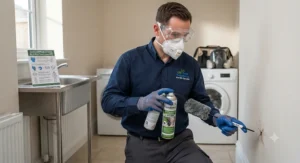
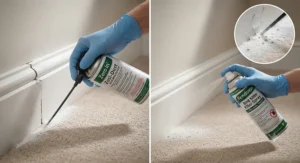
Getting the application right matters as much as picking the right product. Before applying any spray, remove food and water dishes from the cage so you’re not contaminating what your bird eats and drinks straight afterwards, and always spray from the recommended distance rather than close up, since birds’ respiratory systems are considerably more sensitive than a cat’s or dog’s. For spot-on treatments, part the feathers carefully at the base of the neck so the liquid reaches skin rather than sitting on feather tips where it won’t absorb properly, and always weigh your bird first if you’re at all unsure which weight band applies. When treating cage surfaces with a permethrin-based product like NETTEX, spray or wipe thoroughly into every joint, corner and perch fitting — mites hide in gaps as narrow as a millimetre during the day — then allow at least two hours of drying time with the bird kept elsewhere before returning it to the cage.
In the first thirty days of tackling a confirmed infestation, the most common mistake is treating once and assuming the job is done. Because red mites reproduce so quickly, a single treatment round rarely catches every life stage present, so plan on repeat applications roughly a week apart for at least two to three cycles, alongside a full deep clean of the cage between treatments. Wash all removable cage furniture — perches, toys, feeders — in hot water and, where the material allows, a suitable disinfectant, since mites and their eggs can cling to fittings even after a spray treatment has dried. Keep a simple log of when each treatment was applied; it’s easy to lose track of the schedule once symptoms start improving, and stopping too early is the single most common reason infestations bounce back within a fortnight.
Real-World Scenarios: Which Treatment Suits Your Situation
Picture three bird owners dealing with three different problems. The first has a single budgie showing mild overnight scratching and a handful of dark specks on the cage liner each morning — an early-stage, low-severity situation. For them, Birdly Bird Mite Spray or Johnson’s Anti-Mite Extra Spray paired with a thorough weekly clean is a sensible, proportionate first step, rather than reaching immediately for a vet-strength ivermectin spot-on that’s honestly more product than the situation currently calls for.
The second owner has a canary showing more pronounced symptoms — feather loss, visible agitation, mites clearly present on close inspection — and needs something that works faster and more thoroughly. Here, Naqua Mite Treatment Ivermectin 0.10% or Beaphar Anti-Parasite Spot-On, applied correctly by weight and paired with NETTEX Total Mite Kill on the cage itself, gives a genuinely comprehensive approach that tackles both the bird and the environment simultaneously.
The third is managing a full outdoor aviary housing a dozen finches, where a single-cage spray simply won’t cover the space involved. For them, Multi-Mite 2kg Diatomaceous Earth worked thoroughly into perches, nest boxes and bedding, combined with AVI-MITE Red Mite Liquid as an ongoing preventive in the drinking water, is the more practical and cost-effective combination than repeatedly buying small single-cage bottles.
How to Choose a Bird Mite Treatment
Working through these questions in order will get you to the right product faster than browsing reviews at random.
- Confirm it’s actually mites. Check overnight for tiny specks on cage liners or a white sheet draped over the cage, since some symptoms overlap with other conditions best confirmed by an avian vet.
- Assess severity honestly. Mild irritation with a few visible mites calls for a different response than visible feather loss and heavy nighttime activity.
- Decide bird treatment, environment treatment, or both. Serious infestations almost always need both a bird-applied product and a cage or aviary surface treatment.
- Check the weight band for spot-ons. Ivermectin-based products are dosed by bird weight, so an incorrect band either underdoses or risks overdosing.
- Consider your setup size. A single indoor cage suits a spray or spot-on; a full outdoor aviary is better served by a larger powder or liquid product bought in bulk.
- Factor in application frequency. Some products need weekly reapplication, others offer four-week protection — pick what realistically fits your routine.
- Set a treatment and clean schedule together. No product alone fully solves an infestation without a genuine cage-cleaning routine running alongside it.
Chemical vs Natural Bird Mite Treatments: Which Wins?
| Factor | Chemical (Ivermectin/Permethrin) | Natural (DE/Plant Extract) |
|---|---|---|
| Speed of action | Fast, often within days | Slower, more gradual |
| Best For | Active, established infestations | Prevention and mild cases |
| Application effort | Precise dosing or spraying | Powder application, careful dosing in water |
| Environmental impact | Targeted but chemical-based | Mechanical or deterrent, non-toxic |
Neither category is objectively “better” across every situation, and it’s worth resisting the marketing instinct to treat “natural” as automatically safer or “chemical” as automatically more effective. For a confirmed, established infestation, a chemical option like Naqua Mite Treatment Ivermectin 0.10% or NETTEX Total Mite Kill genuinely works faster, and speed matters when a bird is being bitten nightly. For prevention or a very mild early case, natural options like AVI-MITE Red Mite Liquid or Multi-Mite 2kg Diatomaceous Earth do a perfectly good job without introducing pesticide residue into the cage environment unnecessarily.
Common Mistakes When Buying Bird Mite Treatment
The single most common mistake is buying a bird-applied treatment only and skipping the cage or aviary treatment entirely, which leaves the mite population hiding in gaps and crevices completely untouched and guarantees rapid reinfestation within days. A close second is choosing the wrong weight band on a spot-on product — grabbing whatever’s cheapest on the shelf rather than checking your bird’s actual weight against the packaging — which either under-treats or risks an inappropriate dose. Buyers also frequently underestimate how many treatment cycles a genuine infestation needs, expecting one spray or one spot-on application to end the problem when red mites’ rapid breeding cycle typically demands at least two to three repeat treatments a week or so apart. Finally, plenty of first-time buyers reach straight for the strongest chemical product available out of understandable panic, when a milder natural option paired with a proper clean would have been entirely sufficient for what was actually quite a mild, early-caught case.
Mite Infestation Signs: What to Look For
Recognising mite infestation signs early makes the entire treatment process considerably easier, since a mild case caught early responds to lighter treatment than a fully established colony. The classic giveaway is finding tiny dark or reddish specks on cage liners, perches or bedding first thing in the morning — red mites feed on birds overnight and retreat to hide during daylight, so morning is genuinely the best time to check. A simple, low-effort diagnostic method some owners use is draping a white sheet or cloth over the cage overnight; by morning, any mites present will typically be visible against the pale fabric. Behaviourally, watch for restlessness after dark, increased preening or scratching, and in more advanced cases, patches of feather loss or visibly irritated skin. Weight loss, lethargy and pale combs or skin can indicate a heavier infestation causing genuine blood loss, particularly in smaller birds, and at that stage a vet visit alongside treatment is genuinely the sensible next step rather than relying on over-the-counter products alone.
Bird Mite Treatment Options: Sprays, Spot-Ons & Powders Explained
Understanding the different bird mite treatment options available helps explain why this guide features such a spread of formats rather than a single “best” product. Contact sprays, like Johnson’s Anti-Mite Extra Spray and Birdly Bird Mite Spray, work by direct contact with mites on skin, feathers or surfaces, and generally need repeat application to catch mites at different life stages. Spot-on treatments, like Naqua Mite Treatment Ivermectin 0.10% and Beaphar Anti-Parasite Spot-On, are absorbed systemically through the skin and tend to offer longer protection windows with less frequent dosing. Powders, such as Multi-Mite 2kg Diatomaceous Earth, work mechanically rather than chemically and suit larger areas needing thorough, ongoing coverage. Water additives, like AVI-MITE Red Mite Liquid, take the slowest but lowest-stress route, working preventatively without requiring the bird to be directly handled or sprayed at all. None of these formats is universally superior — the right choice depends on infestation severity, setup size, and how comfortable you are handling your bird directly for treatment.
Mite Spray for Cages: What to Look For
If a mite spray for cages is specifically what you’re after, a few practical features are worth prioritising over marketing claims. Check whether the spray is formulated for direct bird application, surface application, or both — some, like Johnson’s Anti-Mite Extra Spray, cover both uses, while others, like NETTEX Total Mite Kill, are explicitly surface-only and shouldn’t be sprayed directly onto a bird. Bottle size matters more than it seems: a 100ml bottle like Birdly Bird Mite Spray suits a single small cage treated occasionally, while a full aviary realistically needs a larger 150ml-plus bottle or a powder product bought in bulk to avoid running out mid-treatment cycle. Finally, check the active ingredient against what you’re comfortable using around a bird that will inevitably preen and ingest some residue — this is exactly why permethrin-based surface sprays specify a drying and clearance time before birds return to treated housing.
Avian Mite Control Products: Chemical vs Natural Ingredients
Among avian mite control products broadly, the active ingredient tells you far more about how a product actually works than the marketing copy on the front of the bottle. Ivermectin, found in Naqua Mite Treatment Ivermectin 0.10% and Beaphar Anti-Parasite Spot-On, is a genuinely potent endectocide effective against a wide range of internal and external parasites, absorbed systemically rather than sitting on the surface. Permethrin, used in products like NETTEX Total Mite Kill and the small-animal-adjacent Johnson’s range, is a contact insecticide that disrupts a mite’s nervous system on direct exposure. Diatomaceous earth, the basis of Multi-Mite 2kg Diatomaceous Earth, works entirely mechanically through physical dehydration rather than any chemical mechanism at all. And plant-based deterrent formulas, like AVI-MITE Red Mite Liquid, rely on making the bird’s blood or scent less appealing to mites rather than directly killing them on contact. Knowing which category a product falls into helps set realistic expectations — a mechanical or deterrent product genuinely won’t act as fast as a systemic or contact insecticide, and that’s a design trade-off rather than a flaw.
Aviary Hygiene: Your First Line of Defence
No bird mite treatment, however strong, fully solves a recurring problem without proper aviary hygiene running alongside it. Red mites survive by hiding in cracks, joints, and organic debris during the day, which means a genuinely thorough clean does more long-term work than any single product. Removing droppings and old bedding daily, rather than weekly, significantly reduces the debris mites and their eggs can shelter in, and a full deep clean of perches, nest boxes and cage furniture with hot water — and a bird-safe disinfectant where appropriate — should happen regularly rather than only once symptoms appear. Wooden fittings are worth particular attention, since untreated wood is considerably harder to fully disinfect than metal or plastic and can harbour mites in tiny grain cracks long after a surface spray has dried. For outdoor aviaries specifically, keeping the surrounding area free of wild bird nests and droppings matters too, since wild birds are a common source of reintroduced mites even after a cage or aviary itself has been thoroughly treated. Building a simple weekly hygiene routine — rather than treating cleaning as a reactive, infestation-only task — is genuinely the single most effective long-term step any bird keeper can take.
Red Mite Lifecycle: Why Reinfestation Happens So Fast
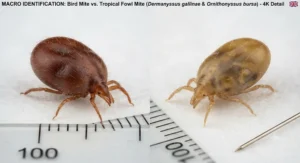
Understanding the red mite lifecycle explains, better than almost anything else in this guide, why a single treatment round so often fails to solve the problem completely. Research on the poultry red mite (Dermanyssus gallinae) shows the species can complete its entire life cycle — egg, larva, protonymph, deutonymph, adult — in as little as one to two weeks under favourable conditions, with adult females capable of laying dozens to well over a hundred eggs across their lifetime. That speed is the core reason a single spray or spot-on treatment, applied once, typically isn’t enough: eggs present at the time of treatment may hatch days later, well after the active treatment has worn off, restarting the cycle. Adding to the challenge, published research on Dermanyssus gallinae notes the mites are remarkably resilient, capable of surviving extended periods without a blood meal by hiding in cracks and crevices away from the host between feeds. Practically, this is exactly why the repeat-treatment schedule outlined earlier in this guide — roughly weekly reapplication across two to three cycles — matters so much more than a single confident spray; you’re not just killing the mites visible today, you’re trying to break a reproductive cycle fast enough that it can’t rebuild itself between treatment rounds.
Long-Term Cost & Maintenance
Treating an active mite infestation is rarely a single purchase, and it’s worth budgeting for the full cycle rather than just the first bottle. A typical infestation resolved properly might involve two to three rounds of a bird-applied treatment like Beaphar Anti-Parasite Spot-On, alongside at least one thorough treatment of the cage with something like NETTEX Total Mite Kill, bringing a realistic total spend closer to £25-£40 rather than the price of a single product alone. Ongoing prevention is considerably cheaper than repeat treatment of full infestations — a bottle of AVI-MITE Red Mite Liquid lasting several weeks of maintenance dosing, or occasional light dusting with leftover Multi-Mite Diatomaceous Earth, costs a fraction of what a full reactive treatment cycle runs to. Factoring in a proper weekly hygiene routine alongside product costs genuinely reduces how often you need to buy treatment at all, since most recurring infestations trace back to gaps in cleaning rather than a product simply “not working.”
Safety & Regulations: What UK Bird Keepers Need to Know
Several products in this category, including ivermectin-based spot-ons like Naqua Mite Treatment Ivermectin 0.10% and Beaphar Anti-Parasite Spot-On, are classified as veterinary medicines in the UK and are marketed under the relevant Veterinary Medicines Regulations framework, meaning they’re formulated and tested specifically for animal use rather than repurposed household products. It’s worth checking product listings on the Veterinary Medicines Directorate’s product database if you want to verify a specific product’s authorisation status before buying, particularly for anything making veterinary medicine claims. Always follow label dosing precisely rather than estimating, since both under-dosing and over-dosing carry real risks — under-dosing can allow resistant mites to survive and multiply, while over-dosing certain active ingredients can cause genuine harm to a small bird’s system. For infestations that don’t improve after a proper two-to-three-cycle treatment course, or where a bird shows signs of significant weight loss, lethargy or visible distress, a vet consultation is genuinely the right next step rather than continuing to cycle through over-the-counter products indefinitely.
Frequently Asked Questions
❓ How quickly does bird mite treatment work?
❓ Can I use dog or cat mite treatment on birds?
❓ Do I need to treat the cage as well as the bird?
❓ Is diatomaceous earth safe for pet birds?
❓ How often should I check for bird mites?
Conclusion
There’s no single best bird mite treatment for every situation, and that’s really the core message of this guide: the right product depends on how severe the infestation is, whether you’re treating one cage or a full aviary, and how comfortable you are handling your bird directly. For a confirmed, active infestation, vet-strength spot-ons like Naqua Mite Treatment Ivermectin 0.10% or Beaphar Anti-Parasite Spot-On paired with a proper surface treatment like NETTEX Total Mite Kill give you the fastest, most thorough combination. For milder cases or ongoing prevention, budget sprays like Johnson’s Anti-Mite Extra Spray and Birdly Bird Mite Spray, or natural options like AVI-MITE Red Mite Liquid and Multi-Mite 2kg Diatomaceous Earth, do a genuinely solid job without reaching for the strongest chemical option unnecessarily.
Whatever you choose, remember that no single bottle solves this on its own — a proper repeat-treatment schedule and a genuine aviary hygiene routine matter just as much as the product itself. Check current prices before buying, since availability shifts regularly, and don’t hesitate to bring in a vet if symptoms persist beyond a couple of proper treatment cycles.
Recommended for You
- 7 Top Immune Support Supplements for Pet Birds in 2026
- Feather Health Supplement for Parrots: 7 Best Picks 2026
- Vitamin supplement for moulting birds: 7 Real UK Picks for 2026
Disclaimer: This article contains affiliate links. As an Amazon Associate, I earn from qualifying purchases. If you purchase products through these links, we may earn a small commission at no additional cost to you.
✨ Found this helpful? Share it with your friends! 💬🤗
