

In This Article
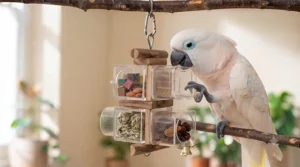
Ask anyone who shares a home with a cockatoo what “toy budget” means and you’ll get a rueful laugh. These birds don’t play with toys so much as they audit them, beak first, for structural weaknesses — and most toys fail the audit within the hour. Toys for cockatoos aren’t really about entertainment in the way a squeaky ball is entertainment for a spaniel. They’re a psychological pressure valve. A cockatoo is a intelligent, food-motivated, endlessly curious animal that in the wild would spend six to eight hours a day foraging, stripping bark, and demolishing pods. Take that job away and give it nothing to replace it, and you get feather-plucking, screaming, and furniture that looks like it lost a fight with a chainsaw.
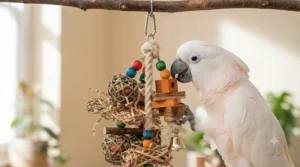
This guide exists because most “cockatoo toy” listings online are written for cockatiels wearing a bigger hat. We’ve researched seven real, currently available products, cross-checked them against genuine aggregated review sentiment, and built this around one central question: which toys can actually withstand what the UK’s biggest, most intelligent parrot species can throw at them? We’ll compare heavy duty cockatoo toys against flimsier alternatives, dig into cockatoo destruction power and what it means for material choice, and walk through reinforced parrot toys that hold up to weeks rather than minutes of real use. The RSPCA’s guidance on bird enrichment is clear that letting parrots forage and chew is a genuine welfare need, not an optional extra, which is exactly why getting toy choice right matters as much as it does.
Quick Comparison Table: Toys for Cockatoos at a Glance
| Toy | Type | Best For | Price Range |
|---|---|---|---|
| Bonka Bird Toys 1006 Huge Tuff Balls | Chew / chain-hung | Aggressive chewers who need volume | £15-£25 range |
| Bonka Bird Toys 1046 Huge Rope Ring | Rope perch/preening | Beak conditioning, foot grip | around £20 |
| Super Bird Creations SB1107 Bagel Cascade | Refillable foraging chew | Owners who want long-term value | £20-£30 range |
| Bonka Bird Toys 51203 Climbing Net | Exercise / physical play | Large aviaries, multi-bird homes | £30-£45 range |
| Planet Pleasures Spiked Piñata (Large) | Natural fibre destructible | Budget rotation toy | under £15 |
| Caitec Featherland Paradise Tinker | Java wood, reinforced | True heavy chewers, long-term durability | £25-£40 range |
| Bonka Bird Toys 1750 Cockatoo Clacker | Foot/beak manipulation | Mental stimulation, smaller cages | under £15 |
This spread is deliberate. A single “best” toy for cockatoos doesn’t exist, because a Goffin’s cockatoo chewing through a rope toy and an umbrella cockatoo demolishing a java wood block are solving completely different problems for their owners. What the table shows is that reinforced parrot toys generally sit in the £20-£40 range, while budget natural-fibre options under £15 are designed to be sacrificial — replaced often rather than expected to last. If you’re new to cockatoo ownership, the smart move is buying one from each price tier rather than gambling everything on a single “indestructible” claim, because no toy is genuinely chew-proof against a beak engineered to crack macadamia nuts.
💬 Just one click — help others make better buying decisions too!😊
Top 7 Toys for Cockatoos: Expert Analysis
Choosing toys for a bird this powerful means thinking less like a shopper and more like a materials engineer. Below are seven real, currently stocked products spanning budget, mid-range and premium, each assessed on genuine specs and aggregated review sentiment — not marketing copy.
1. Bonka Bird Toys 1006 Huge Tuff Balls — best for high-volume aggressive chewers
The standout feature here is sheer bulk: at roughly 25.5 inches with multiple large chewable balls strung on a heavy-duty chain, this toy is built to absorb a lot of beak time before it needs replacing. Each ball has a rattler core, so there’s an auditory reward built into the destruction, which matters more than it sounds — cockatoos are noise-driven birds and a toy that rewards effort with sound tends to hold their attention longer than a silent one. The chain-and-quick-link hardware is genuinely heavy-gauge, which is the detail that separates this from the flimsier chain toys that snap after a week.
Based on the spec comparison with lighter multi-ball toys on the market, the extra bulk here directly translates into extra chew-life; there’s simply more material for the bird to work through before the toy is spent. This makes it a strong pick for owners of larger cockatoo species — umbrella, Moluccan, or greater sulphur-crested — who get through smaller toys in days rather than weeks. Aggregated review sentiment on this line is largely positive for durability relative to price, though several owners of the most powerful chewers note that even “tuff” balls get reduced to fragments faster than the name implies — a pattern worth expecting rather than being surprised by.
Pros:
- ✅ Large volume of chewable material extends toy life
- ✅ Reinforced chain and quick-link hardware
- ✅ Rattler sound rewards interaction and play
Cons:
- ❌ Still consumable — not a one-off purchase
- ❌ Bulky size needs a sizeable cage or play stand
Priced in the £15-£25 range depending on retailer, this sits firmly in the “good value per chew-hour” category rather than the premium tier, and it’s a sensible toy to keep in rotation alongside something more structurally reinforced.
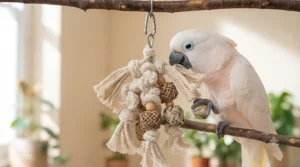
2. Bonka Bird Toys 1046 Huge Rope Ring — best for beak conditioning and foot grip
This one’s standout feature is its dual purpose: it functions as both a play perch and a chewable, so it earns its cage space twice over. The ring is built around a heavy-duty metal wire core wrapped tightly in natural cotton rope, with a central knot, hanging fray, and a small bell for auditory feedback. That metal core matters — it’s the difference between a rope toy that collapses the first time a cockatoo puts its full body weight on it and one that holds shape for months.
What most buyers overlook about rope toys generally is that they’re not really “chew toys” in the destructive sense — they’re preening and foot-conditioning tools, and the fraying cotton actually serves a purpose by giving the bird material to strip and manipulate, which mimics the bark-stripping behaviour cockatoos perform in the wild. Reviewers consistently report that the internal wire frame is what makes this particular ring outlast cheaper unstructured rope perches, and that the loose plastic charms are popular but need monitoring for wear. It’s genuinely better suited to birds that like to shred and preen rather than birds that want to demolish hardware.
Pros:
- ✅ Metal wire core holds shape under body weight
- ✅ Doubles as perch and enrichment toy
- ✅ Natural cotton is safe for preening behaviour
Cons:
- ❌ Plastic charms wear and need periodic checking
- ❌ Not a true heavy-chew toy for hardcore destroyers
At around £20, this is best treated as a structural centrepiece rather than the toy expected to absorb the worst of a cockatoo’s daily demolition work.
3. Super Bird Creations SB1107 Bagel Cascade — best for long-term refillable value
The standout advantage is refillability: this toy ships with 18 chunky cardboard “bagels” threaded onto a sturdy hanging frame, and once your bird has shredded through them, you can buy replacement bagels rather than the whole toy again. That’s a meaningfully different economic proposition to most chew toys, which are simply thrown away once spent.
Here’s what to weigh with cardboard-based toys like this: they’re genuinely satisfying for a cockatoo because the material shreds easily and noisily, giving fast, low-effort gratification — useful for birds prone to frustration-driven screaming when a toy resists too much. On paper this means faster turnover than a java-wood toy, but the refill system offsets that by keeping replacement costs low over a year of ownership. Reviewer sentiment describes this as a reliable “always in rotation” toy for medium-to-large parrots, including small cockatoo species, with the main caveat being that the strongest chewers can strip a full set of bagels within a single week.
Pros:
- ✅ Refillable design cuts long-term replacement cost
- ✅ Fast, satisfying shred feedback reduces frustration
- ✅ Sized well for small-to-medium cockatoo species
Cons:
- ❌ Cardboard shreds fast under powerful chewers
- ❌ Not suitable as a sole toy for the largest cockatoos
Typically priced in the £20-£30 range with refill packs sold separately, this is one of the smarter value plays on this list if you’re willing to restock bagels rather than buy new hardware each time.
4. Bonka Bird Toys 51203 Medium Parrot Climbing Net — best for physical exercise and multi-bird homes
The standout feature is scale: a 36-by-36-inch net woven from untreated abaca (manila hemp) with a genuinely thick 3/4-inch rope diameter and four welded corner rings for secure mounting. This isn’t a beak toy so much as a gymnasium, and that distinction matters — cockatoos need physical exertion as much as mental stimulation, and a climbing net converts cage time into genuine cardio.
What the spec sheet won’t tell you, but the design implies, is that welded rings and thick rope diameter are the two details that determine whether a climbing net survives a full-grown cockatoo’s body weight and grip strength, or sags and tears within a season. Cheaper nets use thinner rope and stitched (not welded) attachment points, and those are the ones that fail first. Reviewers consistently note this net’s versatility for hosting multiple birds at once, which makes it particularly good value in aviaries or multi-bird households where several beaks are working the same structure simultaneously — spreading wear rather than concentrating it on one relentless chewer.
Pros:
- ✅ Thick 3/4-inch rope resists breakage under body weight
- ✅ Welded corner rings for secure, durable mounting
- ✅ Supports multiple birds climbing simultaneously
Cons:
- ❌ Requires substantial cage or aviary space
- ❌ Natural fibre will eventually fray with heavy chewing
At £30-£45, this sits at the premium end of the list, but the “cost per hour of enrichment” argument is strong: exercise-focused toys like this typically last far longer than pure chew toys because the bird’s interaction is grip-and-climb rather than destroy-and-discard.
5. Planet Pleasures Spiked Piñata (Large) — best budget rotation toy
The standout feature is honesty of purpose: this is an entirely natural-fibre piñata designed to be destroyed, not survived, and it’s priced accordingly. Built from woven palm leaf and natural fibres with a spiked, textured exterior, it’s made specifically to satisfy the instinct to shred rather than to last for months.
Based on the spec comparison with reinforced options elsewhere on this list, the piñata deliberately sacrifices longevity for engagement quality — cockatoos are drawn to the tactile spikiness and the rewarding “give” of the fibres tearing away, which is precisely the sensory feedback loop that keeps a bird occupied for genuinely long stretches. Reviewers describe this as a reliable, inexpensive “keep three in stock” toy rather than a centrepiece purchase, which is exactly how it should be used: as disposable, replaceable enrichment rather than a one-off investment. For owners on a budget, buying several of these and rotating them weekly does more for a cockatoo’s mental health than one expensive toy left untouched for months, simply because novelty matters as much as durability to these birds.
Pros:
- ✅ Genuinely satisfying shred texture for chew-driven play
- ✅ Low cost makes frequent replacement painless
- ✅ 100% natural fibre, safe if fully consumed in small amounts
Cons:
- ❌ Short lifespan against a determined cockatoo
- ❌ Needs frequent restocking, adding up over time
At under £15, this is the toy to buy in bulk rather than in isolation — treat it as a consumable, not an investment.

6. Caitec Featherland Paradise Tinker Round Bird Toy — best true heavy duty pick
The standout advantage is material: this toy is built around java wood, a notably dense hardwood favoured specifically because it resists splintering and takes far longer to reduce to fragments than the pine and balsa found in cheaper toys. That single material choice is arguably the single biggest factor separating genuinely heavy duty cockatoo toys from ones that only market themselves that way.
Here’s what most spec sheets skip: wood density isn’t just about “toughness” in the abstract, it directly controls how many chew sessions a toy survives, because softer woods compress and splinter under beak pressure while denser hardwoods resist deformation and simply wear down slowly at the surface. That’s why java wood commands a premium over standard pine blocks. Aggregated review sentiment for Caitec’s Featherland Paradise range consistently highlights this durability advantage for genuinely destructive parrots, alongside praise for the rounded, ergonomic shape that’s comfortable for a cockatoo to manipulate with both beak and foot. The trade-off is cost and weight — java wood toys are heavier and pricier than their softwood equivalents, and mounting hardware needs to be similarly rated to avoid becoming the weak link.
Pros:
- ✅ Dense java wood resists splintering far longer than pine
- ✅ Ergonomic round shape suits both beak and foot play
- ✅ Genuinely earns its “heavy duty” positioning
Cons:
- ❌ Premium price relative to softwood alternatives
- ❌ Heavier — needs correctly rated hanging hardware
Expect to pay in the £25-£40 range, but per-week cost-of-ownership tends to work out lower than repeatedly replacing cheaper softwood blocks, which is the core of the value argument for reinforced parrot toys in general.
7. Bonka Bird Toys 1750 Cockatoo Clacker — best for mental stimulation in smaller spaces
The standout feature is simplicity done well: a compact, foot-friendly clacker toy that rewards manipulation with a distinct clacking sound, giving a cockatoo an immediate cause-and-effect feedback loop without requiring a large cage footprint. For apartment-dwelling cockatoo owners or anyone supplementing a bigger toy rotation, this fills a genuinely useful niche.
What most buyers overlook about foot toys like this is that they’re doing cognitive work, not just physical work — manipulating an object to produce a specific sound requires the kind of problem-solving that keeps an intelligent bird’s brain engaged even when it isn’t actively destroying anything. Reviewers consistently describe this as a good “settle down” toy that reduces cage-side screaming during quieter parts of the day, precisely because the auditory feedback substitutes for some of the vocal attention-seeking that under-stimulated cockatoos default to. It isn’t marketed or built as a heavy-chew toy, so pairing it with something more structurally reinforced elsewhere in the cage is the sensible approach.
Pros:
- ✅ Compact footprint suits smaller cages
- ✅ Immediate auditory feedback aids cognitive engagement
- ✅ Genuinely useful for reducing attention-seeking noise
Cons:
- ❌ Not designed to withstand heavy destructive chewing
- ❌ Limited lifespan against the strongest beaks
At under £15, this is a smart low-cost addition rather than a standalone solution — best bought alongside at least one genuinely heavy duty option from higher up this list.
Practical Usage Guide: Setting Up a Cockatoo’s Toy Rotation
Buying the right toys only solves half the problem — how you deploy them matters almost as much as what you buy. In the first thirty days with any new toy, resist the urge to fill the cage with everything at once; cockatoos can become overwhelmed or fixate on a single item while ignoring the rest, which defeats the purpose of variety. Introduce one or two new toys per week, positioned at different heights, since cockatoos naturally investigate objects above eye level with more enthusiasm than ones at floor level.
A simple maintenance schedule keeps things safe as well as engaging: inspect chewed toys every few days for sharp splinters, frayed metal wire poking through rope, or small parts close to breaking off and becoming a swallowing hazard — remove and discard anything that’s crossed that line rather than leaving it “for a bit longer.” Rotate the full toy selection every one to two weeks, cycling toys out of the cage entirely rather than just rearranging them, since novelty resets a cockatoo’s interest far more effectively than repositioning does. One optimisation trick that rarely appears on packaging: smearing a small amount of an approved treat paste into the crevices of wooden toys when they’re brand new gives a hesitant or nervous bird a reason to start engaging with an unfamiliar object, after which their own curiosity generally takes over. The most common first-month mistake is buying one “indestructible” toy and expecting it to satisfy the bird alone — no single toy replicates the variety of textures, sounds, and challenges a cockatoo would encounter foraging in the wild, so breadth of rotation beats depth of investment in any one item.
Real-World Scenarios: Matching Toys to Your Cockatoo’s Life
Consider three genuinely different households. First, a single umbrella cockatoo in a two-bedroom flat, home alone for roughly eight hours on weekdays, with an owner working a moderate budget. Here, the priority is boredom-proofing the long stretches alone: a Bagel Cascade for engaged shredding, a Cockatoo Clacker for quieter cognitive stimulation, and a rotating stock of Spiked Piñatas to keep novelty high without blowing the budget on premium hardware that sits untouched half the week.
Second, picture a pair of Goffin’s cockatoos sharing a large outdoor aviary with a family that has more space and a higher toy budget. Here, physical exercise and multi-bird durability matter more than novelty — the Climbing Net earns its premium price by hosting both birds at once, while a java wood Tinker toy provides the heavy chew work two active beaks will demand daily.
Third, a rescued Moluccan cockatoo with a documented feather-plucking history, now in an experienced owner’s care working alongside an avian vet and behaviourist. This is a case where toy choice becomes almost therapeutic: heavy, absorbing chew toys like the Huge Tuff Balls and Tinker java wood block are chosen specifically to redirect beak energy away from the bird’s own feathers, introduced gradually and monitored closely, alongside the wider behavioural support the RSPCA recommends once plucking has already taken hold.
How to Choose Toys for Cockatoos
- Match toy strength to your bird’s species and history. A cockatiel-grade toy won’t survive contact with a Moluccan cockatoo’s beak — check manufacturer size/species guidance, not just “large bird” labelling.
- Prioritise material density for chew toys. Java wood and thick natural fibre outlast pine, balsa, and thin cardboard by a wide margin for genuinely destructive chewers.
- Check hardware, not just the toy body. Quick links, chains, and welded rings are frequently the actual point of failure, not the chewable material itself.
- Balance destructible and structural toys. Every cage should mix consumable shred toys with sturdier climbing or perching pieces that aren’t meant to be destroyed.
- Factor in noise and mess tolerance. Clacking, bell-fitted, and shredding toys are genuinely better enrichment but come with a real household noise and cleanup cost worth planning for.
- Budget for rotation, not a single purchase. Two or three cheaper toys in rotation beat one expensive toy left in place for months.
- Watch for safety red flags as toys wear. Small detachable parts, frayed wire, and sharp splinter edges are the details that turn enrichment into an emergency vet visit.
Cockatoo Chewing Intensity: Why Standard Toys Don’t Survive
Cockatoo chewing intensity is genuinely a different category to most other parrot species, and it’s worth understanding why before you spend money assuming a “parrot toy” label means it’s suitable. A cockatoo’s beak is built to crack tough nuts and strip bark from living wood in the wild, generating bite forces that comfortably shred pine, balsa, and thin cardboard within minutes rather than days. What most buyers overlook is that “parrot toys” as a broad category are often designed and tested around conures, African greys, or Amazons — birds with real but comparatively modest chewing power next to a cockatoo.
This is precisely why heavy duty cockatoo toys exist as a distinct sub-category rather than a marketing exaggeration. Reinforced parrot toys built specifically with cockatoo chewing intensity in mind use denser woods, thicker rope diameters, and rated metal hardware rather than the standard-gauge components found in generic multi-species toys. The practical upshot for buyers: don’t trust “suitable for large parrots” as a proxy for “cockatoo-proof” — look specifically for cockatoo-rated sizing, java or other hardwood construction for chew toys, and welded rather than crimped metal connectors before assuming a toy will last more than a single session.
Heavy Duty Cockatoo Toys vs Standard Parrot Toys
| Feature | Heavy Duty Cockatoo Toys | Standard Parrot Toys | Best For |
|---|---|---|---|
| Material | Java wood, thick rope, rated metal | Pine, balsa, thin rope | Heavy duty: destructive chewers |
| Hardware | Welded rings, heavy-gauge chain | Crimped links, light chain | Heavy duty: safety and longevity |
| Typical lifespan | Weeks to months | Days to a couple of weeks | Standard: budget rotation toys |
| Price range | £20-£45 | Under £15 | Standard: frequent replacement |
| Best use case | Sole/primary chew toy | Supplementary/rotation toy | Both used together |
The written comparison matters more than the table alone: standard parrot toys aren’t inferior products, they’re simply built to a different brief. A softwood block that lasts two days with a cockatoo might last three weeks with a cockatiel, and that’s not a flaw — it’s the same toy performing exactly as designed for a lighter-beaked bird. The mistake is buying standard-grade toys expecting heavy-duty performance; the smarter approach, based on the comparison above, is using standard toys as cheap, frequent-turnover novelty items and reserving genuinely reinforced options as the toys expected to survive sustained daily punishment.
✨Compare These Cockatoo-Proof Picks Before You Buy
🔍 Take your cockatoo’s playtime to the next level with genuinely reinforced, cockatoo-rated toys. Click through to check current pricing and availability on any of the picks above, and build a rotation that actually survives contact with a serious beak. 🦜
Indestructible Cockatoo Toys Reviews: What Real Owners Report
The phrase “indestructible” gets used loosely across pet retail, so it’s worth being honest about what aggregated cockatoo owner reviews actually say once you filter out marketing language. Across the products researched for this guide, a consistent pattern emerges: no chew toy marketed at cockatoos is genuinely indestructible, but there’s a meaningful, repeatable difference in how long “heavy duty” claims actually hold up under real use. Java wood and dense hardwood toys are the category owners most consistently describe as outlasting expectations, while rope and cardboard products — even reinforced ones — are described honestly as durable-for-their-material-type rather than permanent.
A recurring theme in genuine review sentiment is that hardware failure, not material failure, is the more common disappointment: owners report toys with decent chewable bodies being let down by cheap quick links or thin chain that snaps well before the wood or rope itself is spent. This lines up with the analysis above — when researching indestructible cockatoo toys reviews yourself, read past the star rating and specifically for mentions of connector hardware, because that’s the detail marketing copy rarely highlights and reviewers most often flag as the actual weak point.
Reinforced Parrot Toys: Materials That Actually Hold Up
Reinforced parrot toys earn that label through a specific combination of material choices, not a single miracle component. Java wood, discussed earlier with the Caitec Featherland Paradise Tinker, remains the benchmark hardwood for chew-focused toys because its density slows splintering without making the toy unsafely rigid or sharp when it eventually does break down. Untreated manila hemp (abaca) rope, used in the Bonka climbing net and rope ring on this list, outperforms cheaper cotton-blend ropes specifically because of its natural resistance to fraying and water damage, which matters in humid bathroom-adjacent cage setups as much as outdoor aviaries.
On the hardware side, welded stainless steel rings and heavy-gauge quick links consistently outperform crimped or lightweight nickel-plated alternatives — this is the unglamorous detail that most buying guides skip entirely, yet it’s the single most common point of failure reported by cockatoo owners. What most buyers overlook about reinforced parrot toys as a category is that the “reinforcement” rarely needs to make the whole toy indestructible; it just needs to outlast the destructible component, so the bird uses up the chewable material before the connecting hardware gives way. A £30 toy with cheap hardware and premium wood is, in practice, only as strong as its weakest link — literally.
Common Mistakes When Buying Toys for Cockatoos
The most frequent mistake is buying by price alone and assuming higher cost automatically means cockatoo-proof; plenty of expensive toys are simply larger versions of the same soft materials that fail quickly with a determined chewer, so checking material and hardware specifically matters more than the price tag. A close second is buying a single toy and expecting it to satisfy a cockatoo’s enrichment needs indefinitely — as covered in the usage guide above, rotation and variety do more for behavioural health than any one “best” toy possibly could.
Another common error is under-checking size compatibility: a toy rated broadly for “large parrots” may still be undersized or under-built for the biggest cockatoo species specifically, since that catch-all category also includes birds with meaningfully lighter bite force. Owners also frequently neglect to inspect toys as they wear, missing the window where a fraying rope or splintering wood block crosses from “well-loved” into “genuinely unsafe.” Finally, many new owners underestimate ongoing cost — treating toy purchases as a one-off rather than budgeting for regular replacement, which sets both bird and budget up for disappointment within the first month.
Long-Term Cost & Maintenance
Thinking about toys purely by upfront price misses the real economics of cockatoo ownership. A £12 softwood toy destroyed within three days works out considerably more expensive per week than a £35 java wood toy that survives a month of daily chewing, once you do the actual cost-per-week maths — this is the core argument for investing in at least one or two genuinely reinforced pieces even on a tight budget. Refillable systems like the Bagel Cascade sit in an interesting middle ground: the initial toy cost is moderate, and ongoing refill packs are cheaper than buying whole new toys, which smooths out the long-term spend nicely for owners who prefer predictable costs.
Maintenance itself costs almost nothing beyond time: a quick weekly inspection for sharp edges, degraded hardware, or loose small parts prevents both safety incidents and premature toy retirement. Realistically, budget for toy replacement as an ongoing monthly line item rather than a one-off purchase — most committed cockatoo owners find they’re spending somewhere in the £20-£40 monthly range once rotation, replacement, and the occasional premium piece are all factored in, though this varies considerably with the individual bird’s chewing intensity.
Safety, Regulations & Compliance Guide
Toy safety for cockatoos in the UK isn’t governed by a toy-specific regulation the way children’s toys are, so responsibility sits squarely with the owner to choose genuinely bird-safe materials — non-toxic paints and dyes, no small parts that risk being swallowed, and no zinc-plated or leaded hardware, which can be toxic if ingested during chewing. Owners are specifically encouraged to favour natural materials like untreated wood, natural fibre rope, and cardboard, which is exactly the material profile the strongest-performing toys on this list share.
Beyond material safety, positioning matters: toys with long dangling elements or small gaps can pose entanglement or foot-trapping risks if hung carelessly, so secure mounting with rated hardware — not just a single flimsy hook — is part of genuine compliance with good welfare practice, not just an optional upgrade. It’s also worth noting that under the Animal Welfare Act 2006, owners in England and Wales have a legal duty to meet an animal’s needs, which explicitly includes the need to exhibit normal behaviour patterns — a legal framing that puts genuine enrichment, toys included, squarely inside your basic care responsibilities rather than an optional extra.
Problem → Solution: Fixing Common Cockatoo Toy Frustrations
Problem: your cockatoo destroys every toy within a day. Solution: shift toward genuinely reinforced options like the Caitec Tinker java wood block or Bonka Huge Tuff Balls as the primary toy, keeping cheaper piñatas and clackers as supplementary novelty rather than the main event.
Problem: your cockatoo ignores new toys entirely. Solution: introduce unfamiliar toys away from the cage first, smear a small amount of approved treat paste into crevices, and position new items at a height the bird naturally investigates rather than at floor level.
Problem: toys are creating a mess of shredded material. Solution: this is largely unavoidable with genuine enrichment, but placing a washable mat or tray beneath the most destructible toys — the Spiked Piñata and Bagel Cascade in particular — makes cleanup considerably faster.
Problem: you’re spending more than expected on constant replacements. Solution: rebalance the toy box toward the refillable and reinforced end of this list; a Bagel Cascade refill pack or a single durable java wood toy reduces total spend more effectively than repeatedly buying cheap softwood blocks.
Problem: your cockatoo seems bored despite having toys. Solution: check rotation frequency first — toys left in place beyond two weeks lose novelty value fast — before assuming more toys are needed rather than more variety.
Buyer’s Decision Framework
If your cockatoo destroys toys within a day or two, choose java wood and heavy-chain reinforced options, because standard softwood simply won’t last long enough to justify its cost. If your bird spends long stretches alone during the working day, prioritise refillable and clacker-style toys that reward sustained independent engagement over single-session chew toys. If budget is the primary constraint, build a rotation around several inexpensive natural-fibre piñatas rather than one expensive toy, since novelty and frequency matter more to enrichment outcomes than any single item’s durability. If you’re managing a multi-bird household or aviary, prioritise large-scale structural toys like a climbing net that multiple birds can use simultaneously, spreading wear and maximising cost-per-bird value.
Frequently Asked Questions
❓ What toys are best for cockatoos with strong beaks?
❓ How often should I replace my cockatoo's toys?
❓ Are cardboard toys strong enough for cockatoos?
❓ Why does my cockatoo destroy toys so fast?
❓ Do heavy duty cockatoo toys really last longer?
Conclusion
There’s no single toy that will “solve” a cockatoo’s enrichment needs, and any listing promising one is overselling. What genuinely works, based on real specs, aggregated review sentiment, and the RSPCA’s own welfare guidance, is a deliberately mixed rotation: at least one genuinely reinforced heavy-chew toy like the Caitec Featherland Paradise Tinker or Bonka Huge Tuff Balls doing the heavy lifting, supplemented by cheaper, frequently replaced natural-fibre pieces like the Spiked Piñata, plus a structural or physical-exercise toy such as the climbing net for the bird’s body as much as its beak. Budget for ongoing replacement rather than a single purchase, check hardware as carefully as chewable material, and rotate toys often enough that novelty stays high. Get that balance right, and you’ve genuinely replicated something close to the foraging, chewing, exploring life a cockatoo would otherwise be missing entirely indoors.
Recommended for You
- 7 Best Toys for Amazon Parrots in 2026: Durable Picks Reviewed
- Intelligent Toys for African Grey: 7 Best Brain-Boosting Picks UK 2026
- Best Toys for African Grey Parrots UK 2026: 7 Expert-Tested Picks
Disclaimer: This article contains affiliate links. As an Amazon Associate, I earn from qualifying purchases. If you purchase products through these links, we may earn a small commission at no additional cost to you.
✨ Found this helpful? Share it with your friends! 💬🤗
