
In This Article
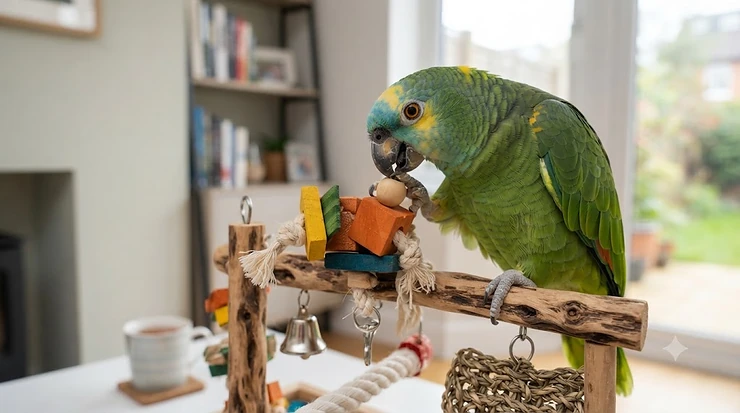
If you live with an Amazon parrot, you already know the drill: you walk into the room, your bird gives you that sideways look, and within forty minutes whatever “indestructible” toy you bought last week is lying on the cage floor in three pieces. Toys for amazon parrots aren’t a luxury purchase — they’re closer to a structural requirement, the same way a teenager needs somewhere to put their energy or they’ll redecorate your walls instead. An Amazon parrot toy is, at its simplest, any safe object designed to satisfy a parrot’s instinct to chew, forage, climb or manipulate with its beak and feet, replacing the hours of natural foraging behaviour these birds would otherwise spend hunting for food in the wild.
What makes Amazons tricky customers isn’t a lack of interest — quite the opposite. Double yellow-headed, blue-fronted and yellow-naped Amazons are famously food-motivated, opinionated, and built with a beak strong enough to crack a Brazil nut without flinching. Toy shopping for one of these birds, then, becomes a balancing act between durability, safety, and genuine mental engagement, and that’s exactly the gap this guide is here to close.
Across the next sections, you’ll find seven real, currently available products spanning budget multi-packs through to premium chew sets, honest analysis of how each one holds up against an Amazon’s bite force, and practical guidance on building a rotation that actually keeps your bird occupied rather than gathering dust by week two. As the RSPCA notes in its bird enrichment guidance, parrots are particularly intelligent and need things to occupy their minds and keep them physically active, so getting this right isn’t fussy bird-parent behaviour — it’s basic welfare.
Quick Comparison Table
Before the deep dive, here’s the at-a-glance version for anyone short on time.
| Toy | Type | Best For | Price Range |
|---|---|---|---|
| BIPY 16-Piece Parrot Toy Bundle | Mixed multi-pack | Starter toy sets, rotation variety | under £25 |
| Jijizhazha Wooden Block Chew Toy | Chew toy | Heavy chewers on a budget | £15-£20 |
| ToughRight 24-Piece Fatty Bagels | Foraging/shredding | Foot-toy and shredding lovers | £15-£25 |
| MQUPIN Large Parrot Wooden Block Toy | Chew toy | Daily beak conditioning | £18-£25 |
| Parrot Essentials Roll & Ring Foot Toy (Pack of 3) | Foot toy | Foot-led, hand-shy birds | £10-£18 |
| Northern Parrots Spin & Chew Activity Swing | Swing/activity | Active, physical players | £25-£40 |
| Caitec Java Wood Chew Set | Premium chew toy | Power chewers, long-term value | £30-£50 |
A quick read of that table tells its own story: this isn’t a one-size-fits-all category, and the “best” toy genuinely depends on whether your bird is a chewer, a forager, or an acrobat. Budget options like the BIPY bundle and the Jijizhazha blocks earn their place by offering volume and variety for not much outlay, which matters when a determined Amazon can reduce a toy to splinters in an afternoon. The premium Caitec set, on the other hand, justifies its higher price through genuinely tougher hardwood that survives long enough to make the cost-per-week look reasonable rather than reckless.
💬 Just one click — help others make better buying decisions too!😊
✨ Don’t Miss These Exclusive Deals!
🔍 Take your Amazon parrot’s playtime to the next level with these carefully selected toys. Click on any highlighted item to check current pricing and availability, and build a rotation your bird will actually use — not ignore.
Top 7 Toys for Amazon Parrots: Expert Analysis
This is the core of the guide: seven real, currently available products, covering budget, mid-range and premium tiers, with honest commentary grounded in their actual construction and in aggregated review sentiment rather than guesswork.
1. BIPY 16-Piece Parrot Toy Bundle — best starter set for toy rotation
The standout feature here is sheer volume: sixteen pieces — bells, coconut shell hangers, a small ladder and assorted chew bits — for one modest outlay, which solves the single biggest mistake new Amazon owners make (buying one toy and expecting it to last).
Each piece uses natural coconut fibre, wood and metal bells rather than painted plastic, which matters because Amazons investigate everything with their tongue and beak first. The set isn’t built to survive a committed power-chewer on its own, but as a foundation for variety it’s hard to beat, since you can hang two or three pieces at a time and rotate the rest weekly. Based on the spec comparison with single-item toys at a similar price, this bundle wins on value simply because you’re paying for eight to ten “tries” rather than betting everything on one untested design.
Reviewers consistently report that the smaller bell and rope pieces vanish fastest with larger Amazons, while the coconut and wood blocks tend to survive several sessions, which lines up with what you’d expect from a mixed-material multi-pack rather than a single-purpose chew toy.
✅ Sixteen pieces give genuine toy-rotation variety from one purchase
✅ Natural coconut and wood materials, not painted plastic
✅ Inexpensive way to test which toy styles your bird prefers
❌ Smaller bell and rope pieces don’t survive committed chewers long
❌ Includes some thin rope elements that need supervision
A set like this typically sits under £25, and as a value verdict, it’s the smartest first purchase for anyone who hasn’t yet worked out their bird’s particular play style.
2. Jijizhazha Wooden Block Chew Toy — purpose-built for Amazon-strength beaks
What stands out about this one is that it’s explicitly marketed for Amazon parrots alongside African greys and macaws, rather than being a generic “small bird” toy stretched to fit a bigger beak.
The block construction uses untreated, multicoloured wood pieces threaded onto a sturdy cord, sized thick enough that an Amazon has to work for each piece rather than snapping through it in seconds. In practice, that thickness is the entire point: thinner dowel toys aimed at cockatiels or budgies get demolished by an Amazon in minutes, while thicker block construction forces a slower, more satisfying destruction process that better matches the bird’s natural chewing rhythm. This is squarely a toy for owners whose Amazon is a confirmed wood-shredder rather than a cuddly type who ignores chew toys altogether.
Aggregated review sentiment across similar wooden block toys in this size class suggests owners with double yellow-headed and blue-fronted Amazons get noticeably longer use than owners of smaller species, simply because the smaller birds can’t generate the same bite force to finish the job quickly.
✅ Sized specifically for large-beaked species, not scaled-down small-bird toys
✅ Multicoloured wood adds visual stimulation alongside chewing satisfaction
✅ Untreated materials reduce ingestion risk if pieces are swallowed
❌ Cord can fray and needs checking every few days
❌ Less mentally stimulating than puzzle-style toys — pure chew satisfaction only
Priced in the £15-£20 range, it’s a strong value pick for a bird whose main love language is destruction.
3. ToughRight 24-Piece Fatty Bagels Foraging Pack — best for shredders and foot-toy fans
The headline feature is the cardboard “bagel” ring shape, designed to be picked up, manipulated with a foot, and methodically shredded — which taps into foraging behaviour rather than pure chewing.
Each ring measures around 1.75 inches, small enough for an Amazon to hold comfortably in one foot while working it apart with the beak, mimicking the kind of manipulative foraging behaviour these birds would use on seed pods in the wild. Here’s what to weigh: cardboard-based foraging toys won’t outlast a hardwood block in raw chew-time, but they deliver a different and arguably more important kind of enrichment — the problem-solving, foot-eye coordination type that the RSPCA specifically flags as essential for intelligent species kept in captivity. What most buyers overlook about foraging-style packs like this is that the value isn’t measured in days of survival, but in minutes of focused engagement per session.
Owners consistently note that Amazons treat these more like a puzzle to dismantle than a chew toy to gnaw on, which is exactly the intended behaviour and a useful contrast to the wood-block style toys elsewhere on this list.
✅ Twenty-four pieces means months of rotation from one pack
✅ Encourages foot-eye coordination and natural foraging movement
✅ Lightweight cardboard is safe even if small fragments are swallowed
❌ Individual rings last minutes to hours, not days
❌ Not suitable as a sole toy for committed wood-chewers
At £15-£25 depending on pack size, the per-piece cost is genuinely low, making this an easy, low-risk addition to any rotation.
4. MQUPIN Large Parrot Wooden Block Toy — daily beak conditioning for medium-large birds
The standout advantage is explicit large-bird sizing, with thick, dense wood blocks built for African greys, macaws and Amazon-sized beaks rather than repurposed cockatiel toys.
Construction relies on chunky natural wood pieces on a reinforced hanging cord, with a weight and density that takes real, sustained chewing pressure to break down — useful information if you’re choosing between this and lighter alternatives, because beak conditioning depends on resistance, not just availability of something to chew. On paper, this means the toy functions almost like a workout for the beak: keeping the keratin worn down evenly, which matters because captive parrots without adequate chewing outlets are prone to overgrown or uneven beak wear, a point covered in detail in the Merck Veterinary Manual’s overview of pet bird health issues. This is best suited to confirmed power-chewers rather than nervous or toy-shy birds, who may find the dense blocks intimidating at first introduction.
A common theme in user feedback on similarly dense wooden block toys is that birds need a few days to “accept” the toy before properly engaging with it — patience during introduction pays off more than swapping toys too quickly.
✅ Genuinely dense wood holds up to sustained Amazon-strength chewing
✅ Helps maintain healthy, even beak wear through regular use
✅ Reinforced cord resists the early failure points of cheaper toys
❌ Higher upfront cost than basic multi-packs
❌ Can take several days for cautious birds to warm up to it
Sitting around £18-£25, it represents solid mid-range value for owners prioritising durability over variety.
5. Parrot Essentials Roll & Ring Foot Parrot Toy (Pack of 3) — best for foot-led, hands-on players
What makes this set distinctive is its design around foot manipulation rather than beak destruction — lightweight rings and rolls sized to be picked up, tossed, and carried.
Each piece in the pack is intentionally light enough for an Amazon to lift and move around the cage, satisfying the instinct to grab, carry and toss objects that’s especially strong in this genus compared with, say, cockatiels. Based on the spec comparison with chew-focused toys, the appeal here isn’t survival time — it’s behavioural variety, since a bird that spends all day gnawing wood and none of it manipulating objects with its feet is missing a whole category of natural movement. Reviewers consistently report that Amazons enjoy throwing these pieces around far more than expected, often using them during supervised out-of-cage time rather than leaving them static in the cage.
This toy type suits social, food-motivated Amazons particularly well, since foot toys can double as a platform for hiding small treats, turning a simple foot toy into a basic foraging exercise.
✅ Lightweight design suits foot manipulation and carrying behaviour
✅ Pack of three means instant rotation without separate purchases
✅ Doubles as a low-effort foraging aid when treats are tucked inside
❌ Won’t satisfy heavy chewers as a standalone toy
❌ Smaller pieces may be tossed out of the cage during play
At a typical £10-£18 for the pack, it’s an affordable way to round out a toy collection that’s currently too chew-heavy.
6. Northern Parrots Spin & Chew Activity Swing — best for active, physical Amazons
The defining feature is the combination function: a swing your bird can perch on and rock, fused with chewable elements positioned within easy beak reach.
The swing element addresses something chew-only toys miss entirely — Amazons are physically energetic birds that benefit from movement-based enrichment, not just gnawing. Here’s what to weigh: a swing alone gives exercise without mental stimulation, while a chew toy alone gives stimulation without movement, so a combination product is solving two problems with one purchase rather than asking you to buy and hang two separate items. What the spec sheet won’t tell you, but owner reports suggest, is that some Amazons take to the swinging motion immediately while others need it introduced stationary first, gradually allowing rocking once the bird is comfortable perching on it.
This is a strong pick for Amazons housed in larger cages or flights with room to actually use the swing’s motion, and a weaker one for birds in tighter quarters where the swing arc has nowhere to go.
✅ Combines physical exercise with chewable enrichment in one product
✅ Suits the genuinely active, climbing nature of Amazon parrots
✅ Replaceable chew elements extend the swing’s working lifespan
❌ Needs cage clearance to swing freely — not ideal for compact cages
❌ Higher price point than single-function chew or foraging toys
Priced around £25-£40, it earns its premium positioning through genuine dual function rather than novelty alone.
7. Caitec Java Wood Chew Set — premium pick for committed power-chewers
The headline advantage is material: java wood, a notably dense hardwood that takes substantially longer for a large parrot to destroy than the pine or balsa used in most budget toys.
Caitec is a long-established US bird toy manufacturer whose java wood range is specifically positioned for large, powerful-beaked species, and the density difference is immediately apparent in handling — these blocks have real heft compared with the lighter chew toys elsewhere on this list. On paper this means a longer working life per toy, which is the entire value argument for paying a premium price: if a £35 java wood set lasts six weeks where a £15 pine toy lasts six days, the cost-per-week actually favours the expensive option. Reviewers consistently note that java wood toys take noticeably longer for Amazons to fully demolish compared with softer pine or basswood alternatives, which tracks with what’s known about the wood’s natural density.
This is not the toy to buy for a nervous or toy-shy bird’s first introduction to chewing — it’s the toy to buy once you already know your Amazon is a serious, committed destroyer that burns through cheaper options too quickly to be cost-effective.
✅ Genuinely dense hardwood outlasts pine and balsa chew toys
✅ Strong cost-per-week value despite higher upfront price
✅ Reputable, established manufacturer with consistent build quality
❌ Premium pricing puts it out of reach for casual toy rotation
❌ Overkill for lighter chewers or toy-shy birds
Typically priced £30-£50, this is the toy worth saving for once you understand your bird’s destruction rate.
Setting Up Your Amazon Parrot Toy Set: A Practical Usage Guide
Buying the toys is the easy part — getting genuine use out of an amazon parrot toy set takes a bit more thought. Start by introducing one new toy at a time rather than overhauling the whole cage in one go; Amazons can be surprisingly cautious about unfamiliar objects despite their bold reputation, and a sudden cage full of strange new shapes can backfire into avoidance rather than play. Place the new item a short distance away first, letting your bird approach in its own time, then move it closer to the favoured perch once curiosity takes over.
For the first thirty days, keep a loose mental log of which toy types actually get used. Most new owners assume their bird will go straight for the flashiest, most colourful option, but it’s just as common for an Amazon to ignore a brightly coloured toy in favour of a plain wooden block that offers better resistance. Once you’ve identified the preferred style — chewing, foraging, foot manipulation — weight future purchases toward that category rather than buying blind. A simple maintenance schedule helps too: check rope and cord elements weekly for fraying, since loose threads pose a far higher entanglement risk than the toy’s main body, and rotate two or three toys out for fresh ones every couple of weeks to prevent the boredom that sets in once a toy’s challenge has been fully “solved.”
A common first-month mistake is overcrowding the cage with toys in an attempt to provide maximum stimulation; in practice, four to six well-chosen items beat ten crammed-in ones, since an overcrowded cage limits flight and movement space, which works against the enrichment goal rather than supporting it.
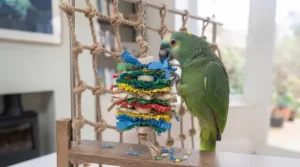
Real-World Scenarios: Matching Toys to Your Amazon’s Play Style
Different households, different birds, different budgets — here’s how three realistic owner profiles map onto the products above, illustrating how amazon parrot play style should genuinely drive purchasing decisions rather than price alone.
Consider a first-time Amazon owner with a young double yellow-headed Amazon and a modest budget. The sensible starting point is the BIPY 16-Piece Bundle paired with the Parrot Essentials Roll & Ring set, giving enough variety to observe play style without overcommitting financially before the bird’s preferences are even established. Compare that with an experienced owner whose blue-fronted Amazon is a known, committed wood-destroyer working through cheap toys in days — for this household, the Caitec Java Wood Chew Set and the MQUPIN block toy make far more financial sense, since the higher per-item price is offset by genuinely longer survival time. Finally, picture an owner with a large flight cage and a physically energetic yellow-naped Amazon that spends more time climbing and swinging than sitting still; here the Northern Parrots Spin & Chew Activity Swing earns its keep precisely because it serves the bird’s movement needs rather than just its chewing instinct.
The throughline across all three scenarios is the same: budget, environment and observed play style should each shape the toy mix, rather than defaulting to whatever’s cheapest or most heavily marketed.
What Is the Right Approach to Toys for Amazon Parrots?
In short: toys for amazon parrots means providing a rotating mix of safe, durable objects — chew, foraging, foot and movement toys — matched to your individual bird’s beak strength, energy level and natural behaviour, swapped regularly enough to keep genuine mental engagement rather than becoming background furniture.
Understanding your bird’s particular amazon parrot play style is the single biggest factor in getting toy purchases right, and it usually falls into one of a few recognisable patterns. Amazon parrots are a genus of around thirty species native to Central and South America, and that wild foraging heritage is exactly why captive birds need such varied toy stimulation. Some Amazons are primarily chewers, working steadily through wood and cardboard with quiet, methodical focus. Others lean foraging — more interested in searching and manipulating than outright destruction — and respond best to puzzle-style or treat-hidden toys. A third group are physical players, gravitating toward swings, ladders and anything that lets them climb or swing rather than sit and gnaw. Most Amazons show traits from more than one category, which is exactly why a single toy type rarely satisfies a bird long-term, and why the strongest toy collections deliberately include at least one option from each play style.
How to Choose Durable Amazon Parrot Toys
Picking durable amazon parrot toys reliably comes down to a handful of repeatable checks, regardless of which specific product you’re considering:
- Check the material density first. Hardwoods like java wood or thick pine blocks resist an Amazon’s bite force far longer than soft balsa or thin dowel, directly affecting how long a toy survives.
- Inspect the connecting hardware. Stainless steel components are safer and longer-lasting than cheaper plated metal, which can corrode or, worse, introduce zinc into a chewed toy.
- Match size to your bird, not the packaging label. A toy labelled “medium-large” by one manufacturer may still be undersized for a robust Amazon — when in doubt, size up.
- Favour replaceable-element designs. Toys built around a reusable frame with swappable chew pieces, like activity swings, stretch your money further than single-use designs.
- Read aggregated review themes, not star ratings alone. A 4.5-star average tells you little; recurring comments about how quickly a toy was destroyed tell you far more about real-world durability.
- Prioritise natural, untreated materials. Vegetable-dyed wood and undyed rope reduce the risk of harmful residue if your bird ingests small fragments during chewing.
- Budget for replacement, not permanence. Even the toughest java wood toy is eventually going to lose to a determined Amazon — factor ongoing replacement cost into your decision rather than expecting a single “forever” toy.
Features That Actually Matter (And Those That Don’t)
Marketing copy on bird toy packaging tends to lean heavily on colour variety and novelty shapes, but neither correlates strongly with how long a toy survives or how engaged your bird stays. What actually matters is wood density, hardware quality, and size appropriateness for your specific bird — the three factors that show up again and again across the products reviewed above. Bright colours do add visual stimulation, which isn’t nothing, but they’re a secondary feature, not a reason to choose one toy over a structurally superior alternative.
Conversely, features that genuinely don’t matter as much as packaging suggests include exact piece counts in mixed bundles (a sixteen-piece pack with ten throwaway pieces isn’t necessarily better value than a six-piece pack of substantial items) and “vet recommended” style language, which carries no regulatory weight in pet toy marketing and shouldn’t substitute for checking material and construction quality yourself.
Medium to Large Parrot Toys vs Toys for Smaller Birds
A frequent and costly mistake is buying medium to large parrot toys sized for cockatiels or budgies simply because they’re cheaper or more widely stocked. The table below sets out the practical differences.
| Factor | Small Bird Toys | Medium-Large (Amazon-Suitable) Toys |
|---|---|---|
| Material thickness | Thin dowel, light rope | Thick blocks, reinforced cord |
| Typical lifespan with an Amazon | Hours | Days to weeks |
| Hardware | Light plastic clips | Stainless steel hooks/links |
| Risk if undersized | Choking on small parts, rapid destruction | N/A — appropriately matched |
| Price range | £5-£12 | £15-£50 |
The clearest takeaway from this comparison is that buying undersized toys isn’t actually a saving — it’s a false economy, since an Amazon will demolish a small-bird toy in a fraction of the time it would take to work through a properly sized one, meaning you end up buying replacements far more often. There’s also a genuine safety dimension here: thinner components designed for lighter birds can fail unpredictably under an Amazon’s bite force, occasionally creating sharp edges or swallowable fragments that a correctly sized toy is built to resist.
💬 Ready to Build a Toy Rotation That Lasts?
Compare current prices on the products above and start with one chew toy, one forager and one foot toy — the simplest, most effective rotation for almost any Amazon.

Common Mistakes When Buying an Amazon Parrot Toy Set
Even well-intentioned owners trip over the same handful of errors when assembling an amazon parrot toy set. The first is buying based purely on visual appeal — bright colours and interesting shapes catch human eyes in a shop or online listing, but they say nothing about whether the toy will survive contact with an Amazon’s beak. The second is under-stocking variety, sticking to a single toy type (usually chew toys) and wondering why the bird seems bored despite having “enough” toys; as covered above, foraging and movement needs go unmet by chew toys alone.
A third common error is ignoring hardware quality in favour of the toy’s headline material. A beautifully dense java wood block strung on cheap, thin cord is only as durable as that weakest link, and frayed or snapped cord is also a genuine entanglement hazard. Finally, many owners introduce too many new toys simultaneously, overwhelming a cautious bird and triggering avoidance rather than engagement — better to add one or two pieces at a time and observe before expanding further.
Understanding Amazon Species Toy Needs
Not every Amazon is built the same, and amazon species toy needs genuinely differ across the more commonly kept species. Double yellow-headed and yellow-naped Amazons tend to be among the more food-driven, vocally confident birds, often showing strong interest in foraging-style toys that involve searching or manipulating for a reward. Blue-fronted Amazons are frequently described by owners as particularly determined chewers, making the denser hardwood options on this list — the MQUPIN block and Caitec java wood set — a sensible starting point rather than an optional upgrade. Smaller Amazon species, such as the white-fronted Amazon, generally need less aggressively sized toys than the larger double yellow-headed or mealy Amazon, so checking your specific bird’s size against a toy’s recommended weight range matters more than assuming “Amazon-sized” is a single fixed category.
Individual personality plays just as large a role as species, though — some birds defy every generalisation, so treat species patterns as a sensible starting point for your first purchases, not a rigid rulebook.
Long-Term Cost & Maintenance
Toy spending for an Amazon parrot is an ongoing cost, not a one-off purchase, and budgeting realistically avoids the frustration of feeling like you’re “always buying toys.” A useful way to think about it is cost-per-week rather than sticker price: a £15 toy destroyed in a week costs more over a month than a £40 toy that survives six weeks, even though the upfront number looks worse. Rotating a mix of budget multi-packs for variety and one or two premium durable pieces for longevity tends to balance the books better than committing entirely to either extreme.
| Toy Type | Typical Price | Typical Lifespan with an Amazon | Approx. Cost per Week |
|---|---|---|---|
| Budget multi-pack piece | £1-£3 | 1-7 days | £1-£3 |
| Mid-range wooden block | £15-£25 | 2-4 weeks | £4-£10 |
| Premium java wood set | £30-£50 | 5-8 weeks | £4-£7 |
Looking at the table, the premium tier actually lands close to mid-range on a per-week basis once you account for survival time, which is the core argument for occasionally spending more rather than always defaulting to the cheapest option. Maintenance costs beyond the toys themselves are minimal — mostly time spent checking hardware and rope condition — but factoring replacement frequency into your monthly pet budget avoids nasty surprises.
Safety, Regulations & Compliance Guide
Safety considerations for Amazon parrot toys centre overwhelmingly on materials and hardware rather than design novelty. Galvanized toys, chains, mesh and bells are recognised sources of zinc exposure in pet birds, and clinical signs of zinc toxicosis include reduced appetite, gastrointestinal disease, weakness and increased thirst, which is precisely why every product reviewed above favours wood, natural fibre or stainless steel over cheap plated metal hardware. The Parrot Society UK’s veterinary guidance on zinc poisoning reinforces this, noting that inexpensive metal toys, links, chains or fasteners can contain zinc and should generally be avoided in favour of safer alternatives.
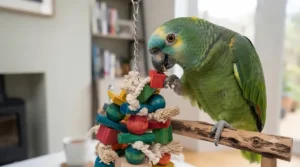
Beyond metal toxicity, rope and cord present an entanglement risk if frayed strands aren’t checked regularly — a five-minute weekly inspection is enough to catch most problems before they become dangerous. There’s no specific UK licensing requirement for owning common Amazon parrot species as pets, though anyone considering a CITES-listed parrot species should check current regulations before purchase, since import and ownership rules vary by species and have changed in recent years.
Frequently Asked Questions
❓ What toys are best for Amazon parrots?
❓ How often should I change my parrot's toys?
❓ Are wooden toys safe for Amazon parrots?
❓ Why does my Amazon parrot destroy toys so quickly?
❓ How many toys does an Amazon parrot need in its cage?
Conclusion
Choosing toys for amazon parrots isn’t really about finding one perfect product — it’s about building a rotation that respects how genuinely varied these birds’ needs are, from a blue-fronted Amazon’s relentless chewing to a yellow-naped’s love of foraging puzzles. The seven products covered here, from the budget-friendly BIPY bundle through to the premium Caitec java wood set, each solve a different piece of that puzzle, and the right combination depends entirely on your individual bird’s play style, your cage setup, and how much replacement cost you’re comfortable budgeting for monthly.
Start small if you’re new to this, observe what your Amazon actually gravitates toward in the first month, and build outward from there rather than guessing at the full collection upfront. Durability matters, but so does variety — a cage full of identical chew blocks misses just as much enrichment value as a cage with no toys at all.
✨ Found Your Bird’s Perfect Toy Match?
🦜 Check current pricing on the picks above and start your Amazon’s toy rotation today — your bird (and your walls) will thank you.
Recommended for You
- Intelligent Toys for African Grey: 7 Best Brain-Boosting Picks UK 2026
- Best Toys for African Grey Parrots UK 2026: 7 Expert-Tested Picks
- Best Toys for Large Parrots UK 2026: 7 Heavy-Duty Picks That Last
Disclaimer: This article contains affiliate links. As an Amazon Associate, I earn from qualifying purchases. If you purchase products through these links, we may earn a small commission at no additional cost to you.
✨ Found this helpful? Share it with your friends! 💬🤗
