
In This Article
There’s a common misconception that finches are somehow the “low maintenance” option of the pet bird world — just pop them in a cage, sprinkle some seed, and off you go. Wrong. Deeply, completely wrong.
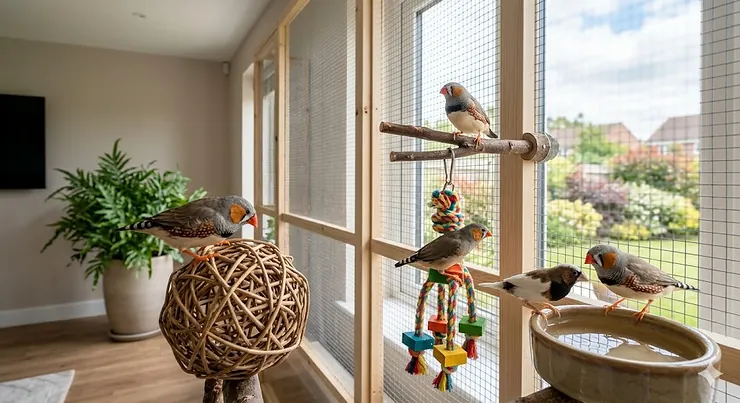
Finches are intelligent, socially complex little creatures with brains that do not appreciate staring at four bare cage walls all day. According to the RSPCA’s bird welfare guidance, pet birds require mental stimulation and environmental enrichment as a fundamental welfare need — not a luxury extra. Boredom in cage birds can manifest as feather-plucking, repetitive swaying, and general listlessness. None of which you want for a bird you’ve taken on as a companion.
Finding suitable toys for finches, however, is its own quiet puzzle. These are tiny birds — often under 15 cm in length — and most bird toys on the market are scaled for parrots or cockatiels. Shove an oversized ring toy into a zebra finch’s cage and you’ve wasted money on something that will hang there, ignored, for the next six months. The sweet spot is finding toys proportioned correctly for finches, made from finch safe toy materials, and designed around how finches actually play: flitting, perching, occasionally investigating things with their beaks, and occasionally singing at their own reflection with concerning enthusiasm.
This guide covers seven genuine products available on Amazon.co.uk, with honest commentary on who each one suits, what the specs actually mean in practice, and how to build an enrichment rotation that keeps your flock genuinely stimulated — not just technically entertained.
What are suitable toys for finches? In short: lightweight, small-scale enrichment items — swings, ladders, mirrors, foraging aids, and natural perches — made from non-toxic materials like untreated wood, natural fibres, and bird-safe dyes, sized for birds under 15 cm and designed to encourage natural behaviours like perching, investigating, and gentle beak manipulation.
Quick Comparison: Suitable Toys for Finches at a Glance
| Product | Type | Best For | Approx. Price (GBP) | Flock-Friendly? |
|---|---|---|---|---|
| Trixie Wooden Swing with Bells | Swing/perch | Single birds & pairs | Under £8 | ✅ Yes |
| Happy Pet 8-Step Wooden Ladder | Ladder/climber | Active, curious finches | Under £10 | ✅ Yes |
| Keersi Colourful Rotate Ladder | Rotating ladder | Variety-seeking flocks | £8–£12 | ✅ Yes |
| KATUMO Bird Swing with Chew Toys | Combo swing set | Bored single birds | £8–£14 | ✅ Yes |
| Hamiledyi Mirror Perch Swing | Mirror/perch | Solo finches only | Under £8 | ⚠️ Use with care |
| HEEPDD Natural Seagrass Foraging Toy | Foraging toy | Instinct-driven enrichment | £6–£10 | ✅ Yes |
| Parrot Essentials Small Bird Toy Set | Multi-toy bundle | New owners, starter kits | £10–£18 | ✅ Yes |
From the table above, the price difference between individual toys and a starter bundle is fairly modest — usually just a few pounds. For first-time finch owners, the bundle option eliminates the guesswork of sourcing compatible pieces separately. That said, experienced keepers with an established flock will get more value from single, targeted purchases they can swap out on a rotation. The mirror perch is the one option requiring genuine thought: keep reading for why.
💬 Just one click — help others make better buying decisions too! 😊
✨ Don’t Miss These Exclusive Deals!
🔍 Take your finches’ enrichment to the next level with these carefully selected products. Click any highlighted item to check current pricing and availability on Amazon.co.uk. These picks will help you find exactly what your birds need!
Top 7 Suitable Toys for Finches: Expert Analysis
1. Trixie Wooden Swing with Bells for Small Birds
Trixie is a German pet brand with genuine, long-standing credibility in the UK avian market — and this small wooden swing with dangling bells is one of the tidiest examples of simple done right. The perch bar sits at a diameter between 8–10 mm, which is ideal for finch feet; anything wider and they can’t grip comfortably, anything narrower and you risk toe strain. The bells are small enough that they produce a soft, gentle tinkle rather than the sort of clang that would send your birds careering off the perch in alarm.
In my experience, finches often take a few days to warm up to a new swing — don’t be disheartened if it hangs untouched for 48 hours. Once they start using it, the gentle rocking motion satisfies their natural urge to perch on branches that sway in the breeze. This is a toy that earns its place in any cage, regardless of flock size.
UK reviewers consistently praise how easy it is to clip in and out for cleaning — important, since cage hygiene matters more than most new owners expect.
✅ Correctly scaled for finch feet
✅ Budget-friendly, well under £8
✅ Natural untreated wood — finch safe toy materials confirmed
❌ Bell coating should be checked on arrival (remove if paint appears flaking)
❌ Single swing suits pairs well but not large flocks without duplicating
Value verdict: Outstanding for the price range. A solid first addition to any cage.
2. Happy Pet Wooden Multi-Coloured 8-Step Ladder
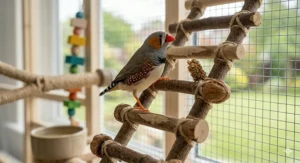
Happy Pet is one of the most consistently available UK pet brands on Amazon.co.uk, and this ladder is a genuine staple. Eight wooden rungs connected by twisted cotton rope give it a slightly flexible, living feel that finches seem to appreciate — it moves just enough to keep things interesting, without being so unstable that nervous birds avoid it entirely.
The rungs are coloured with food-safe dyes, which matters significantly. Cheap imported toys sometimes use industrial coatings that are genuinely hazardous if your bird chews the wood (and finches will chew the wood). The colour variety also appears to attract initial curiosity, making the settling-in period shorter than with plain wooden options.
What most UK buyers overlook about ladders is that finches don’t climb them the way a parrot would — they hop, flutter, and land sideways. Position this toy horizontally across a section of the cage rather than vertically, and you’ll see far more engagement. It essentially becomes an extended perch with texture variation, which is excellent for foot health.
UK customers rate this highly for durability and note that the cotton rope holds up well even with multiple birds.
✅ Food-safe dyes — genuinely important for chew-happy birds
✅ Horizontal placement dramatically increases use
✅ Widely available with next-day Prime delivery
❌ Eight steps may crowd a compact cage — measure before purchasing
❌ Cotton rope connection points need periodic inspection for fraying
Value verdict: Mid-range price for a well-made, versatile toy. Worth it for active flocks.
3. Keersi Colourful Rotate Ladder Toy for Finches and Canaries
Now here’s something a little more interesting. The Keersi Rotate Ladder is designed specifically for small birds including finches and canaries, and what sets it apart is the rotating central section — individual rungs that spin when a bird lands on them. This sounds gimmicky. It isn’t. That unpredictable movement mimics the micro-instability of natural branch perching, and it keeps birds far more engaged than a rigid, static perch.
The materials mix natural wood with coloured plastic connectors. The plastic components are confirmed as non-toxic and bird-safe, though if you’re philosophically committed to all-natural setups, this one will feel like a compromise. For practical purposes — particularly for finch flock toy sharing — the rotating elements create individual engagement that means multiple birds can interact with it simultaneously without direct competition over a single perch point.
This is genuinely one of the better-designed small bird toys currently available on Amazon.co.uk, and the price point sits in a range that makes it easy to buy two for a larger aviary.
UK buyers note the colour range is vibrant without being garish, and the assembly is straightforward.
✅ Rotating sections = sustained engagement beyond initial novelty
✅ Designed specifically for finch/canary scale
✅ Excellent for finch flock toy sharing in group housing
❌ Plastic connectors won’t appeal to purists
❌ Rotation mechanism needs occasional checking to ensure no sharp edges develop
Value verdict: A step above the basics. Recommended for keepers with curious, active birds.
4. KATUMO Bird Swing Toy with Colourful Chewing Accessories
KATUMO have built a reasonable reputation for affordable, colourful bird enrichment, and this swing set offers more bang per pound than most. The central swing is a standard wooden perch in appropriate finch sizing, but it comes accompanied by dangling chew pieces — coloured wooden beads, small knotted rope sections, and a bell at the base. Think of it less as a swing and more as a sensory station: multiple textures, sounds, and engagement points in one compact unit.
For keepers with a single bird or a pair, this kind of multi-element toy addresses a real need. Finches kept without companions are particularly prone to boredom-related behaviours, and having several interactive elements within one toy creates the illusion of a richer environment. The spec sheet won’t tell you this, but the dangling components also serve as a gentle distraction from feather-picking in solo birds — something worth knowing if you’re managing a lone finch for welfare reasons.
Installation is via a standard cage clip and takes about 30 seconds, which UK reviewers appreciate — no tools, no drama.
✅ Multiple engagement points in one unit
✅ Particularly helpful for single or pair-housed finches
✅ Easy clip installation — works on all standard cage bars
❌ Some chew pieces are quite small; inspect regularly for wear
❌ Coloured dye quality varies — check on first delivery
Value verdict: Good value, especially as a standalone enrichment option for solo birds.
5. Hamiledyi Bird Mirror Perch Stand with Wooden Swing
Mirrors for finches are genuinely controversial in avian welfare circles, so let’s address that first. Research from animal behaviour studies at institutions like the University of Lincoln’s animal behaviour unit suggests that mirrors can provide companionship-mimicry for solo birds, but may also cause confusion or mild obsessive behaviour in some individuals — particularly zebra finches, who become remarkably invested in their own reflection. The consensus among experienced keepers is: mirrors are fine in moderation for single birds and should generally be avoided or removed in flocks where they create competition for “access” to the reflection.
With that caveat clearly on the table — the Hamiledyi Mirror Perch is a well-constructed piece. The mirror is encased in a wooden frame with no sharp edges, the perch diameter is appropriate for finches, and the swing function adds movement that prevents the bird from developing a fixed-staring habit. UK customers note the mirror itself is clear and good quality; some cheaper versions distort the image, which appears to disorient birds rather than engage them.
✅ Well-encased mirror — no sharp edges or loose glass
✅ Swing element prevents static fixation on the reflection
✅ Natural wood frame — finch safe toy materials throughout
❌ Not suitable for flocks — use only with single birds
❌ Monitor bird behaviour; remove if obsessive habits develop
Value verdict: A considered purchase for solo finch keepers. Not a toy to deploy thoughtlessly.
6. HEEPDD Natural Seagrass Foraging Mat and Toy
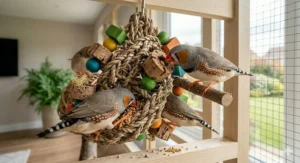
This one operates on a completely different principle from swings and ladders, and it’s arguably the most behaviourally significant toy on this list. Foraging — searching for food by manipulating materials — is one of the most natural and time-consuming activities a wild finch engages in. A caged bird that receives seed in a bowl has that entire behavioural repertoire simply… removed. The result is surplus time and energy with nowhere to go.
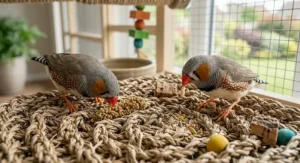
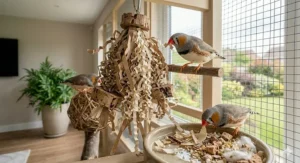
The HEEPDD seagrass mat changes that equation. Natural seagrass fibres can be shredded, pulled, and investigated; small treats (millet sprays work beautifully) tucked into the weave give birds a genuine foraging problem to solve. This is minimal noise finch toys territory — seagrass produces almost no sound, making it ideal for households where the cage is in a shared living space and you’d prefer not to live with the constant background soundtrack of bells.
The material is completely natural, undyed, and confirms finch safe toy materials compliance without any need for additional research on your part. UK reviewers note it lasts considerably longer than expected, even with multiple birds pulling at it simultaneously.
✅ Addresses natural foraging behaviour — highest welfare value on this list
✅ Minimal noise — excellent for living rooms and flats
✅ Completely natural material, zero synthetic components
❌ Needs replacing once significantly shredded (treat this as an ongoing cost)
❌ Less visually engaging than colourful options — some birds take longer to investigate
Value verdict: The most behaviourally enriching pick here. Worth buying in multiples to rotate.
7. Parrot Essentials Small Bird Toy Starter Set (8-Piece)
Parrot Essentials is a UK-based specialist pet supplier with good availability on Amazon.co.uk, and their small bird starter sets represent a sensible way to equip a cage without buying eight individual products and hoping they’re compatible. The eight-piece set typically includes a swing, a ladder, two hanging bell toys, a mirror toy (small), rope perch sections, and a foraging element — essentially a complete enrichment setup in one purchase.
The real advantage here isn’t the individual pieces — you could arguably source each component separately for similar money. The advantage is curation: the pieces are sized to work together in a standard finch or canary cage without overcrowding, which is a genuine pitfall when buying individual toys from different suppliers. A cage that’s too cluttered is actually stressful for finches, who need clear flight paths even in an enclosed space.
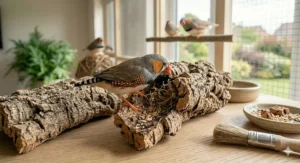
For first-time finch owners setting up a new cage — or anyone who’s realised their birds have been staring at four bare walls for a month — this is the most sensible entry point. The natural branch toys for finches included in the set use untreated wood that’s properly dried, reducing the risk of mould in UK humidity conditions.
✅ Complete, curated setup — removes guesswork for new owners
✅ Pieces are sized to work together without cage overcrowding
✅ UK-based supplier with reliable Amazon.co.uk availability
❌ Individual piece quality slightly lower than specialist single purchases
❌ Mirror component: follow the same caveats as mentioned above
Value verdict: The best starting point for new finch keepers. Graduate to specialist pieces once you know your birds’ preferences.
How to Build an Enrichment Rotation: A Practical Guide for UK Finch Owners
Here’s something the product listings won’t tell you: the single most effective thing you can do for your finches isn’t buying one great toy. It’s rotating toys on a regular schedule. Finches, like most birds, habituate quickly. A toy that provokes enthusiastic investigation on Day 1 becomes invisible furniture by Day 10. The solution is simple, essentially free, and wildly underused.
The Two-Week Rotation System
Divide your toys into two equal groups. Install Group A in the cage for two weeks. Remove Group A, install Group B. Wait two weeks. Return to Group A. The birds experience each toy as “new” again after the gap — particularly if you slightly rearrange its position in the cage. This approach means you effectively double your enrichment value from the same investment, and it takes approximately three minutes of effort per fortnight.
Positioning matters enormously. Hang swings and ladders at varying heights; natural branch toys for finches should be placed towards the top third of the cage where finches instinctively prefer to perch (birds feel safer at height). Keep the lower quarter of the cage clear for the food and water stations, and leave at least one unobstructed flight path diagonally across the cage interior. A congested cage is a stressed cage.
Seasonal considerations for UK keepers. During the shorter, darker British winter months (November to February), finches tend to be less active and may show less interest in toys generally. This is normal — adjust your expectations and prioritise foraging toys during this period, as the food-seeking motivation remains constant even when play motivation dips. In spring and summer, activity ramps up considerably and you may find you need a richer rotation to keep pace.
Cleaning cadence. Wipe down toys with a damp cloth and bird-safe disinfectant every two weeks when you rotate. Seagrass foraging toys should be replaced entirely once visibly shredded — don’t let mould establish in the fibres, which can happen quickly in the damp British climate, particularly in ground-floor flats and houses with older ventilation.
Real UK Finch Owner Scenarios: Matching the Right Toy to Your Setup
Profile 1: The City Flat Keeper (London, Manchester, Birmingham)
Living in a two-bedroom flat with thin walls and a shared hallway, Sarah keeps two zebra finches in a 60 cm × 40 cm flight cage in the living room. Her primary concern is minimal noise — she works from home and her neighbours are close. The HEEPDD seagrass foraging mat is her best choice as a primary toy: entirely silent, behaviourally rich, and small enough not to dominate limited cage space. She can supplement with the Trixie swing (minimal bell noise when birds are resting) and the Happy Pet ladder positioned horizontally for texture enrichment. Total spend: under £25. Total disruption to her Zoom calls: near zero.
Profile 2: The Garden Aviary Keeper (Rural Shropshire, Kent, or the Yorkshire Dales)
James has an outdoor aviary housing eight finches across several species. Finch flock toy sharing is his priority — he needs toys robust enough for multiple birds without creating territorial flashpoints. For him, the Keersi Rotate Ladder (its rotating elements mean no single bird can “claim” a static spot) paired with multiple seagrass foraging mats spread across the aviary floor creates healthy, dispersed engagement. The Parrot Essentials starter set gives him the variety to distribute across the aviary’s different zones. Key outdoor note: bring all toys inside during prolonged rain. Even “natural” materials can develop mould quickly in British weather, and replacing them is far less costly than a vet visit.
Profile 3: The Rehoming Owner (A Solo Bird with Uncertain History)
Claire has just rehomed a single Bengalese finch whose previous owners kept it without companions. The bird shows early signs of boredom — repetitive movement near the food dish. Her priority is enrichment that provides stimulation without the risk of overstimulation in a bird that may be adjusting to a new environment. The KATUMO multi-element swing gives multiple gentle interaction points without requiring the bird to do much initially — it can engage at its own pace. Once settled, a small mirror (the Hamiledyi option) can provide a safe degree of “social” stimulation for the solo bird. She should monitor the mirror response carefully and remove it if the finch becomes fixated rather than casually curious.
How to Choose Suitable Toys for Finches: 6 Criteria That Actually Matter
Choosing suitable toys for finches is less overwhelming than it looks, provided you work through six clear criteria before clicking “Add to Basket”:
- Scale appropriately. A finch’s foot spans roughly 2–3 cm. Perch diameters of 8–12 mm are ideal. Anything labelled “for parrots” or “medium birds” is almost certainly too large and should be passed over without guilt.
- Verify the materials. Look explicitly for: untreated natural wood, food-safe or non-toxic dyes, natural fibres (seagrass, cotton, sisal), or stainless steel hardware. Avoid: zinc-coated components, lead-containing paints, treated woods (cedar, plywood, painted dowels), and anything with very small loose parts that could be swallowed.
- Consider your flock size. For finch flock toy sharing environments, prioritise toys with multiple interaction points or buy duplicates of single-perch options. One swing between six birds creates a territorial flashpoint, not enrichment.
- Match the toy type to the behaviour you’re targeting. Boredom-busting → foraging toys. Physical activity → swings and ladders. Companionship enrichment (solo birds only) → mirrors. Beak conditioning → natural branch toys for finches with appropriate wood hardness.
- Think about noise output. This matters more than most listings acknowledge. Bells that sound charming on a product video can become genuinely wearing over a full day in a small British flat. If noise is a concern, skew towards foraging mats, ladders, and plain swings over bell-heavy sets.
- Plan for rotation from the outset. Buy at minimum two “sets” of enrichment so you can alternate. The marginal cost is low; the enrichment benefit is substantial.
Finch Safe Toy Materials: What to Look For (and What to Avoid Entirely)
This section is worth printing and keeping near your cage. The difference between bird-safe and bird-hazardous materials isn’t always obvious from a product listing, and unfortunately some of what’s sold on general marketplace platforms hasn’t been rigorously tested.
Safe materials — confirmed:
- Untreated hardwoods: apple, pear, willow, birch, beech
- Natural fibres: sisal, seagrass, hemp, undyed cotton rope
- Stainless steel hooks and clips
- Food-safe, water-based dyes (check product listings for this specific language)
- Natural shells, cuttlebone, dried palm leaves
Materials to avoid categorically:
- Zinc or galvanised metal (causes heavy metal poisoning — a genuine veterinary emergency)
- Treated or painted wood (varnish, lacquer, preservatives)
- Cedar or redwood (naturally toxic to birds)
- Rope fibres with very loose weave (toe entanglement risk)
- Any toy with very fine chains or links a bird’s leg could slide through
The British Veterinary Association’s companion animal welfare guidance notes that material safety is a primary responsibility of bird owners and should be considered when selecting any cage accessory. When in doubt, contact the seller directly and ask for material safety data — reputable suppliers will have this information readily available.
One more thing the spec sheet won’t tell you: inspect every toy on arrival before installing it. Run your fingers along all edges for sharp points, check that any paint is fully dry and not flaking, and confirm that all hardware connections are secure. Takes two minutes. Has saved many a bird from an entirely preventable injury.
Common Mistakes When Buying Finch Toys
Buying parrot-sized toys “because they look sturdier”
They do look sturdier. They’re also approximately three times too big for a bird the size of a grown human thumb. Finches won’t engage with oversized toys — the scale simply doesn’t match their behavioural instincts. Size down, always.
Installing too many toys at once
A cage that’s 40% filled with hanging toys is a cage where your finches can’t fly. These birds need open airspace for their psychological wellbeing as much as they need enrichment. Three to four well-chosen toys in a standard cage is plenty; rotate rather than accumulate.
Choosing bells for a flat with noise sensitivity
The product photos make them look delightful. Four hours of a zebra finch enthusiastically batting a metal bell at 7am on a Saturday is a different experience. Know your noise tolerance before prioritising jingly toys.
Ignoring material composition to save a pound or two
The cheapest bird toys on any marketplace platform are cheap because corners have been cut somewhere. Often that somewhere is the dye or the metal hardware. The cost of a single avian vet visit in the UK — typically starting at £40–£80 for a consultation alone — will make the extra £3 for a reputable product look extraordinarily sensible in retrospect.
Forgetting that mirrors are not suitable for flocks
Already covered this in the product section, but it bears repeating: a single mirror in a multi-bird enclosure is a recipe for competition and territorial stress. Mirrors are solo-bird tools, used thoughtfully.
Benefits of Toy Enrichment vs. Bare Cage: Why It’s Not Optional
| Factor | Bare Cage | Enriched Cage |
|---|---|---|
| Mental stimulation | None | Daily, varied |
| Physical activity | Flight only | Flight + climbing + foraging |
| Feather condition | Higher risk of plucking | Reduced boredom-plucking |
| Behavioural health | Stereotypic behaviours likely | Natural repertoire maintained |
| Longevity indicators | Reduced | Improved |
| Noise output | Often increased (distress calls) | More contented vocalisations |
The evidence here isn’t anecdotal — research into avian welfare published through the UK’s Animal Welfare Foundation consistently identifies environmental enrichment as a primary factor in cage bird health outcomes. A finch that has things to do is a finch that is actively living rather than merely surviving.
✨ Don’t Miss These Exclusive Deals!
🔍 Click any highlighted product to check current pricing and availability on Amazon.co.uk. These carefully selected picks will help you find exactly what your birds need — with free next-day delivery for Prime members.
FAQ: Suitable Toys for Finches
❓ What types of toys are most suitable for finches in the UK?
❓ Are there finch safe toy materials I should specifically look for on Amazon.co.uk?
❓ Can finches share toys in a flock, or does each bird need its own?
❓ How often should I rotate toys to keep my finches stimulated?
❓ Are there minimal noise finch toys suitable for UK flat dwellers?
Conclusion: Small Birds, Big Enrichment Needs
Finches might be the smallest residents in your home, but their welfare requirements are no less meaningful than those of larger pets. The right enrichment doesn’t need to be expensive, complicated, or time-consuming to source — but it does need to be right: correctly scaled, made from finch safe toy materials, appropriate for your flock size, and rotated regularly enough to stay genuinely engaging.
The seven products reviewed here represent the best of what’s realistically available on Amazon.co.uk right now, across a range of prices and enrichment types. For most keepers, starting with a foraging mat (the seagrass option), a simple swing, and a wooden ladder gives you a solid, safe, versatile foundation. Build from there as you learn what your specific birds respond to. Every flock has its personality, and that’s rather the point.
✨ Don’t Miss These Exclusive Deals!
🔍 Browse all highlighted products on Amazon.co.uk and check current pricing. Prime members enjoy free next-day delivery on eligible orders — so your finches could be enriched by tomorrow morning.
Recommended for You
- Toys for Canaries: 7 Best UK Picks for a Happy Bird (2026)
- Best Boredom Breakers for Budgies UK 2026 (7 Top Picks)
- Best Toys for Budgies UK 2026: 7 Picks They’ll Actually Love
Disclaimer: This article contains affiliate links. As an Amazon Associate, I earn from qualifying purchases. If you purchase products through these links, we may earn a small commission at no additional cost to you.
✨ Found this helpful? Share it with your mates! 💬🤗
