
In This Article
If your budgie spends hours perched in the same spot, barely engaging with their cage, you’re witnessing the quiet cost of captivity. In the wild, budgerigars across the Australian outback spend 40-50 kilometres worth of flying time foraging for seeding grasses each day—a relentless physical and mental workout that keeps their minds sharp and bodies fit. Strip away that challenge, and you’re left with a bored bird prone to feather plucking, excessive screaming, and a dull demeanour that’s rather heartbreaking to watch.
Enter foraging balls for budgies—deceptively simple toys that replicate the puzzle-solving, treat-discovering experiences your budgie’s evolutionary wiring craves. These aren’t mere cage decorations; they’re mental gymnasiums that transform mealtime from a two-minute seed-gobbling session into an engaging 20-minute challenge. The best foraging balls available on Amazon.co.uk in 2026 combine durable construction, budgie-safe materials, and clever designs that actually hold your bird’s attention for more than five minutes.
What British budgie owners often overlook is that proper foraging enrichment isn’t optional—it’s the difference between a bird that merely exists and one that genuinely thrives. Throughout this guide, I’ll walk you through the seven most effective foraging balls currently available to UK buyers, explain what separates brilliant designs from disappointing duds, and share practical strategies for introducing these toys to even the most cautious budgie. By the end, you’ll have everything needed to transform your budgie’s cage into a proper stimulation centre rather than a glorified holding pen.
Quick Comparison Table: Top Foraging Balls at a Glance
| Product | Material | Size | Best For | Price Range (£) | UK Prime |
|---|---|---|---|---|---|
| Acrylic Rotating Wheel Feeder | Clear acrylic | 13cm diameter | Beginners & visual learners | £8-£12 | ✅ |
| Bamboo Timothy Grass Ball | Natural bamboo | 7cm diameter | Natural chewers | £5-£9 | ✅ |
| Stainless Steel Puzzle Ball | Stainless steel | 8cm diameter | Aggressive chewers | £12-£18 | ✅ |
| Clear Sphere Treat Dispenser | Food-grade plastic | 9cm diameter | Intermediate foragers | £7-£11 | ✅ |
| Woven Rattan Foraging Ball | Natural rattan | 6cm diameter | Shreddable variety | £4-£7 | ✅ |
| Multi-Chamber Activity Ball | BPA-free plastic | 10cm diameter | Advanced puzzles | £10-£15 | ✅ |
| Loofah & Paper Ball Set | Natural loofah/paper | 5cm diameter (3-pack) | Destructive play | £6-£10 | ✅ |
From the comparison above, the Acrylic Rotating Wheel offers the best introduction for budgies new to foraging—the transparent design lets them see the treats inside, building confidence before tackling more complex challenges. The Stainless Steel option justifies its premium pricing for households where multiple budgies might squabble over toys, as it’ll outlast plastic alternatives by years. Budget-conscious buyers should note that the Woven Rattan balls deliver exceptional value under £7, though they’re consumable items your budgie will eventually destroy—a trade-off that matters when you’re restocking monthly versus annually.
💬 Just one click — help others make better buying decisions too!😊
Top 7 Foraging Balls for Budgies: Expert Analysis
1. Acrylic Rotating Wheel Feeder — The Visual Learner’s Gateway
The transparent rotating wheel design makes this the ideal first foraging toy for budgies who’ve never worked for their food. At 13cm diameter, it mounts securely to cage bars whilst the central wheel mechanism rotates as your budgie pecks at the strategically placed holes. What makes this particularly clever for UK budgies is the visibility—your bird can actually see the millet or seeds inside, which dramatically reduces the intimidation factor that causes many budgies to ignore opaque foraging toys entirely.
The acrylic construction withstands British humidity without warping, unlike wooden alternatives that can develop mould in our damp climate. UK customers consistently report that even cautious budgies engage with this within 2-3 days of introduction, compared to weeks for more complex designs. The smooth rotating action provides satisfying feedback that keeps budgies returning throughout the day.
Pros:
- Transparent design builds confidence in nervous budgies
- Rotating mechanism provides instant gratification that maintains interest
- Easy to clean—critical for preventing bacterial growth in damp British homes
Cons:
- Lightweight construction means aggressive budgies might knock it loose from moorings
- Limited capacity holds roughly 2 tablespoons of seed—requires daily refilling
Price Range: Around £8-£12 depending on supplier. Represents solid value for a reusable training tool that typically lasts 12-18 months before the rotating mechanism wears out. UK buyers particularly appreciate that it ships from UK warehouses for next-day Prime delivery.
2. Bamboo Timothy Grass Ball — Nature’s Perfect Chew
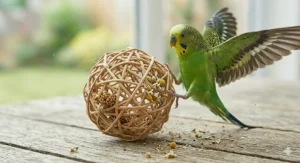
Stuffed with genuine Timothy grass and constructed from woven bamboo strips, this foraging ball appeals to budgies’ instinct to shred and forage simultaneously. The 7cm diameter suits budgies perfectly—large enough to contain meaningful treats, compact enough that even smaller budgies can manipulate it with beak and feet. What British budgie keepers particularly value is the dual-purpose design: your budgie forages for hidden treats whilst simultaneously engaging in natural chewing behaviour that keeps their beak properly trimmed.
The bamboo material handles British humidity reasonably well, though outdoor aviaries in particularly wet regions might see faster deterioration. UK customers report these lasting 3-6 weeks with daily use before requiring replacement—acceptable given the £5-£9 price point. The natural aesthetic also appeals to owners preferring eco-friendly options over plastic.
Expert opinion: This works brilliantly for budgies transitioning from seed-only diets to more varied nutrition. Hide chopped vegetables or pellets amongst the timothy grass, and your budgie learns to forage for healthier options whilst enjoying the familiar comfort of grass—mimicking their natural Australian grassland diet.
Pros:
- Completely biodegradable and bird-safe if ingested
- Dual enrichment—foraging plus beak exercise
- Natural materials reduce plastic waste
Cons:
- Consumable item requiring monthly replacement
- Can become tatty-looking within a week of enthusiastic shredding
Price Range: Typically £5-£9 for a single ball or around £12-£15 for multi-packs. Smart UK buyers stock up on 3-packs to ensure continuous supply without paying repeated delivery fees.
3. Stainless Steel Puzzle Ball — The Indestructible Investment
For households with multiple budgies or particularly destructive chewers, this stainless steel construction represents the premium tier of foraging balls. The 8cm diameter features multiple access ports of varying sizes, creating a genuine puzzle that challenges even experienced foragers. What sets this apart for UK buyers is the rust-proof stainless steel that tolerates our damp climate without degrading—critical when you’re investing £12-£18 in a single toy.
The weight provides stability that lightweight plastic alternatives lack, preventing the frustrating wobble that can discourage budgies mid-forage. UK customers with multiple budgies particularly value the durability—where plastic balls might crack under competitive pecking, stainless steel maintains integrity for years. The intellectual challenge increases as you adjust treat sizes; larger treats require more manipulation to extract through the ports.
Expert opinion: In my experience, this works best for budgies who’ve mastered simpler foraging toys and need escalated challenges. Introducing it too early can frustrate budgies into giving up entirely. The stainless steel also maintains hygiene better than porous materials—a quick boil sterilises it completely, rather important when preventing bacterial transmission between multiple birds.
Pros:
- Exceptional longevity—typically 3-5 years of daily use
- Hygiene-friendly stainless steel resists bacterial growth
- Weight prevents cage-rattling that disturbs sleeping birds
Cons:
- Premium pricing puts it beyond some budgets
- Heavier weight unsuitable for very small or elderly budgies
Price Range: Around £12-£18, positioning it as an investment piece. UK buyers should verify UKCA marking for safety compliance—reputable sellers include this certification documentation.
4. Clear Sphere Treat Dispenser — The Strategic Intermediate Challenge
This 9cm transparent sphere features adjustable openings that let you calibrate difficulty—start wide for beginners, gradually narrow the ports as your budgie’s skills improve. The food-grade plastic construction suits UK homes whilst the clear design maintains that crucial visibility factor that keeps budgies engaged. What makes this particularly effective is the internal bell that provides audible feedback when your budgie successfully manipulates the sphere—positive reinforcement that accelerates learning.
UK customers report this works brilliantly for budgies who’ve outgrown basic foraging but aren’t quite ready for expert-level stainless steel puzzles. The adjustability means one toy serves your budgie’s entire foraging journey from novice to advanced. The lightweight construction makes it suitable for budgies who enjoy tossing toys around—part of the enrichment involves chasing it across the cage floor.
Pros:
- Adjustable difficulty grows with your budgie’s abilities
- Internal bell provides satisfying audible feedback
- Lightweight encourages active play beyond just pecking
Cons:
- Plastic can scratch over time, reducing visibility
- Some UK buyers report the magnetic closure weakening after 6-8 months
Price Range: Typically £7-£11 on Amazon.co.uk. Represents excellent value for an adaptable training tool, though budget for eventual replacement as the closure mechanism fatigues.
5. Woven Rattan Foraging Ball — The Shreddable Budget Champion
At just 6cm diameter, these natural rattan spheres punch well above their modest £4-£7 price point. The woven construction creates numerous crevices where you can tuck treats, whilst the natural material invites destructive chewing that budgies genuinely relish. For British budgie owners on tighter budgets, these offer exceptional enrichment value—your budgie gets dual satisfaction from foraging and shredding, and you’re not devastated when the toy reaches end-of-life after 2-3 weeks.
The natural aesthetic appeals to owners preferring eco-friendly options, and the rattan handles British humidity better than paper-based alternatives. UK customers often purchase these in multi-packs, rotating fresh balls weekly to maintain novelty. The compact size suits smaller cages where larger foraging toys might overwhelm available space.
Expert opinion: These work brilliantly as transitional toys for budgies suspicious of unfamiliar objects. The natural material feels less threatening than bright plastic, and budgies who refuse manufactured toys often accept rattan immediately. Hide a favourite treat deep in the weave, and even the most stubborn budgie typically investigates within hours.
Pros:
- Budget-friendly pricing makes regular replacement affordable
- Natural material reduces environmental impact
- Compact size suits smaller British cage dimensions
Cons:
- Consumable design requires frequent replacement
- Can create mess as budgies shred the material
Price Range: Around £4-£7 individually, or £10-£15 for 3-packs. Smart UK buyers stock up during Amazon Prime Day sales for year-round supply.
6. Multi-Chamber Activity Ball — The Advanced Mental Gymnasium
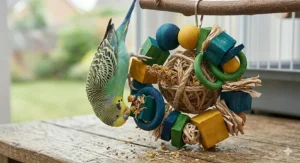
This 10cm BPA-free plastic sphere features four independent chambers that rotate independently, creating a genuinely complex puzzle that challenges experienced foragers. Each chamber requires different manipulation techniques to access—one spins, another slides, a third requires pecking specific pressure points. For UK budgies who’ve mastered simpler foraging toys and display obvious boredom, this provides the mental challenge that prevents destructive behaviours.
The complexity means budgies typically spend 15-20 minutes working through all four chambers—substantial engagement time that reduces cage boredom significantly. UK customers with particularly intelligent budgies report this toy maintaining interest for months, whereas simpler designs lose appeal within weeks. The BPA-free plastic construction addresses health concerns whilst remaining budget-friendly compared to stainless steel alternatives.
Pros:
- Four independent challenges provide extended engagement
- Adjustable difficulty in each chamber grows with your budgie’s skills
- Substantial enrichment time prevents boredom-related behaviours
Cons:
- Complex design makes thorough cleaning more time-consuming
- Some UK buyers report smaller budgies struggling with the size
Price Range: Typically £10-£15 on Amazon.co.uk. Premium pricing reflects the engineering complexity, but UK buyers consistently rate this as worth the investment for intelligent, easily-bored budgies.
7. Loofah & Paper Ball Set (3-Pack) — The Destructive Play Specialists
These 5cm diameter balls combine natural loofah with crinkled paper, creating irresistible texture combinations that budgies seem genuinely obsessed with destroying. The 3-pack format suits UK budgies perfectly—rotate a fresh ball weekly to maintain novelty whilst the previous balls dry after cleaning. What makes these particularly effective is the consumable nature actually features in the enrichment; budgies derive satisfaction from progressively shredding the materials until nothing remains.
The natural loofah and paper construction handles British humidity reasonably well, though avoid outdoor aviaries in particularly wet regions. UK customers appreciate the mess these create is biodegradable—simply compost the shredded remains rather than dealing with plastic fragments. The compact size suits budgies who prefer foot toys they can manipulate whilst perched.
Expert opinion: These work brilliantly for budgies displaying destructive tendencies like attacking cage bars or shredding newspaper. Channel that energy into appropriate outlets, and you’ll notice reduced stress behaviours within days. Hide tiny treats in the loofah fibres for added foraging challenge.
Pros:
- Satisfies destructive instincts through appropriate outlets
- Biodegradable materials suit eco-conscious UK buyers
- 3-pack format ensures continuous supply
Cons:
- Requires frequent replacement—budget £6-£10 monthly
- Creates considerable mess requiring daily cage cleaning
Price Range: Around £6-£10 for 3-pack sets. UK buyers should verify the paper uses bird-safe vegetable dyes rather than chemical inks that could harm budgies.
How Foraging Balls Replicate Wild Budgie Behaviour
Understanding why foraging balls work requires appreciating what budgerigars actually do in their native Australian habitat. Wild budgies are nomadic granivores that travel in massive flocks across grasslands, spending the bulk of daylight hours foraging for seeding grasses. They don’t simply eat what’s presented—they actively search, test with their specialised brush-tipped tongues, shell seeds, and fossick on the ground for overlooked treasures. This constant mental and physical engagement keeps wild budgies remarkably fit and mentally acute.
In British homes, we’ve essentially removed 90% of a budgie’s natural behavioural repertoire by providing seed in a dish. Imagine spending your entire life in a room where meals appear on a tray—you’d likely develop the avian equivalent of depression fairly quickly. Research demonstrates that budgies with enriched diets and foraging opportunities display more active behaviour, better feather condition, and enhanced cognitive engagement compared to those fed exclusively from static dishes.
Foraging balls restore that crucial challenge. When your budgie manipulates a rotating wheel to access millet, they’re engaging the same problem-solving circuits that wild budgies use to extract seeds from tough grass heads. The physical manipulation exercises feet and beak, whilst the mental challenge prevents the cognitive decline that leads to repetitive behaviours like bar-chewing or excessive vocalisation.
The British Context: Why UK Budgies Need Extra Enrichment
British budgies face particular challenges that make foraging enrichment even more critical. Our shorter winter days mean budgies spend considerably more time indoors compared to their Australian counterparts who enjoy consistent 12-hour daylight year-round. From November through February, UK budgies might experience just 8 hours of natural light—the remaining 16 hours confined to cages with minimal stimulation breeds the exact boredom that foraging toys combat.
Additionally, British homes tend toward compact dimensions compared to Australian or American housing. Smaller cages mean less flight space, which further reduces physical activity. Foraging balls compensate by providing mental exercise that partially substitutes for the physical workout a larger cage would offer. A budgie working through a complex foraging puzzle for 20 minutes receives mental stimulation equivalent to flying circuits around a large aviary—different exercise type, similar enrichment value.
Practical Usage Guide: Maximising Foraging Ball Effectiveness
Initial Introduction Strategy
Most budgies display suspicion toward unfamiliar objects—an evolutionary adaptation that keeps wild budgies alive in environments filled with predators. Rushing the introduction typically results in ignored toys gathering dust in cage corners. Instead, employ gradual habituation that respects your budgie’s cautious nature.
Week 1: Place the foraging ball outside the cage where your budgie can observe it from safety. Position it near their favourite perch so they associate the new object with comfortable territory. Many UK budgies will initially fluff feathers and retreat—perfectly normal defensive behaviour.
Week 2: Move the ball just inside the cage door, but don’t fill it yet. Let your budgie investigate on their terms. Curious budgies might approach and peck experimentally; fearful ones might continue ignoring it. Patience matters enormously here—forcing interaction creates negative associations that persist for months.
Week 3: Add familiar, highly-valued treats. For most British budgies, millet spray works brilliantly as it’s visually obvious and universally beloved. Place one seed where it’s barely visible through the foraging ball’s opening. When your budgie eventually retrieves it—even accidentally—they’ve experienced the fundamental foraging concept: effort yields reward.
Week 4+: Gradually increase difficulty. Bury treats deeper, use smaller pieces, switch to less-obvious rewards like pellets or chopped vegetables. Monitor your budgie’s frustration levels—if they abandon the toy mid-session, you’ve escalated too quickly. Dial back the difficulty until they’re succeeding 70-80% of the time, then inch forward again.
Optimal Placement and Rotation
Strategic placement transforms mediocre foraging balls into brilliant enrichment tools. Mount foraging balls near perches your budgie already favours—they’ll naturally investigate objects in familiar territory. Avoid placing them near water dishes where treats might become soggy, or directly beneath high perches where droppings contaminate the toy.
British budgie keepers often overlook rotation schedules, leaving the same foraging ball in place for months until budgies lose interest entirely. Professional avian behaviourists recommend rotating toys every 7-10 days. You don’t need dozens of different toys—three foraging balls rotated cyclically maintain novelty indefinitely. Store unused toys out of sight; when they reappear after absence, budgies engage as if discovering something new.
Hygiene Maintenance in the British Climate
Our damp British climate creates ideal conditions for bacterial and fungal growth on foraging toys—rather more concerning than in drier climates. Establish weekly cleaning routines that prevent contamination without using harsh chemicals that might harm budgies.
For plastic and acrylic foraging balls, hot soapy water suffices for routine cleaning. Use a bottle brush to reach internal chambers where seed husks accumulate. Rinse thoroughly—soap residue can cause digestive issues if ingested. Air-dry completely before refilling; damp toys in humid British homes grow mould within 48 hours.
Stainless steel foraging balls tolerate more aggressive cleaning. A monthly boil sterilises them completely, eliminating bacteria that resist soap-and-water cleaning. Natural material balls like rattan or loofah require replacement rather than deep cleaning—attempting to wash them typically accelerates deterioration rather than extending lifespan.

Common Mistakes When Introducing Foraging Balls
Mistake 1: Starting with Expert-Level Complexity
The most frequent error British budgie owners make is purchasing the most complex, expensive foraging ball immediately, assuming it provides maximum enrichment. A budgie who’s never worked for food confronting a multi-chamber stainless steel puzzle typically ignores it entirely—the cognitive leap from “food appears in dish” to “food requires 15 minutes of manipulation” proves too vast.
Start embarrassingly simple. A transparent ball with treats clearly visible and easily accessed builds the foundational concept that effort yields rewards. Once your budgie masters that, complexity can increase incrementally. Think of it like teaching maths—you wouldn’t begin with calculus simply because it’s the most advanced option.
Mistake 2: Filling with Inappropriate Rewards
Not all treats motivate equally, and using low-value rewards in foraging toys undermines the entire enrichment concept. If your budgie can access identical pellets in their food dish, why would they bother working through a complex puzzle for the same thing? Foraging balls require premium rewards that justify the effort.
For most British budgies, millet spray represents the gold standard—universally loved, visually obvious, and substantial enough to maintain interest. Other high-value options include:
- Sunflower seeds (sparingly—they’re fatty but irresistible)
- Dried fruits chopped into tiny pieces
- Spray millet broken into 1cm segments
- Favourite vegetables like finely diced bell pepper
Reserve these premium treats exclusively for foraging toys. When your budgie learns that foraging balls contain rewards unavailable elsewhere, engagement increases dramatically.
Mistake 3: Ignoring Individual Personality Differences
British budgie owners often follow rigid foraging schedules without considering their individual bird’s temperament. A confident, curious budgie might master complex foraging balls within days. A nervous, cautious budgie might require months of patient introduction before attempting even simple toys.
Watch your budgie’s body language closely. Relaxed posture, curious head-tilting, and gentle exploratory pecking indicate healthy engagement. Fluffed feathers, rapid breathing, or retreat to far corners signal excessive stress. If introduction attempts consistently trigger fear responses, your budgie might benefit from even simpler starting points—try scattering loose seeds on the cage floor to establish the foraging concept before introducing enclosed balls.
Mistake 4: Neglecting Safety Verification
In the rush to provide enrichment, some UK budgie owners overlook critical safety verification. Not all foraging balls sold on Amazon.co.uk meet British safety standards—some contain toxic materials, sharp edges, or small parts that present choking hazards.
Before introducing any foraging ball, perform these safety checks:
- UKCA marking verification: Post-Brexit, products should display UKCA certification indicating British safety compliance
- Material safety: Avoid painted surfaces using lead-based paints; opt for stainless steel, food-grade plastics, or untreated natural materials
- Part security: Tug firmly on all components—bells, chains, closures. If anything detaches with moderate force, your budgie will definitely pull it loose
- Size appropriateness: Openings should allow beak access without risk of head entrapment; typically 1.5-2.5cm diameter suits budgies perfectly
Foraging Balls vs Traditional Feeding Methods: A Practical Comparison
The debate between foraging enrichment and traditional dish-feeding divides British budgie owners, though research increasingly supports foraging’s benefits. Understanding the practical differences helps you make informed decisions about your budgie’s feeding routine.
Time Investment Reality
Traditional feeding takes approximately 2 minutes daily—scoop seed into dish, refresh water, done. Foraging balls require 5-10 minutes for filling and placement, plus weekly cleaning time. For time-pressed British budgie owners juggling work and family commitments, this represents genuine consideration. However, the enrichment benefits typically reduce other time demands—budgies receiving adequate mental stimulation display fewer behavioural problems requiring intervention.
Consider this practical example: A bored budgie might scream excessively for attention, requiring 20-30 minutes of interaction to settle. That same budgie engaged with foraging balls for 20 minutes daily often exhibits calmer behaviour, actually reducing total time investment. The question isn’t whether foraging takes more time, but whether you’d rather spend that time on enrichment or behaviour management.
Nutritional Control Considerations
Traditional dish-feeding allows precise nutritional monitoring—you know exactly what and how much your budgie consumes. Foraging balls introduce variables; budgies might work harder for favourite treats whilst ignoring nutritionally superior options. Some UK budgie owners express concern that foraging toys enable selective eating that compromises balanced nutrition.
The solution involves strategic reward selection. Use foraging balls for treats and supplements whilst maintaining a base diet in traditional dishes. For example, pellets and seed mix remain freely available in dishes, whilst chopped vegetables and millet appear exclusively in foraging toys. This approach ensures adequate nutrition whilst using premium treats to motivate foraging behaviour.
Cost-Benefit Analysis for UK Budgie Owners
Initial investment in quality foraging balls ranges £25-£45 for a complete starter set (3-4 balls at varying difficulty levels). Traditional feeding requires only basic dishes, typically £5-£10 total. However, long-term costs shift the equation.
Budgies receiving adequate enrichment typically display:
- Reduced destructive behaviours (fewer replacement cage accessories)
- Better physical health (lower veterinary costs)
- Enhanced mental wellbeing (reduced medication for anxiety-related issues)
A 2024 study in the Journal of Exotic Pet Medicine found that budgies with enriched environments averaged 10-15 years lifespan versus 5-7 years for those on basic care—effectively doubling your time with your feathered companion. Viewed through that lens, £45 in foraging balls represents remarkable value.
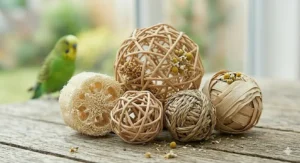
How to Choose the Right Foraging Ball for Your UK Budgie
Assessing Your Budgie’s Experience Level
Begin by honestly evaluating your budgie’s current foraging sophistication. Has your budgie ever worked for food, or have meals always appeared in static dishes? The answer fundamentally shapes which foraging ball suits them best.
Complete beginners require transparent designs where rewards remain visible—the Acrylic Rotating Wheel or Clear Sphere Dispenser work brilliantly. These build confidence through immediate success, establishing the effort-reward connection that underpins all foraging behaviour.
Intermediate foragers who’ve mastered basic toys need escalated challenges to maintain engagement—the Multi-Chamber Activity Ball or Bamboo Timothy Grass Ball provide that next difficulty tier without overwhelming them.
Advanced foragers displaying obvious boredom with simpler toys demand genuine puzzles—the Stainless Steel Puzzle Ball or customised combinations of multiple foraging challenges keep expert budgies mentally engaged.
Material Selection for British Conditions
Britain’s damp climate influences material durability significantly. What works brilliantly in dry Australian or Mediterranean climates might develop mould within weeks in Manchester or Edinburgh.
Stainless steel represents the premium choice for British conditions—completely rust-proof, hygiene-friendly, and tolerates our humidity without degradation. The higher initial investment (£12-£18) pays off through years of reliable service.
Food-grade plastics offer mid-range durability at budget-friendly prices (£7-£12). They handle British humidity adequately, though expect 12-18 months lifespan before plastic fatigues and cracks. Verify BPA-free certification to avoid potential health issues.
Natural materials (bamboo, rattan, loofah) provide excellent short-term enrichment but require regular replacement in damp British homes. Budget £4-£9 monthly for consumable natural material toys. They’re worth the recurring cost for the shredding satisfaction budgies derive, but represent operating expenses rather than one-time investments.
Size Appropriateness for Budgie Anatomy
Budgies measure approximately 18cm from beak to tail, with heads roughly 2.5cm wide. Foraging balls must accommodate these proportions whilst providing genuine challenge.
Diameter considerations: 5-10cm diameter suits budgies perfectly. Smaller balls (under 5cm) may not hold meaningful treat quantities; larger balls (over 12cm) can prove too heavy for budgies to manipulate effectively.
Opening sizes: 1.5-2.5cm diameter openings allow beak access whilst preventing head entrapment—a genuine safety concern with poorly designed toys. Too-large openings reduce puzzle difficulty; too-small openings create frustration.
Weight factors: Budgies weighing 25-35 grams need lightweight toys they can nudge and manipulate. Stainless steel balls work well when hung but might prove too heavy for budgies who enjoy rolling toys across cage floors. Lighter plastic or natural material balls suit active play better.
UK-Specific Considerations for Foraging Ball Selection
Seasonal Lighting Adjustments
British budgies experience dramatic seasonal variations that impact foraging behaviour. Winter’s short days (8 hours natural light in December) versus summer’s extended daylight (16 hours in June) create behavioural fluctuations that smart UK owners accommodate through strategic foraging ball deployment.
During darker winter months, budgies display reduced activity levels—natural response to shorter days triggering semi-dormant states. Counter this by:
- Positioning foraging balls near artificial lighting that extends “daylight” to 12-14 hours
- Using highly motivating treats that encourage engagement despite reduced energy
- Rotating toys more frequently (every 5-7 days instead of 10) to maintain novelty
Summer’s extended daylight increases activity and energy expenditure. Budgies tackle more complex foraging challenges during these months, making summer ideal for introducing advanced toys or escalating difficulty levels.
Addressing Limited Space in British Homes
British homes average significantly smaller than Australian or North American properties, translating to more compact budgie cages. The typical British budgie cage measures 45-60cm length—adequate for a single budgie but offering limited space for extensive toy arrays.
Strategic foraging ball selection matters enormously in compact spaces:
- Vertical hanging balls utilise often-wasted vertical space rather than consuming precious horizontal perching area
- Multi-functional toys combining foraging with chewing or climbing reduce total toy count whilst maintaining enrichment variety
- Compact designs (5-7cm diameter) provide mental challenge without overwhelming small cages
British budgie owners should resist the temptation to cram excessive toys into limited space. Three well-chosen, regularly rotated foraging balls typically provide more enrichment than six toys creating a cluttered environment that restricts movement.
UK Delivery and Availability Factors
Post-Brexit import changes affect foraging ball availability and pricing for UK budgie owners. Products shipping from EU sellers now face customs duties and extended delivery times—frustrating when you’re eager to provide enrichment.
Prioritise Amazon.co.uk sellers offering Prime delivery from UK warehouses. These typically arrive within 24 hours and avoid import complications. Verify the seller’s location before purchasing—some Amazon.co.uk listings actually ship from overseas despite appearing domestic.
Additionally, check for UKCA marking on product listings. This post-Brexit safety certification replaced CE marking and confirms products meet British safety standards. Reputable UK sellers prominently display UKCA compliance; absence might indicate grey-market imports of questionable safety.

Long-Term Cost and Maintenance Analysis
Investment Breakdown for Complete Foraging Setup
Establishing effective foraging enrichment requires strategic investment. Here’s realistic UK pricing for a comprehensive setup:
Initial Investment (First Month):
- Beginner foraging ball (acrylic/clear plastic): £8-£12
- Intermediate challenge ball: £10-£15
- Consumable natural material balls (3-pack): £6-£10
- Premium treats for motivation: £5-£8
- Total: £29-£45
Monthly Operating Costs:
- Replacement natural material balls: £6-£10
- Premium foraging treats: £5-£8
- Cleaning supplies: £2-£3
- Total: £13-£21 monthly
Annual Investment:
- Initial setup: £35 average
- 12 months operating costs: £17 × 12 = £204
- Replacement of worn plastic balls: £10-£15
- Annual Total: £249-£254
This represents roughly £21 monthly investment in your budgie’s mental wellbeing—comparable to a couple of takeaway coffees. Viewed against preventing behavioural issues requiring veterinary intervention (£40-£80 per consultation), the preventive value becomes obvious.
Durability Expectations by Material Type
Understanding realistic lifespan helps UK budgie owners budget appropriately:
Stainless Steel (Premium Tier):
- Expected lifespan: 3-5 years of daily use
- Failure mode: Typically attachment points wear before ball itself fails
- Cost per year: £3-£6 (£15 initial investment ÷ 3-5 years)
Food-Grade Plastic (Mid-Tier):
- Expected lifespan: 12-18 months
- Failure mode: Plastic fatigue causes cracking, especially near openings
- Cost per year: £6-£10
Natural Materials (Budget/Consumable):
- Expected lifespan: 2-4 weeks of active use
- Failure mode: Intentional—budgies shred them completely
- Cost per year: £78-£130 (£6-£10 monthly × 12)
The numbers reveal an interesting pattern: stainless steel, despite premium pricing, actually delivers lowest annual cost through exceptional longevity. Natural materials cost most annually but provide irreplaceable shredding satisfaction. Smart UK budgie owners typically maintain both—a permanent stainless steel puzzle ball for complex challenges, supplemented by rotating natural material balls for destructive play.

FAQ: Everything UK Budgie Owners Ask About Foraging Balls
❓ How often should I refill foraging balls for my budgie?
❓ Are foraging balls safe for budgies left alone during UK work hours?
❓ Can I use foraging balls if my budgie is on a restricted diet?
❓ Do foraging balls work for elderly or disabled budgies?
❓ How do I stop my budgie ignoring their foraging ball completely?
Conclusion: Transforming Your Budgie’s Life Through Foraging Enrichment
The difference between a budgie that merely exists and one that genuinely thrives often comes down to whether we’ve bothered replicating the mental challenges their evolution prepared them for. Foraging balls aren’t expensive luxuries for pampered pets—they’re fundamental enrichment tools that restore dignity to captive budgies by returning a measure of the problem-solving their wild cousins experience daily.
Throughout this guide, we’ve explored seven excellent foraging balls available on Amazon.co.uk in 2026, each suited to different budgie personalities and owner budgets. The Acrylic Rotating Wheel provides brilliant introduction for nervous beginners, whilst the Stainless Steel Puzzle Ball challenges experienced foragers with genuine complexity. Natural material options like Bamboo Timothy Grass and Woven Rattan balls satisfy destructive instincts whilst remaining budget-friendly for UK buyers managing monthly household expenses.
What matters most isn’t selecting the single “perfect” foraging ball—it’s committing to the ongoing enrichment process. Start simple, observe your budgie’s responses carefully, and incrementally increase challenges as their confidence and skills develop. British budgie owners who embrace this patient, individualised approach consistently report transformed birds: brighter plumage, cheerful vocalisations, and playful personalities replacing the dull lethargy that signals psychological decline.
Your budgie’s daily experience rests largely in your hands. Will you provide mere survival—food in a dish, water in a bottle, four walls to contemplate endlessly? Or will you offer the mental engagement that transforms existence into a life worth living? The seven foraging balls reviewed here represent accessible, affordable tools for choosing the latter. Your budgie can’t advocate for their own enrichment needs, but they’ll demonstrate profound gratitude through the vibrant personality that emerges when their minds receive the stimulation evolution designed them to crave.
Recommended for You
- 7 Best Foraging Toys for Parrots: UK Expert Guide 2026
- 7 Best Hand Rearing Formula for Parrots UK 2026
- 7 Best Egg Food for Breeding Birds UK 2026
Disclaimer: This article contains affiliate links. As an Amazon Associate, I earn from qualifying purchases. If you purchase products through these links, we may earn a small commission at no additional cost to you.
✨ Found this helpful? Share it with your mates! 💬🤗
