In This Article
Somewhere between the seed bowl and the vet’s waiting room sits a small brown bottle that most bird owners buy once, use for three weeks, then forget about in the cupboard under the sink. That’s the story of bird multivitamin drops for a lot of us — good intentions, patchy follow-through. And yet the science behind why your budgie, cockatiel or African grey might need them at all is genuinely interesting, and worth five minutes of your attention before you spend a penny.
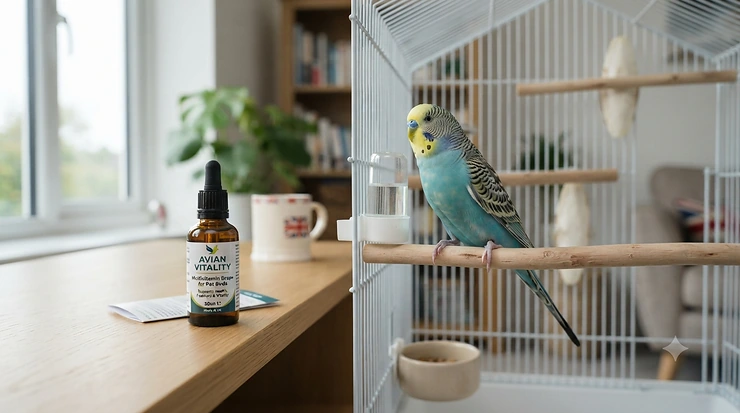
Seed-only diets are, frankly, a bit of a con. They look like food, birds love them, and they are almost completely lacking in vitamin A, calcium and several B vitamins that a bird’s body can’t manufacture on its own. Bird multivitamin drops exist to plug that gap — a liquid supplement added to drinking water or food that tops up the nutrients a seed-heavy or otherwise imperfect diet leaves out. They’re not medicine, they’re not a substitute for a proper pellet-based diet, and — this bit matters — they’re not automatically safe just because the bottle says “vitamins.”
In this guide we’ve dug into seven real bird multivitamin drops sold in the UK, compared what’s actually in them, and worked through where liquid vitamins genuinely help versus where they can do more harm than good. We’ll cover all-in-one bird vitamins, liquid multivitamin for birds dosing, vitamin drops for parrots specifically, the avian nutrition basics that explain why any of this matters, what vet-recommended supplements actually look like in practice, and the vitamin overdose risk that too many product listings gloss over entirely.
Quick Comparison Table
For readers in a hurry, here’s the shape of the market before we go deep.
| Product | Format | Best For | Price Range |
|---|---|---|---|
| BSP Liquid Multi-Vitamin Drops | Water-soluble drops | Parrots, no added sugar | £5-£10 |
| Johnson’s Vit-Min Drops | Water or food drops | Budget, all cage birds | £4-£8 |
| Oasis Vita-Drops | Water-soluble drops | Small birds, NRC formula | £8-£13 |
| Beaphar Multi-Vit for Birds | Food-mixed drops | Moulting, feather condition | £5-£9 |
| Sky EC Bird Plus Drops | Water or food drops | Single-bird budget bottle | £4-£7 |
| Nekton-S Multi-Vitamin | Powder (non-liquid) | Serious aviculturists | £10-£25 |
| Vetark Zolcal-D | Liquid calcium & D3 | Breeding hens, egg-layers | £8-£14 |
A glance at that table tells you most of what you need to know about positioning: BSP Liquid Multi-Vitamin Drops and Johnson’s Vit-Min Drops sit at the accessible end and cover general-purpose daily use, while Nekton-S Multi-Vitamin and Vetark Zolcal-D are the specialists — one for breadth of potency, one for a very specific calcium job. Beaphar Multi-Vit for Birds carves out its own niche around moulting, which is worth knowing if your bird looks like it’s shedding a jumper every fortnight. None of these prices are exact — Amazon pricing shifts constantly, so treat these as a guide and check current pricing before you buy.
💬 Just one click — help others make better buying decisions too!😊
Top 7 Bird Multivitamin Drops: Expert Analysis
Coverage here spans budget, mid-range and specialist products, plus one deliberately non-liquid alternative, because “drops” isn’t always the only sensible delivery method — more on that later.
1. BSP Liquid Multi-Vitamin Drops — no added sugar, fully water-soluble
The standout feature of BSP Liquid Multi-Vitamin Drops is what it leaves out rather than what it puts in: no sugary flavourings, which matters more than it sounds like it should. Sugary vitamin water left sitting in a bowl for a day is basically a bacterial culture medium, and that’s a genuinely common failure mode of cheaper water-additive vitamins. This formula is dosed at one drop per 100ml of drinking water daily, and the per-kilogram concentrate includes vitamin A, D3, E, C, the B-complex range, biotin and folic acid.
Based on the spec sheet, this is a broad-spectrum “cover the basics” product rather than a targeted one, which makes it a sensible daily default for parrots and other hookbills whose owners want simplicity over precision. Reviewers on specialist parrot retailer sites describe it as straightforward to dose and unfussy to store, though as with most UK avian supplements, published aggregated review data is thinner than you’d find for, say, dog food — so treat that sentiment as directional rather than exhaustive.
Pros:
- ✅ No added sugar, reducing bacterial growth risk in water
- ✅ Simple one-drop-per-100ml dosing is hard to get wrong
- ✅ Broad vitamin spread covers A, D3, E, C and B-complex
Cons:
- ❌ Daily water changes still required regardless of formula
- ❌ Verified independent review volume is limited
At around £5-£10 for a 100ml bottle, BSP Liquid Multi-Vitamin Drops represents solid value for money if your bird drinks reliably — the catch, as we’ll cover in the transformation section below, is that not all birds do.
2. Johnson’s Vit-Min Drops — the most recognisable UK high-street pick
If you’ve ever walked into a British pet shop and scanned the bird aisle, you’ve probably seen Johnson’s Vit-Min Drops before you’ve seen almost anything else on this list. That ubiquity is the standout feature — it’s stocked practically everywhere, from garden centres to Amazon UK, which counts for something when your bird runs low on a Sunday. Per 100ml, the formula lists vitamin A at 300,000iu, D3 at 11,000iu, E at 490iu, vitamin C at 445mg, plus the B-complex range and choline chloride, dosed at 2-5 drops per 10ml of water depending on bird size.
What most buyers overlook about this one is that Johnson’s positions it explicitly for birds in poor condition, recovering from illness, or heading into a breeding season — it’s marketed as a supportive product for specific life stages rather than a permanent daily fixture, which is actually the more medically defensible way to think about supplementation generally. One independently verified customer review on a UK veterinary retailer’s site described noticeable benefit in a cockatiel given the product over time, which lines up with the product’s stated use case, though a single review obviously isn’t proof of anything at scale.
Pros:
- ✅ Widely stocked across UK pet shops and Amazon
- ✅ Clear size-based dosing table (small, medium, large birds)
- ✅ Positioned honestly for recovery and breeding support, not just daily use
Cons:
- ❌ High vitamin A concentration needs careful dosing accuracy
- ❌ Independently verified review data is sparse
Priced in the £4-£8 range for 100ml, Johnson’s Vit-Min Drops earns its high-street reputation on availability and trust rather than novelty — it’s the vitamin drop equivalent of own-brand paracetamol: nothing flashy, does the job.
3. Oasis Vita-Drops — built to the National Research Council’s bird vitamin standard
Oasis Vita-Drops, made by Kordon, leans hard on a specific credential as its standout feature: the formula is built to match the vitamin recommendations published by the US National Research Council’s Committee on Animal Nutrition for small cage birds — a genuinely research-anchored baseline rather than a proprietary in-house recipe. The “Focus-Formula” small bird version targets budgies, cockatiels, canaries, conures and lovebirds specifically, while a separate “Big Birds” variant is formulated for amazons, cockatoos and macaws.
On paper this means owners get a supplement with a documented nutritional rationale rather than marketing shorthand, and the ingredient list — vitamin A palmitate, D3 cholecalciferol, E, sodium ascorbate as vitamin C, the full B range, biotin, folic acid and choline chloride — reads like a textbook rather than a guess. Dosing is water-based (one drop per ounce for hookbills, one drop per two ounces for canaries and finches) with an option to scatter drops directly onto food instead. It’s worth noting this is primarily sold through US-linked Amazon listings and specialist importers rather than dedicated UK stock, so availability and delivery times can vary — check the current Amazon UK listing before assuming next-day delivery.
Pros:
- ✅ Formulated to a documented nutritional research standard
- ✅ Separate small-bird and big-bird formula options
- ✅ Dual dosing method — water or direct food application
Cons:
- ❌ Primarily an import listing, so UK stock and shipping vary
- ❌ Concentration figures are described as proprietary, limiting transparency
Expect to pay roughly £8-£13 for a small bottle once shipping is factored in, which puts Oasis Vita-Drops at the pricier end of the budget tier — justified, in my view, if the NRC-aligned formulation matters to you more than convenience.
4. Beaphar Multi-Vit for Birds — built around moulting and feather condition
The standout feature of Beaphar Multi-Vit for Birds is its explicit framing around moult support — the product description leans specifically on promoting a “rapid and complete moult” and helping to prevent feather plucking, which sets it apart from the more generic all-purpose drops on this list. It’s a food-mixed rather than water-mixed product, dosed by drops directly onto feed: one to two drops for canaries and finches, three for parakeets, five for larger parrots, seven for pigeons and small poultry, and specific ratios for anyone making up homemade egg food.
Here’s what the spec sheet won’t tell you outright, but the framing implies: feather regrowth is genuinely one of the more nutrient-hungry processes a bird’s body goes through, drawing heavily on protein and several B vitamins, so a product angled at moulting support has a reasonably sound physiological rationale rather than being pure marketing spin. That said, aggregated independent review sentiment specifically for the moult-support claim isn’t something we could verify beyond the manufacturer’s own product description, so treat that specific benefit as a stated formulation goal rather than a proven outcome.
Pros:
- ✅ Contains 12 vitamins per the published additive list
- ✅ Clear species-based drop dosing table
- ✅ Food-based application avoids water-hygiene concerns
Cons:
- ❌ Moult-support claims aren’t independently verified in reviews
- ❌ Less suited to birds that pick around loose food additions
At roughly £5-£9 for a 20ml bottle, Beaphar Multi-Vit for Birds is a reasonable pick specifically timed to your bird’s moulting season rather than a year-round default.
5. Sky EC Bird Plus Multivitamin Drops — a compact bottle for one or two birds
If your household has a single budgie or a modest pair of cockatiels rather than a full aviary, Sky EC Bird Plus Multivitamin Drops in its 30ml bottle is sized sensibly for that reality — the standout feature here is genuinely just proportion. A full 100ml bottle of vitamins can sit half-used and past its best before a small household gets through it, so a smaller format reduces waste. Dosing is one drop per 30ml of drinking water, or one to three drops scattered onto food every one to three days.
Based on the spec comparison with the larger-format products on this list, Sky EC Bird Plus doesn’t distinguish itself on formulation complexity — it’s a straightforward general multivitamin aimed at correcting deficiencies, supporting immunity, aiding digestion and improving plumage condition, in line with what most all-purpose drops claim. What it does well is match bottle size to a smaller flock, which is an underrated practical consideration that specification tables rarely capture.
Pros:
- ✅ Smaller 30ml format suits single-bird or pair households
- ✅ Simple flexible dosing — water or direct food scatter
- ✅ Genuinely budget-friendly entry point
Cons:
- ❌ Smaller bottle means more frequent repurchasing for larger flocks
- ❌ Independent, verifiable review data is currently thin
Priced around £4-£7, Sky EC Bird Plus Multivitamin Drops is best thought of as the sensible starter bottle rather than the long-term aviary solution.
6. Nekton-S Multi-Vitamin — the zoo-grade non-liquid alternative
Every list needs the product that breaks its own rules a little, and Nekton-S Multi-Vitamin is it — this is a powder, not a liquid drop, included deliberately because it’s genuinely one of the most widely used avian supplements among serious keepers, and understanding why matters even if you end up choosing a liquid instead. Manufactured in Germany since 1967, Nekton-S is used by zoos and animal parks internationally, and the company’s own positioning is blunt: a significant proportion of avian disease is attributed to inadequate feeding rather than infection, which is roughly consistent with what veterinary nutrition literature says about seed-heavy diets.
What most buyers overlook about powder formats generally is that they sidestep the water-hygiene problem entirely — no daily water changes, no risk of vitamins degrading in sunlight-exposed drinking bowls, no bacterial bloom from sugary residue. The trade-off, and it’s a real one, is that powder sprinkled loosely onto whole seed tends to sit on the husk rather than the kernel, so birds that dehusk seed before eating — which is most parrots and finches — may get very little of the actual supplement unless it’s mixed into soft food, fruit or a moistened base instead.
Pros:
- ✅ Trusted by zoos and professional aviculturists for decades
- ✅ Avoids water-hygiene and light-degradation issues entirely
- ✅ Manufactured to consistent German production standards
Cons:
- ❌ Not a liquid drop — dosing method differs from the rest of this list
- ❌ Poor adherence to dehusked seed reduces effective delivery
Running from roughly £10 up to £25 depending on pack size, Nekton-S Multi-Vitamin sits at the premium end, and it earns that price through longevity of use in professional settings rather than flashy marketing.
7. Vetark Zolcal-D — the specialist calcium and vitamin D3 liquid
Rounding out the list is Vetark Zolcal-D, and its standout feature is specialisation rather than breadth — this isn’t a general multivitamin at all, it’s a targeted liquid calcium and vitamin D3 supplement, water-soluble and dosed into drinking water or directly by mouth. Vitamin D3 is essential for calcium absorption, and a bird can be eating calcium-rich food and still become deficient if D3 is missing from the equation — that’s precisely the gap this product is built to close.
Here’s where honest analysis matters most: this product is not a substitute for a broad-spectrum multivitamin drop like the others on this list, and buying it thinking it replaces one would leave gaps in vitamin A, the B-complex range and vitamin E entirely. Where it earns its place is for breeding hens, egg-laying females at risk of egg-binding or soft-shelled eggs, and growing chicks with high bone-development demands — situations where calcium and D3 specifically, not vitamins generally, are the bottleneck. Aviary and breeder forums consistently flag calcium-D3 liquids like this as an emergency-adjacent product for egg-bound hens, which tracks with how the manufacturer positions it.
Pros:
- ✅ Directly addresses calcium-absorption deficiency via D3
- ✅ Useful emergency-adjacent support for egg-binding risk
- ✅ Water-soluble liquid format is easy to dose accurately
Cons:
- ❌ Not a substitute for a full-spectrum multivitamin
- ❌ Narrow use case means it’s unnecessary for many pet birds
At around £8-£14 for a 120ml bottle, Vetark Zolcal-D is a targeted purchase for breeders and keepers of laying species rather than a default pick for the average companion parrot.
Top 7 Products: Full Comparison
| Product | Key Vitamins | Dosing Method | Best For | Price Range |
|---|---|---|---|---|
| BSP Liquid Multi-Vitamin Drops | A, D3, E, C, B-complex | Water (1 drop/100ml) | General daily use, parrots | £5-£10 |
| Johnson’s Vit-Min Drops | A, D3, E, C, B-complex, choline | Water or food, size-based | Recovery, breeding season | £4-£8 |
| Oasis Vita-Drops | A, D3, E, C, B-complex, biotin | Water (species-based) | Small birds, NRC formula | £8-£13 |
| Beaphar Multi-Vit for Birds | 12-vitamin blend | Food drops, species-based | Moulting, feather condition | £5-£9 |
| Sky EC Bird Plus Drops | General multivitamin blend | Water or food | Single bird, budget | £4-£7 |
| Nekton-S Multi-Vitamin | Vitamins, amino acids, minerals | Powder on soft food | Serious aviculturists | £10-£25 |
| Vetark Zolcal-D | Calcium + D3 only | Water or oral | Breeding hens, egg-layers | £8-£14 |
Read across that table and a pattern emerges: five of these seven products are genuinely interchangeable general-purpose multivitamins, differentiated mostly by dosing convenience and bottle size rather than dramatic formula differences. The two outliers — Nekton-S Multi-Vitamin and Vetark Zolcal-D — aren’t really competing with the others at all; one trades liquid convenience for delivery reliability, and the other trades breadth for calcium-specific precision. If you only take one thing from this table, let it be that “best” here depends entirely on whether you need general cover or a specific nutritional gap filled.
Practical Usage Guide: Getting Bird Multivitamin Drops Right
Buying the bottle is the easy part. Using it correctly is where most owners quietly go wrong, usually without realising it.
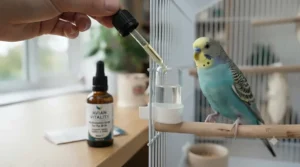
Start with water freshness, not the vitamin dose. Any liquid added to drinking water needs that water changed daily, ideally within 24 hours, because vitamin-enriched water left sitting becomes a breeding ground for bacteria surprisingly fast — warm room temperatures accelerate this further. If you can’t commit to a daily water change, a food-mixed drop like Beaphar Multi-Vit for Birds sidesteps the problem more reliably than a water-additive one.
Watch for selective drinking. Some birds, budgies especially, will simply avoid water that tastes or smells different, which means a vitamin-dosed bowl can go untouched while the bird quietly dehydrates on principle. If your bird’s water consumption visibly drops after you introduce drops, switch to the food-application method instead of assuming the problem will resolve itself.
Don’t double up formulas without doing the maths. Layering a general multivitamin like BSP Liquid Multi-Vitamin Drops on top of a fortified pellet diet that’s already vitamin-enriched is one of the most common — and most avoidable — routes to over-supplementation, which we cover properly in the safety section below.
Common first-30-days mistakes worth flagging early: dosing by eye rather than by the drop count stated on the label, forgetting that a fresh bottle needs a fresh water change schedule from day one, and assuming a supplement that worked for a friend’s cockatiel will suit a different species at the same dose — it won’t, and the dosing tables that come with products like Johnson’s Vit-Min Drops exist precisely because bird size drives dosage.
Storage matters too: keep bottles away from direct sunlight, which degrades several vitamins (A and E particularly), and check the cap seal each use — a loose cap left in a humid kitchen cupboard is a quietly common way for a bottle to spoil before its stated shelf life.
Real-World Scenarios: Which Product Fits Which Bird
The single budgie in a flat. One bird, modest cage, owner working from home. A smaller bottle like Sky EC Bird Plus Multivitamin Drops avoids waste, and because there’s only one water bowl to manage, the daily-change discipline is genuinely easy to maintain here.
The recovering rescue cockatiel. A bird that’s arrived underweight or with poor feather condition from a neglectful previous setup is a textbook case for Johnson’s Vit-Min Drops, given its explicit positioning around supporting birds in poor condition — paired, ideally, with a vet check rather than used as a substitute for one.
The breeding aviary with laying hens. Multiple birds, active breeding season, real risk of calcium-related egg problems. This is where Vetark Zolcal-D earns its keep specifically, layered alongside a general multivitamin like Oasis Vita-Drops rather than instead of one — calcium and D3 alone won’t cover vitamin A or the B-complex range.
The serious hobbyist with a mixed collection of finches and softbills. Multiple species, multiple cages, less patience for daily water-bowl swaps across the board. Nekton-S Multi-Vitamin, mixed into soft food or egg food rather than sprinkled on dry seed, avoids the water-hygiene workload entirely and scales sensibly across a larger collection.
What Are Bird Multivitamin Drops?
Bird multivitamin drops are liquid supplements — usually water-soluble concentrates — added to a pet bird’s drinking water or food to supply vitamins such as A, D3, E, C and the B-complex range that seed-heavy or otherwise imbalanced diets commonly lack.
That definition matters because it sets a boundary: drops are a supplement to a diet, not a diet substitute, and the UK’s regulatory framework broadly reflects that distinction. Most bird multivitamin drops sold in Britain fall outside the tighter Prescription-Only or NFA-VPS veterinary medicine categories that the Veterinary Medicines Directorate oversees, because they’re classed as nutritional supplements rather than medicines — which is precisely why they’re sold on general sale through pet shops and Amazon rather than requiring a prescribing professional. That’s convenient, but it also means there’s less regulatory scrutiny on dosing accuracy than you’d get with an actual veterinary medicine, so the responsibility for correct use sits more heavily with the owner.
How to Choose Bird Multivitamin Drops
- Start with your bird’s actual diet, not the bottle’s promises. A bird already on 70-80% high-quality pellets needs far less supplementation than one on an all-seed mix — check the pellet packaging for existing vitamin fortification first.
- Match the delivery method to your bird’s habits. Selective drinkers do better with food-mixed drops; birds that peck around loose powder do better with water-soluble liquids.
- Check the species-specific dosing table before buying. Products like Johnson’s Vit-Min Drops and Beaphar Multi-Vit for Birds publish size-based dosing — confirm your bird’s category is covered clearly.
- Decide if you need general cover or a specific nutrient. Most birds want a broad formula; breeding hens and growing chicks may need calcium-D3 specifically, as with Vetark Zolcal-D.
- Factor in your realistic daily routine. If daily water changes genuinely won’t happen, a food-based product removes that failure point before it starts.
- Look for transparency in the additive list. Products publishing exact per-kilogram or per-100ml vitamin concentrations, rather than vague marketing claims, give you more control over avoiding excess.
- Treat any supplement as short-to-medium term unless a vet says otherwise. Ongoing daily supplementation without periodic reassessment is where overdose risk starts to creep in.
Common Mistakes When Buying Bird Multivitamin Drops
The single most common mistake is buying vitamins reactively — a bird looks a bit off, panic sets in, a bottle gets ordered same-day — rather than reviewing the actual diet first. Vitamins are not a fix for an underlying husbandry or diet problem; they’re a patch, and sometimes not even the right one.
A close second is ignoring bird size when dosing. A formula calibrated for a macaw applied at the same drop count to a budgie is a meaningfully different relative dose, and the size-based tables that come with products like Johnson’s Vit-Min Drops exist for exactly this reason — skipping them is asking for trouble.
Third: assuming “natural” or “vet-approved” marketing language means a product is risk-free at any dose. Vitamin A and D3 are both fat-soluble, meaning they’re stored in the body rather than flushed out, and that storage mechanism is precisely what makes over-supplementation with these two vitamins particularly dangerous compared with water-soluble ones like vitamin C.
All-in-One Bird Vitamins vs Single-Nutrient Supplements
The all-in-one bird vitamins category — general multivitamin drops like BSP Liquid Multi-Vitamin Drops or Oasis Vita-Drops — covers the widest possible range of nutrients in one bottle, which is genuinely the right starting point for most companion birds on an imperfect diet. The appeal is simplicity: one product, one dosing routine, broad coverage.
Single-nutrient supplements like Vetark Zolcal-D work differently, targeting one specific deficiency pathway rather than attempting broad cover. The comparison isn’t really “which is better” — it’s “which problem are you solving.” An all-in-one product diluted across a dozen nutrients will never deliver calcium and D3 at the concentration a genuinely calcium-deficient breeding hen needs; conversely, dosing a non-breeding budgie exclusively with a calcium-D3 liquid leaves it short on vitamin A, arguably the single most common deficiency in pet birds. Most well-managed collections use a general multivitamin as the baseline and layer a single-nutrient product only when a specific situation — breeding, illness recovery, a vet-flagged deficiency — calls for it.
Liquid Multivitamin for Birds: Water vs Food Dosing
Every liquid multivitamin for birds on this list gives you a choice between two delivery routes, and the choice matters more than the brand.
Water dosing is easiest to measure precisely — a drop count per set volume is simple maths — but it lives or dies on daily water changes and on your bird actually drinking normally. Some pet-bird nutrition sources go further, cautioning that additives can alter water’s taste enough to suppress drinking altogether in sensitive individuals, which quietly defeats the entire purpose of supplementing in the first place.
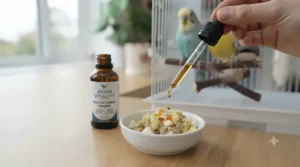
Food dosing, whether scattered on soft food, mixed into egg food, or dropped directly onto moistened pellets, avoids the taste-aversion problem but introduces a different one: birds that dehusk seed before eating, which includes most parrots and finches, may leave the vitamin-coated husk behind entirely and eat the untreated kernel underneath. The practical fix, used by most experienced keepers, is applying drops to soft, moist, or pelleted food rather than dry whole seed — the vitamin actually stays on something the bird swallows.
Vitamin Drops for Parrots: Species-Specific Guidance
Vitamin drops for parrots need slightly different handling than drops for finches or canaries, mostly because of scale and behaviour rather than fundamentally different biology. Larger parrot species — African greys, amazons, macaws — need proportionally higher drop counts, which is exactly why Oasis Vita-Drops offers a separate “Big Birds” formula rather than a one-size-fits-all bottle.
Parrots are also notoriously food-selective, which pushes many keepers toward food-mixed drops over water additives, since a smart cockatoo will often work out that the water tastes different and simply avoid it. One nutritional wrinkle worth knowing: Eclectus parrots specifically are recognised in avian care literature as unusually sensitive to over-supplementation and dietary imbalance compared with other parrot species, so if you keep Eclectus, err toward more conservative dosing and closer veterinary guidance than you would for a budgie or cockatiel.
Avian Nutrition Basics: What Your Bird’s Diet Is Missing
Understanding avian nutrition basics starts with an uncomfortable truth: seeds are essentially bird junk food. They’re calorie-dense, fat-heavy, and — this is the crucial bit — genuinely low in vitamin A, calcium, and several amino acids like lysine and methionine that a bird’s body can’t synthesise on its own. According to veterinary nutrition references including the Merck Veterinary Manual, vitamin A deficiency remains common but frequently overlooked in pet birds, and it’s specifically diets high in seeds and nuts that carry the greatest risk, because those diets combine low vitamin A content with excess fat.
The clinical picture when vitamin A runs low isn’t subtle once you know what to look for: nasal discharge, sneezing, swelling around the eyes, laboured breathing, poor feather quality and feather plucking, sore feet, and loss of appetite. Calcium deficiency shows up differently, mostly affecting bone development and, in breeding females, egg quality — soft-shelled eggs and egg-binding are the classic red flags. The uncomfortable irony here is that pelleted, nutritionally complete diets already solve most of this at the source, yet plenty of owners keep offering seed alongside pellets and watch their birds selectively eat the tastier, nutritionally poorer option — which is precisely the scenario multivitamin drops exist to backstop.
Vet-Recommended Supplements: What Avian Vets Actually Say
Here’s where the honest picture gets a little less tidy than product marketing suggests. Veterinary guidance on vet-recommended supplements is more conditional than most bottle labels imply — the consistent professional position is that supplementation should address an identified gap, not run indefinitely as a blanket precaution. UK veterinary professional guidance, overseen by bodies such as the Royal College of Veterinary Surgeons, emphasises that anyone advising on veterinary products should be satisfied the person using them understands safe administration — a standard that, frankly, most supermarket vitamin-bottle labels don’t come close to meeting on their own.
In practice, what an avian vet is likely to actually recommend is a full diet review first — how much of the diet is pellets versus seed versus fresh food — before reaching for a bottle at all. Where supplementation does get recommended, it’s typically targeted: vitamin A support for a bird already showing signs of deficiency, or calcium-D3 specifically for a breeding hen, rather than a everything-at-once multivitamin used as a permanent daily ritual. If your bird has a diagnosed or suspected deficiency, that’s a conversation for your vet, not a guess based on a product review.
Vitamin Overdose Risk: Safety, Regulations and Compliance
This is the section too many buying guides skip, and it shouldn’t be skipped, because vitamin overdose risk in birds is real and not especially rare. Vitamin A and vitamin D3 are both fat-soluble, meaning excess amounts are stored in body tissue rather than excreted, and repeated over-dosing can lead to toxicosis — veterinary nutrition sources specifically flag that indiscriminate vitamin A supplementation, ironically, can also reduce the absorption of other nutrients, compounding the problem rather than fixing it. Vitamin D3 excess is linked to calcium deposits in soft tissue and kidney problems in more severe cases.
The practical safety rules are straightforward even if they’re often ignored: never combine multiple multivitamin products simultaneously without professional guidance, never assume a fortified pelleted diet needs additional multivitamin drops on top, and never increase dosing beyond the label because “a bit extra can’t hurt” — with fat-soluble vitamins specifically, it can. From a regulatory standpoint, most bird multivitamin drops in the UK are sold as general-sale nutritional products rather than classified veterinary medicines, and the relevant legal framework — set out in the Veterinary Medicines Regulations — draws that distinction around risk level and the need for professional oversight. That lighter classification is precisely why the dosing discipline has to come from you, the owner, rather than from a pharmacist checking your bird’s chart.
If you’re ever uncertain whether your bird is showing early signs of over-supplementation — lethargy, reduced appetite, unusual thirst, or laboured breathing — stop the supplement and speak to an avian vet promptly rather than waiting to see if it resolves on its own.
✨ Ready to Sort Your Bird’s Vitamins Once and For All?
🔍 Compare the seven picks above, match one to your bird’s actual diet and routine, and check current pricing and availability before you order. A little research now saves a lot of guesswork — and a possible vet bill — later.
Long-Term Cost and Maintenance
Cost-per-use is where the cheaper bottles start to look less cheap and the pricier ones start to make more sense. A £5 bottle of Sky EC Bird Plus Multivitamin Drops at 30ml, used at roughly one drop per 30ml of water daily for a single budgie, lasts a reasonable stretch before repurchase — but scale that same usage rate across a four-bird household and you’re reordering monthly, which changes the maths considerably against a larger 100ml bottle like Johnson’s Vit-Min Drops at a similar or lower per-ml cost.
Nekton-S Multi-Vitamin, despite its higher upfront price, tends to work out more economical per dose across a larger mixed collection precisely because powder isn’t diluted the way liquid concentrates often are, and a single tub stretches across multiple soft-food preparations. The maintenance side of the equation matters just as much as raw cost: water-additive products carry an ongoing “cost” in daily time spent changing bowls, which food-mixed and powder products largely avoid. When you tally genuine total cost of ownership — product price, replacement frequency, and the time cost of correct daily use — the food-based and powder options often edge out the water-additive ones for multi-bird households, even when their sticker price looks higher.
Frequently Asked Questions
❓ Do all pet birds need multivitamin drops?
❓ How often should I give bird multivitamin drops?
❓ Can bird multivitamin drops cause overdose?
❓ What's the difference between all-in-one bird vitamins and calcium supplements?
❓ Are liquid vitamins better than powder for parrots?
Conclusion
If there’s one honest takeaway from comparing seven real bird multivitamin drops side by side, it’s that the product matters less than the reasoning behind using it. A general all-in-one formula like BSP Liquid Multi-Vitamin Drops or the widely stocked Johnson’s Vit-Min Drops covers most companion birds on an imperfect diet perfectly well, while specialist products like Vetark Zolcal-D or the powder-format Nekton-S Multi-Vitamin earn their place only in more specific circumstances — breeding season, moulting, or a mixed collection where daily water changes simply aren’t realistic.
What ties every section of this guide together is the same underlying principle avian vets keep returning to: diet review first, targeted supplementation second, and a healthy respect for the fact that more vitamins is not automatically better — fat-soluble ones especially can do real harm in excess. Match the product to your bird’s actual diet and your household’s actual routine, respect the dosing table, and treat any bottle of drops as a supplement to good feeding, never a replacement for it.
✨ Don’t Miss These Exclusive Deals!
🔍 Take your bird’s nutrition to the next level with the picks compared above. Click through to check current pricing and availability, and give your feathered flatmate the balanced diet it actually deserves.
Recommended for You
- Budgie Vitamin Drops Under £15: 7 Real Picks Tested (2026)
- Eco Friendly Bird Toys UK: 7 Safe Picks Tested for 2026
- 7 Best Acrylic Bird Toys UK 2026: Clear, Durable & Safe Picks
Disclaimer: This article contains affiliate links. As an Amazon Associate, I earn from qualifying purchases. If you purchase products through these links, we may earn a small commission at no additional cost to you.
✨ Found this helpful? Share it with your friends! 💬🤗
