
In This Article
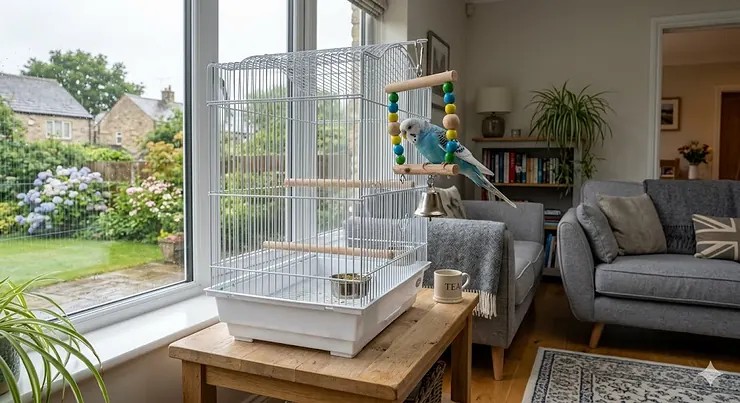
Here’s a scene that will be familiar to anyone who has ever kept a parrot: you buy a fancy new toy, hang it in the cage with great ceremony, and your bird looks at it with the withering contempt of a Victorian aristocrat inspecting an uninvited house guest. Then, two weeks later, you discover it has developed an obsessive relationship with a bottle cap it found on the floor.
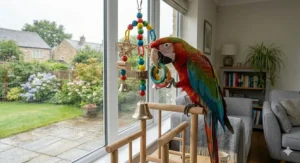
Bell toys for birds, however, tend to be different. There’s something almost hardwired in the way parrots respond to that metallic jingle — ring the bell, get stimulation, ring it again. It is, in the most literal sense, a game they invented themselves.
Bell toys for birds are enrichment devices featuring one or more metallic or wooden bells, typically hung inside a cage or attached to a play stand, designed to produce sound when touched, pecked, or shaken. They deliver auditory stimulation — which, for a creature that communicates primarily through sound, is not a trivial thing. Research from Hartpury University Centre has found that parrots without adequate auditory enrichment show significantly increased rates of stereotypic behaviour. A bored parrot is a destructive, plucking, screaming parrot. Bell toys are a rather elegant part of the solution.
But — and this is important — not all bell toys are created equal. Some are made from galvanised metal that can leach zinc, which the Parrot Society UK classifies as genuinely dangerous. Some bells have clapper gaps that are the exact wrong size for a curious beak. Getting this right matters. This guide exists to help you do exactly that.
Quick Comparison: Bell Toys for Birds at a Glance
| Product | Best For | Size | Bell Material | Price Range |
|---|---|---|---|---|
| Rosewood Stainless Steel Bell Toy | Budgies & small birds | Small | Stainless steel | Under £10 |
| Rosewood Large Bell Bird Toy | Medium parrots | Large | Galvanised metal | Around £10–£15 |
| Pethee 8-Pack Bird Toys Set | Multi-toy value | Small–medium | Mixed metal | Under £15 |
| Acidea Wooden Knots Block with Bells | African Greys, large parrots | Medium–large | Metal bells on wood | £10–£20 |
| Hypeety Pet Bird Mirror with Bell | Budgies, cockatiels | Small | Metal | Under £10 |
| Trixie Parrot Toy with Bells | Conures, medium parrots | Medium | Metal | £10–£18 |
| GingerUPer Bird Swing Chewing Toy | Cockatiels, conures | Small–medium | Metal | Under £12 |
All products available on Amazon.co.uk. Prices are indicative ranges only — check Amazon.co.uk for current pricing.
From this table, a clear pattern emerges: for small birds like budgies and cockatiels, value-bundle sets such as the Pethee 8-Pack offer the widest variety for the money. For larger, more destructive species like African Greys or cockatoos, investing in a heavier, solid-construction option like the Acidea Wooden Knots Block pays dividends — these birds will demolish a flimsy bell in an afternoon and consider it a light warm-up.
💬 Just one click — help others make better buying decisions too! 😊
✨ Don’t Miss These Exclusive Deals!
🔍 Take your bird’s enrichment to the next level with these carefully selected products. Click on any highlighted item to check current pricing and availability on Amazon.co.uk. These picks will help your feathered companion thrive!
Top 7 Bell Toys for Birds: Expert Analysis
1. Rosewood Stainless Steel Bell Parrot Toy
Rosewood is one of the most recognisable British pet brands on Amazon.co.uk, and their stainless steel bell toy is about as no-nonsense as bird enrichment gets. A single, properly-sized stainless steel bell on a sturdy hook. That’s the whole thing. And for many small-to-medium birds, that’s genuinely all they want.
The stainless steel construction is the headline specification here, and it matters enormously. Unlike galvanised bells — which The Merck Veterinary Manual identifies as a common source of zinc toxicosis in pet birds — stainless steel is non-reactive, non-toxic, and resistant to the kind of determined beak-driven destruction that parrots treat as a personal challenge. It also wipes clean in seconds, which is no small thing when your bird has deposited its breakfast on the toy with typical enthusiasm.
In my view, this is the safest entry-level bell toy on the market for UK buyers who are uncertain about what they’re looking for. It’s sized appropriately for budgies, cockatiels, lovebirds, and small conures. The hook fits standard UK cage bar gauges without modification. UK reviewers consistently note that the sound is pleasantly crisp without being shrill enough to turn the neighbours against you — a legitimate consideration for anyone in a flat or terrace.
Where it falls short: there is no secondary enrichment. No wood to chew, no beads to manipulate. For a bird that needs complexity, it’s a starting point, not a destination.
✅ Genuinely safe stainless steel — no zinc concerns
✅ Compatible with standard UK cage fittings
✅ Quiet enough for flat and terraced house living
❌ Very simple — limited enrichment value for intelligent birds
❌ Single-use; no chew or forage element
Price range: under £10 — exceptional value for a safe, durable, Rosewood-quality bell toy.

2. Rosewood Large Bell Bird Toy
The bigger sibling. Where the stainless steel version is surgical in its simplicity, the Rosewood Large Bell Bird Toy swings in with a galvanised metal build and substantially more presence inside the cage. It’s designed for medium to large parrots — think Amazons, African Greys, or the larger cockatoos that can reduce a lesser bell toy to abstract sculpture within minutes.
The galvanised construction deserves a moment’s pause. Galvanised steel does contain zinc, and the RSPCA advises caution with galvanised cage components. The key distinction, which avian vets have noted, is that electro-galvanised coatings — tightly bonded, non-flaking — pose substantially less risk than hot-dip galvanising. Rosewood has a long track record in UK pet retail, and their manufacturing reflects awareness of this distinction. That said, if you have a particularly aggressive chewer or a bird that obsessively mouths its metal fittings, the stainless steel option is categorically the safer choice.
For most medium parrot owners with a sensibly cautious supervision approach, this is a solid, heavy-duty option. The size means it produces a proper, resonant ring rather than the tinny jingle of smaller bells — and parrots with more developed spatial awareness respond more enthusiastically to fuller, lower-pitched tones.
UK reviewers note that it attaches easily to standard cage bars and doesn’t rattle irritatingly against the cage walls during the night.
✅ Substantial build — survives larger parrots
✅ Rich, resonant bell tone preferred by larger birds
✅ Easy-fit hook for standard UK cages
❌ Galvanised metal — requires monitoring for aggressive chewers
❌ Minimal secondary enrichment
Price range: around £10–£15 — reasonable for a large-format Rosewood bell toy.
3. Pethee 8 Pack Budgie Toys Bird Toys Set
Now we’re into entirely different territory. The Pethee 8-Pack is not a single bell toy — it’s an entire enrichment package containing a swing, bells, a mirror, climbing ladders, and wooden chewing elements, all priced at under £15. For anyone setting up a cage for the first time, or for a budgie owner who wants to provide genuine variety without spending a small fortune, this is difficult to argue against.
The bells within the set are small-bird-sized and metal. They won’t survive a cockatoo. But for budgies, cockatiels, lovebirds, and parrotlets, the scale is exactly right. The genius of a multi-toy set is precisely what avian enrichment specialists recommend: rotating toys regularly keeps the cage feeling novel without requiring constant new purchases. With eight items, you can leave four in rotation and swap in the others every two weeks. The bird experiences a “new” environment twice a month at a cost of approximately £1.87 per toy.
The practical caveat: inspect every component individually before hanging it. Some items in budget multi-packs have inconsistent finishing. Check that bell clappers are firmly attached and that there are no sharp wire ends on the swing or ladder fixings. A two-minute check protects your bird from unnecessary risk.
UK Prime members can typically expect next-day delivery, which makes this a sensible emergency option when you’ve suddenly noticed your budgie has destroyed its entire toy collection (they do this — usually at weekends).
✅ Exceptional value — 8 toys for under £15
✅ Variety supports proper enrichment rotation
✅ Correct sizing for budgies and small birds
❌ Variable quality control — inspection before use is essential
❌ Not suitable for medium or large parrots
Price range: under £15 — outstanding value for budgie and cockatiel owners.
4. Acidea Wooden Knots Block Parrot Toys with Bells
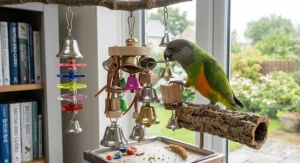
This is the one for the serious parrot keeper. The Acidea Wooden Knots Block is a multi-element hanging toy combining natural untreated wood blocks in multiple colours with metal bells, designed for African Greys, cockatoos, medium macaws, and the upper end of the conure spectrum.
The wood is the real selling point. Untreated, natural hardwood blocks satisfy the instinctive need to chew that parrots carry in their DNA — in the wild, an African Grey spends a substantial portion of its day working through bark and branches. A good wooden toy with bells gives the bird something to destroy (the wood) and something that responds to its efforts with noise (the bells). The combination is enrichment on two levels simultaneously: tactile and auditory. The RSPCA’s enrichment guidance specifically endorses untreated natural wood as one of the safest and most appropriate toy materials for parrots.
For UK buyers, one practical note: natural wood toys do absorb moisture more readily than plastic or metal equivalents. In a British winter, if your bird’s cage is near a window or in a room with condensation issues, check wooden components monthly for any signs of soft spots or mould. It’s a mild inconvenience, not a dealbreaker, but worth knowing.
UK reviewers with African Greys report this toy lasting several weeks before requiring replacement — a reasonable lifespan for a large, active bird with a powerful beak.
✅ Natural wood satisfies chewing instinct
✅ Bell and chew elements provide multi-layered enrichment
✅ Appropriate sizing for large, powerful birds
❌ Requires moisture-checking in damp UK winters
❌ Will need periodic replacement — budget accordingly
Price range: £10–£20 — worth every penny for large parrot owners.
5. Hypeety Pet Bird Mirror with Bell
A mirror with a bell attached is one of the oldest bird toy designs on record, and Hypeety’s version is a reliable, well-reviewed example of the format. The blue variant is particularly popular on Amazon.co.uk, and the combination of visual stimulation (mirror) with auditory stimulation (bell) addresses two enrichment modalities in one tidy package.
For single budgies or cockatiels — birds that are kept alone and need companionship cues — the mirror element provides a meaningful social substitute. A bell attached to the mirror means the “companion” in the reflection appears to produce sound, which is cognitively engaging in a way a static mirror is not. The Hagen Avicultural Research Institute notes that bells are particularly popular with parrots precisely because they provide simultaneous auditory and visual stimulation, and that birds can learn to ring them as a deliberate game.
The honest caveat on mirror toys is this: some birds develop an over-reliance on their reflection to the point where it substitutes for seeking genuine interaction. Monitor your bird’s behaviour. If they’re spending all day talking to the mirror and ignoring you, rotate it out for a week. Used sensibly, this is a fine, compact toy that fits easily in smaller UK cages — important for anyone in a flat with limited floor space for a larger cage setup.
✅ Dual stimulation — visual and auditory
✅ Compact — fits small cages in flats
✅ Great for single birds needing social cues
❌ Monitor for mirror obsession in solo-kept birds
❌ Smaller size limits appeal for medium and large parrots
Price range: under £10 — a well-priced dual-enrichment option for small birds.

6. Trixie Parrot Toy with Bells
Trixie is a German pet accessories brand with strong distribution across UK Amazon and independent pet retailers. Their parrot bells toys typically feature a combination of hanging metal bells with colourful rope or wood elements — a mid-market option that bridges the gap between basic bell toys and full enrichment systems.
The construction quality sits noticeably above the budget end of the market. Fixings are more consistently finished, and the bell tones are tuned at a frequency that anecdotally seems to produce strong engagement in conures and medium parrots — species that tend to be particularly sound-reactive. If you have a sun conure that communicates primarily by screaming (which, if you have a sun conure, you know all too well), channelling that vocal energy into bell-ringing is genuinely useful.
Trixie products on Amazon.co.uk come in variants suited for different cage sizes, and the brand’s products are generally consistent in quality. For UK buyers, this is a solid mid-range choice: not as austere as the single-bell Rosewood options, not as feature-rich as the Acidea wooden system, but reliably well-made and priced in a range that doesn’t require a fortnight of deliberation.
Post-Brexit, some EU-manufactured products carry slightly higher UK retail prices due to import adjustments — Trixie products fall into this category, but you benefit from full UK consumer protection, 14-day cooling-off rights under Consumer Contracts Regulations, and Amazon.co.uk’s typically swift returns process.
✅ Reliable German quality — consistent construction
✅ Strong engagement with sound-reactive conures
✅ Mid-range variety — bells plus secondary elements
❌ Slight price premium vs equivalent Chinese-manufactured options
❌ Range is smaller on Amazon.co.uk than on EU platforms
Price range: £10–£18 — fair for a well-constructed mid-range bell toy.
7. GingerUPer Parrot Toys Bird Swing Chewing Toy
The GingerUPer swing toy occupies a useful niche: it combines physical activity (swinging) with auditory enrichment (bells) and chew opportunity (coloured wood blocks) in a single hanging unit. The red variant has been particularly popular on Amazon.co.uk, and UK reviewers describe strong initial engagement from cockatiels and conures.
What makes the swing-bell combination interesting from an enrichment standpoint is the physics: when the bird lands on the swing, the bells ring. The bird associates landing with noise production. This is cause-and-effect learning — the same kind of cognitive engagement that avian enrichment research identifies as mentally beneficial. It is, in miniature, a version of what Hartpury University’s research on auditory enrichment found: the key is not passive sound but interactive sound that the bird itself controls.
The colour is worth mentioning. Parrots perceive colour in the UV spectrum beyond human visible light — they see the world in four colour channels versus our three. Brightly coloured toys aren’t just aesthetically appealing to owners; they are genuinely more visually stimulating to the birds. The GingerUPer’s use of contrasting primary colours is not decorative whimsy. It’s enrichment.
Sized for cockatiels and small-medium conures, this is not a toy for a macaw. But for its target species, it is a well-designed, multi-function piece of enrichment at a sensible price.
✅ Swing + bells = physical and auditory enrichment
✅ Cause-and-effect play develops cognitive engagement
✅ Bold colours stimulate UV-sensitive bird vision
❌ Too small and fragile for large parrots
❌ Wood elements will need replacement with active chewers
Price range: under £12 — excellent multi-function value for cockatiels and small conures.
The Safety Question: What Bell Materials Are Actually Safe for Your Bird?
Let’s talk about something the product listings rarely explain clearly enough: the materials question. It matters significantly more with bell toys than with almost any other category of bird enrichment, because bells are metal, birds chew metal, and some metals are seriously dangerous.
Stainless Steel: The Gold Standard
Stainless steel is the safest metal for bird toys. It contains no zinc, no lead, doesn’t rust in the damp British climate, and can be cleaned with a damp cloth or rinsed under the tap. If you have any doubt about what metal a bell is made from, stainless steel is the answer to reach for first.
The Zinc Problem
The Parrot Society UK describes zinc as one of the most common sources of heavy metal toxicity in captive parrots. Galvanised metal — which is steel coated with zinc to prevent rust — is found in a significant proportion of cheap bird toys. The distinction that matters is between hot-dip galvanising (rough, flaky coating that can chip off) and electro-galvanisation (tightly bonded, smooth coating). The former should be avoided with any bird that actively chews its toys. When in doubt, choose stainless steel.
Symptoms of zinc toxicosis, as documented by avian vets, include polyuria, weight loss, weakness, and in acute cases, seizures. It is treatable when caught early — but prevention is infinitely preferable. If you notice any of these symptoms in a bird that has access to galvanised metal toys, contact an avian vet promptly.
The Bell Clapper Gap
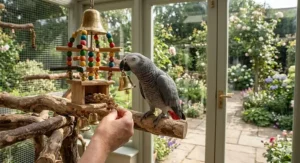
This is the detail that almost nobody mentions: the gap between the bell body and the clapper. If this gap is large enough for a beak to insert — but not large enough for the beak to withdraw — you have a trap, not a toy. The “cow bell” or “liberty bell” design, with a clapper that hangs freely inside a closed body, is widely considered the safest design by avian safety specialists. Avoid open-sided bells or jingle-bell designs with accessible split clappers for any bird.
A Simple Safety Check Before Hanging Any Bell Toy
Run your thumbnail along any metal component. If material flakes off under light pressure, that is a coating that will flake under beak pressure. Don’t hang it. This thirty-second check could prevent a veterinary emergency.
How to Choose Bell Toys for Birds in the UK: A Practical Framework
Getting this right is simpler than the sheer volume of options on Amazon.co.uk might suggest. Work through these steps:
- Match to bird size. A budgie’s beak cannot work a bell designed for an African Grey. An African Grey will destroy a budgie bell within the hour. Size compatibility is the non-negotiable starting point.
- Prioritise stainless steel if you can. Particularly for birds known to aggressively mouth metal fittings. The price difference between galvanised and stainless is usually small. The health implications of getting it wrong are not.
- Check the bell design. Liberty bell or cow bell body — closed, with the clapper inside. Avoid open jingle bells or designs with accessible clapper mechanisms.
- Consider your living situation. If you live in a flat or a terraced house with shared walls, bell volume genuinely matters. A single stainless steel bell produces a crisper, quieter tone than a cluster of smaller bells. Buying six bells for a flat-dwelling budgie at 7am is a social experiment with a predictable outcome.
- Think about secondary enrichment. A bell on its own is auditory stimulation. A bell attached to a wooden block is auditory plus tactile enrichment. A bell on a swing is auditory plus physical. Combination toys deliver more value per cage hook.
- Plan for rotation. Buy at least two toys so you can swap them fortnightly. This is not excessive — it is basic enrichment practice that prevents boredom without requiring continuous new purchases.
- Inspect before hanging. Every toy, regardless of price point. Check for sharp wire ends, loose fixings, and coating integrity. This takes less than two minutes.
Real-World Scenario: Matching Bell Toys to UK Bird Owners
Profile 1: The London Flat-Dweller with a Budgie Sarah lives in a one-bedroom flat in Islington, renting, with thin walls and a landlord who has already had Words about the budgie. She needs bell toys that are genuinely engaging but not audibly offensive at 6am. The Rosewood Stainless Steel Bell Toy is the right answer — a crisp, controlled ring that won’t carry through walls. Paired with the Pethee 8-Pack for rotational variety (the swing and mirror elements are silent), she gets enrichment without neighbourly incident.
Profile 2: The Manchester Suburban Family with a Cockatiel The Patel family has a cockatiel called Mango who lives in the living room, gets a good five hours of out-of-cage time daily, and is frankly bored between 9am and 3pm when the house empties. The GingerUPer Swing Chewing Toy addresses the physical-and-auditory gap during empty house hours — the cause-and-effect bell-ringing keeps Mango engaged without requiring human participation. The Hypeety Mirror with Bell complements this as a companionship supplement during solo periods.
Profile 3: The Rural Scottish Smallholder with an African Grey Dr. Mackenzie has kept parrots for fifteen years and currently houses an African Grey called Gregor who is, putting it diplomatically, a discerning critic of inadequate enrichment. The Acidea Wooden Knots Block with Bells is built for precisely this bird — the combination of wood destruction and bell-ringing satisfies both the foraging instinct and the social-signalling drive. At Gregor’s level of intelligence, the toy needs to be rotated with a wooden foraging option every fortnight to maintain novelty.
Common Mistakes When Buying Bell Toys for Birds
Most of these mistakes are made by well-intentioned owners who simply didn’t know what they didn’t know.
Buying for your aesthetics, not your bird’s needs. That hand-painted ceramic bell with the lovely floral motif is charming. It is also painted, potentially with lead-containing pigments, and ceramic if chipped becomes a sharp edge. Your bird does not care about the floral motif.
Ignoring size compatibility. A bell too small for a parrot’s beak is not just useless — it’s a choking risk. A bell too large for a budgie provides no engagement because the bird cannot move it. The product listing should state the recommended species; take this seriously.
Buying galvanised metal for heavy chewers. For a budgie that gently mouths its bell occasionally, electro-galvanised metal is probably fine with normal supervision. For an African Grey, a cockatoo, or any bird that makes sustained chewing of metal objects its primary hobby, galvanised anything is a risk not worth taking.
Buying only one toy. Enrichment rotation is not optional if you want a mentally healthy bird. One bell toy provides one environment. Multiple toys in rotation provide many environments. The cost difference between buying one and buying three or four over a few months is small. The enrichment difference is substantial.
Ignoring the clapper design. The single most overlooked safety factor in bell toys. Check it every time.
✨ Don’t Miss These Exclusive Deals!
🔍 Ready to invest in your bird’s happiness? Check current pricing and availability on Amazon.co.uk for all the bell toys featured in this guide. Prime members enjoy free next-day delivery on eligible orders!
Bell toys are among the most cost-effective forms of bird enrichment available. A stainless steel single bell in the £5–£10 range will last many months with a small bird and still years with appropriate supervision. Wooden bell combinations in the £10–£20 range will need replacing every few months with a large parrot — but this is a running cost of roughly £5–£8 per month, which is modest by any measure.
Value Comparison: Bell Toys vs Alternatives
| Enrichment Type | Average Cost | Lifespan (Active Bird) | Enrichment Value |
|---|---|---|---|
| Stainless steel bell toy | Under £10 | 6–12 months | Auditory |
| Wooden + bell combination | £10–£20 | 4–8 weeks (large parrot) | Auditory + tactile |
| Foraging toy | £10–£25 | 2–4 weeks | Cognitive + tactile |
| Bell + swing combination | Under £15 | 4–8 weeks | Auditory + physical |
| DIY untreated wood + safe bell | £5–£10 | Variable | Tactile + auditory |
The RSPCA’s enrichment guidance notes that owners can make their own toys from untreated wood, pine cones, and natural-fibre cord — and adding a safely-sourced stainless steel bell to a DIY wooden toy is a perfectly sound approach if you want to manage costs without sacrificing quality.
Over the course of a year, a reasonable bell-toy budget for a single budgie or cockatiel is £20–£40, assuming rotational buying across three or four products. For a large parrot, budget £60–£100 annually to account for the destruction rate. Neither figure should cause alarm.
Features That Actually Matter (And Those That Don’t)
Worth Paying For:
- Stainless steel construction. Non-negotiable upgrade if your bird chews metal.
- Liberty-bell clapper design. A closed, freely-hanging clapper inside a sealed bell body. Safest design available.
- Appropriate size for your species. This is not decorative guidance — it’s a safety specification.
- Natural untreated wood components. Where present, these add meaningful enrichment depth.
- Solid hook or quick-link attachment. Flimsy C-hooks open under pressure from medium and large birds. A properly closed quick-link prevents escape — which matters less in a cage than it sounds, but matters significantly for play-stand use.
Marketing Noise You Can Safely Ignore:
- “Eco-friendly” claims without specifying material. Greenwashing exists in pet accessories as much as anywhere else.
- “Recommended by vets” without citation. Meaningful vet endorsements are specific and verifiable.
- Exact decibel ratings. No bell toy manufacturer has tested these to any meaningful standard. Judge bell volume by species and household situation, not marketing copy.
- “Promotes intelligence” as a standalone claim. Enrichment supports wellbeing; it doesn’t confer specific cognitive gains that can be attributed to one toy. The research is more nuanced than the packaging suggests.
FAQ: Bell Toys for Birds
❓ Are bell toys safe for parrots?
❓ What size bell toy should I buy for my budgie?
❓ Are noise-making bird toys available on Amazon.co.uk with Prime delivery?
❓ Can bell toys help with feather plucking in parrots?
❓ Are galvanised bell toys safe for birds in the UK?
Conclusion: The Right Ring Makes All the Difference
Bell toys for birds are not a luxury. They are an efficient, affordable, and genuinely evidence-supported component of any serious enrichment programme — one that addresses auditory stimulation in a way that foraging toys and chew blocks cannot replicate. For a species that communicates through sound, that uses vocalisation to navigate its social world, and that finds silence more stressful than noise, a bell that rings when pecked is a small but meaningful gift.
Choose stainless steel where possible. Check the clapper design before you buy anything. Match the size to the species. Rotate regularly. And perhaps buy slightly more toys than you think you need — because “slightly too much enrichment” is a problem that has never once sent a parrot to the vet.
All seven products in this guide are available on Amazon.co.uk. Prime members get free next-day delivery; non-Prime orders over £25 qualify for free standard delivery. Prices change frequently — check each listing for current availability and pricing.
✨ Don’t Miss These Exclusive Deals!
🔍 Ready to find the perfect bell toy for your bird? Browse our top picks on Amazon.co.uk and find the one that’s right for your feathered companion. Your bird’s beak is waiting — and so is that satisfying jingle.
Recommended for You
- Best Grapevine Bird Toys UK 2026: 7 Natural Picks Your Parrot Will Love
- Best 7 Cardboard Shredding Toys for Parrots UK 2026 – Safe & Eco-Friendly Picks
- Best Natural Palm Bird Toys UK 2026: 7 Top Picks Reviewed
Disclaimer: This article contains affiliate links. As an Amazon Associate, I earn from qualifying purchases. If you purchase products through these links, we may earn a small commission at no additional cost to you.
✨ Found this helpful? Share it with your mates! 💬🤗
