In This Article
A perch cleaner for parrots is a bird-safe spray, concentrate or wipe that dissolves droppings and food residue from perches. The disinfectant versions also reduce bacteria, fungi and viruses without leaving a toxic film. Used properly, it protects foot health, cuts odour and lowers the risk of passing germs between birds.
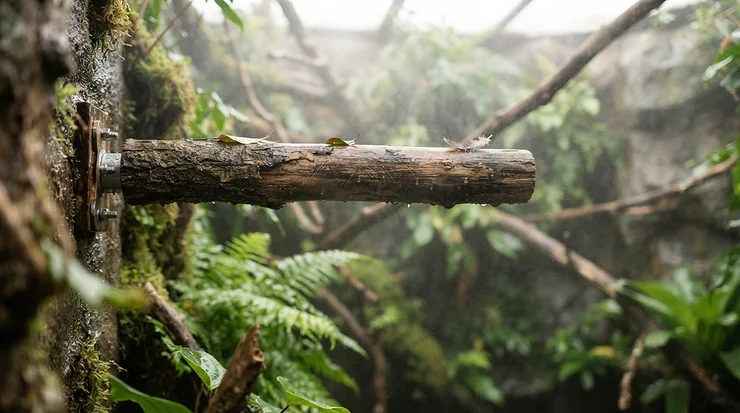
Your parrot spends most of its waking life standing on a few lengths of wood. Those perches are its sofa, dining table, bathroom floor and gym, all in one. Yet most of us wipe them with whatever is under the sink, or forget them until the cage starts to smell.
That habit is worth breaking. Dried droppings turn to dust, and dust travels. Psittacosis, for example, is usually caught by inhaling aerosolised dried droppings or respiratory secretions from infected birds. Wikipedia’s psittacosis entry sets out how the disease spreads. Wet-cleaning with the right product is the sensible way to keep that dust down.
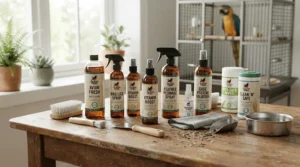
This guide compares seven real UK-available products. It also covers wooden perch cleaning spray, perch disinfectant for parrots and the perch hygiene product routine that suits each type of home. You’ll also find advice on droppings buildup on perches, foot health and natural wood perch care. Everything here comes from product specifications, manufacturer and retailer guidance, and aggregated review sentiment. I haven’t hand-tested any of it. Prices are ranges only, so check current pricing before you buy.
Quick Comparison: Perch Cleaner for Parrots at a Glance
| Product | Type | Format | Price range | Best For |
|---|---|---|---|---|
| Vetark Ark-Klens | Cleaner + disinfectant | RTU spray or concentrate | Under £12 | Vetark Ark-Klens suits budget-minded routine wipe-downs |
| Poop-Off Bird Poop Remover | Dropping remover | 32oz trigger spray | £11-£15 | Poop-Off suits dried-on droppings and brush scrubbing |
| F10 Avian Disinfectant Ready to Use | Disinfectant | 1 litre trigger | £10-£15 | F10 Avian Disinfectant Ready to Use suits busy owners who want no mixing |
| Avisafe Ready-to-Use Disinfectant | Disinfectant | 500ml trigger | £10-£14 | Avisafe suits owners who dislike strong smells |
| F10 SC Super Concentrate | Disinfectant | 100ml concentrate | £12-£16 | F10 SC Super Concentrate suits multi-bird homes and breeders |
| F10 CLXD Avian Disinfectant Cleanser | Cleaner + disinfectant | 1 litre concentrate | Mid-£10s to £25 | F10 CLXD suits one-step cleaning of heavily soiled surfaces |
| Vetark Tamodine-E | Iodophor disinfectant | 250ml concentrate | £12-£16 | Vetark Tamodine-E suits periodic deep cleans and quarantine |
Looking at the table, the real split isn’t price but job. Poop-Off removes mess, while the F10 range, Avisafe, Vetark Ark-Klens and Vetark Tamodine-E are built to disinfect. Most households end up with one of each type. Concentrates such as F10 SC Super Concentrate cost the most up front, but they work out far cheaper per wash than ready-to-use sprays.
💬 Just one click — help others make better buying decisions too!😊
Top 7 Perch Cleaner for Parrots Picks: Expert Analysis
1. Vetark Ark-Klens — best budget all-rounder for routine wipe-downs
Vetark Ark-Klens is a cleaner, disinfectant and deodoriser in one bottle, and it’s unscented, which matters to birds that notice everything. It’s sold as a 500ml ready-to-use spray or a 250ml concentrate. Listings give its active ingredient as benzalkonium chloride, and the general rate is about 10ml per 5 litres of water. One retailer says the 250ml bottle makes up to 100 litres of solution. In practice, a concentrate bottle outlasts almost every ready-to-use spray on the shelf.
Based on the label claims, this is the sensible default for a pet-parrot home. Manufacturer information describes it as effective against E. coli and Salmonella, and relevant to psittacosis and Chlamydia control, so it covers the usual household risks. It’s less suited to caked-on droppings, because it isn’t an enzyme dissolver. You’ll want a brush for those.
On reviews, I couldn’t verify Amazon UK counts. One specialist retailer’s listing for the spray shows roughly 91% positive across 38 reviews, which points to broad satisfaction. Expect to pay under £12 for the spray; check current pricing.
Pros:
- ✅ Very low cost per litre of made-up solution
- ✅ Unscented, so it won’t put birds off
- ✅ Cleans, disinfects and deodorises in one product
Cons:
- ❌ Concentrate needs careful measuring
- ❌ Stuck-on droppings still need scrubbing
2. Poop-Off Bird Poop Remover — best for dissolving dried-on droppings
Poop-Off Bird Poop Remover is a pure dropping remover rather than a disinfectant. It comes as a 32oz (roughly 950ml) trigger spray, with a brush-top bottle in some markets. Suppliers describe it as free of solvents, detergent, alcohol and bleach. Retailers also state it can be used with the bird in the cage. The makers say it works best with a brush on perches and dried droppings, and that’s honest advice.
What the spec sheet won’t tell you is why this matters. Droppings from fruit, pellets and veg dry like cement on rough bark. A spray that lets you wipe rather than chisel means less dust in the air, which is the real hygiene win.
It isn’t a germ-killer, so pair it with a disinfectant on perches you share between birds. Reviewer sentiment on specialist UK retailers is positive, though the review pools are small, with a handful of reviews per listing. Stock at UK suppliers also seems patchy, and one retailer suggests alternatives. Check availability before relying on it. The 32oz bottle sits around £11-£15.
Pros:
- ✅ Loosens dried droppings without harsh scraping
- ✅ Described as safe with the bird in the cage
- ✅ Also works on carpets, fabrics and play stands
Cons:
- ❌ Cleans only, with no disinfecting claim
- ❌ UK stock can be patchy
3. F10 Avian Disinfectant Ready to Use — best no-mixing disinfectant spray
The F10 Avian Disinfectant Ready to Use is a pre-diluted 1 litre trigger spray for cages, perches, bowls and surfaces. Retailer descriptions say it’s aldehyde- and iodine-free and works against bacteria, fungi, spores and viruses. You spray, leave it to air-dry and move on, with no rinsing. Once opened, one UK retailer advises using it within three to six months. That’s a real consideration if you only have one small bird.
Here’s what to weigh. Guidance on using it near birds varies between sellers. Some say it’s usable around birds as directed, while another UK parrot retailer states plainly that it can’t be used in the cage while the parrot is present. The safe route is to follow your bottle’s label and keep the bird out during application.
On reviews, the pool is thin, with one retailer showing a single 5-star rating, so I can’t claim a verified consensus. Expect roughly £10-£15 for a litre.
Pros:
- ✅ Ready to use with no measuring
- ✅ Broad-spectrum claims including spores
- ✅ Air-dries with no rinsing needed
Cons:
- ❌ Short use-by window once opened
- ❌ Retailer advice on bird presence varies
4. Avisafe Ready-to-Use Disinfectant — best gentle-smelling option for sensitive households
Avisafe Ready-to-Use Disinfectant (The Birdcare Company, 500ml) contains halogenated tertiary amines, pre-diluted to 1:50. Retailers list it for use on perches, cages, bowls, brooders and nest boxes, and describe it as non-corrosive, biodegradable and pleasant-smelling. That last point matters because many birds dislike harsh fragrance.
There’s one analytical catch. The maker says the concentrate is Defra-approved against avian flu at a 1:10 dilution, but this ready-to-use bottle is 1:50. Don’t assume the spray meets the outbreak-strength rate. If you ever need that, buy the concentrate and check the current Defra approved disinfectant guidance.
Reviews on the brand’s own store are glowing, with users praising simplicity and smell. Treat that as aggregated but self-hosted sentiment. Pricing sits around £10-£14 for 500ml.
Pros:
- ✅ Pleasant, mild scent
- ✅ Listed for perches and nest boxes
- ✅ Concentrate version available for stronger needs
Cons:
- ❌ Spray strength isn’t the avian-flu rate
- ❌ Most reviews sit on the brand’s own site
5. F10 SC Super Concentrate — best value for multi-bird homes and breeders
F10 SC Super Concentrate is the economy champion. A 100ml bottle is diluted at 2ml per litre for general disinfection, 4ml for high-level work and 8ml for resistant viruses such as PBFD, according to retailer dosing guidance. That means 100ml can make dozens of litres of working solution. Its listed composition is quaternary ammonium and biguanidine compounds.
On paper, the strengths are breadth and economy. The catch is precision. You’re measuring millilitres, so a cheap oral syringe is a sensible companion buy. It also needs clean surfaces, because organic matter blunts any disinfectant. Wash off droppings first, then apply.
The product is marketed to avian vets and breeders. Public review data on Amazon UK is something I couldn’t verify, so judge it on specification and label. Expect roughly £12-£16 for 100ml.
Pros:
- ✅ Extremely cheap per litre made up
- ✅ Multiple dilution tiers for different risks
- ✅ Small bottle is easy to store
Cons:
- ❌ Needs precise measuring
- ❌ Requires pre-cleaning for best results
6. F10 CLXD Avian Disinfectant Cleanser — best one-step cleaner and disinfectant
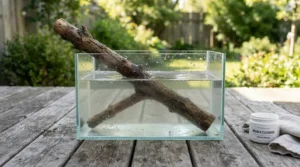
F10 CLXD Avian Disinfectant Cleanser adds detergent to the F10 formula, so it lifts grime and disinfects in the same pass. It’s a green, soapy concentrate with a slight pine scent. The general rate is 1:100, or 10ml in a litre. Rates for tougher jobs vary between retailer listings, so follow your own bottle. The detergent leaves a residue, so rinse anything beaks touch, and bowls in particular.
Think of it as the heavy-duty option for a stand that’s been sat in for a month. Because soap clings to wood fibres, give natural perches a clean-water rinse and a long air-dry. Some birds may dislike the fragrance, so rinse thoroughly.
Review data is scarce, so there’s no verified consensus. Expect a litre to land in the mid-£10s to £25 range; check pricing.
Pros:
- ✅ Cleans and disinfects in one step
- ✅ Economical dilution for a litre bottle
- ✅ Good for heavily soiled stands and floors
Cons:
- ❌ Soap residue needs rinsing off
- ❌ Pine scent may bother some birds
7. Vetark Tamodine-E — best for periodic deep cleans and quarantine
Vetark Tamodine-E is an iodophor disinfectant with a wide spectrum against bacteria, fungi and viruses. Its party trick is a built-in colour marker that fades when the solution becomes inactive. Listings say to wipe or rinse it off after use in animal accommodation, which rules it out as a spray-and-forget perch product.
Where it shines is the occasional full reset. That could be a new bird’s quarantine period, or after an illness when you’re replacing wooden items anyway. Because it’s coloured, test a hidden patch of wood first.
Reviews are thin and mostly come from aviary and reptile keepers, so there’s no robust parrot-owner verdict. At around £12-£16 for 250ml, it’s a modest cost for a cupboard staple.
Pros:
- ✅ Colour marker shows treated areas
- ✅ Wide-spectrum, low-toxicity profile
- ✅ Handy for quarantine deep cleans
Cons:
- ❌ Must be rinsed or wiped off
- ❌ Coloured solution may mark pale wood
How to Choose a Perch Cleaner for Parrots
Picking the right perch cleaner for parrots comes down to seven decisions. Work through them in order.
- Decide whether you need cleaning, disinfecting or both. Cleaners lift droppings, and disinfectants lower germ loads. Disinfectant works poorly on dirty surfaces, so most homes need both.
- Check the surface. Natural wood is porous. One owner forum notes that some disinfectant labels specify non-porous surfaces, so read yours.
- Check the dilution. A strong concentrate used wrongly is worse than a weak spray used right.
- Weigh convenience against cost. Ready-to-use sprays are quicker, and concentrates win on price per litre.
- Consider scent. Birds have sensitive airways, so mild or unscented often wins.
- Check contact time and rinsing. Some products air-dry, while others need a wipe or rinse.
- Verify any regulatory claim. If a brand says Defra-approved, confirm it on the official list.
Wooden Perch Cleaning Spray: What Works on Porous Branches
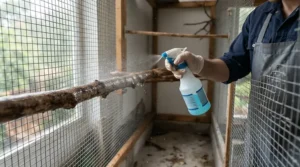
Wood drinks. That’s why a wooden perch cleaning spray behaves differently on a branch than on a stainless bowl. Liquids and droppings soak into grain, and a surface wipe can leave residue beneath.
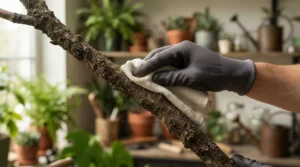
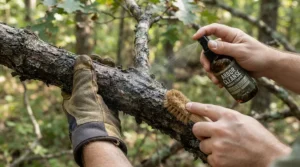
Based on the product guidance above, the most dependable routine is mechanical rather than chemical. Spray, give it a minute to loosen the mess, scrub with a stiff brush, rinse where the label requires, then dry thoroughly. Poop-Off Bird Poop Remover is built around that brush-and-spray idea. Vetark Ark-Klens is a sensible follow-up on branches you want sanitised.
Avoid soaking a delicate natural branch in strong solution for hours. It can crack or hold moisture. Retailer guidance also advises testing delicate surfaces on a small hidden section first. For cheap insurance, keep a spare set of perches. Rotating clean, fully dry branches in and out of the cage is a trick owners often share.
Perch Disinfectant for Parrots: When Cleaning Isn’t Enough
Cleaning removes what you can see. A perch disinfectant for parrots tackles what you can’t. That means bacteria, fungi and some viruses sitting in the micro-grooves of wood.
You don’t need to disinfect daily. Routine hygiene is a regular clean plus a periodic disinfect. Step up after illness, when introducing a new bird, or in a multi-bird home. For avian flu risk periods, UK keepers are directed to Defra’s approved disinfectant scheme. The government’s guidance on approved disinfectants explains when it matters. One caution: manufacturer claims differ. Avisafe’s seller says it is on the Defra list, while F10 documents state the brand withdrew from the listing on safety grounds. Check the live list rather than trusting packaging.
For everyday use, F10 SC Super Concentrate, Avisafe Ready-to-Use Disinfectant and F10 Avian Disinfectant Ready to Use all fit. Whatever you pick, don’t leave puddles, because birds may drink them.
Perch Hygiene Product Routine: A Step-by-Step Usage Guide
A perch hygiene product only works inside a routine. This is a practical weekly rhythm.
Daily (two minutes): Spot-spray fresh droppings with Poop-Off Bird Poop Remover or Vetark Ark-Klens and wipe. Fresh mess is far easier than dried.
Weekly (ten minutes): Remove perches. Scrub with a brush and your chosen cleaner, rinse if the label says so, then apply a disinfectant. F10 SC Super Concentrate or Avisafe work well here. Let everything dry fully before returning it.
Monthly: Inspect each perch for cracks, pits, splinters or stubborn staining. Replace anything that holds mess in its grain.
Two-set rotation: Keep a second set of perches so one set can dry while the other is in use. Damp wood invites mould.
First-30-day mistakes to avoid: over-concentrating solutions, skipping the pre-clean, and refitting damp perches.
Wet methods also keep dust down. A JW Pet perch-scrubber listing on Amazon US, for example, advises moistening perches to limit dust. The same principle applies with sprays: wet it, then wipe.
Droppings Buildup on Perches: Problem → Solution Guide
Droppings buildup on perches is the number one complaint, and each version has its own fix.
Problem: crusted, hardened droppings. Wet them first, then use a dissolver. Poop-Off Bird Poop Remover plus a stiff brush is the obvious pairing.
Problem: sticky fruit residue. Soap works better than disinfectant. F10 CLXD Avian Disinfectant Cleanser handles greasy or sugary films, then rinse.
Problem: lingering smell. Smell means residue. Clean first, then deodorise with Vetark Ark-Klens, which is positioned as deodorising.
Problem: mould on damp natural wood. Mould signals moisture, so dry thoroughly and replace affected branches. Don’t rely on disinfectant alone.
Problem: rope perches that never come clean. Owners often keep a spare rope set, soak the dirty one, then dry it fully before swapping back. Rope is hard to sanitise, so treat it as semi-disposable.
Consistency beats intensity. Ten minutes weekly prevents the build-up that leads to scraping, dust and sore feet.
Natural Wood Perch Care: Keeping Branches Fresh and Safe
Natural wood perch care has a simple goal: keep the variety and texture your parrot’s feet need, without keeping germs along for the ride.
Natural branches are generally recommended over dowels. Avian health sources favour a mix of diameters and textures. The vet-reviewed Hagen Avicultural Research Institute guide to bumblefoot lists wrong-sized, uniform, rough or dirty perches as common environmental causes. That means branches deserve regular inspection and cleaning.
Care tips grounded in the above:
- Scrub and dry rather than soak.
- Retire any branch that is deeply pitted, cracked or permanently stained.
- Use a mild, rinsed cleaner such as Vetark Ark-Klens between deep cleans.
- Check wood species suitability with an avian vet or reputable supplier before adding new branches.
Think of branches as consumables. A few pounds spent on replacement wood costs less than a vet visit.
Foot Health: Why Perch Hygiene Matters for Your Parrot
Foot health is where perch hygiene pays off. Bumblefoot (pododermatitis) is a common condition in pet birds. Wikipedia’s bumblefoot overview notes that heavier birds face more foot pressure, and avian vet sources add that poor perching is a major driver. Dirty perches add a bacterial risk on top. As one veterinary summary puts it, dirty cages, soiled perches, or wet bedding create an environment where bacteria thrive.
The advice from avian veterinary literature is consistent: offer perches of varied diameter and texture, and avoid abrasive pumice or sandpaper-style perches. Rope and natural wood are the usual recommendations. Clean perches help because there’s less irritant and bacteria load on skin that’s already under pressure.
Check your bird’s feet during cuddles. Redness, shiny thin skin, scabs or favouring one foot all justify a vet visit. Don’t try to treat it with household disinfectant. Hygiene is prevention, not a cure.
Real-World Scenarios: Matching Products to Your Home
Scenario 1: A single African grey in a flat. Budget is modest, space is tight, and you have two minutes each morning. A kit of Poop-Off Bird Poop Remover for daily mess and Vetark Ark-Klens for weekly wipe-downs covers it with little storage.
Scenario 2: A hobby breeder with a flock of budgies. Volume and cost per litre matter most. F10 SC Super Concentrate wins on economy, with Avisafe concentrate as a second option if you want a milder smell.
Scenario 3: A new rescue bird in quarantine. Disease risk is highest. Use F10 CLXD Avian Disinfectant Cleanser to clean, then Vetark Tamodine-E for periodic deep resets, and talk to your avian vet about protocol.
In each case, buy for the job. Don’t buy for the brand.
Perch Cleaner vs Disinfectant vs Home Remedies
Hot soapy water and vinegar are the traditional alternatives. They’re cheap, and for light mess they’re fine. But a dedicated perch cleaner for parrots or a veterinary disinfectant comes with label-level guidance on dilution and bird-safe use, which kitchen cupboard remedies don’t.
| Approach | Removes droppings | Kills germs | Best For |
|---|---|---|---|
| Hot soapy water | Good | Limited | Light, daily cleaning |
| Vinegar solution | Moderate | Not label-verified | Occasional freshening |
| Poop-Off Bird Poop Remover | Excellent | No claim | Dried-on droppings |
| Vetark Ark-Klens | Good | Yes (label claims) | Routine all-rounder |
| F10 SC Super Concentrate | Needs pre-clean | Yes, broad spectrum | Flocks and breeders |
The takeaway: home remedies handle mess but not microbes. If you’ve got one bird and a healthy routine, soapy water plus a periodic Vetark Ark-Klens wipe may be plenty. For multiple birds, new arrivals or illness, a labelled disinfectant such as F10 SC Super Concentrate is worth the small spend.
Common Mistakes When Buying and Using a Perch Cleaner for Parrots
Skipping the pre-clean. Disinfectant on top of droppings is largely wasted. Remove the mess first.
Dry-scraping. Scraping dried droppings creates the dust you’re trying to avoid. Wet first.
Leaving puddles. Avisafe’s own retailer guidance warns against leaving puddles that birds might drink.
Using an expired solution. One UK seller advises using F10 ready-to-use within three to six months of opening.
Returning damp perches. Wet wood grows mould. Dry fully, or rotate spares.
Assuming “Defra-approved” applies at every strength. Approval is tied to specific dilutions. Check the official list.
Choosing strong fragrance. Birds’ airways are delicate, so favour mild or unscented where you can.
Long-Term Cost and Maintenance
Concentrates look pricey on the shelf but are cheap per use, while ready-to-use bottles reverse that. Here’s how the value stacks up.
| Product | Format | Price range | Value verdict | Best For |
|---|---|---|---|---|
| Vetark Ark-Klens | Concentrate / RTU | Under £12 | Excellent | Everyday households |
| Poop-Off Bird Poop Remover | RTU | £11-£15 | Good for the job | Heavy droppings |
| F10 Avian Disinfectant Ready to Use | RTU | £10-£15 | Fair (convenience premium) | Occasional use |
| F10 SC Super Concentrate | Concentrate | £12-£16 | Outstanding per litre | Multi-bird homes |
| Vetark Tamodine-E | Concentrate | £12-£16 | Good (occasional use) | Deep cleans |
The pattern is clear. F10 SC Super Concentrate and Vetark Ark-Klens concentrate deliver the lowest cost per wash, while ready-to-use sprays charge for convenience. One sensible approach is to mix them. Use a concentrate for weekly disinfecting and keep a ready-to-use bottle of Poop-Off by the cage for daily mess. Don’t forget replacement perches, which are the real recurring cost.
Safety, Regulations and Compliance Guide
A few UK-relevant points are worth knowing.
Defra approval isn’t a general safety badge. The scheme assesses efficacy against specific notifiable diseases at set dilutions. Industry documents note it isn’t compulsory for everyday use, but approved products must be used in declared outbreaks. Check the live list rather than relying on packaging, because approval status can change.
Follow the label. Retailer guidance on using disinfectants with birds present varies, so move your parrot to another room, ventilate and let surfaces dry.
Protect yourself. Wear gloves, and consider a mask when cleaning heavily soiled cages. Avoid dry sweeping.
Store properly. Keep concentrates cool, labelled and away from children and pets.
Ask your vet. If your bird is ill, don’t rely on cleaning products. Seek professional help.

FAQ
❓ Can I use vinegar as a perch cleaner for parrots?
❓ How often should I clean parrot perches?
❓ Is a wooden perch cleaning spray safe to use while my parrot is in the cage?
❓ How do I remove old droppings stuck on natural branches?
❓ Should I replace natural wood perches or just disinfect them?
Conclusion
Choosing a perch cleaner for parrots isn’t about finding one miracle bottle. It’s about building a small, sensible kit. A dropping remover handles the daily mess, a labelled disinfectant covers the unseen risks, and a consistent routine keeps droppings buildup on perches from ever getting started. Of the seven picks, Vetark Ark-Klens is the best all-round value, Poop-Off Bird Poop Remover is the best mess-dissolver, and F10 SC Super Concentrate is the best economy choice for flocks. Avisafe Ready-to-Use Disinfectant suits scent-sensitive homes, and F10 CLXD Avian Disinfectant Cleanser and Vetark Tamodine-E cover heavy-duty and deep-clean jobs.
Remember the bigger picture too. Clean perches support foot health, but varied, well-chosen natural wood does most of the work. The IVIS veterinary guide to bumblefoot prevention is a useful next read on choosing the right perches.
Recommended for You
- Bird-Safe Cage Disinfectant: 7 Proven Picks For UK Owners (2026)
- Bird Toy Cleaner Buy: 7 Best Safe Picks For UK Owners (2026)
- Top Rated Cage Cleaner Under £10: 7 Proven Picks (2026)
Disclaimer: This article contains affiliate links. As an Amazon Associate, I earn from qualifying purchases. If you purchase products through these links, we may earn a small commission at no additional cost to you.
✨ Found this helpful? Share it with your friends! 💬🤗
