In This Article
Nothing quite unsettles a parrot owner like watching their bird fidget and preen through the night, feathers looking a little rougher each morning than the last. Before you assume the worst, it’s worth knowing something that surprises a lot of first-time owners: genuine feather mites are actually far rarer in pet parrots than people assume, and a lot of what gets blamed on mites turns out to be something else entirely — stress, diet, or a bird simply going through a moult. Still, when mites genuinely are the culprit, getting the right feather mite treatment for parrots matters, and getting it wrong (or skipping proper hygiene alongside it) can drag a minor problem into a much bigger one.

This guide pulls together real UK products — sprays, spot-on treatments and in-water solutions with genuine active ingredients, dosing information and manufacturer guidance — rather than a rewritten shopping page. We’ll cover feather mite symptoms so you know what you’re actually looking at, walk through a proper quarantine protocol for any new or recovering bird, and get specific about mite reinfestation prevention, because treating the bird without treating its environment is one of the most common ways owners end up back where they started. Whether you’re dealing with a confirmed parrot mite infestation treatment situation right now or simply want a sensible plan in place before you need one, here’s what actually works, and why.
Quick Comparison Table
| Product | Active Ingredient | Application | Best For |
|---|---|---|---|
| Johnsons Anti-Mite Extra Spray | Permethrin | Direct spray on bird | Budget first-line treatment |
| Vetafarm Avian Insect Liquidator (AIL) | Permethrin, Piperonyl Butoxide, Methoprene | Direct spray, bird + environment | Bird and cage treated together |
| Vetafarm SCATT | Moxidectin | Spot-on (thigh) | Scaly face and air sac mite |
| Dr Rob Marshall’s S76 | Ivermectin (water-soluble) | In drinking water or spot-on | Whole-flock/aviary treatment |
| Beaphar Insecticidal Bird Spray | Pyrethrin-based | Direct spray on bird | Gentle, budget-conscious option |
| F10SC Veterinary Disinfectant | Not insecticidal (broad-spectrum disinfectant) | Cage, perches, environment | Quarantine and reinfestation prevention |
| Xeno 450 Spot-On | Ivermectin (450µg) | Spot-on (vet-prescribed) | Larger parrots, POM-V cases |
Look closely at that table and a pattern emerges: no single product on this list is a complete solution on its own. The Johnsons Anti-Mite Extra Spray and Vetafarm Avian Insect Liquidator (AIL) target the mites you can see directly on the bird, while F10SC Veterinary Disinfectant handles the environment those mites are hiding in — skip one half of that equation and you’re likely to be treating the same infestation again within weeks. Products like Vetafarm SCATT and Xeno 450 Spot-On are more specialised, aimed specifically at burrowing mites like Knemidokoptes rather than surface-dwelling parasites, so matching the right product to the right mite genuinely matters here.
💬 Just one click — help others make better buying decisions too!😊
What Is Feather Mite Treatment For Parrots?
Feather mite treatment for parrots refers to insecticidal or acaricidal products — sprays, spot-on solutions or in-water medications — used to eliminate external parasitic mites living on a bird’s skin or feathers, alongside disinfecting the cage and surrounding environment where mites and eggs can survive off the host. As Knemidokoptes, the genus responsible for the most common burrowing mite in pet parakeets and parrots, illustrates, different mite species require genuinely different treatment approaches rather than a single one-size-fits-all spray.
Top 7 Feather Mite Treatments For Parrots: Expert Analysis
1. Johnsons Anti-Mite Extra Spray — the accessible first-line spray most owners reach for first
The standout with the Johnsons Anti-Mite Extra Spray is straightforward accessibility — it’s a water-based pump spray widely stocked and easy to find without needing a prescription, making it the product most UK bird owners encounter first when searching for a mite treatment. Its active ingredients are permethrin alongside powdered fenugreek and garlic essential oil, formulated specifically to kill red mite, northern mite, lice and other common external parasites on caged birds and pigeons while providing residual protection against reinfestation.
On paper, permethrin-based sprays like this one work well against surface-dwelling mites and lice that live openly on feathers and skin, but they’re generally less effective against burrowing species such as Knemidokoptes, which tunnel beneath the skin surface where a topical spray has limited reach. Based on the spec comparison with the rest of this list, this makes the Johnsons spray a sensible starting point for red mite or lice specifically, but not necessarily the right choice if your bird is showing the crusty, honeycomb-textured lesions characteristic of scaly face mite.
Aggregated customer sentiment consistently describes the spray as easy to use directly on caged birds, with reviewers specifically noting it worked well for parrots experiencing scratching and irritation. A recurring theme in feedback is appreciation for the straightforward pump-spray format, which doesn’t require measuring or mixing before use, though as with most permethrin sprays, some reviewers note repeat applications are needed for a fully resolved infestation rather than expecting a single treatment to end things.
Pros:
- ✅ Widely available without a veterinary prescription
- ✅ Simple pump-spray format needs no mixing or measuring
- ✅ Effective against red mite, northern mite and lice specifically
Cons:
- ❌ Limited effectiveness against burrowing mites like Knemidokoptes
- ❌ Typically needs repeat applications for full resolution
Usually found in the under-£10 range for a 150ml bottle, this is a reasonable starting point for suspected surface mites, though a confirmed burrowing infestation will need a more targeted product from further down this list.
2. Vetafarm Avian Insect Liquidator (AIL) — treats the bird and its housing in one product
The Vetafarm Avian Insect Liquidator (AIL) earns its place here through genuine dual-purpose design: it’s formulated as both a direct-application bird spray and an environmental treatment for cages, perches, nest boxes and aviary floors, using the same bottle for both jobs. Its active constituents — permethrin, piperonyl butoxide and methoprene — combine an instant-kill insecticide with an insect growth regulator, meaning it doesn’t just kill adult mites on contact but also disrupts the hatching and maturation of any eggs left behind.
What most owners overlook about products like AIL is that the growth-regulator component is arguably more important long-term than the instant-kill effect, since a single spray only kills what’s present at that moment — the six-week residual protection against re-infestation is what actually breaks the mite life cycle over time. Here’s what to weigh: manufacturer guidance specifically states AIL is safe enough to use on newly hatched chicks, which matters if you’re treating a breeding pair or aviary rather than a single companion bird, and it’s explicitly recommended for use during the warmer spring and summer months when mite populations typically peak.
Reviewers consistently describe AIL as a reliable go-to for controlling bird mites, with feedback specifically praising its dual use on both the bird directly and the surrounding cage environment in a single product. A recurring point in aggregated sentiment is that owners appreciate not needing to buy a separate cage disinfectant and bird spray, since AIL is explicitly designed to cover both jobs; the main caveat some reviewers raise is that, as with any permethrin-based product, its effectiveness against deep burrowing mites remains more limited than a targeted spot-on treatment.
Pros:
- ✅ Six-week residual protection through an insect growth regulator
- ✅ Doubles as both a direct-application spray and cage treatment
- ✅ Manufacturer-stated as safe for use on newly hatched chicks
Cons:
- ❌ Still less effective than spot-on treatments against burrowing mites
- ❌ Requires careful dilution if using the concentrate rather than ready-to-use format
Typically priced in the £10-£20 range depending on size and concentrate versus ready-to-use format, AIL represents strong value specifically because it removes the need to buy a separate environmental disinfectant for routine mite control.
3. Vetafarm SCATT — the specialist for scaly face and air sac mite
The Vetafarm SCATT is a genuinely different category of product from the sprays above: a spot-on liquid containing moxidectin, applied directly to the skin of the thigh rather than sprayed across the feathers, specifically targeting Scaly Face mite (Knemidokoptes pilae) and Air Sac mite (Sternostoma tracheacolum) — both burrowing or internally-migrating parasites that surface sprays struggle to reach effectively.
Based on the spec comparison with the permethrin sprays covered above, SCATT’s spot-on delivery is the key differentiator: because moxidectin is absorbed systemically through the skin rather than sitting on the feather surface, it can reach mites burrowing beneath the skin around the beak and cere, which is precisely why manufacturer dosing instructs one drop for birds under 30g and two drops for birds between 30-100g, applied directly to bare skin rather than sprayed broadly. What most buyers overlook is that treatment timelines for scaly face mite are considerably longer than a surface infestation — manufacturer guidance notes it can take up to six weeks for the full effects of treatment to become visible, so this isn’t a same-week fix.
Aggregated review sentiment for SCATT is strongly positive, with owners repeatedly describing visible improvement in affected birds within days of treatment, alongside general observations of birds appearing brighter and more settled shortly after application. A consistent theme across reviews is reassurance around safety margins — SCATT is widely used across budgerigars, canaries, finches and parrots without reported adverse reactions at the standard dose, though as with any weight-based dosing product, accurately weighing the bird before treatment is repeatedly flagged as essential rather than optional.
Pros:
- ✅ Specifically effective against burrowing mites sprays can’t reach
- ✅ Simple weight-based dosing with a reusable dropper bottle
- ✅ Strong aggregated safety record across multiple parrot species
Cons:
- ❌ Full effects can take up to six weeks to become apparent
- ❌ Not intended for red mite or lice — a different problem to sprays above
Typically priced around £15-£20 for a 50ml bottle, SCATT is the specialist tool to reach for specifically when your parrot’s symptoms point to scaly face or air sac mite rather than a general lice or red mite problem.
4. Dr Rob Marshall’s S76 — the whole-aviary, in-water option
Dr Rob Marshall’s S76 takes a fundamentally different approach again: it’s a water-soluble treatment containing ivermectin, added directly to drinking water over two consecutive days, making it the practical choice when an entire aviary or multi-bird household needs treating rather than a single companion parrot. Individual birds can alternatively be treated with a single drop applied undiluted to the skin of the neck, giving it flexibility between flock-wide and individual dosing.
On paper, the appeal of an in-water treatment is logistical rather than pharmacological — trying to individually spray or spot-on treat a dozen aviary birds is time-consuming and stressful for the birds, while adding a measured dose to the communal water source treats everyone simultaneously with minimal handling. Here’s what to weigh: manufacturer guidance describes S76 as suitable for use at any stage of the breeding cycle without harming fertility in mature birds, fledglings or eggs, which is a genuinely useful property if mites are detected during breeding season when handling and stress need to be minimised.
Reviewers consistently report visible improvement within a day or two of starting treatment, with owners specifically noting tightened, glossier feathers and increased activity levels as early positive signs. A recurring theme in aggregated feedback is that S76 is frequently paired with a preventative maintenance schedule — treating for two consecutive days each month during high-risk periods such as juvenile growth or the moult — rather than being used purely as a one-off emergency treatment, reflecting its role as much in mite reinfestation prevention as in acute treatment.
Pros:
- ✅ Treats an entire flock simultaneously through drinking water
- ✅ Manufacturer-stated safe throughout the breeding cycle
- ✅ Suits both emergency treatment and ongoing preventative dosing
Cons:
- ❌ Less precise dosing than a per-bird spot-on for single companion birds
- ❌ Must be freshly prepared and birds must actually drink treated water to be effective
Generally priced in the £15-£20 range for a 30ml bottle, S76 makes most sense for breeders, aviaries or multi-bird households rather than someone with a single companion parrot, where a spot-on treatment offers more precise control.
5. Beaphar Insecticidal Bird Spray — a gentler budget alternative
The Beaphar Insecticidal Bird Spray rounds out the budget end of this list as a pyrethrin-based direct-application spray, positioned as a gentler alternative to permethrin formulations for owners who prefer a naturally-derived active ingredient. Pyrethrin, extracted from chrysanthemum flowers, has a long history of use in avian insecticidal sprays and works on contact against mites and lice living on the feather surface.
What most buyers overlook about pyrethrin-based sprays compared with permethrin equivalents is that pyrethrin typically breaks down faster once exposed to light and air, meaning it generally offers less residual protection between applications — a trade-off some owners are happy to accept in exchange for a shorter-acting, naturally-derived active ingredient. Based on the spec comparison with the Johnsons and Vetafarm sprays above, Beaphar sits in a similar surface-mite category rather than targeting burrowing species, so the same caveat applies: it’s a sensible choice for lice or red mite, not scaly face mite.
Aggregated review sentiment describes Beaphar as a reliable, no-fuss option for routine mite control, with reviewers appreciating the straightforward spray application and reasonable value for money. The most consistently repeated point across owner feedback is that, precisely because pyrethrin breaks down relatively quickly, more frequent reapplication is needed compared with permethrin-based alternatives to maintain protection between routine cage cleans.
Pros:
- ✅ Naturally-derived pyrethrin active ingredient
- ✅ Straightforward direct-spray application
- ✅ Competitively priced against other surface-mite sprays
Cons:
- ❌ Shorter residual protection than permethrin-based alternatives
- ❌ Not effective against burrowing mites such as scaly face mite
Typically priced around £8-£12, Beaphar is a solid budget pick specifically for owners wanting a naturally-derived spray for routine surface-mite control rather than a targeted burrowing-mite treatment.
6. F10SC Veterinary Disinfectant — the environmental half of the equation most owners skip
The F10SC Veterinary Disinfectant isn’t an insecticide at all — it’s a broad-spectrum veterinary disinfectant used to sanitise cages, perches, food bowls and quarantine spaces, and it earns its place on this list precisely because so many feather mite infestations recur when owners treat the bird but never properly disinfect its environment. F10SC has a long-standing clinical track record in UK avian veterinary practice, valued specifically for being effective against a wide range of pathogens while remaining safe to use around birds when diluted and applied correctly.
Here’s what to weigh: no amount of spraying or spot-on treatment on the bird itself will permanently resolve an infestation if mites and their eggs are still living in cage crevices, perch grooves or nest box material, which is exactly the gap F10SC is designed to close. On paper, this makes it less a “treatment” in the conventional sense and more an essential companion product — the piece of a proper parrot mite infestation treatment plan that stops the same mites reinfecting a freshly-treated bird within days of finishing a course of spray or spot-on.
Aggregated review sentiment consistently places F10 among the most trusted disinfectant options in UK avian circles, with owners and breeders specifically citing its comprehensive pathogen coverage and long clinical history as reasons for continued use. A recurring theme in feedback is that F10SC is frequently recommended alongside, rather than instead of, a dedicated mite treatment — reinforcing that this product’s job is prevention and environmental control rather than directly killing mites on the bird’s body.
Pros:
- ✅ Long clinical track record in UK avian veterinary practice
- ✅ Broad-spectrum coverage well beyond mites alone
- ✅ Essential for breaking the reinfestation cycle after treatment
Cons:
- ❌ Does not treat mites directly on the bird — requires pairing with a spray or spot-on
- ❌ Correct dilution is essential and needs following carefully
Typically priced in the £10-£18 range depending on concentrate size, F10SC is genuinely non-optional if you’re serious about mite reinfestation prevention rather than just treating a single flare-up.
7. Xeno 450 Spot-On — the vet-prescribed option for larger parrots
The Xeno 450 Spot-On sits apart from everything else on this list as a genuine prescription-only veterinary medicine (POM-V) containing 450 micrograms of ivermectin, licensed in the UK specifically for birds over 666g body weight — putting it firmly in the territory of larger parrot species such as African greys, Amazons and macaws rather than budgerigars or smaller parakeets. Because ivermectin is classed as an endectocide, it works against both external parasites like mites and lice and certain internal parasites simultaneously, applied as a single spot-on dose absorbed through the skin.
What most buyers overlook about Xeno 450 is that, as a POM-V product, it legally cannot be purchased without a prescription following a clinical assessment by a veterinary surgeon — this isn’t a shelf product you add to a basket, and rightly so given the broader pharmacological action and the documented risk of serious reactions in certain non-target species when ivermectin-based products are used incorrectly. Based on the spec comparison with the shelf-available sprays above, this makes Xeno 450 the option your avian vet may reach for specifically when a larger parrot has a confirmed, more stubborn infestation that hasn’t responded to first-line treatments, rather than a first port of call for a minor case.
Because this is a prescription-only clinical product rather than a mass-market consumer item, aggregated public review volume is naturally much lower than for the shelf-available sprays on this list — this is expected and appropriate for a POM-V medicine, and it’s precisely why veterinary oversight, rather than online reviews, should be your primary source of confidence in this product. What professional and veterinary sources consistently agree on is its effectiveness against parasites causing skin and feather problems in birds when correctly prescribed and dosed for the individual animal.
Pros:
- ✅ Broad-spectrum action against both external and certain internal parasites
- ✅ Vet-supervised dosing tailored to your specific bird
- ✅ Licensed specifically for larger parrot species over 666g
Cons:
- ❌ Requires a veterinary prescription and clinical assessment
- ❌ Not suitable for pregnant, lactating, or very young birds
Typically costing in the £20-£35 range per pack depending on your veterinary practice, Xeno 450 is the option to discuss with your avian vet for confirmed, larger-bird cases rather than something to self-prescribe from a shelf.
Practical Usage Guide: Applying Feather Mite Treatment Safely
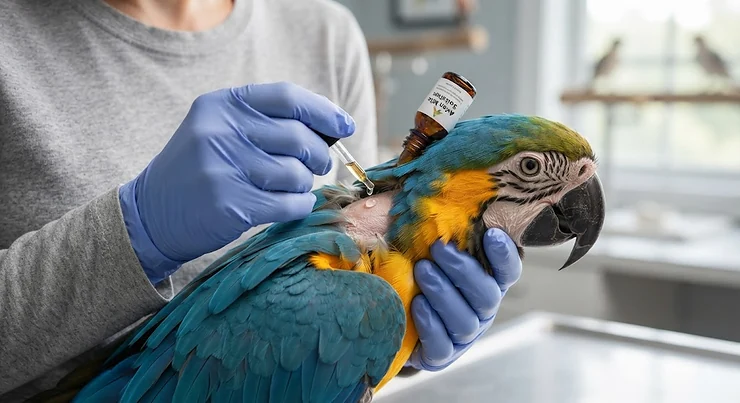
Getting a feather mite spray for parrots to actually work depends heavily on application technique, and this is exactly the practical detail a product label alone doesn’t always make clear. When spraying directly onto a bird, hold the bottle at the manufacturer-recommended distance — typically 30-40cm — rather than spraying close-up, and always avoid the eyes, nostrils and face directly; most manufacturer guidance specifically warns against spraying face-on, instead recommending you cover the head lightly by hand or spray the body first and let the bird preen the product through naturally. For spot-on treatments, accurately weighing your bird before dosing is essential, since these products are dosed by body weight in very small volumes where even a modest miscalculation matters proportionally more than it would with a larger animal.
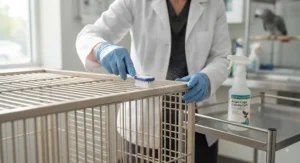
A common mistake in the first treatment cycle is stopping after a single application because visible scratching has calmed down — most insecticidal sprays and even spot-on treatments need a repeat application roughly two to three weeks later to catch mites that have hatched from eggs since the first treatment, since most products don’t reliably kill eggs on contact even when they kill adult mites effectively. Equally important, and frequently skipped, is treating the cage, perches and any nest box alongside the bird on the same day — a mite treatment applied to the bird while leaving mites thriving in cage crevices is treating half the problem, which is precisely why pairing a direct spray with an environmental disinfectant like F10SC matters so much in practice. Finally, always read the specific product’s guidance on food and water removal before spraying, since several manufacturers recommend removing food and water bowls briefly during application to avoid contamination, then replacing them once the spray has dried.
Real-World Scenarios: Matching Treatment to Your Parrot’s Situation
Picture three genuinely different situations, because the right feather mite treatment depends heavily on which one you’re actually facing. Consider a single companion budgerigar showing early scratching and mild irritation with no visible crusting — for this case, a budget surface spray such as the Johnsons Anti-Mite Extra Spray or Beaphar Insecticidal Bird Spray, combined with a thorough cage clean, is a reasonable and proportionate first step before assuming anything more serious. Now picture a breeding pair with several chicks in the nest box, where handling stress needs to stay minimal — here, Dr Rob Marshall’s S76 added to the water supply treats the whole family without the repeated handling that individual spot-on dosing would require.
Finally, imagine a large African grey showing the honeycomb-textured crusting around the beak and cere characteristic of scaly face mite, a case that hasn’t responded to an over-the-counter spray after a couple of weeks — this is precisely the scenario where a trip to an avian vet for a proper diagnosis and a prescription like Xeno 450 Spot-On, or a targeted product like Vetafarm SCATT, makes far more sense than repeating a surface spray that was never designed to reach a burrowing parasite in the first place. None of these three answers is universally “correct” — the right choice depends entirely on the mite species involved, the number of birds affected, and how the bird is presenting, which is exactly why an accurate read on symptoms matters before reaching for any product.

Parrot Mite Infestation Treatment: Step-By-Step Response
When you suspect a genuine infestation rather than a one-off itch, working through a clear sequence matters more than reaching for the first product on a shelf. First, confirm it’s actually mites: cover the cage overnight with a pale sheet, including the base, and check for tiny dark specks or blood-flecked marks the following morning, since red mites feed at night and hide during the day, making daytime visual checks unreliable on their own. Second, identify roughly which category of mite you’re dealing with — surface parasites like red mite and lice typically cause restlessness and visible activity on the sheet, while burrowing mites like Knemidokoptes produce the distinctive crusty, honeycomb-textured lesions around the beak, cere or legs rather than obvious surface movement.
Third, match your product to that category using the comparisons above rather than defaulting to whatever’s cheapest — a surface spray on a genuine scaly face infestation wastes time the bird doesn’t have, given how uncomfortable and progressive burrowing mite lesions can become if left untreated. Fourth, treat the environment on the same day as the bird, disinfecting the cage, perches and any shared toys, since skipping this step is the single most common reason infestations appear to clear up and then return within a few weeks. Fifth, if there’s any uncertainty about which parasite you’re dealing with, or if a first-line spray hasn’t shown improvement within roughly two weeks, book an avian vet appointment rather than escalating to stronger products yourself — a proper diagnosis, potentially involving a skin scraping under microscopy, removes the guesswork entirely.
Feather Mite Symptoms: Spotting an Infestation Early
Feather mite symptoms in parrots range from subtle to unmistakable depending on the species involved and how established the infestation has become, so knowing the early signs genuinely helps catch a problem before it progresses. The earliest and most common sign is restlessness, particularly at night, since many surface-dwelling mites such as red mite are more active after dark and cause noticeable irritation that disrupts normal roosting behaviour; owners frequently notice a bird that seems unusually fidgety or repeatedly preening a specific area well before any visible damage appears.
More advanced or specific symptoms depend on the mite species: excessive preening focused on one area, small dark specks visible at the base of feathers, or fine blood-tinged marks on cage liners are consistent with surface parasites, while grey-white, honeycomb-textured crusting around the beak, cere, eyes or legs points specifically towards a burrowing mite such as Knemidokoptes rather than red mite or lice. As the RSPCA’s own guidance on pet bird health notes more broadly, external parasites are sometimes over-suspected as a cause of feather problems that actually stem from other causes entirely, so it’s worth ruling out stress, poor diet, or a natural moult before assuming mites are automatically responsible for every feather issue. If in doubt, a vet-performed skin scraping remains the only truly reliable way to confirm which parasite, if any, is actually present.
Feather Damage From Mites: What to Expect
Feather damage from mites varies significantly depending on which mite is involved, and understanding what’s actually happening beneath the surface helps set realistic expectations for recovery. Surface-dwelling parasites like red mite and lice primarily cause irritation and blood loss from feeding, which can leave feathers looking dull or roughed-up from excessive preening and scratching, but rarely causes structural damage to the feather itself once the parasite is eliminated. Quill mites, by contrast, live inside the feather shaft and directly weaken its structure, which can cause feathers to become genuinely brittle and prone to breaking — a meaningfully different type of damage that surface treatment alone won’t fully resolve until the affected feathers are naturally replaced during the bird’s next moult.
Burrowing mites such as Knemidokoptes cause a different pattern of damage entirely, tunnelling into the skin and feather follicles themselves to create the characteristic honeycomb crusting, which — if left untreated for an extended period — can progress to genuine deformity of the beak and significant feather loss in severely affected areas. What the spec sheet won’t tell you, but veterinary sources consistently note, is that feathers already damaged by mites generally can’t be repaired directly; recovery instead comes down to eliminating the parasite so healthy new feathers can grow in during the bird’s next natural moult cycle, which is why patience alongside prompt treatment matters as much as the treatment itself.
How to Choose a Feather Mite Treatment For Parrots
- Identify the mite type before buying anything. Surface parasites (red mite, lice) and burrowing parasites (Knemidokoptes) need genuinely different products, so don’t guess.
- Match delivery method to your situation. A single companion bird suits a spray or spot-on; a breeding aviary often suits an in-water treatment like S76 for whole-flock coverage.
- Check whether the product is prescription-only. POM-V products like Xeno 450 require a vet visit, which also means a proper diagnosis alongside treatment.
- Pair any bird treatment with an environmental disinfectant. A product like F10SC prevents the same mites reinfecting a freshly-treated bird within weeks.
- Read the residual-protection window on the label. Products with an insect growth regulator (like AIL’s methoprene) offer longer protection than a plain contact spray.
- Confirm the product is safe for your bird’s life stage. Some treatments carry specific warnings around chicks, breeding birds, or very young animals — check before applying.
- Plan for a second application. Almost no single-use spray or spot-on reliably kills eggs, so budget for a repeat treatment roughly two to three weeks later.
Feather Mite Spray vs Spot-On and In-Water Treatments
| Factor | Spray (e.g. Johnsons, AIL, Beaphar) | Spot-On (e.g. SCATT, Xeno 450) | In-Water (e.g. S76) |
|---|---|---|---|
| Best against | Surface mites, lice | Burrowing mites (scaly face, air sac) | Whole-flock outbreaks |
| Handling stress | Moderate — full-body application | Low — single small dose | Very low — no direct handling |
| Precision | Broad coverage | Weight-based, precise | Less precise per-bird |
| Prescription needed | Usually no | Sometimes (e.g. Xeno 450) | Usually no |
| Best For | Single birds with visible surface irritation | Confirmed burrowing mite cases | Aviaries and breeding groups |
The table makes the trade-off fairly clear: a feather mite spray for parrots is the accessible, low-commitment first step for a single bird showing general irritation, but it genuinely isn’t the right tool for a burrowing infestation, where a spot-on treatment’s systemic absorption does a job topical spraying simply can’t. In-water treatments trade some per-bird precision for the ability to treat an entire flock with minimal stress and handling, which matters considerably more in a busy aviary than it does for a single companion parrot. Choosing correctly here isn’t about which product is “strongest” in the abstract — it’s about matching delivery method to both the mite species involved and the number of birds you’re treating.
Quarantine Protocol For New and Recovering Parrots
A proper quarantine protocol is arguably the single most effective mite reinfestation prevention measure available, and it’s one many owners skip entirely when bringing home a new bird. Any newly acquired parrot, regardless of how healthy it appears, should be housed in a completely separate room from existing birds for a minimum of 30 days, using separate food and water bowls, separate cleaning equipment, and ideally separate air space rather than just a different cage in the same room, since airborne dust and feather debris can carry parasites between spaces more easily than owners expect.
During this quarantine window, observe the new bird closely for any of the feather mite symptoms covered earlier, and consider a precautionary once-over with a broad-spectrum product like the Vetafarm Avian Insect Liquidator (AIL) even in the absence of obvious symptoms, since some mite infestations — particularly early-stage burrowing mites — aren’t visibly obvious for the first few weeks. The same quarantine principle applies in reverse when a bird is recovering from a confirmed infestation: keep the treated bird separated from the rest of your flock until you’ve completed the full treatment course, including any second application, and disinfected its cage and belongings with something like F10SC Veterinary Disinfectant before reintroduction. Skipping quarantine, in either direction, is one of the most common ways a resolved single-bird infestation becomes a whole-household problem.
Mite Reinfestation Prevention: Long-Term Strategies
Mite reinfestation prevention comes down to breaking the cycle at every point a mite could realistically survive, rather than treating the bird once and assuming the job is done. Regular cage hygiene sits at the centre of this: a full clean and disinfection of the cage, perches, food bowls and any nest box on a consistent schedule — weekly at minimum, more often during active treatment — removes the environmental reservoir where mites and eggs persist even after a bird itself has been successfully treated. Because red mite in particular can survive off a host for roughly a month even without feeding, a single deep clean immediately after treatment often isn’t enough on its own; a second clean two to three weeks later, timed alongside any repeat spray or spot-on application, closes the gap where surviving mites would otherwise re-establish.
Beyond routine hygiene, preventing new introductions matters just as much: maintaining the quarantine protocol above for every new bird, avoiding contact between your birds and wild birds or their nests where possible, and periodically inspecting nest boxes — a known hiding spot for mites even after the birds themselves have been treated — all reduce the odds of a repeat infestation. For aviaries or households with a history of recurring mite problems, some owners build a low-dose preventative treatment into their routine, such as the periodic S76 dosing schedule covered earlier, applied during known higher-risk periods like the moult rather than only reaching for treatment after symptoms reappear.
Common Mistakes When Buying a Feather Mite Treatment For Parrots
The most common mistake is buying a permethrin or pyrethrin surface spray for a bird that actually has a burrowing mite infestation, then concluding the product “doesn’t work” when really it was never designed to reach mites tunnelling beneath the skin — as covered above, matching product to mite species is the single most important buying decision here. A closely related error is stopping treatment after one application because visible symptoms have improved, without accounting for the fact that most products don’t reliably kill mite eggs, meaning a newly hatched generation can restart the same problem within a couple of weeks.
Another recurring pitfall is treating the bird thoroughly while completely ignoring the cage, perches and nest box, which — as covered in the reinfestation prevention section above — is precisely how a seemingly resolved infestation returns. Owners also frequently underestimate how long burrowing-mite treatments take to show visible results, sometimes switching products or doubling doses out of impatience when the original treatment simply hadn’t reached its full multi-week timeline yet, which risks overdosing rather than solving anything faster. Finally, a specific and important mistake is assuming any mite treatment is automatically safe to buy over the counter — some genuinely effective products, like Xeno 450, are prescription-only for good reason, and self-sourcing a prescription-only medicine without veterinary oversight carries real safety risk for the bird.
Safety and Regulations: UK Veterinary Medicines Rules
It’s worth understanding how UK law categorises the products covered in this guide, because it directly affects what you can buy without a prescription and why. Under the Veterinary Medicines Regulations, authorised veterinary medicines fall into distinct legal categories: AVM-GSL products can be sold by anyone, NFA-VPS products can be supplied by a vet, pharmacist or Suitably Qualified Person without a prescription, while POM-V products — such as Xeno 450 — can only be supplied following a genuine clinical assessment of the animal by a veterinary surgeon. This is precisely why a shelf-available spray like the Johnsons or Beaphar products covered earlier can be bought freely, while Xeno 450 legitimately requires a vet visit first — it’s not an arbitrary hurdle, but a safeguard reflecting the broader pharmacological action and documented risk profile of ivermectin-based products in certain non-target species.
Beyond the legal classification, general safety practice matters regardless of which product category you’re using: always weigh your bird accurately before any weight-dosed treatment, follow label guidance on distance and technique when spraying directly onto a bird, avoid spraying near the eyes, nostrils or open wounds, and wash your hands thoroughly after handling any insecticidal product. If a bird shows any unusual reaction after treatment — lethargy, laboured breathing, or a loss of appetite — stop use immediately and contact your avian vet rather than waiting to see if it resolves on its own, since these can indicate a genuine adverse reaction rather than a normal treatment response.
Frequently Asked Questions
❓ What are the first signs of feather mites in parrots?
❓ Can I treat feather mites without a vet?
❓ How long does feather mite treatment take to work?
❓ Do I need to treat the cage as well as the bird?
❓ How can I prevent feather mites coming back?
Conclusion
There’s no single correct feather mite treatment for parrots, and the products covered here reflect genuinely different jobs rather than competing versions of the same thing. The Johnsons Anti-Mite Extra Spray, Vetafarm Avian Insect Liquidator (AIL) and Beaphar Insecticidal Bird Spray cover surface-dwelling mites and lice at an accessible price point, while Vetafarm SCATT and the prescription-only Xeno 450 Spot-On are the tools to reach for when a burrowing mite like Knemidokoptes is genuinely confirmed. Dr Rob Marshall’s S76 earns its place for aviaries and breeding groups needing whole-flock treatment with minimal handling, and F10SC Veterinary Disinfectant, while not an insecticide itself, is arguably the most overlooked but essential piece of the puzzle — the product that actually stops a resolved infestation from quietly coming straight back.
Whichever combination fits your situation, the underlying principles stay the same: correctly identify what you’re actually dealing with before buying anything, treat the environment alongside the bird every time, follow through on repeat applications rather than stopping at the first sign of improvement, and don’t hesitate to involve an avian vet the moment something doesn’t add up. Mites are treatable, and most cases resolve well — the outcomes that go wrong are almost always about an incomplete treatment plan rather than a genuinely resistant parasite.
✨ Don’t Miss These Exclusive Deals!
🔍 Take your parrot’s feather health seriously with the treatments featured above. Click through on any highlighted product to check current pricing and availability on Amazon UK. Getting the right product matched to the right problem is the difference between a resolved infestation and a recurring one.
Recommended for You
- Scaly Leg Mite Treatment for Budgies: 7 Proven Fixes
- Scaly Face Treatment for Budgies Review 2026: 7 Products That Work
- 7 Top Rated Bird Wormer Under £20 Picks for 2026: Full Guide
Disclaimer: This article contains affiliate links. As an Amazon Associate, I earn from qualifying purchases. If you purchase products through these links, we may earn a small commission at no additional cost to you.
✨ Found this helpful? Share it with your friends! 💬🤗
