
In This Article
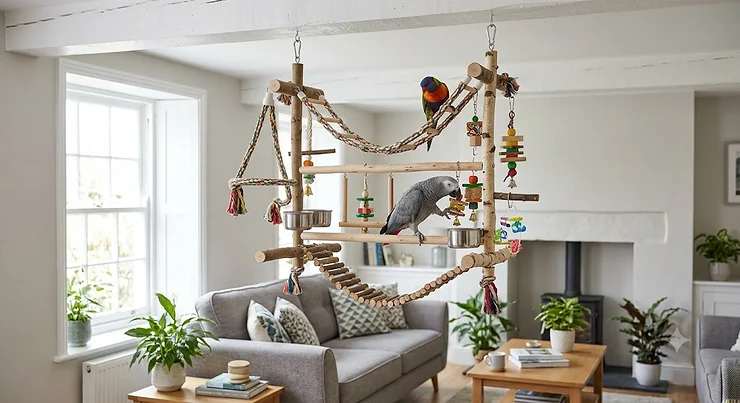
Somewhere above most parrot cages in Britain sits a patch of wasted real estate. It is flat, it is boring, and your bird has almost certainly noticed. A hanging bird play gym turns that dead space into a proper perching, chewing and exploring zone, mounted directly onto or above the cage roof so your parrot can step out without you having to rearrange the living room. In practice, it is a small frame of perches, ladders and toy hooks, usually wood or metal, that either clips onto the bars of the cage top or hangs from a bracket just above it, giving the bird a “third space” that is neither cage nor free-range chaos. If you keep a budgie, cockatiel, conure or grey and you have ever watched them pace the same three perches for the tenth time that day, you already understand the problem this solves.
We researched real, currently listed products, genuine aggregated review sentiment and UK welfare guidance to put together this guide, rather than simply reformatting a spec sheet. Reviewers on Amazon UK consistently mention that even sceptical, “will he even use it” birds tend to investigate a new cage top gym within the first afternoon, which lines up with the wider point made by welfare bodies: birds need enrichment that changes and challenges them, not just a bigger cage. The RSPCA’s guidance on bird enrichment is explicit that hanging toys for the cage or aviary are one of the simplest ways to improve a captive bird’s welfare, and a hanging bird play gym is essentially that principle scaled up into a whole activity centre.
Across this article we cover the seven real products worth considering in 2026, how they stack up on comparison tables, a proper walkthrough of installing and maintaining one, and the regulatory and welfare context that UK owners in particular should know about before they buy. Expect honest pros and cons, not marketing copy, and prices given only as ranges since exact figures change by the week.
Quick Comparison Table: Hanging Bird Play Gym at a Glance
| Product | Best For | Mounting Style | Price Range |
|---|---|---|---|
| Trixie Natural Living Playground (35 x 29 x 25 cm) | Budget first-time buyers | Freestanding cage top | under £25 |
| Trixie Natural Living Climbing Frame (47 cm) | True in-cage hanging gym | Hangs inside cage | under £20 |
| PawHut Bird Play Stand Portable | Mobility around the house | Freestanding on wheels | £30-£45 range |
| LIMIO Natural Wood Parrot Playstand | Feeding + play combined | Freestanding cage top/tabletop | £25-£35 range |
| Trixie Wooden Playground (55 x 41 x 41 cm) | Multi-bird households | Freestanding, larger footprint | £30-£40 range |
| Hamiledyi 4-Layer Large Bird Playground | Active, agile species | Freestanding, multi-tier | £35-£50 range |
| Relaxdays XL Activity Centre | Large parrots, African greys | Freestanding, extra-large | £45-£65 range |
Looking at the spread above, the two Trixie entries dominate the budget end because they are genuinely small, lightweight builds rather than scaled-down versions of a bigger stand cut down to a lower price. The middle of the table is where things get interesting: the PawHut and LIMIO options add wheels or feeder cups respectively, which matters more for day-to-day practicality than raw size. At the premium end, the Hamiledyi and Relaxdays models justify their price with genuine multi-tier height and load capacity for bigger birds, not just extra branding.
💬 Just one click — help others make better buying decisions too!😊
Top 7 Hanging Bird Play Gyms: Expert Analysis
1. Trixie Natural Living Playground — best lightweight budget cage top gym
The standout here is genuinely the price-to-footprint ratio: at 35 x 29 x 25 cm, this is small enough to sit directly on a standard cage top without dwarfing it, which is the single biggest complaint buyers have about larger play gyms. Constructed from natural wood with a cotton ring, ladder and rope section, the frame doesn’t bolt to the base, meaning you can lift the whole play area off in seconds for cleaning, though that same design also lets it “scissor” and wobble slightly if a larger bird lands on it heavily. Based on the spec comparison with the rest of this list, this is really built for budgies, small parakeets and canaries rather than anything conure-sized or above; the branch diameters are simply too slim for a bigger grip. Reviewers consistently report that birds investigate it within hours of installation, and one long-term Amazon UK reviewer noted they had bought the same model four times over four years because their bird kept the habit going. A recurring theme in aggregated feedback is exposed wood glue around the base joints, which several owners flagged as worth checking before leaving a bird unsupervised with it. Trixie Natural Living Playground sits at the very entry level of this category, typically under £25, and represents strong value if your bird is small enough to make full use of the perch spacing.
Pros:
- ✅ Genuinely compact footprint suits a standard cage top
- ✅ Natural, chewable wood bark birds enjoy stripping
- ✅ Detaches easily from the base for quick cleaning
Cons:
- ❌ Frame can wobble under a heavier bird’s weight
- ❌ Some review reports of exposed glue at joints
2. Trixie Natural Living Climbing Frame — best true hanging gym for inside the cage
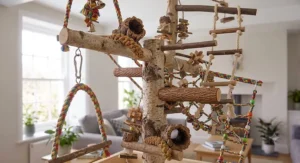
This is the one product on the list that is a hanging gym in the literal sense: rather than sitting on top of the cage, it hangs directly inside it from the cage roof, giving you roughly ten small natural perches in one compact unit. What most buyers overlook about this model is that it solves a completely different problem to the freestanding stands above; it adds usable vertical space within the existing footprint of the cage rather than requiring extra room outside it, which is exactly the enrichment gap the RSPCA highlights when it talks about hanging toys and rope encouraging natural chewing behaviour. At 47 cm, it is sized for parakeets, budgies and canaries, with irregular natural branches that vary in thickness, giving the bird’s feet a workout that a uniform dowel perch simply cannot match. One long-term UK reviewer described it as “essentially 10 small perches in 1”, and said it maximises vertical space without needing to buy anything else. Assembly does require a little patience, since some perches must be glued into pre-drilled holes using the included non-toxic glue, and it is explicitly a smaller-bird product, not something to hang for a cockatoo or macaw. If you’re specifically after a hanging parrot toy stand rather than a cage top platform, this is the more literal match, priced typically under £20.
Pros:
- ✅ Adds vertical space directly inside the existing cage
- ✅ Varied natural branch widths exercise the feet properly
- ✅ Genuinely affordable entry point into hanging enrichment
Cons:
- ❌ Assembly involves gluing perches into place
- ❌ Only suitable for small to medium-small species
3. PawHut Bird Play Stand Portable — best for moving the gym around the house
The headline feature is the four-wheel base, which lets you roll this stand from the living room to a balcony or patio without dismantling anything, something none of the other entries here offer. Specification-wise, it comes with two stainless steel feeding bowls set into a round tray roughly 60 cm across, a wooden perch section standing about 111 cm high, and a removable tray underneath that catches droppings and spilled seed for easy cleaning. In practice this means you can position your bird near natural light for part of the day and then wheel the whole set-up back beside the cage in the evening, which is a genuinely different use case to the fixed cage top gyms above it on this list. Aggregated UK reviews are mixed on build consistency: some owners describe it as sturdy and well finished, while others report a degree of wobble or a finish that feels rougher than the price would suggest, so this is a case where checking the most recent reviews before ordering pays off. It suits households with multiple birds or anyone who wants a dedicated play and feeding station that lives outside the cage entirely rather than attaching to it. Typical pricing sits in the £30-£45 range depending on the specific finish and retailer stock at the time.
Pros:
- ✅ Rolls on castors for flexible room-to-room placement
- ✅ Stainless steel bowls resist staining and odour
- ✅ Removable tray makes daily cleaning genuinely quick
Cons:
- ❌ Build quality reports are inconsistent between units
- ❌ Takes up more floor space than a cage top gym
4. LIMIO Natural Wood Parrot Playstand — best for combining feeding and play
What sets this apart on the spec sheet is the inclusion of four stainless steel cups alongside the usual perches, ladder and swing, meaning food, water, treats and a foraging item can all sit within the same play zone rather than needing separate dishes elsewhere. The removable tray beneath the stand is sized to take standard cleaning liners, so daily upkeep does not mean scrubbing the whole wooden frame each time, only swapping the liner. On paper this means the stand does double duty as both an enrichment centre and a satellite feeding station, which particularly suits owners who like to encourage their bird out of the cage for meals as a way of building confidence away from the bars. Reviewers of comparable natural wood LIMIO stands note that assembly is straightforward without tools, though the natural, hand-finished branches mean no two units look quite identical, which is a feature rather than a flaw for anyone wanting a less uniform, more “branch-like” aesthetic. It is rated for small to medium birds such as parakeets, budgies, cockatiels and lovebirds rather than larger parrots, and typically retails in the £25-£35 range. If cage top accessories with genuine multi-function value matter to you, the built-in cup system is the differentiator here.
Pros:
- ✅ Four cups cover food, water, treats and foraging in one spot
- ✅ Tool-free assembly using screw-together wooden parts
- ✅ Removable tray simplifies day-to-day cleaning
Cons:
- ❌ Not rated for anything beyond medium-sized birds
- ❌ Natural branch variation means sizing can differ slightly per unit
5. Trixie Wooden Playground — best larger stand for multi-bird households
At 55 x 41 x 41 cm, this is noticeably larger than the two Trixie entries earlier on this list, and the standout advantage is simply more simultaneous perching space, useful if you keep two or three budgies or a single cockatiel that wants room to move rather than a single static perch. The build includes wooden ladders, a swing and a metal-chain ring toy that hangs from a hook, giving a wider mix of activity types than the smaller natural playground above it. Here’s what to weigh before buying: several UK reviewers reported the assembly holes not quite lining up with the supplied dowels, occasionally requiring extra glue or a bit of manual widening, so budget fifteen to twenty minutes rather than the five the packaging implies. Once built, though, feedback is largely positive on stability, with one reviewer noting their budgie “took to it straight away” once extra toys and a large bell were added to increase the initial appeal. This model works best as a genuine second base for the bird rather than a brief novelty, since the larger footprint means it earns its floor or table space more convincingly with regular multi-bird use. Expect to pay somewhere in the £30-£40 range, making it a natural step up from the entry-level Trixie playground once your flock outgrows the smaller frame.
Pros:
- ✅ Larger surface genuinely suits two or more small birds
- ✅ Wider mix of ladders, swing and hanging ring toy
- ✅ Lightweight enough to reposition around the home easily
Cons:
- ❌ Assembly fit can be fiddly on some units
- ❌ Bulkier footprint than the smaller Trixie models
6. Hamiledyi 4-Layer Large Bird Playground — best multi-tier gym for active climbers
The four-layer, 32-inch design is the clear differentiator here: rather than a single perching plane, birds can move vertically between tiers, which suits naturally acrobatic, high-energy species that get bored fast on a flat layout. Reviewers consistently note that conures, cockatiels and small cockatoos treat the tiered structure almost like an obstacle course, hopping and climbing between levels rather than simply standing still, which is a meaningfully different play pattern to the single-storey stands earlier in this list. Based on the spec comparison, the extra height (32 inches, roughly 81 cm) means it needs a genuinely clear spot in the room rather than sitting directly on a standard-height cage, so it is better understood as a dedicated play tree than a literal cage topper. What most buyers overlook about multi-tier gyms generally is that more levels also means more surfaces to clean, so factor slightly more maintenance time into your weekly routine compared with a flat single-tier design. It typically ships with a removable tray for easier cleanup despite the added height, which keeps the extra complexity manageable. Pricing usually falls in the £35-£50 range, positioning it as a premium but not top-tier option for owners with genuinely active birds.
Pros:
- ✅ Four tiers give real vertical variety, not just height
- ✅ Suits high-energy species that get bored of flat layouts
- ✅ Removable tray keeps the taller design manageable to clean
Cons:
- ❌ Needs floor or table clearance, not just cage top space
- ❌ More surfaces mean a bit more weekly cleaning
7. Relaxdays XL Activity Centre — best premium option for large parrots
This is the largest, most heavily built entry on the list at roughly 130 x 60 x 60 cm, with a metal frame, approach rod and two integrated bowls designed with bigger species such as African greys and amazons specifically in mind. The extra scale matters practically: smaller stands simply cannot bear the weight or beak strength of a large parrot for long, and undersized perches force big feet into an uncomfortably tight grip, which the RSPCA’s general housing guidance flags as a welfare consideration in its own right. What the spec sheet won’t tell you, but the design implies, is that the mobility built into models like this (often on castors) matters even more at this size, since a fixed 130 cm structure is a genuine piece of furniture you will want to reposition rather than lift. The approach rod design gives the bird a clear, low-stress route onto the stand rather than requiring an awkward step-up, which is a small design detail that experienced keepers of nervous or older birds tend to value highly. This is very much a “buy once” purchase rather than something to size up from later, and the investment reflects that: expect to pay in the £45-£65 range, making it the premium end of this whole comparison. For anyone specifically searching for genuine vertical space for a large parrot rather than a compact budgie accessory, this is the product that actually matches that brief.
Pros:
- ✅ Genuinely sized and rated for large parrot species
- ✅ Approach rod gives a low-stress route onto the stand
- ✅ Sturdy metal frame built to take repeated heavy use
Cons:
- ❌ Significant floor footprint, not a true cage topper
- ❌ Premium price reflects its scale and durability
Top 7 Products: Specs, Range and Ratings Comparison
| Product | Material | Approx. Size | Best For | Price Range |
|---|---|---|---|---|
| Trixie Natural Living Playground | Natural wood | 35 x 29 x 25 cm | Budgies, canaries | under £25 |
| Trixie Natural Living Climbing Frame | Natural wood | 47 cm hanging | Parakeets, budgies | under £20 |
| PawHut Bird Play Stand Portable | Wood + steel bowls | 111 cm tall | Multi-room use | £30-£45 range |
| LIMIO Playstand | Natural wood + steel | Cage top / tabletop | Feeding + play combo | £25-£35 range |
| Trixie Wooden Playground | Wood + metal chain | 55 x 41 x 41 cm | Multi-bird flocks | £30-£40 range |
| Hamiledyi 4-Layer Playground | Wood, multi-tier | 32″ (approx. 81 cm) | Active climbers | £35-£50 range |
| Relaxdays XL Activity Centre | Metal + wood | 130 x 60 x 60 cm | Large parrots | £45-£65 range |
Read together, this table shows a fairly clean size-to-species relationship: the smaller and cheaper the frame, the smaller the bird it genuinely suits, with the Relaxdays XL Activity Centre sitting apart as the only entry built for large parrot body weight and beak strength. Buyers often make the mistake of choosing on price alone and then finding their cockatiel or conure outgrows a budgie-scale frame within months, so cross-reference this table against your actual species before checking out. If in doubt between two adjacent sizes, most experienced keepers size up rather than down, since an underused large stand is a much smaller problem than a bird that cannot comfortably use its perches at all.
Benefits vs Traditional Cage-Only Set-Ups
| Factor | Cage-Only Set-Up | With a Hanging/Cage Top Play Gym |
|---|---|---|
| Vertical space used | Minimal beyond existing perches | Cage roof or in-cage space actively used |
| Enrichment variety | Static, same 2-3 perches daily | Ladders, swings, cups, hooks in rotation |
| Owner interaction | Limited to cage-side visits | Encourages supervised out-of-cage time |
| Foraging opportunity | Food dish only | Cups and hooks allow scatter/foraging set-ups |
The practical difference this table points to is behavioural rather than cosmetic: a cage-only set-up gives a bird the same fixed geography every single day, while adding a play gym introduces genuine novelty and choice, both of which the RSPCA lists among the core drivers of good captive bird welfare. It is also worth noting that a play gym does not replace time out of the cage entirely; it simply gives that time more structure and purpose, which several aggregated reviews describe as making birds noticeably calmer once the initial “what is this new thing” period passes. None of this requires an expensive set-up, either, since even the budget Trixie entries on this list deliver a meaningful uplift over a bare cage top.
Setting Up and Maintaining Your Cage Top Play Gym
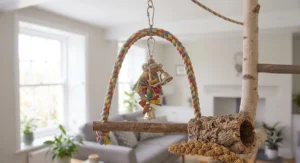
Getting a hanging bird play gym right is less about the unboxing and more about the first thirty days of positioning, introduction and upkeep. Start by placing the stand somewhere the bird can see it from inside the cage for a day or two before attempting to introduce them to it directly; birds that are shown a new object gradually settle in far faster than birds startled by a sudden change. Most flat-pack wooden gyms, including every Trixie model reviewed above, need branches pushed or lightly glued into pre-drilled holes, so dry-fit every piece before applying any glue, since forcing an ill-fitting dowel is the single most common cause of cracked wood reported in reviews. Once assembled, anchor the stand securely, whether that means resting it flush on a stable cage top or, for hanging in-cage models, checking the mounting hook is rated for the frame’s full weight plus a bird landing on it with force. A common first-month mistake is leaving droppings trays unemptied because the novelty toy gets less daily attention than the main cage; set a simple reminder to check and empty it alongside your regular cage clean. For ongoing maintenance, inspect chewable wood sections weekly for splintering, since natural wood is meant to be shredded but sharp fragments should be removed before they become a hazard, and rotate any small hanging toys every couple of weeks to keep the whole set-up genuinely stimulating rather than becoming part of the furniture your bird has stopped noticing.
Real-World Scenarios: Which Gym Fits Your Bird?
The city-flat budgie owner. If you’re keeping two budgies in a compact London flat with limited surface space, choose the Trixie Natural Living Climbing Frame because it hangs inside the existing cage rather than eating into your worktop or windowsill, giving you genuine vertical enrichment without a footprint increase.
The multi-bird household with a spare table. If you have three or four small birds and a console table free near a window, the Trixie Wooden Playground or LIMIO Natural Wood Parrot Playstand make sense because their larger surface area lets several birds use the space at once without constant squabbling over a single perch.
The African grey or amazon keeper. If your bird is a large parrot that spends genuine daily supervised time outside the cage, only the Relaxdays XL Activity Centre on this list is actually rated for that body size and beak strength; smaller frames will simply not hold up.
How to Choose a Hanging Bird Play Gym
- Match the frame to your species’ size and strength, since a budgie-scale gym will not survive contact with a cockatoo, while an oversized frame can feel intimidating to a small parakeet.
- Check the mounting method against your actual cage, because a genuinely hanging design needs bars or a bracket to hook onto, whereas a freestanding cage top gym only needs a flat, stable surface.
- Look for a removable dropping tray, as this single feature has the biggest impact on how often you will actually clean the thing.
- Prioritise varied perch diameters over sheer size, since irregular natural branches do more for foot health than one large uniform platform.
- Consider mobility if your layout changes often, in which case a wheeled stand like the PawHut Bird Play Stand Portable earns its slightly higher price.
- Read the most recent aggregated reviews for build consistency, since wood-based flat-pack gyms show more unit-to-unit variation than metal-framed premium stands.
- Budget for replacement toys, not just the frame, because the hanging hooks and cups are designed to be swapped regularly to keep enrichment genuinely novel.
Cage Top Play Gym vs Hanging Parrot Toy Stand: What’s the Real Difference?
These two terms get used almost interchangeably in listings, but the mechanics differ in a way that matters for your buying decision. A cage top play gym, such as the Trixie Natural Living Playground or LIMIO Natural Wood Parrot Playstand, is a freestanding structure that simply rests on the flat roof of the cage; it adds an entirely new play surface but takes up literal extra height above the cage, which matters if you have low ceilings, shelving or a light fitting nearby. A genuine hanging parrot toy stand, by contrast, like the Trixie Natural Living Climbing Frame, hooks or clips inside the existing cage structure itself, adding enrichment within the same footprint you already have rather than building upward from it. In practice, cage top gyms tend to offer more surface area and variety since they are not constrained by the cage’s internal bar spacing, while hanging in-cage frames are the better fit for smaller rooms, multi-cage set-ups, or owners who are not confident their bird will reliably stay on top of an open, unenclosed platform. Neither is objectively better; the right call depends on your available space above the cage and how much supervised time you can realistically give a bird using an open-top structure versus one still technically inside its enclosure.
Vertical Space and Bird Toys for Multi-Bird and Beginner Households
For anyone new to keeping birds, “vertical space” is one of those phrases that sounds abstract until you actually watch a bird use it. It ties directly back to the legal duty of care Blue Cross explains every UK pet owner has to meet a species-appropriate environment, and for a bird that means far more than horizontal floor space. Wild parrots and budgerigars move constantly between different heights while foraging, socialising and avoiding threats from below, and a flat cage with two horizontal perches simply cannot replicate that. This is precisely the gap that products like the Hamiledyi 4-Layer Large Bird Playground are built to close, since its tiered structure forces genuine height changes into daily movement rather than side-to-side hopping alone. Beginner households with a single small bird often underestimate how much difference this makes; owners who add even a modest hanging climbing frame frequently report a visibly calmer, more active bird within the first week. For multi-bird households the logic compounds further, since vertical variety also reduces competition for the same one or two favoured perches, something the Trixie Wooden Playground‘s wider layout is specifically suited to. If you are starting from nothing, prioritising one genuinely tiered or hanging structure over several small, similar-height toys will generally deliver a bigger welfare improvement for the same budget.
Cage Top Accessories That Actually Matter (And Those That Don’t)
Not every accessory bundled into a cage top gym earns its place, and a bit of honest filtering saves both money and clutter. Removable feeder cups, like those included with the LIMIO Natural Wood Parrot Playstand, genuinely matter because they let you offer foraging treats or fresh water away from the main cage dish, encouraging the bird to actually use the new space rather than treating it as an occasional novelty. A sturdy toy hook, present on the PawHut Bird Play Stand Portable, also earns its keep since it lets you rotate small hanging toys weekly without buying an entirely new stand. On the other hand, decorative mirrors bundled with some budget gyms are one accessory worth treating with caution, since prolonged unsupervised mirror access can encourage some species to fixate on their own reflection rather than genuinely exploring the rest of the structure. Similarly, thin metal bells with small gaps are worth inspecting closely before use, as poor-quality versions have been flagged in aggregated reviews as a snagging risk for claws. The accessories that consistently add value are the ones that change the bird’s behaviour, feeding, foraging, climbing, chewing, rather than the ones that simply look appealing in a product photo.
Long-Term Cost and Maintenance of a Bird Play Gym
A hanging bird play gym is rarely a one-off purchase in the way a single toy is, and it is worth budgeting accordingly rather than being surprised later. The frame itself, whether a budget Trixie natural wood model or a premium Relaxdays activity centre, typically lasts years if kept dry and inspected regularly, but consumable elements, rope, cotton rings, softer chewable wood sections, wear down faster and need periodic replacement, generally every few months for a bird that chews enthusiastically. Reviewers of the smaller Trixie playgrounds specifically note buying the same product repeatedly over several years as their bird wears through the natural wood, which is a genuinely different cost pattern to a one-time metal-framed structure like the Relaxdays XL Activity Centre that simply needs hardware checks rather than full replacement. Cleaning supplies, liner paper for removable trays and the occasional replacement toy hook or cup add a modest but real ongoing cost on top of the initial purchase price. Viewed over two or three years, the cheaper Trixie-style gyms and the premium metal stands often land at a fairly similar total cost of ownership once you factor in how much more frequently the budget wood options need replacing, so it is worth thinking in terms of years of use rather than upfront price alone when comparing options on this list.
Safety, Regulations and Compliance for UK Bird Owners
Any hanging bird play gym in the UK sits within the broader legal framework of the Animal Welfare Act 2006, which places a legal duty of care on owners to meet their pet’s core welfare needs, protecting all vertebrate animals and requiring keepers to meet those needs in practice, not just on paper. The PDSA’s guide to the five welfare needs frames this practically, noting that meeting a pet’s environment need means providing the right type of home with a comfortable place to rest as well as space to exercise and explore, a description that applies directly to the additional exercise space a hanging or cage top gym provides. Beyond the legal framing, practical safety still matters: check that any hanging model is mounted on a hook or bracket rated for its full loaded weight, inspect wood-based gyms for splintering that could injure feet or beaks, and avoid painted or treated wood finishes that are not explicitly marked as bird-safe, since a chewing bird will ingest whatever coating is on the surface. None of the seven products reviewed here require any special licence or registration to own, as they fall under general companion animal equipment rather than any regulated category, but responsible use still means supervising a bird’s first sessions on any new structure until you are confident it is stable and safe.
Buyer’s Decision Framework
If you keep a single small bird in a compact flat, choose a hanging in-cage frame like the Trixie Natural Living Climbing Frame because it adds enrichment without needing extra room. If you keep several small to medium birds and have surface space to spare, choose a larger freestanding gym such as the Trixie Wooden Playground or LIMIO Natural Wood Parrot Playstand because their wider layout reduces perch competition. If your priority is moving the play area around different rooms through the day, choose the PawHut Bird Play Stand Portable for its wheeled base. If you keep a large parrot species, choose the Relaxdays XL Activity Centre since it is the only entry genuinely rated for that scale, and treat anything smaller as a false economy that risks both the bird’s comfort and the product’s durability.
FAQ
❓ Do hanging bird play gyms actually get used, or do birds ignore them?
❓ Can I put a cage top play gym on any cage?
❓ How often should I replace toys on a hanging parrot toy stand?
❓ Is a hanging gym safe to leave unsupervised overnight?
❓ What size bird cage top gym do I need for a cockatiel?
Conclusion
A hanging bird play gym is one of the more affordable, genuinely welfare-positive upgrades you can make to a bird’s daily routine, and the right choice really does come down to your bird’s size and your available space rather than chasing the most expensive option on the shelf. Budget-conscious owners of small birds are well served by the Trixie Natural Living Playground or the true hanging Trixie Natural Living Climbing Frame, both of which deliver real enrichment for under £25. Multi-bird households get more value from the wider surface of the Trixie Wooden Playground or the feeding-integrated LIMIO Natural Wood Parrot Playstand, while owners wanting mobility should look to the PawHut Bird Play Stand Portable. Active, agile species benefit from the tiered climbing variety of the Hamiledyi 4-Layer Large Bird Playground, and only large parrot keepers really need to stretch to the Relaxdays XL Activity Centre, which is genuinely built for that scale rather than simply priced for it. Whichever you choose, remember that the frame itself is only half the equation, rotating toys, keeping trays clean and supervising early sessions is what actually turns a play gym into a lasting welfare improvement rather than an expensive ornament.
Recommended for You
- Standing Bird Play Gym: 7 Best Picks for UK Parrots (2026)
- Tabletop Bird Play Gym 2026: 7 Best Compact Picks
- Best Bird Play Gym: 7 Top Parrot Play Stands Reviewed 2026
Disclaimer: This article contains affiliate links. As an Amazon Associate, I earn from qualifying purchases. If you purchase products through these links, we may earn a small commission at no additional cost to you.
✨ Found this helpful? Share it with your friends! 💬🤗
