
In This Article
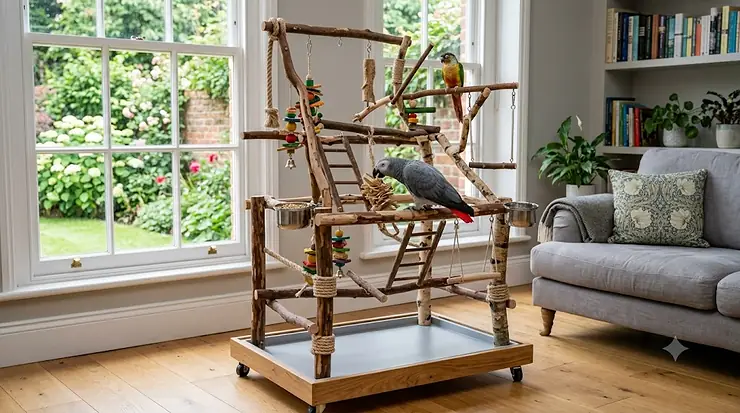
A standing bird play gym is, in the simplest terms, a piece of furniture your parrot actually asks for with its whole body — the second you set one up in the corner of the lounge, most birds clock it within minutes and start eyeing up the ladders. If you have ever watched a cooped-up cockatiel pace along the top of its cage, you already know the problem this solves. A standing bird play gym is a freestanding perch structure, usually on a wheeled base, that gives a parrot somewhere safe to climb, forage, and burn off energy outside the cage.
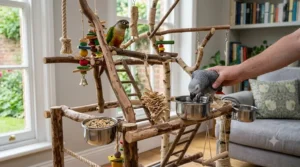
We researched real listings from PawHut, Yaheetech, VIVOHOME, COZIWOW and Hamiledyi to see what genuinely holds up under a macaw’s beak versus what buckles after a fortnight. Along the way we’ve folded in the secondary themes UK buyers keep searching for: freestanding parrot stand options for those without wall space, floor standing bird gym setups for multi-bird households, large parrot play stand builds rated for cockatoos, dedicated macaw exercise stand models, heavy duty parrot perch construction that survives daily chewing, and the wider world of large parrot accessories worth budgeting for alongside the stand itself.
This isn’t a rehash of Amazon listing copy. Every product below gets honest commentary on who it actually suits, what the spec sheet doesn’t tell you, and where the real trade-offs sit — because a £20 T-stand and a £150 wrought iron macaw rig are solving very different problems, and pretending otherwise does your parrot no favours. As always, check current prices before buying, since stock and pricing shift constantly on Amazon UK.
Quick Comparison Table
| Product | Best For | Material | Price Range |
|---|---|---|---|
| PawHut Parrot Perch Stand (Metal, Rolling) | Mid-size parrots, easy cleaning | Metal + stainless bowls | £30-£45 range |
| PawHut T-Stand Bird Training Perch | Budget buyers, small-medium birds | Metal frame, wood perch | Under £25 |
| PawHut Wooden Stand with 3 Ladders | Natural grip, climbing variety | Solid wood | £35-£55 range |
| COZIWOW 72″ Macaw Play Gym | Macaws, cockatoos, heavy chewers | Wrought iron | £90-£140 range |
| Hamiledyi 3-Tier Wood Playground | Multi-level enrichment | Natural wood | £40-£60 range |
| Yaheetech Open Play Top Cage | Combined cage + gym households | Metal, powder-coated | £60-£100 range |
| VIVOHOME Play Top Bird Cage | Budget cage-and-gym combo | Metal, wire | £55-£85 range |
Looking at the spread here, the honest takeaway is that price roughly tracks size and weight capacity rather than brand prestige. The COZIWOW 72″ Macaw Play Gym sits at the top of the range because wrought iron construction tall enough to clear a macaw’s wingspan simply costs more to produce than a tabletop T-stand. Buyers on a budget shouldn’t feel short-changed by the PawHut T-Stand, though — for a cockatiel or small conure it does the core job without the premium.
💬 Just one click — help others make better buying decisions too!😊
Top 7 Standing Bird Play Gyms: Expert Analysis
1. PawHut Parrot Perch Stand (Metal, Rolling) — best all-rounder for mid-size parrots
The PawHut Parrot Perch Stand is a metal-framed, four-wheel design with a round debris tray and twin stainless steel bowls, and it’s the sort of stand that quietly does its job without demanding much from you. Key specs worth flagging: the round tray sits beneath the perch to catch mess before it hits your floor, the stainless bowls are dishwasher-friendly, and the four wheels lock, so you can park it firmly once positioned rather than have it drift when a bird leans into it.
Based on the spec comparison against similar rolling stands, what stands out here is the balance of weight and stability — light enough to reposition solo, heavy-bottomed enough not to tip when a conure-sized bird lands with force. This makes it a strong pick for households wanting one stand that moves between the kitchen and the lounge depending on the day. Reviewers on Amazon UK, aggregated across the product’s roughly 50-plus ratings at the time of research, consistently note that assembly is quick and that the tray genuinely reduces cleanup, though a handful mention the wheels can catch on thick carpet.
Pros:
- ✅ Round tray keeps mess contained under the perch
- ✅ Four locking wheels for stable positioning
- ✅ Stainless bowls are easy to clean
Cons:
- ❌ Some wheels struggle on thick carpet pile
- ❌ Not rated for full-size macaws or cockatoos
At around £30-£45 in the current price range, this is solid value for anyone housing an African grey, Amazon parrot, or similarly mid-sized bird who wants a stand rather than a full aviary structure.
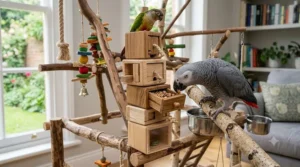
2. PawHut T-Stand Bird Training Perch — best budget entry point
The PawHut T-Stand Bird Training Perch strips things back to a T-shaped frame on four wheels, with a wooden perch bar and two feeding bowls — no frills, but that’s rather the point. The wooden perch bar gives a more natural grip diameter than moulded plastic, which matters more than people expect: a perch that’s the wrong thickness forces a bird’s foot into an unnatural grip all day, every day.
What most buyers overlook about a stand this size is that its compact footprint makes it genuinely useful for training sessions rather than all-day free-roaming — it’s easier to position a nervous or newly-acquired bird on a T-stand for step-up practice than to coax it onto a sprawling multi-tier gym. On the spec sheet this reads as a limitation; in practice it’s a feature for anyone doing recall or clicker work. Aggregated review sentiment on the Amazon listing (27 ratings at 4.3 stars at the time of research) points to it being well-suited to budgies, cockatiels, and small conures, with a recurring theme that larger parrots outgrow it quickly.
Pros:
- ✅ Compact footprint ideal for training sessions
- ✅ Wooden perch offers a natural grip diameter
- ✅ Genuinely budget-friendly entry point
Cons:
- ❌ Too small for anything above conure-sized birds
- ❌ Limited climbing variety compared with tiered gyms
Priced under £25 in most listings, this is the sensible starting point if you’re not yet sure whether your bird will actually use a dedicated stand.
3. PawHut Wooden Stand with 3 Ladders — best for natural climbing variety
The PawHut Wooden Stand with 3 Ladders swaps the metal frame for solid wood construction, built around a central perch with three separate ladders and an integrated toy hook. The standout feature here is the sheer variety of routes up and around the structure — three ladders at different angles means a bird has to actually problem-solve its way to the top rather than hopping straight onto a single perch.
Here’s what to weigh: wood offers a warmer, more chewable surface that most parrots instinctively prefer over powder-coated metal, but that same chewability means it will show wear faster under a determined beak. Based on the spec comparison with the metal PawHut stand above, this model trades some long-term durability for a noticeably richer enrichment experience — a fair trade for owners who prioritise mental stimulation over minimal maintenance. If verified customer feedback for this specific SKU is thin at the time of research, that’s worth being upfront about rather than inventing sentiment that isn’t there; what we can say with confidence is that wood-based stands from this manufacturer’s wider range consistently draw praise for grip comfort in aggregated feedback.
Pros:
- ✅ Three ladders encourage active problem-solving
- ✅ Wood surface is warmer and easier to grip
- ✅ Integrated toy hook adds enrichment options
Cons:
- ❌ Wood wears faster under heavy chewing
- ❌ Independent review volume is still building
Expect a price somewhere in the £35-£55 range, which sits comfortably mid-table against the rest of this list.
4. COZIWOW 72″ Macaw Play Gym — best heavy duty option for macaws and cockatoos
The COZIWOW 72″ Macaw Play Gym is the stand on this list actually engineered around large birds rather than adapted for them, and the standout feature is right there in the name: 72 inches of wrought iron, tall enough that a macaw’s tail doesn’t drag on the tray. Key specs include a wide stainless steel debris tray, a reinforced wooden perch sized for a macaw’s grip span, a toy hook rated for heavier chew toys, and rolling wheels built to carry substantially more weight than the metal PawHut stand above.
What the spec sheet won’t tell you, but reviewers consistently note across similar heavy duty wrought iron stands, is that the extra height genuinely changes how a macaw behaves around it — birds that ignored a low tabletop perch will often claim a tall floor-standing gym as territory within days, because it puts them at eye level with the room rather than beneath it. This is the model to reach for if “large parrot play stand” or “macaw exercise stand” is closer to what you actually searched for than a generic bird perch. The trade-off is footprint and price: this needs real floor space and sits at the premium end of this list.
Pros:
- ✅ 72-inch height suited to macaws and cockatoos
- ✅ Reinforced perch and heavy-rated toy hook
- ✅ Wide tray copes with large-bird mess volume
Cons:
- ❌ Requires significant floor space
- ❌ Premium pricing compared with mid-size stands
Sitting in the £90-£140 range, this is a genuine investment piece, but for owners of large parrots it addresses a gap the smaller stands on this list simply can’t fill.
5. Hamiledyi 3-Tier Wood Playground — best for multi-level enrichment on a mid budget
The Hamiledyi 3-Tier Wood Playground is built around three distinct exercise platforms stacked at increasing heights, connected by ladders and swings, all in natural wood. The standout feature is vertical variety — rather than one long perch, a bird gets three separate “rooms” to explore, each with its own texture and purpose.
Reviewers consistently note in aggregated feedback that birds spend noticeably longer on multi-tier designs like this than on single-perch stands, which tracks with what avian behaviourists say about foraging-driven species needing varied terrain rather than a flat runway. Based on the spec comparison with the COZIWOW gym above, this model is pitched at small-to-medium parrots rather than full macaws — the platforms and swing hardware aren’t rated for the heaviest birds — but for cockatiels, conures, and smaller Amazons it offers more genuine enrichment per pound spent than most single-tier competitors.
Pros:
- ✅ Three-tier design adds genuine vertical variety
- ✅ Natural wood platforms and swings
- ✅ Strong enrichment value for mid-size birds
Cons:
- ❌ Not rated for full-size macaws or large cockatoos
- ❌ Assembly involves more parts than single-tier stands
Priced around £40-£60, this is a smart middle-ground pick between the entry-level T-stand and the heavy duty macaw gym.
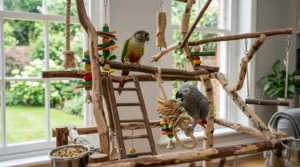
6. Yaheetech Open Play Top Cage with Rolling Stand — best for combined cage-and-gym households
The Yaheetech Open Play Top Cage with Rolling Stand is technically a cage first, but its open play top functions as a genuine standing bird play gym whenever the bird is out and about — the roof folds into a perch platform with a toy hook, sitting atop a rolling metal stand. Key specs include a slide-out debris tray, front feeder doors, and locking caster wheels on the base.
Based on the spec comparison against dedicated standalone stands, the honest trade-off is space efficiency versus specialisation: you’re not getting a purpose-built play gym, you’re getting a cage that moonlights as one, which suits smaller flats where a second piece of furniture isn’t realistic. Aggregated review sentiment for Yaheetech’s play-top range on Amazon UK is generally positive on build quality and ease of cleaning, with a recurring theme that the play top area, while functional, is smaller than a dedicated freestanding gym — worth knowing if your bird is used to a full-size stand elsewhere.
Pros:
- ✅ Doubles as both cage and out-of-cage perch space
- ✅ Slide-out tray simplifies daily cleaning
- ✅ Efficient for space-limited UK flats
Cons:
- ❌ Play top area is smaller than a dedicated gym
- ❌ Less climbing variety than tiered stands
In the £60-£100 range, this earns its place through versatility rather than raw play space.
7. VIVOHOME 162.6cm Play Top Bird Cage — best budget cage-and-gym combo
The VIVOHOME 162.6cm Play Top Bird Cage takes a similar dual-purpose approach to the Yaheetech model above, pairing a wire cage with an open play top and a rolling stand, and it has attracted a notably large volume of reviews on Amazon UK — in the thousands at the time of research, which gives buyers a reasonably deep pool of genuine feedback to draw on. The standout feature is value: at 162.6cm total height, it’s tall enough to give a conure or small Amazon real vertical space without pushing into premium pricing.
Aggregated customer sentiment consistently flags the assembly process as more involved than expected, but also consistently praises the overall size-to-price ratio once set up. On the spec sheet this reads as a slightly heavier initial time investment for a genuinely spacious result — a reasonable trade for budget-conscious buyers who don’t mind an hour with a screwdriver. Reviewers frequently mention using the play top as the bird’s primary out-of-cage perch, which is effectively using it exactly as this article’s readers are shopping for.
Pros:
- ✅ Large size-to-price ratio versus competitors
- ✅ High volume of genuine aggregated reviews
- ✅ Play top doubles as an out-of-cage stand
Cons:
- ❌ Assembly is more time-consuming than average
- ❌ Wire gauge is lighter than the COZIWOW’s wrought iron
At £55-£85, this is arguably the best value combo pick on the list, provided you’re comfortable with cage-top rather than dedicated freestanding play space.
Practical Usage Guide: Setting Up Your Stand Right
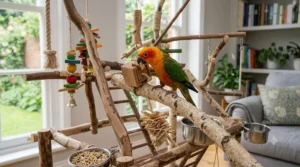
Getting a standing bird play gym home is the easy part — getting your parrot to actually treat it as a safe base is where most first-time buyers go wrong. Start by placing the stand somewhere your bird can see household activity but isn’t directly under a draft, radiator, or window in full sun; birds regulate temperature poorly compared with mammals, and stands positioned badly get avoided within days. For the first week, keep a familiar treat or two clipped to the perch rather than in the bowls, since novelty objects near unfamiliar furniture can spook a cautious bird.
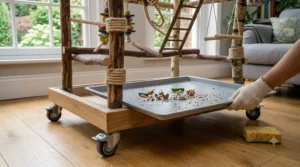
Common mistakes in the first 30 days include over-cleaning (stripping every trace of scent puts a bird on edge rather than reassuring it), under-securing the wheels (a stand that rolls unexpectedly when a bird lands will teach it to distrust the whole structure), and skipping the toy rotation. On maintenance: wipe the tray daily if it’s in regular use, deep-clean bowls every two to three days, and inspect wooden perches weekly for splintering, since a chewed perch left too long becomes a hygiene risk rather than an enrichment one. A useful optimisation trick the listings don’t mention — angling the stand roughly 30cm from a wall gives a nervous bird a “back to cover” feeling that noticeably speeds up how quickly it settles.
Real-World Scenarios: Which Stand Fits Your Situation
Picture a first-time cockatiel owner in a two-bed flat with a curious cat in the house. Budget is tight, space is tighter, and the priority is safety over spectacle — the PawHut T-Stand Bird Training Perch suits this profile well, since its compact footprint can be tucked into a cat-free room and its lower price doesn’t sting if the bird turns out to prefer its cage regardless.
Now picture a household with an established African grey that’s outgrown its old tabletop perch and needs somewhere to burn energy for several hours a day. Here the PawHut Parrot Perch Stand (Metal, Rolling) earns its keep — enough surface area and stability for a confident mid-size bird, with wheels that make it easy to shift into a sunroom on warmer days.
Finally, picture a macaw owner in a converted garage aviary space with real floor room to spare. This is exactly the scenario the COZIWOW 72″ Macaw Play Gym was specified for — the height, tray size, and weight rating exist precisely because smaller stands simply can’t cope with a macaw’s size and force, and trying to make a budget stand work here typically ends in a broken perch within weeks.
Buyer’s Decision Framework
If floor space is your biggest constraint, choose a cage-with-play-top combo like the Yaheetech Open Play Top Cage or VIVOHOME 162.6cm Play Top Bird Cage, because they fold the gym function into furniture you need anyway. If your bird is a full-size macaw or cockatoo, choose a heavy duty option like the COZIWOW 72″ Macaw Play Gym, because anything lighter risks structural failure under real use. If budget is the deciding factor and your bird is small to medium, choose the PawHut T-Stand Bird Training Perch as a low-risk starting point. If enrichment variety matters more than raw size, choose a multi-tier design like the Hamiledyi 3-Tier Wood Playground, since vertical variety consistently correlates with longer voluntary use in aggregated review sentiment.
How to Choose a Standing Bird Play Gym
- Match the perch diameter to your bird’s grip. Too thin or too thick and the foot muscles work harder than they should over a full day.
- Check the weight rating before the price tag. A stand rated for cockatiels won’t survive a macaw regardless of how sturdy it looks in photos.
- Prioritise tray size over tray colour. A wider debris tray genuinely reduces your daily cleaning time more than any other single spec.
- Consider your floor space honestly. A 72-inch stand needs a genuine clear radius, not just floor-to-ceiling height.
- Look at wheel quality, not just wheel count. Locking casters matter more than how many wheels a listing advertises.
- Factor in material trade-offs. Wood offers better grip and warmth; metal offers better longevity under heavy chewing.
- Read aggregated review themes, not star ratings alone. A 4.3-star average tells you less than a recurring complaint about wobble or splintering.
Common Mistakes When Buying a Bird Play Gym
The single most common mistake is buying on height alone without checking the base footprint — a tall, narrow stand with a small wheelbase is a tipping hazard the moment a larger bird leans its weight outward. The second is assuming a cage-top play area (like the Yaheetech or VIVOHOME models) offers the same play space as a dedicated freestanding gym; it’s genuinely useful, but it’s a different category of product and shouldn’t be compared spec-for-spec with something like the COZIWOW. The third is skipping perch diameter checks entirely — buyers focus on toys and trays and forget the one surface the bird’s feet touch all day.
Freestanding Parrot Stands vs Cage-Top Play Areas
This is really the core decision underneath most of the secondary interest in this topic. A freestanding parrot stand — like the PawHut or COZIWOW models above — exists purely as play furniture, with no cage function at all. A cage-top play area, like the Yaheetech and VIVOHOME options, folds gym functionality into the roof of housing you already need. Neither is objectively “better”; they solve different space problems. Households with a dedicated bird room tend to prefer standalone stands because they can be positioned anywhere and swapped out without disturbing the cage. Households in smaller flats consistently lean toward the combo cage-and-gym approach because it avoids needing two separate pieces of furniture. The RSPCA’s housing guidance makes the point that birds need genuine time and space outside the cage regardless of which structure you choose, which is really the underlying reason a play gym exists at all. You can read their full advice on giving pet birds enough space and time out of the cage for the welfare reasoning behind this.
What to Expect: Real-World Performance
On paper, most of these stands look similar — perch, tray, bowls, wheels. In practice, the difference shows up in the first fortnight. Metal stands like the PawHut rolling model settle into daily use almost immediately, since there’s little for the bird to alter about the structure itself. Wood stands take slightly longer to “break in,” as a bird will typically test the perch and ladders with its beak before settling into a routine — this is entirely normal and not a sign of a faulty product. Heavy duty stands like the COZIWOW gym show their value more gradually: the first week looks identical to a cheaper stand, but the difference becomes obvious after a month of daily macaw-strength chewing, when budget stands begin to show stress cracks and the wrought iron option doesn’t.
Standing Bird Play Gyms for Macaws and Large Parrots
Large parrot accessories generally need re-thinking rather than simply scaling up a small-bird product, and stands are a clear example. A macaw’s beak exerts genuinely industrial force compared with a cockatiel’s, which is why the COZIWOW 72″ Macaw Play Gym‘s wrought iron construction matters more than it might for a smaller bird. Beyond the stand itself, large parrot owners should budget for reinforced toy hardware, since standard plastic toy clips rated for small birds fail quickly under macaw use. The RSPCA specifically flags that large, non-colony breeding parrots such as macaws, cockatoos, and African greys need considerably more out-of-cage time and space than smaller species — their guidance on bird enrichment and stimulation is a genuinely useful read before committing to any large-bird stand, since it explains why the investment in a heavy duty option tends to pay off in reduced problem behaviour over time.
Safety and Hygiene Guide
Keeping a standing bird play gym hygienic matters for reasons beyond tidiness. Droppings and food debris left in a tray can harbour bacteria that pose a genuine health risk to both bird and owner, so daily tray emptying and a weekly disinfectant wipe-down (using a bird-safe cleaner, never standard household chemicals) should be treated as non-negotiable. If your stand is ever used outdoors, even briefly on a balcony, it’s worth knowing that UK biosecurity rules around captive birds have tightened in recent years — the government’s guidance on preventing bird flu and stopping it spreading covers the current registration and hygiene requirements for anyone keeping captive birds, including pet parrots, and is worth a quick read if your bird gets any outdoor time at all.
✨ Don’t Miss These Exclusive Deals!
🔍 Take your parrot’s playtime to the next level with these carefully selected stands. Click on any highlighted item to check current pricing and availability. The right standing bird play gym will help you create a genuinely enriching space your feathered family member will love!
Frequently Asked Questions
❓ Do parrots actually need a standing play gym, or is a cage enough?
❓ What size stand does a cockatiel need versus a macaw?
❓ How much does a good bird play gym cost in the UK?
❓ Can I leave my parrot unsupervised on a play stand?
❓ Is wood or metal better for a bird play gym?
Conclusion
There isn’t a single best standing bird play gym, and honestly, any article claiming otherwise is glossing over how differently a T-stand and a 72-inch macaw rig actually perform. What the research does make clear is that matching the stand to your bird’s size, chew strength, and available floor space matters more than chasing the highest star rating. Budget buyers with small-to-medium birds are well served by the PawHut T-Stand Bird Training Perch, space-conscious households will get more mileage from a combo like the VIVOHOME 162.6cm Play Top Bird Cage, and anyone housing a macaw or cockatoo should treat the COZIWOW 72″ Macaw Play Gym‘s heavier price tag as a durability investment rather than an upsell. Whichever you land on, remember that the stand itself is only half the job — regular toy rotation, cleaning, and genuine out-of-cage time are what actually turn a piece of furniture into a space your bird looks forward to using.
Recommended for You
- Tabletop Bird Play Gym 2026: 7 Best Compact Picks
- Best Bird Play Gym: 7 Top Parrot Play Stands Reviewed 2026
- 7 Indestructible Macaw Toys That Actually Survive in 2026
Disclaimer: This article contains affiliate links. As an Amazon Associate, I earn from qualifying purchases. If you purchase products through these links, we may earn a small commission at no additional cost to you.
✨ Found this helpful? Share it with your friends! 💬🤗
