
In This Article
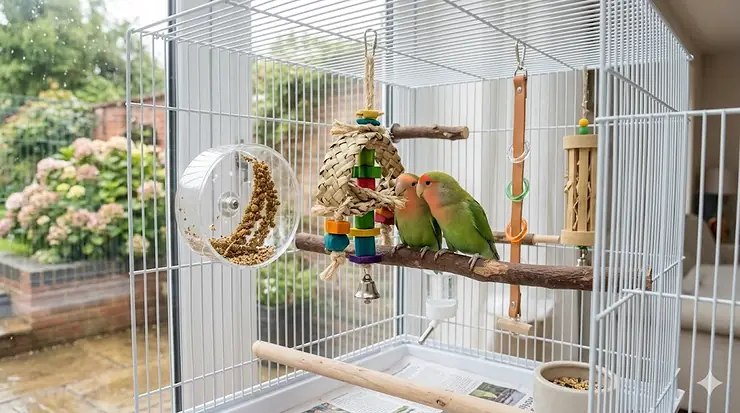
Buy a lovebird a toy and there’s a real chance it gets one curious sideways glance, one half-hearted peck, and then total indifference in favour of the loose thread on your dressing gown. This is the dirty secret of toys for lovebirds: a good chunk of what’s racked up in the pet aisle is built to catch a human eye in a shop, not a bird’s actual attention. Lovebirds are small, fierce, endlessly social parrots — and like any parrot, they’re wired to spend most of a wild day foraging, chewing, shredding and dismantling things with surgical focus. A cage with nothing to wreck is, to a lovebird, basically solitary confinement with snacks.
That’s the whole point of toys for lovebirds: they’re stand-ins for the jungle. Foraging puzzles, chew toys, climbing nets and mineral blocks give a bird something to do with the hours you’re not around, and the RSPCA is blunt about why that matters — birds kept as pets can’t behave as they would in the wild, and giving them the chance to forage, chew and climb is essential to their welfare, not a nice extra. Get the toy selection right and you’ll see a calmer, busier, less screamy bird. Get it wrong — cheap plastic, wrong size, nothing rotated for months — and you’ll likely see the opposite. Below, seven real, currently listed picks from Amazon.co.uk, what each one is genuinely good for, and where your money’s better spent than wasted.
Quick Comparison Table
| Toy | Type | Price Range (GBP) | Best For |
|---|---|---|---|
| Trixie Natural Bird Toy Cork Wood | Chew toy | Under £10 | First-time toy buyers, light chewers |
| Rosewood Boredom Breaker Bamboozlers Climbing Net | Climbing/foraging | £10–£15 | Active pairs, out-of-cage playtime |
| Rosewood Boredom Breaker Woven Wonders Comet | Shred/chew | Under £10 | Heavy shredders, paper-obsessed birds |
| JW Activitoy Tip & Treat | Mirror + treat dispenser | £10–£20 | Single birds, mentally curious lovebirds |
| Living World Bird Toy Value Pack | Multi-toy assortment | £10–£20 | New owners building a rotation |
| Trixie Wooden Playground | Play stand | £20–£40 | Supervised out-of-cage time, terraced houses |
| Cuttlefish Bone with Metal Holder (4-pack) | Mineral/beak conditioning | Under £10 | Every lovebird, permanently |
A glance down that “Best For” column tells you most of what you need: there isn’t one best toy for lovebirds, there’s a kit. The cuttlefish bone and the cork wood chew toy cover the basics for next to nothing, the Rosewood and JW options earn their higher price through more complex foraging and shredding mechanics, and the play stand is really a different category of purchase — a holiday home for supervised time outside the cage, not cage furniture. If you’re buying just one thing today, start with a foraging or chew toy under £10 and build outward; if you’re furnishing a new cage from scratch, the value pack plus the cuttlefish bone gets you 80% of the way there for under £30.
💬 Just one click — help others make better buying decisions too! 😊
✨ Don’t Miss These Exclusive Deals!
🔍 Take your lovebird’s playtime up a notch with these carefully selected picks. Click on any highlighted toy to check current pricing and availability on Amazon.co.uk — stock and prices shift fast, so it’s worth a look before they sell out.
Top 7 Toys for Lovebirds: Expert Analysis
1. Trixie Natural Bird Toy Cork Wood
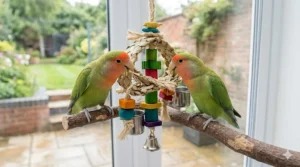
The Trixie Natural Bird Toy Cork Wood is exactly what it sounds like — a chunk of natural, untreated cork on a hanging cord, and that simplicity is the appeal. Cork is soft enough for a lovebird’s beak to make real progress on it within a single session, which matters more than it sounds: birds given something they can visibly destroy tend to settle faster than birds given something indestructible they just bounce off. What most UK buyers overlook is that this isn’t a toy you leave forever — cork wears down fast, so think of it as a renewable resource rather than a one-off purchase. In Britain’s damp autumns, cork can soften further and turn slightly mouldy if your bird doesn’t get through it within a few weeks, so a quick check-and-bin routine is worth building in. Reviewers consistently mention it disappearing faster than expected, which from a lovebird’s point of view is the entire point.
✅ Cheap, genuinely chewable, natural material
✅ Good starter toy for nervous or new owners
✅ Lightweight, easy to hang anywhere in a small UK cage
❌ Doesn’t last — needs replacing regularly
❌ Too soft to hold a determined chewer’s interest alone
Price & verdict: Around £7, and at that price it’s less an investment than a consumable — buy two or three at once so you’re not caught short.
Trixie ships from UK warehouse stock, so delivery is normally quick.
2. Rosewood Boredom Breaker Bamboozlers Climbing Net
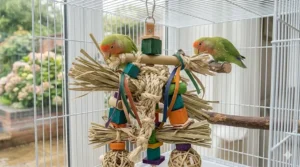
The Rosewood Boredom Breaker Bamboozlers Climbing Net is one of the few toys on this list explicitly sized for lovebirds rather than budgies on one side and macaws on the other — Rosewood’s own medium sizing bracket lists lovebirds by name alongside cockatiels and ringnecks. It’s woven from abaca rope and bamboo with no glue, wire or plastic anywhere in it, which matters in practice: a lot of cheaper imported nets use thin wire reinforcement that can snag a claw or, worse, get swallowed in pieces. What most buyers don’t realise until they’ve used one is that the net works just as well flat on the floor of a play stand as it does hung vertically, so it does double duty for in-cage climbing and supervised out-of-cage exploring — handy if your flat doesn’t have room for a separate floor gym. For a pair of bonded lovebirds, this is the toy most likely to get used together, since both birds can climb and forage from it at once without competing for a single perch point.
✅ Correctly sized for lovebirds specifically
✅ No wire, glue or plastic — genuinely chewable end to end
✅ Works hung or flat, in-cage or on a play stand
❌ Bamboo rings eventually get chewed through and need replacing
❌ Hand-crafted batches mean slight size variation between units
Price & verdict: Typically £10–£15, and given how few toys on the market are correctly scaled for lovebirds rather than guessed at, this earns its place near the top of most rotations.
3. Rosewood Boredom Breaker Woven Wonders Comet
If your lovebird’s defining personality trait is “turns paper into confetti,” the Rosewood Boredom Breaker Woven Wonders Comet is built for exactly that bird. It’s hand-woven from bamboo, palm leaf and abaca by Fair Trade producers, and it’s deliberately designed to be destructible rather than durable — the entire object is meant to come apart under a determined beak over a couple of weeks. That’s a different value proposition to most toys, and it’s worth being upfront with yourself about it before buying: you’re not paying for longevity, you’re paying for a satisfying demolition project. In a British winter, when a lovebird’s outdoor time and bonus enrichment often drops because nobody fancies opening a cold conservatory door, a shred toy like this becomes a genuinely useful way to fill the gap left by less daylight and less supervised free-flying.
✅ Specifically marketed and sized for lovebirds
✅ 100% natural materials, ethically sourced
✅ Excellent outlet for paper-shredding, nest-building instincts
❌ Gets demolished quickly — not a long-term toy
❌ Sheds small natural debris, which means a bit more cage cleaning
Price & verdict: Usually under £10. Treat it as a rotating consumable rather than a permanent fixture and it’s good value.
4. JW Activitoy Tip & Treat
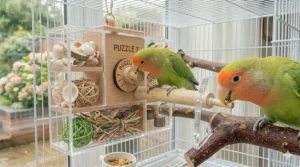
The JW Activitoy Tip & Treat is the most “thinking bird” toy on this list. It combines a mirror backing with a rocking treat dispenser, so the bird has to physically tip the mechanism to release whatever you’ve loaded into it — millet, a small piece of dried fruit, whatever your vet’s happy with. The cage-bar clip means it attaches in seconds without tools, which sounds trivial until you’ve spent twenty minutes trying to wire something else into a cramped UK budgie-and-lovebird-sized cage on a cold kitchen counter. The mirror element is the one to watch with lovebirds specifically: some birds treat their reflection as a flock-mate and calm right down, while others — particularly unpaired, hormonal lovebirds — can become fixated or even aggressive toward “the other bird.” Introduce it gradually and watch the first few sessions before leaving it unattended.
✅ Genuine problem-solving element, not just decoration
✅ Quick cage-bar attachment, no extra hardware
✅ Reusable — refill and reset rather than replace
❌ Mirror can occasionally trigger territorial behaviour in single lovebirds
❌ Plastic construction means it’s not chewable long-term
Price & verdict: Generally in the £10–£20 range. Worth it for the mental workout, but watch your bird’s reaction to the mirror before assuming it’s a hit.
5. Living World Bird Toy Value Pack (Assortment 2)
For anyone setting up a cage from scratch, the Living World Bird Toy Value Pack is the pragmatic choice: a mixed bundle of smaller toys — bells, chewables, hanging shapes — at a price that works out cheaper per item than buying each separately. The real value here isn’t any single toy in the box, it’s the variety, which solves the single biggest mistake new lovebird owners make: buying one “best” toy and assuming the job’s done. Lovebirds, like most parrots, habituate to objects fast — the University of Bristol’s review of parrot enrichment research notes that most of the literature focuses on foraging variety precisely because novelty, not any one object, is what keeps engagement up. A value pack gives you a built-in rotation from day one rather than a single static toy gathering dust by week three.
✅ Best cost-per-toy of anything on this list
✅ Built-in variety means less habituation, more engagement
✅ Good for cages housing a bonded pair, who’ll compete for favourites
❌ Individual pieces are lower quality than dedicated single toys
❌ Some items in the assortment will suit your bird better than others — expect a few duds
Price & verdict: Typically £10–£20 for the full assortment, which against buying six toys separately is comfortably the better deal.
6. Trixie Wooden Playground
The Trixie Wooden Playground is the odd one out on this list because it isn’t cage furniture at all — it’s a freestanding play stand with ladders, a swing, a perch and a hanging toy, meant to sit on a table or worktop during supervised out-of-cage time. For lovebird owners in typical British homes — flats, terraces, houses without a dedicated bird room — this solves a real spatial problem: you get a defined “bird zone” that isn’t the whole kitchen, and the bird gets a genuine change of scenery rather than just more cage. It folds down reasonably flat for storage between sessions, which matters more in a small UK living room than it would in a sprawling US suburban house. Worth noting: this is explicitly a supervised-only product — lovebirds are escape artists and chewers, and an unsupervised play stand in a room with houseplants, electrical cables or other pets is asking for trouble.
✅ Solves the “no extra space” problem common to UK homes
✅ Genuine change of environment, not just another toy in the same cage
✅ Foldable for storage in compact flats
❌ Needs full supervision — not a leave-it-and-go product
❌ The largest, priciest item here — a bigger commitment than a single toy
Price & verdict: Usually £20–£40 depending on size and seller. A meaningful spend, but one that pays off in actual out-of-cage enrichment rather than another bell on a string.
7. Cuttlefish Bone with Metal Holder (4-Pack)
It isn’t flashy, but the humble Cuttlefish Bone with Metal Holder belongs in every lovebird cage, permanently. Cuttlebone is the internal shell of the cuttlefish — naturally calcium-rich, and a soft enough material that a lovebird can grind its beak against it without any risk of injury. The practical upside is twofold: it’s a calcium top-up (handy since seed-heavy diets are often calcium-poor) and it’s a self-administered beak trim, since lovebirds naturally wear their beaks down against it rather than needing a vet visit to do it for them. A four-pack with metal holders is the sensible way to buy it in the UK — postage on a single cuttlebone barely makes sense, and having spares means you’re never caught out when one finally crumbles. It’s also one of the few items here that genuinely never gets “boring,” because it isn’t really a toy in the play sense — it’s maintenance your bird does for itself.
✅ Genuine health benefit, not just entertainment
✅ Extremely cheap per unit when bought in a pack
✅ Self-administered beak conditioning, reducing vet trims
❌ Not interactive or stimulating in the way other toys are
❌ Needs replacing once fully ground down — check it monthly
Price & verdict: Under £10 for four with holders included — arguably the best value-for-welfare item on this entire list.
How to Choose Toys for Lovebirds in the UK
- Size it to the bird, not the species name on the packet. A toy labelled “small/medium” sized for cockatiels can dwarf or, worse, trap a lovebird’s smaller feet and beak — check the actual centimetre measurements, not just the species list.
- Match the material to your bird’s behaviour. A heavy chewer needs cork, balsa or untreated wood that disappears fast; a shredder needs paper, palm leaf or abaca; a puzzle-solver needs mechanisms, not textures.
- Check for anything that could be ingested. Small bells, beads or loose string fragments are a genuine swallowing risk — UK pet shops vary wildly in quality control, so read recent reviews before trusting “bird safe” on the box.
- Plan for rotation, not permanence. Buy three or four cheaper toys instead of one expensive one, and swap them weekly — this single habit does more for engagement than any individual toy’s design.
- Budget for replacement, not just purchase. Destructible toys are doing their job correctly when they get destroyed — factor in roughly £5–£10 a month for consumables once your bird settles in.
- Consider your home, not just your cage. A play stand only earns its keep if you have a safe, supervisable spot for it — in a small flat, a climbing net that doubles between cage and floor use is often the smarter buy.
A Practical Toy Rotation Guide for UK Owners
Most of the value in toys for lovebirds comes not from which toy you buy but from how you manage them after purchase. Start with three or four toys covering different behaviours — one chew, one forage, one shred, one mineral — and only ever have two or three available in the cage at once, swapping one out every five to seven days. This keeps novelty high without overwhelming a cage that, in most UK setups, is already on the smaller side. Inspect every toy weekly for fraying, splintering or mould, which is more of an issue here than in drier climates — a cork or wood toy left in a humid kitchen or conservatory during a wet British spell can turn soft and mildewed faster than the packaging suggests. Store the “off-duty” toys somewhere properly dry, not in a damp shed or unheated garage, and give them a quick wipe-down before reintroducing. Finally, introduce anything genuinely new slowly: place it outside the cage for a day or two first, then just inside the door, before assuming your lovebird will accept it on day one. Nervous or recently rehomed birds especially need this slower introduction.
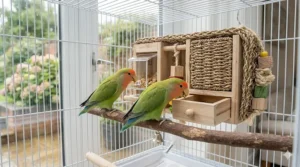
Three UK Households, Three Different Toy Setups
A first-time owner in a one-bedroom flat in Leeds with a single, recently-acquired lovebird found the JW Activitoy Tip & Treat did more for her bird’s confidence than anything else, simply because the treat-dispensing mechanism gave the bird something to “win” daily — a small thing that, over a few weeks, visibly reduced the screaming that had worried her at first. A retired couple in a Cotswolds cottage with a long-established bonded pair built their setup around the Rosewood Boredom Breaker Bamboozlers Climbing Net plus the Trixie Wooden Playground, using the latter for an hour of supervised garden-room time most afternoons — the net’s flat-or-hung versatility meant it worked in both locations without buying two separate items. A family in a Birmingham terrace with three lovebirds, where space and budget were both tight, leaned almost entirely on the Living World Bird Toy Value Pack rotated between two cages weekly, topped up with cuttlefish bone in every cage permanently — proof that a sensible rotation habit can matter more than any single premium purchase.
Toys for Lovebirds vs Cheap Multi-Packs: What the Extra Few Pounds Buys
Scroll Amazon.co.uk for “bird toys lovebird” and you’ll find enormous unbranded bundles — eight, ten, sixteen pieces — for less than the price of one Rosewood toy. The appeal is obvious, and for owners on a tight budget they’re not without merit: more objects in the cage generally beats none. But the trade-off is real. Unbranded bundles frequently use thinner wire, less consistent paint (worth checking for lead-free claims, since not all sellers state this clearly), and plastics that splinter into sharp edges rather than wearing down safely. A branded toy from Trixie, Rosewood or JW typically costs two to four times more per piece, but the materials are more consistently bird-safe, sized more accurately for the species stated, and — in Rosewood’s case — entirely free of glue or wire by design. If your budget only stretches to the cheaper bundle, the sensible middle ground is to use it for supervised play sessions only, while reserving anything left unattended overnight for the better-made, pricier alternative.
Common Mistakes UK Buyers Make When Choosing Lovebird Toys
The most frequent error is buying a single, large, expensive toy and expecting it to last — and entertain — indefinitely, when most lovebirds lose interest in a static object within days regardless of price. A close second is ignoring size guides and buying whatever’s marketed generically as a “parrot toy,” which often means something scaled for a cockatiel or African grey, not a bird the size of a fist. Owners also frequently underestimate how quickly a destructible toy needs replacing in a UK climate — cork, untreated wood and natural fibre toys soften faster in damp British air than in a drier climate, and a toy left too long can grow mould that’s invisible until you really look. Finally, many buyers skip the cuttlefish bone or mineral block entirely, treating it as optional because it isn’t “fun” — it’s the one item on this entire list with a genuine nutritional function, and it’s also the cheapest.
What to Expect: Toys for Lovebirds in a Real British Home
Specs on a packet rarely tell you how a toy behaves on a grey Tuesday in a terraced house in February, so here’s the honest version. Short winter daylight hours mean less natural activity overall, so toys that encourage movement — climbing nets, swings, the play stand — do more heavy lifting in November through February than in summer, when an open window and natural light do some of the entertaining for you. Damp is the recurring British villain: natural-material toys left near a kitchen, bathroom or steamy conservatory window will degrade faster than the same toy in a dry spare room, so location in the home matters as much as the toy itself. Smaller UK living spaces mean toy rotation storage needs thinking through — a shoebox in a cupboard works fine for spare cork and cuttlebone, but bulkier play stands need a fold-flat design if they’re going to survive in a typical British hallway or under-stairs cupboard. None of this is a reason to avoid natural-material toys — if anything, it’s the reason rotation and regular checks matter more here than they might in a drier, larger home elsewhere.
Long-Term Cost & Toy Rotation Budgeting in the UK
A reasonable starting kit — one chew toy, one foraging net, a value pack and a cuttlefish four-pack — comes in comfortably under £50, which also clears Amazon.co.uk’s typical £25 free-delivery threshold with room to spare, or arrives next-day if you’re on Prime. After that initial outlay, ongoing costs are genuinely modest: budgeting roughly £5–£10 a month for replacing consumable items (cork, shred toys, cuttlebone) keeps a rotation fresh without much financial strain, and most of that gets absorbed naturally if you buy in multi-packs rather than single items each time. The one larger, occasional cost is a play stand or similar furniture-style toy, which is a one-off rather than a recurring spend — buy once, use for years, provided it’s stored properly between sessions. Compared to the ongoing cost of an avian vet visit for a beak trim that a cuttlebone would have handled for free, the maths on toy spending is straightforward: it’s cheap insurance against boredom-driven problems that cost considerably more to fix later, including the kind of feather-plucking behaviour that’s well documented in captive parrots and that the Royal Veterinary College’s own clinical guidance treats as a genuine, multi-factorial welfare condition rather than a quirky habit.
✨ Don’t Miss These Exclusive Deals!
🔍 Ready to build your lovebird’s toy rotation? Check current pricing and availability on Amazon.co.uk for any of the picks above before stock runs low.
FAQ
❓ How many toys does a lovebird need in its cage?
❓ Are wooden and cork toys safe to leave in a damp UK conservatory?
❓ Do bonded lovebird pairs need separate toys each?
❓ Will toys for lovebirds qualify for free delivery on Amazon.co.uk?
❓ Can I return a lovebird toy if my bird won't use it?
Conclusion
There’s no single best toy for lovebirds, and anyone telling you otherwise hasn’t actually lived with one. What works is a small, rotating collection that covers chewing, foraging, climbing and basic mineral needs, swapped often enough to stay interesting and checked often enough to stay safe — especially in a British home where damp and short winter days work against natural materials more than they would elsewhere. Start cheap, watch what your particular bird actually goes for, and build outward from there. The gov.uk guidance on the Animal Welfare Act 2006 is clear that allowing a pet to exhibit normal behaviour isn’t optional generosity — it’s a legal welfare need, and for a lovebird, a decent toy rotation is one of the simplest, cheapest ways to actually meet it.
✨ Don’t Miss These Exclusive Deals!
🔍 Take your lovebird’s setup further with the picks covered above — check current Amazon.co.uk pricing while stock lasts.
Recommended for You
- Suitable Toys for Finches: 7 Best Picks for Happy UK Birds (2026)
- Toys for Canaries: 7 Best UK Picks for a Happy Bird (2026)
- Best Boredom Breakers for Budgies UK 2026 (7 Top Picks)
Disclaimer: This article contains affiliate links. As an Amazon Associate, I earn from qualifying purchases. If you purchase products through these links, we may earn a small commission at no additional cost to you.
✨ Found this helpful? Share it with your mates! 💬🤗
