In This Article
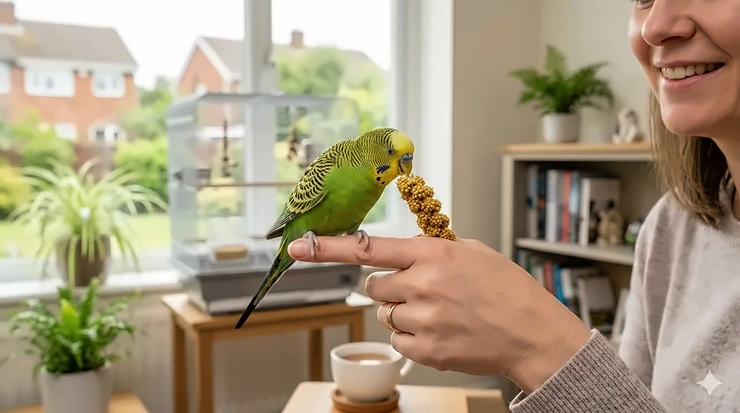
Training your budgie isn’t merely about teaching clever tricks—it’s fundamentally about building an unbreakable bond with your feathered companion whilst supporting their mental stimulation and overall wellbeing. I’ve spent years working with budgerigars, and I can tell you with absolute certainty that choosing proper budgie treats for training makes the difference between a nervous bird that won’t approach your hand and a confident companion that eagerly participates in daily sessions.
The truth is, many budgie owners unknowingly sabotage their training efforts. Too sugary? Your bird becomes hyperactive and unfocused. Too large? Training sessions end prematurely. Wrong nutritional profile? You’re inadvertently compromising health whilst trying to bond. According to veterinary nutritionists, treats should comprise no more than 10% of your budgie’s daily diet—yet they must be irresistible enough to motivate learning.
This comprehensive guide reviews seven exceptional UK products available on Amazon.co.uk, complete with real prices, nutritional breakdowns, and proven training techniques. Whether you’re hand-taming a nervous rescue or teaching advanced tricks, you’ll find evidence-based solutions here that actually work in real-world UK settings.
Quick Comparison Table: Top Budgie Training Treats
| Product | Best For | Price (£) | Key Feature | Rating |
|---|---|---|---|---|
| SKYGOLD Millet Spray 1kg | Budget bulk buying | £13-15 | Natural, handpicked | ⭐⭐⭐⭐⭐ |
| Vitakraft Kracker Trio | Variety & engagement | £24.35 | 6 flavours | ⭐⭐⭐⭐⭐ |
| Johnsons Honey Bars (40) | Long-term value | £33-34 | Individually wrapped | ⭐⭐⭐⭐½ |
| Britten & James Millet | Premium quality | £16.99 | 10-inch sprays | ⭐⭐⭐⭐⭐ |
| HappyPet Tweeter’s Treats | Budget beginners | £1.99-2.59 | Convenient 2-pack | ⭐⭐⭐⭐ |
| Vitakraft Egg-Grass Seeds | Moulting support | £19.60 | High protein | ⭐⭐⭐⭐½ |
| Vitakraft Honey-Sesame | Flavour preference | £19.60 | Natural honey coating | ⭐⭐⭐⭐½ |
💬 Just one click – help others make better buying decisions too! 😊
Top 7 Budgie Treats for Training: Expert Analysis
1. SKYGOLD Finest Millet Spray – Best Overall Value
Price: £13-15 for 1kg | Amazon.co.uk
When it comes to budgie treats for training, SKYGOLD Finest Millet Spray stands as the undisputed champion. This naturally grown, handpicked millet comes from the Copdock Mill family, who’ve been producing bird seed mixes for over 40 years in the UK. Each 1kg bag contains chunky, thick sprays with exceptional seed coverage.
From a nutritional standpoint, it’s brilliant. Contains approximately 10% protein, essential magnesium, phosphorus, and calcium whilst remaining low in fat—crucial when offering multiple treats during sessions. The alkaline carbohydrate content ensures high digestibility. UK customers consistently report their budgies “can’t get enough,” with value at roughly 50-60p per spray compared to £1-2 in pet shops.
Pros: Outstanding value • Natural composition • Versatile sizing
Cons: Some arrive slightly broken • Requires proper storage
For training, break off small 2-3 centimetre sections rather than offering entire sprays. This ensures continued motivation throughout multiple repetitions without satiation.
2. Vitakraft Budgie Kracker Trio Mixed Variety Pack – Best for Engagement
Price: £24.35 for 7-pack (21 sticks) | Amazon.co.uk
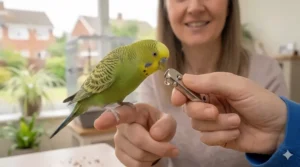
The Vitakraft Trio Mix delivers six distinct flavours: Egg & Grass Seeds, Apricot & Fig, Honey & Sesame, Orange & Apricot, Sesame & Banana, and Kiwi & Lemon. Behavioural psychology demonstrates that unpredictable rewards create stronger motivation—when your budgie doesn’t know which flavour comes next, they maintain peak engagement.
These sticks undergo triple-baking in Germany, creating unique texture budgies find irresistible whilst providing beak exercise. The sugar-free recipe means you’re not compromising health, and vitamin fortification supports wellbeing. UK customers report their budgies treating these “like crack,” demolishing sticks within hours.
Pros: Six flavours prevent boredom • Triple-baked texture • Sugar-free recipe
Cons: More expensive per gramme • Can arrive slightly crumbly
Break off 1-2 centimetre pieces for training. The varied flavours help identify preferences—invaluable for difficult training challenges requiring maximum motivation.
3. Johnsons Bulk Box Honey Bars – Best Long-Term Value
Price: £33-34 for 40 bars | Amazon.co.uk
For serious trainers, Johnsons Honey Bars offers unparalleled sustainability. Forty individually wrapped bars provide months of training at significantly reduced cost. Each bar weighs 35 grammes and measures approximately 12 centimetres long.
The composition combines carefully selected seeds with natural honey binding. Johnsons has refined this formula over decades, achieving the sweet spot between palatability and nutrition: 13.7% protein, 5.7% fibre, 4.5% fat. Individual wrapping maintains freshness across extended periods.
One UK customer calculated saving £14 compared to singles whilst another noted a box lasting 10 months. The practical green hanging clip simplifies both cage mounting and hand-holding.
Pros: Exceptional cost-per-serving • Individual wrapping • Consistent quality
Cons: Some arrive broken • Honey requires moderation
Store opened bars in airtight containers. Break into small pieces rather than offering whole sections for optimal training effectiveness.
4. Britten & James Premium Millet Sprays – Best Premium Option
Price: £16.99 for 1kg (40-55 sprays) | Amazon.co.uk
Britten & James Premium Millet represents absolute quality. These large, thick, 25-centimetre specimens undergo rigorous quality control, ensuring consistent seed density, optimal ripeness, and minimal stem wastage. The nutritional profile matches quality millet: low fat, high carbohydrate, excellent digestibility.
UK customers consistently praise size and quality. One review noted “the pieces are huge!” whilst another appreciated secure box packaging preventing damage. At roughly 30-40p per spray, the premium positioning reflects exceptional quality.
Pros: Exceptionally large sprays • Premium quality control • Multi-species suitable
Cons: Higher price point • Large sprays require storage space
Break off small pieces for training, or hang partial sprays as post-training rewards encouraging continued good behaviour throughout the day.
5. HappyPet Tweeter’s Treats – Best Budget Beginner Option
Price: £1.99-2.59 for 2-pack | Amazon.co.uk
Not everyone needs industrial quantities, particularly beginners. HappyPet Tweeter’s Treats serves this demographic perfectly with excellent quality at accessible pricing. Each pack contains two honey-flavoured seed sticks measuring approximately 10 centimetres long.
The honey flavour proves particularly popular—customers consistently report their birds “love them.” At £1.99-2.59, you can experiment without substantial outlay. UK availability through Amazon Prime ensures quick delivery.
Pros: Extremely affordable • Convenient 2-pack • Fast UK delivery
Cons: Limited quantity for active trainers • Slightly crumbly
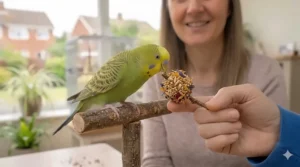
Break into sections for hand-feeding. The honey binding creates cohesive pieces perfect for training, and slight crumbliness actually advantages training—smaller pieces mean more repetitions.
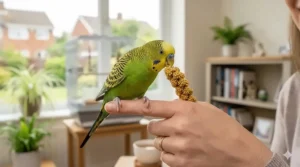
6. Vitakraft Egg-Grass Seeds Kracker – Best for Moulting
Price: £19.60 for pack of 7 (14 sticks) | Amazon.co.uk
Training during moulting presents unique challenges. Vitakraft Egg-Grass Seeds addresses these whilst maintaining effectiveness. The egg provides high-quality protein essential for feather development, whilst grass seeds deliver sustained energy. During moult, budgies require approximately 25% more protein.
UK customers specifically mention this as their budgies’ favourite. One noted “would eat every single day given a chance,” whilst another reported four budgies reducing sticks to bare wood within hours. This exceptional palatability maintains training momentum even during discomfort.
Pros: High protein supports feather development • Exceptional palatability • Beak-conditioning texture
Cons: Egg may not suit digestive sensitivities • Premium pricing
Offer smaller, more frequent rewards during moult. Shorter sessions (5-7 minutes) with high-value rewards maintain motivation without exhaustion.
7. Vitakraft Honey-Sesame Kracker – Best for Flavour Variety
Price: £19.60 for pack of 7 (14 sticks) | Amazon.co.uk
Sometimes success hinges on discovering that special flavour your budgie finds irresistible. Vitakraft Honey-Sesame frequently proves to be that game-changer, particularly for birds bored with standard millet.
The honey provides natural sweetness without refined sugars, whilst sesame seeds deliver healthy fats, protein (approximately 20%), and distinctive nutty flavour. One cockatiel owner noted their bird “much prefers them to treat sticks made for cockatiels,” whilst multiple budgie owners report fastest consumption of this variety.
Pros: Distinctive flavour profile • Exceptional palatability • Sesame supports feather quality
Cons: May create preference over regular diet • Honey requires moderation
Reserve honey-sesame for challenging sessions or breakthrough moments. The high palatability means it should be “earned” through significant effort, creating powerful positive associations.
✨ Don’t Miss These Exclusive Deals!
🔍 Take your budgie training to the next level with these carefully selected products. Click on any highlighted item to check current pricing and availability on Amazon.co.uk. These treats will help you create authentic training success your feathered friend will love!
Understanding Budgie Nutrition for Training
Before implementing techniques, let’s establish foundational nutrition knowledge. According to the RSPCA, budgies require diverse nutrition reflecting their wild Australian diet. In captivity, approximately 60-70% should comprise quality pellets, with remaining 30-40% split between fresh vegetables, fruits, and treats.
Treats should never exceed 10% of total daily intake. For a typical budgie consuming approximately 15 grammes daily, this translates to 1.5 grammes of treats—roughly equivalent to a small millet piece or half a Kracker stick. Exceeding this risks obesity, fatty liver disease, and vitamin deficiencies according to VCA Animal Hospitals.
The Millet Truth
Millet spray contains approximately 10% protein, 4% fat, and substantial carbohydrates. It’s easily digestible and provides quick energy—perfect for training requiring multiple repetitions. However, it lacks vitamins A, D, and E. The solution? Use millet specifically for training whilst ensuring bulk nutrition comes from quality pellets and fresh foods.
Treats for Life Stages
Young Budgies (Under 1 Year): Require higher protein (12-14%). Egg-based treats support development.
Adult Budgies (1-7 Years): Maintain with moderate protein (10-12%). Standard millet and varied Krackers work perfectly.
Senior Budgies (7+ Years): May require softer treats. Briefly soaking millet creates suitable texture.
Moulting Budgies: Temporarily increase protein to 14-16%. Egg-based treats prove particularly valuable.
Positive Reinforcement Training Fundamentals
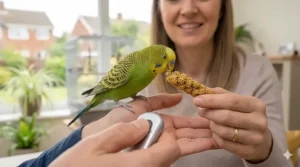
Modern budgie training relies exclusively on positive reinforcement—rewarding desired behaviours whilst ignoring undesired ones. This approach, grounded in behavioural science researched by institutions like Wikipedia on Operant Conditioning, proves vastly more effective than punishment-based methods.
The Psychology of Rewards
When your budgie performs desired actions and immediately receives valued treats, their brain releases dopamine—a neurotransmitter associated with pleasure and motivation. This creates powerful neural connections between actions and positive feelings.
Critically, timing proves essential. Research demonstrates rewards delivered within 2-3 seconds create strongest associations. Delays beyond 5 seconds may result in associating rewards with current behaviour rather than intended action. This explains why tiny, quickly-consumed treats work better than large ones.
Building Trust Foundation
Successful training requires establishing yourself as a reliable positive source. Invest time in basic trust-building:
Week 1-2: Sit near cage whilst reading, occasionally offering treats through bars.
Week 3-4: Begin offering treats from open palm near cage entrance.
Week 5-6: Introduce gentle step-up training using detailed techniques below.
According to avian behaviourists, gradual approaches create lasting trust far more reliably than rushed attempts that frighten birds.
The Jackpot Technique
Variable reward schedules prove more effective than predictable ones. Rather than rewarding every successful repetition equally, occasionally deliver “jackpot” rewards for excellent performance.
Standard Reward: Small millet piece (normal success)
Jackpot Reward: Larger preferred treat piece (breakthrough achievement)
This unpredictability maintains peak motivation because your budgie never knows whether the next attempt might yield extraordinary reward.
Step-by-Step Training Techniques
Teaching “Step Up” – Foundation Command
Every advanced trick builds upon step-up. Here’s the evidence-based protocol:
Protocol:
- Position finger horizontally at budgie’s lower chest whilst holding treat in opposite hand where visible.
- Apply gentle pressure against lower chest whilst saying “step up” in calm tone.
- Immediately reward the instant budgie lifts even one foot—don’t wait for complete step-up initially.
- Gradually raise criteria over sessions, eventually only rewarding complete step-ups.
- Practice 5-10 repetitions per session, twice daily. Quality beats quantity.
Avoid: Moving finger too quickly • Delaying rewards • Training when tired • Expecting perfection immediately
Most budgies master reliable step-ups within 7-14 days, though individual variation is normal.
Target Training for Advanced Tricks
Target training teaches budgies touching designated objects (typically sticks) with beaks, creating foundation for complex behaviours.
Protocol:
- Present target stick approximately 2-3 centimetres from beak.
- Click and reward (or simply reward) any interaction—looking counts initially.
- Gradually require closer proximity, then touching, then sustained touching.
- Introduce movement once touching is reliable.
- Expand to flight by placing budgie across room, presenting stick, rewarding flight to target.
Recall Training: Flying to Hand
Perhaps the most impressive yet practical skill involves reliable flight recalls.
Stage 1: Place budgie 15 centimetres from hand. Hold treat visibly whilst saying recall command. Reward immediately upon landing.
Stage 2: Gradually extend to 30 centimetres, then 60 centimetres, rewarding every success.
Stage 3: Progress to full room distance (2-4 metres), ensuring clear flight paths.
Stage 4: Practice with gradually increasing distractions—other people, gentle noise, multiple perches.
According to professional trainers, properly executed recall training can save birds’ lives by enabling capture in emergencies.
Common Training Challenges & Solutions
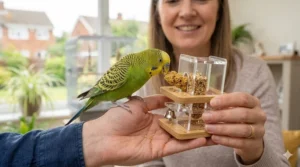
Challenge: Budgie Won’t Accept Hand Treats
Solution: Begin with cage-bar treats where hands don’t enter personal space. Over days/weeks, gradually position treats inside cage entrance whilst keeping hands still. Never chase budgies—this destroys trust requiring weeks to rebuild.
Challenge: Budgie Bites During Training
Solution: Never punish biting—this worsens problems. Identify triggers. Does biting occur when approaching from above? Approach horizontally instead. Does it happen when tired? Shorten sessions.
Challenge: Treat Motivation Decreases
Solution: Reduce treat size—pieces should be 5-7mm maximum. Rotate varieties to maintain interest. End whilst budgie still wants more rather than continuing until satiation.
Challenge: Inconsistent Performance
Solution: Standardise everything: same commands, same hand signals, same environment initially. Record sessions to identify patterns in successful versus unsuccessful attempts.
Creating Sustainable Training Schedules
Consistency determines success more than any other factor.
Daily Structure
Morning Session (10-15 minutes): Begin 30-60 minutes after cage uncovering when alert but hungry. Focus on challenging new skills whilst energy peaks.
Evening Session (5-10 minutes): Review previously learned behaviours. Keep shorter as budgies tire towards day’s end.
Weekly Progression
Week 1: Establish basic step-up reliability
Week 2: Begin target training or recall foundations
Week 3: Introduce first trick or advanced behaviour
Week 4: Consolidation—practice everything learned
Repeat with increasingly complex behaviours
Monthly Reviews
Every 4 weeks, video-record sessions and assess:
- Which behaviours show improvement?
- Where has progress stalled?
- Does budgie show stress or reluctance?
- Are treat rewards still effective?
Adjust accordingly—training should always remain positive.
Rest and Recovery
Schedule one training-free day weekly, two-week breaks twice yearly, and immediate cessation if illness appears. According to avian behaviourists, forced training when unwilling creates negative associations requiring months to overcome.
Storage and Safety Guidelines
Even premium treats lose value when improperly stored.
Optimal Storage
Temperature: Cool, stable (15-20°C ideal). Avoid radiators, sunny windows.
Humidity: Below 60%. UK climate often exceeds this—use airtight containers with desiccant.
Light: Store in opaque containers or dark cupboards.
Container Choice: Glass jars with rubber seals or quality plastic containers.
Shelf Life
Unopened: Millet spray 12 months • Kracker sticks 18 months • Honey bars 12-18 months
Opened: Millet spray 3-4 months • Kracker sticks 2 months • Honey bars 6+ months (wrapped)
Safety Red Flags
Immediately discard treats showing visible mould, off odours, unusual texture, pest infestation, or discolouration. Never risk questionable treats—replacement costs dramatically exceed potential veterinary bills.
Frequently Asked Questions
❓ How much millet spray should I give my budgie for training?
❓ Can I use budgie treats for training every single day?
❓ Which budgie treats work best for hand-taming nervous rescue birds?
❓ Are Vitakraft Krackers better than plain millet spray for training?
❓ How do I prevent my budgie becoming dependent on honey-based treats?
Conclusion: Your Journey to Training Success
Selecting appropriate budgie treats for training represents just one component of successful education, yet it’s a foundation upon which everything builds. Throughout this guide, we’ve explored the science behind treat-based learning, reviewed seven exceptional UK-available products, and detailed evidence-based techniques that transform nervous budgies into confident companions.
Remember these essential principles:
Quality Matters: Premium treats like Britten & James or Vitakraft varieties deliver superior palatability translating to enhanced motivation and faster learning.
Variety Prevents Boredom: Rotating between millet spray, seed sticks, and Kracker flavours maintains engagement across weeks and months whilst providing nutritional diversity.
Moderation Ensures Health: Treats should never exceed 10% of total daily diet, protecting against obesity whilst ensuring they retain motivational power.
Consistency Determines Success: Regular, brief training sessions create stronger learning than sporadic marathon attempts. Ten minutes daily beats one hour weekly.
The products reviewed—from budget-friendly HappyPet to premium Britten & James—all serve legitimate purposes depending on circumstances, budgets, and objectives. Success comes from matching products to situations whilst applying consistent, patient, positive techniques.
Your budgie possesses remarkable intelligence and capacity for learning. With appropriate treats, evidence-based techniques, and patient consistency, you’ll develop bonds transcending simple pet ownership into genuine companionship. Whether teaching basic step-ups or elaborate tricks, the journey itself provides enrichment and joy for both participants.
Recommended for You
- Budgie Pellets vs Seed Mix: 7 Best Options UK (2026 Guide)
- 7 Best Budgie Food UK 2026
- 7 Best Hospital Cage with Heat Lamp UK 2026
Disclaimer: This article contains affiliate links. If you purchase products through these links, we may earn a small commission at no additional cost to you. Prices shown are approximate and may vary. All recommendations reflect genuine assessment based on UK availability and customer feedback.
✨ Found this helpful? Share it with your mates! 💬🤗
