In This Article
You’ve probably heard conflicting advice about whether budgie pellets or seed mix is better for your feathered friend. I certainly did when I first brought home my budgie, Charlie. The pet shop insisted seeds were “natural,” whilst my avian vet recommended pellets for balanced nutrition. So which is actually right?
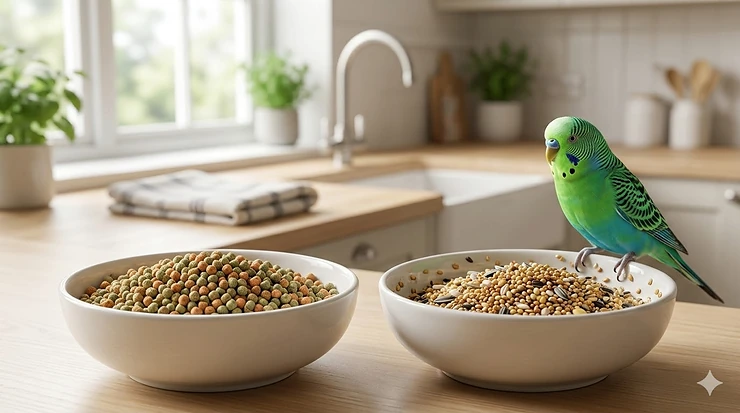
The truth is, a seed-only diet can lead to nutritional deficiencies because seeds lack essential vitamins, minerals, and protein. After spending months researching budgie nutrition and consulting with veterinary nutritionists, I’ve discovered that the budgie pellets vs seed mix debate isn’t quite as straightforward as choosing one over the other. The healthiest approach involves understanding how both fit into a balanced budgie diet, with pellets forming the nutritional foundation and seeds serving as occasional treats.
In this comprehensive guide, I’ll walk you through everything you need to know about transitioning budgie diet choices, review the best budgie pellets UK options available on Amazon.co.uk in 2026, and show you exactly how to switch budgie to pellets safely. Whether you’re looking for budgie complete food or trying to understand pellet-based budgie nutrition, this article has got you covered with real products, actual prices in GBP, and practical advice you can implement today.
Quick Comparison Table
| Aspect | Budgie Pellets | Seed Mix |
|---|---|---|
| Nutritional Balance | Complete vitamins, minerals, protein | High fat, low vitamins/minerals |
| Waste | Minimal | High (hulls and selective eating) |
| Convenience | Simple to serve | Requires supplementation |
| Cost (Monthly) | £8-15 | £5-10 |
| Veterinary Recommendation | 60-80% of diet | Maximum 20% as treats |
| Transition Difficulty | Moderate (2-12 weeks) | Not applicable |
💬 Just one click – help others make better buying decisions too!😊
Top 7 Budgie Food Products: Expert Analysis
1. Lafeber Gourmet Pellets Tropical Fruit Complete Budgie Food 567g
When it comes to pellet-based budgie nutrition, Lafeber Gourmet Pellets stand out as a premium choice that combines palatability with nutrition. Made with real papaya, mango, and pineapple pieces, these pellets contain no added sugar or artificial colours, making them an excellent option for health-conscious budgie owners.
Key Specifications:
- Weight: 567g
- Protein: 15.1% minimum
- Omega-3 fatty acids: 0.32%
- Formulated specifically for budgerigars and small parakeets
Price Range: £13.00-£16.98
UK buyers report that their budgies transition to these pellets more readily than unflavoured alternatives, thanks to the natural fruit content. One customer noted their previously fussy budgie accepted these within days of introduction.
✅ Pros:
- Natural fruit flavours increase palatability
- Balanced Omega-3 and Omega-6 fatty acids
- No artificial preservatives or colours
❌ Cons:
- Higher price point than basic pellets
- Some budgies may take time to accept
2. ZuPreem Natural Budgie Pellets 1kg
For those seeking one of the healthiest budgie food brands without breaking the bank, ZuPreem Natural offers excellent value. This mid-range option provides complete nutrition with natural ingredients and has become Amazon’s Choice for budgie pellets.
Key Specifications:
- Weight: 1kg (also available in FruitBlend variety)
- Protein: 14% minimum
- Contains essential vitamins and minerals
- Available in canary size (ideal for smaller budgies)
Price Range: £10.98-£16.98
Customer feedback from the UK market highlights that budgies often prefer the canary-sized pellets over the standard budgie size, as they’re easier to manipulate and swallow. The natural formulation contains no artificial dyes, unlike the FruitBlend variety.
✅ Pros:
- Excellent value for money
- Canary size perfect for budgies
- Widely recommended by UK bird keepers
❌ Cons:
- Some birds reject initially
- FruitBlend contains artificial colours
3. Extra Select Budgie Seed Mix (3 Litre Storage Tub)
Whilst pellets should form the dietary foundation, Extra Select Budgie Seed Mix remains a popular choice for supplementing pellet diets or as transitioning budgie diet aid. This traditional blend includes yellow millet, plain canary seed, and red millet.
Key Specifications:
- Available in 1L, 3L, and 5L tubs
- High in B vitamins and carbohydrates
- Contains vegetable oil
- Convenient reusable storage container
Price Range: £6.49-£11.99 (depending on size)
UK customers appreciate the handy storage tub which keeps seeds fresh and pest-free. However, as with all seed mixes, this should comprise no more than 20% of your budgie’s daily diet to prevent nutritional imbalances.
✅ Pros:
- Excellent value (£3.40/kg)
- Practical storage tub included
- High carbohydrate content for moulting birds
❌ Cons:
- Nutritionally incomplete on its own
- Can lead to selective eating
- High fat content
4. Harrison’s Adult Lifetime Superfine Organic Pellets 454g
Regarded by avian veterinarians as the gold standard, Harrison’s Adult Lifetime Superfine represents the premium tier of balanced budgie food options. These USDA organic certified pellets contain no fillers, artificial preservatives, or synthetic ingredients.
Key Specifications:
- Weight: 454g
- 100% organic ingredients
- Superfine size perfect for budgies
- Formulated by avian nutritionists
Price Range: £13.00-£17.00
UK bird keepers report exceptional feather quality and overall health improvements after switching to Harrison’s. The organic formulation uses ground whole grains, legumes, and vegetables, making it substantially different from corn-soy-wheat based competitors.
✅ Pros:
- Certified organic ingredients
- No fillers or by-products
- Veterinary nutritionist approved
❌ Cons:
- Most expensive option
- Strong smell some owners find off-putting
- Conversion can take longer
5. Roudybush Daily Maintenance Crumbles (Mini)
For science-backed nutrition, Roudybush Daily Maintenance delivers. Developed through 16 years of research at the University of California, Davis, these steam-pelleted crumbles retain nutrients whilst eliminating harmful bacteria.
Key Specifications:
- Available in crumbles and mini pellets
- Protein: 11%
- Fat: 7%
- No artificial colours or flavours
Price Range: £9.00-£17.00 (depending on size)
UK availability has improved significantly, with several specialist retailers now stocking Roudybush. The steam-pelleting process preserves beneficial nutrients better than conventional heat-extrusion methods, making this a favourite among serious budgie breeders.
✅ Pros:
- Research-backed formulation
- Steam-pelleted for nutrient retention
- No added sugars
❌ Cons:
- Less readily available in UK than competitors
- Plain appearance may reduce initial acceptance
- Limited flavour variety
6. Premium Budgie Food Seed Mix 2.5L (Hungry Pets)
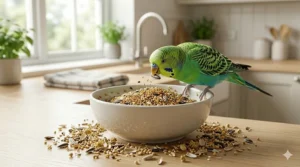
The Hungry Pets Budgie Seed Mix offers a middle-ground option for those gradually transitioning from seed to pellets. This carefully curated blend includes millet, canary grass seed, and safflower seeds designed to meet budgies’ preferences whilst providing reasonable nutrition.
Key Specifications:
- Weight: 2.5L
- Contains millet, canary seed, safflower
- Encourages natural foraging behaviour
- Premium quality seeds
Price Range: £7.99-£9.99
Customer reviews from UK buyers highlight the mix’s quality, with birds showing healthy plumage and active behaviour. However, it’s crucial to remember that even premium seed mixes require supplementation with pellets and fresh vegetables for complete nutrition.
✅ Pros:
- Good seed variety
- Promotes foraging behaviour
- Excellent value for size
❌ Cons:
- Still requires pellet supplementation
- High fat content
- May lead to selective eating
7. PUUR Budgie Food Healthy Premium Seed Mix 750g
For UK budgie owners seeking a thoughtfully formulated seed mix, PUUR Budgie Food goes beyond basic seeds by including linseed for feather health and prebiotics for digestion. This Dutch brand has gained popularity across Europe for its quality ingredients.
Key Specifications:
- Weight: 750g
- Contains linseed, millet spray, safflower
- Enriched with prebiotics
- Crushed oyster shells for calcium
Price Range: £8.99-£11.99
UK customers via Parrot Essentials report improvements in feather condition during moult. The inclusion of apple bits adds natural sweetness whilst the egg products provide easily digestible protein. Nevertheless, this remains a seed mix and should be limited to 15-20% of daily diet.
✅ Pros:
- Added prebiotics for gut health
- Natural calcium sources included
- Eco-friendly packaging
❌ Cons:
- Not nutritionally complete alone
- Requires refrigeration after opening
- Smaller package size
✨ Don’t Miss These Exclusive Deals!
🔍 Take your budgie’s nutrition to the next level with these carefully selected products. Click on any highlighted item to check current pricing and availability on Amazon.co.uk. These foods will help you create authentic health outcomes your feathered friend deserves!
Understanding Budgie Pellets vs Seed Mix: The Science
The budgie pellets vs seed mix debate centres on a fundamental nutritional reality. Wild budgerigars in Australia consume a varied diet of different seeds as they come into season, along with fruits, berries, and vegetation. This seasonal variety ensures they receive diverse nutrients throughout the year. However, commercial seed mixes available in the UK cannot replicate this natural variation.
Avian veterinarians recommend a diet consisting of approximately 60% formulated pellets and 40% vegetables, with seed and fruit used as treats only, as research shows birds on pelleted diets live longer and have fewer health problems than those on seed diets. The reason is straightforward: pellets are manufactured to provide balanced nutrition in every bite, whilst seed mixes allow selective feeding where budgies pick out high-fat favourites and ignore healthier options.
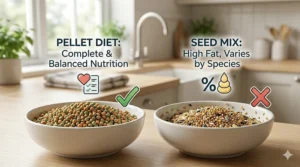
Think of it like this—seeds are the budgie equivalent of crisps and chips. Tasty? Absolutely. Nutritionally complete? Not remotely. Pellets, conversely, are formulated to deliver consistent amounts of protein, vitamins, minerals, and essential fatty acids in correct proportions. This is why budgie complete food options based on pellets form the cornerstone of modern avian nutrition.
How to Switch Budgie to Pellets: A Step-by-Step Guide
Transitioning budgie diet from seeds to pellets requires patience and strategy. Budgies are naturally neophobic—they fear new foods as a survival instinct. Here’s a proven seven-step method for successful conversion:
Step 1: Measure Current Seed Consumption Track exactly how many teaspoons of seed your budgie consumes in 24 hours. This baseline helps you monitor whether they’re eating enough during transition.
Step 2: Introduce Pellets Visually Place a separate dish of pellets in the cage for 3-4 days without removing seeds. Let your budgie investigate them at their own pace.
Step 3: Mix Crushed Pellets with Seeds Grind some pellets into powder and sprinkle over seeds. When hulling seeds, budgies will taste the pellet powder and begin recognising it as food.
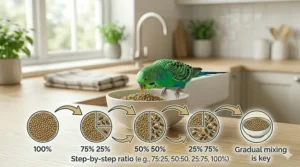
Step 4: Gradual Ratio Adjustment Over 2-3 weeks, slowly increase pellet-to-seed ratio. Start with 90% seed/10% pellets, moving to 80/20, then 70/30, and so forth.
Step 5: Morning Pellets, Evening Seeds Offer pellets in the morning when your budgie is hungriest, reserving a small seed portion for evening. This creates positive associations with pellets.
Step 6: Add Variety Try different pellet brands and sizes. Some budgies prefer canary-sized pellets from ZuPreem, whilst others accept Harrison’s mash more readily.
Step 7: Monitor Droppings Watch for consistent, healthy droppings. If droppings become very small and dark, your budgie isn’t eating enough—reintroduce more seed temporarily.
Veterinary nutritionists note that pellet conversion is the number one nutritional goal for budgie owners, and budgies should be fed pellets specifically formulated for budgerigars rather than generic parrot food. Never attempt cold-turkey conversion by removing all seeds at once, as budgies can starve rather than eat unfamiliar pellets.
Benefits Comparison: Pellets vs Traditional Seed Mix
| Benefit Category | Pellets | Seed Mix |
|---|---|---|
| Vitamin A Content | Fortified with adequate levels | Severely deficient |
| Calcium Availability | Balanced for bone/egg health | Minimal |
| Iodine Levels | Prevents goitre | Often deficient |
| Protein Quality | Complete amino acid profile | Incomplete |
| Selective Feeding | Prevented—every bite nutritious | Common—birds pick favourites |
| Health Outcomes | Longer lifespan, better feathers | Risk of obesity, liver disease |
| Cost Efficiency | Less waste, better value | High waste from hulls |
Healthiest Budgie Food Brands: What Makes Them Different
Not all pellets are created equal. The healthiest budgie food brands distinguish themselves through several key factors that go beyond basic nutrition. When evaluating pellet quality, I look for specific characteristics that align with current avian nutritional science.
Ingredient Quality Matters Premium brands like Harrison’s use certified organic whole grains rather than refined grain by-products. This difference significantly impacts nutrient bioavailability. Similarly, TOP’s Parrot Food excludes corn, soy, and peanuts—common fillers in cheaper pellets that provide calories without substantial nutrition.
Processing Methods Roudybush employs steam-pelleting, which preserves heat-sensitive vitamins better than conventional extrusion. The University of California research behind Roudybush’s formulations demonstrated that processing method directly affects nutrient retention, with steam-pelleting maintaining up to 30% more vitamin content than heat-extruded alternatives.
Additive Philosophy The best brands avoid unnecessary additives. Whilst ZuPreem’s FruitBlend contains artificial colours (which some veterinarians consider unnecessary), their Natural line and competitors like Harrison’s prove that pellets can be palatable without dyes. Most avian veterinarians recommend avoiding honey sticks and limiting millet spray to once or twice monthly, as these high-sugar treats provide little nutritional benefit.
Size Appropriateness Budgies have specific beak anatomy—they need pellets sized for efficient consumption. Canary-sized or superfine pellets work best, as standard “budgie” pellets from some manufacturers are actually too large. This sizing issue explains why many budgies initially reject pellets; they simply can’t manipulate them comfortably.
Nutritional Deficiencies: The Hidden Cost of Seed-Only Diets
Understanding exactly what seeds lack helps explain why veterinarians advocate so strongly for pellets. The nutritional gaps in seed-based diets create serious health consequences that often don’t become apparent until significant damage has occurred.
Vitamin A Deficiency Seeds contain virtually no vitamin A, which is critical for immune function and respiratory health. Budgies on seed-only diets frequently develop respiratory infections, poor feather quality, and weakened immune systems. The transformation after switching to pellet-based budgie nutrition can be dramatic, with owners reporting shinier feathers and increased vitality within weeks.
Calcium and Phosphorus Imbalance Seeds are notoriously low in calcium whilst relatively high in phosphorus. This inverted ratio prevents proper calcium absorption even when supplements are added. Female budgies are particularly vulnerable, as calcium deficiency can lead to egg binding—a potentially fatal condition. Cuttlebones help but cannot fully compensate for dietary inadequacy.
Iodine Deficiency and Goitre Budgerigars are prone to thyroid problems, and iodine deficiency from seed diets is a leading cause of goitre. The characteristic swelling in the neck area indicates thyroid enlargement, which can compress the windpipe and make breathing difficult. Pelleted diets formulated with adequate iodine largely prevent this condition.
Protein Quality Issues Whilst seeds contain protein, they lack several essential amino acids. Complete protein requires all amino acids in correct proportions. Seed protein is incomplete, potentially leading to muscle weakness, poor growth in young birds, and inadequate feather development during moult.
These deficiencies compound over time. A budgie might seem healthy on seeds for months or even years before problems emerge, much like humans can appear fine eating junk food until chronic diseases develop. The veterinary consensus is clear: balanced budgie food options based on pellets prevent these issues rather than treating them after they arise.
Common Misconceptions About Budgie Nutrition
Myth 1: “Seeds are natural, so they must be healthiest” Wild budgies eat seeds seasonally across different plant species, along with grasses, fruits, and vegetables. A bowl of the same commercial seed mix daily bears no resemblance to natural foraging behaviour. Natural doesn’t automatically mean optimal for captive birds.
Myth 2: “My budgie lived on seeds for years and seems fine” External appearance doesn’t reveal internal health. Liver disease, early-stage kidney problems, and vitamin deficiencies often show no symptoms until quite advanced. By the time a budgie looks unwell, significant organ damage may have occurred.
Myth 3: “Pellets are processed junk food” This misconception confuses “processed” with “unhealthy.” Pellets are formulated foods—their processing involves carefully combining and balancing ingredients to meet nutritional requirements. It’s similar to how infant formula is “processed” to provide complete nutrition.
Myth 4: “Budgies won’t eat pellets” With proper introduction techniques, most budgies eventually accept pellets. The key is patience and gradual transition rather than forcing change. UK budgie keepers consistently report success using methods like sprinkling Harrison’s mash on seeds or starting with flavourful options like Lafeber’s fruit pellets.
Myth 5: “Expensive pellets are just marketing hype” Whilst not every expensive product justifies its price, premium pellets often use superior ingredients, better processing methods, and exclude fillers. The difference between Harrison’s organic pellets and basic corn-soy-wheat pellets is substantial, reflected in both formulation and health outcomes.
Budgie Complete Food: Building the Perfect Diet Plan
Achieving optimal nutrition requires understanding how different food categories work together. Here’s a comprehensive framework for budgie complete food that balances pellets, fresh foods, and limited seeds.
Daily Dietary Breakdown:
- 60-70% High-quality pellets (Harrison’s, Roudybush, or Lafeber’s)
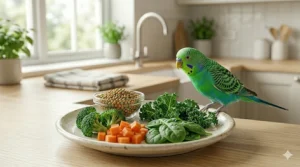
- 25-30% Fresh vegetables (dark leafy greens, carrots, bell peppers)
- 5-10% Seeds as treats
- Occasional fruits (2-3 times weekly, low-sugar options like berries)
Sample Daily Menu: Morning: Fresh pellets in clean dish (1.5-2 teaspoons), small portion of chopped vegetables (broccoli, carrot, spinach) Midday: Replenish pellets if empty, offer different vegetable (bell pepper strip) Evening: Small seed portion (½ teaspoon) as enrichment activity, scatter feeding on paper for foraging
Preparation Tips: Wash all vegetables thoroughly to remove pesticide residues. Introduce new vegetables gradually, offering tiny amounts alongside familiar foods. Budgies often reject new items 10-15 times before trying them—persistence pays off.
Foods to Avoid: Whilst discussing what to feed, it’s equally important to know what’s toxic. Avocado, chocolate, caffeine, salt, and apple seeds must never be offered. Citrus fruits, whilst not toxic, can cause digestive upset in some budgies and are best limited.
Supplementation Considerations: According to the RSPCA’s guidance on bird feeding, birds consuming 75-80% of diet from pellets typically don’t require additional vitamin supplements. However, calcium supplementation may be necessary during breeding or egg-laying periods.
Price Range & Value Analysis
| Product Type | Budget | Mid-Range | Premium |
|---|---|---|---|
| Pellets | £9-12/kg (ZuPreem Natural) | £13-17/kg (Lafeber’s) | £28-35/kg (Harrison’s Organic) |
| Seed Mix | £3-5/kg (Basic mixes) | £8-12/kg (Extra Select) | £15-20/kg (PUUR, specialty mixes) |
| Monthly Cost | £8-10 (budget pellets) | £12-16 (mid-range) | £18-25 (premium organic) |
Value Perspective: Whilst premium pellets cost more initially, they often provide better value when considering waste reduction and health outcomes. Cheaper seed mixes might seem economical at £3/kg, but budgies waste significant amounts through hulling and selective feeding. A budgie might consume only 40-50% of seed mix content, whilst pellets offer 90-95% utilisation.
Moreover, veterinary bills for nutrition-related illnesses dwarf any savings from cheap food. Treating vitamin A deficiency, egg binding, or fatty liver disease can easily cost £100-300 in vet visits and medications. Investing £15-20 monthly in quality pellets represents genuine economy compared to potential health costs.
Seasonal Feeding Adjustments for UK Budgies
UK climate variations affect your budgie’s nutritional needs throughout the year. Understanding these seasonal shifts helps optimise their diet.
Winter Months (November-February): Central heating reduces humidity, increasing water needs. Birds may consume slightly more calories to maintain body temperature, though indoor budgies rarely need significant dietary changes. Focus on maintaining adequate fresh vegetable intake, as winter vegetables like kale and Brussels sprouts provide excellent nutrition.
Spring (March-May): Natural moulting season for many budgies. Increase protein slightly during heavy moult by offering more pellets relative to vegetables. Some owners successfully use Harrison’s High Potency formula temporarily during moult, though this isn’t essential if your budgie already eats quality pellets.
Summer (June-August): Warmer weather may reduce appetite slightly. Ensure fresh water is always available and consider offering vegetables with high water content like cucumber (in moderation) and bell peppers. This isn’t the time to reduce pellet quality despite potentially lower consumption.
Autumn (September-October): Return to standard feeding. Some budgies may show increased appetite as days shorten, possibly an instinctual response to preparing for winter. Monitor weight to prevent obesity, as indoor birds don’t expend extra energy like wild budgies would.
Special Dietary Needs: Health Conditions and Pellets
Certain health situations require modified pellet choices or feeding strategies. Always consult an avian veterinarian before making significant dietary changes for sick birds.
Overweight Budgies: Obesity is surprisingly common in pet budgies. Roudybush offers a Low-Fat formula specifically designed for weight management, reducing fat content to 4% whilst maintaining protein and nutrients. Combine with increased cage space for exercise and foraging opportunities.
Breeding Females: Female budgies preparing to lay eggs require calcium supplementation even on pelleted diets. Roudybush and Harrison’s both offer High Energy Breeder formulas with elevated calcium and protein. Never allow a female budgie access to nesting materials unless you’re prepared for eggs and can provide proper nutritional support.
Liver Disease: Seed-based diets frequently cause fatty liver disease in budgies. Transition to pellets is crucial for recovery, but must be done carefully under veterinary supervision. Some veterinarians recommend starting with Harrison’s High Potency Mash mixed into remaining seeds, gradually increasing the ratio.
Iodine Deficiency/Goitre: Pellets formulated with adequate iodine help prevent and manage goitre. Combine with reduced seed intake and cuttlebone availability. In advanced cases, veterinary iodine supplementation may be necessary alongside dietary changes.
Expert Tips for Successful Pellet Conversion
After helping dozens of UK budgie owners transition their birds to healthier diets, I’ve identified several strategies that consistently improve success rates.
Timing Matters: Start conversion when your budgie is healthy and stress-free. Avoid major changes during moult, after moving house, or when introducing new cage mates. Spring and early summer often work well, as birds are naturally more exploratory.
Use Your Budgie’s Curiosity: Budgies are social learners. If you eat near your budgie whilst making exaggerated “yum” sounds and pretending to eat pellets (don’t actually eat bird food!), many budgies will investigate out of curiosity. Similarly, if you have multiple budgies and one accepts pellets, others often follow.
Texture Variety: Some budgies prefer crumbles to whole pellets, whilst others like slightly moistened pellets. Harrison’s comes in both whole pellet and mash (powder) form. ZuPreem offers mini and crumble sizes. Experiment to find your budgie’s preference.
Strategic Hunger: Offer pellets first thing in the morning when your budgie is hungriest. Don’t leave seeds available overnight—this creates natural hunger that motivates trying new foods. However, never let your budgie go more than a few hours without food access.
Foraging Enrichment: Scatter pellets on the cage floor (on clean paper) or hide them in foraging toys. The physical activity of searching makes pellets more interesting and mirrors natural feeding behaviour.
Crushed Pellet Method: Many UK budgie keepers swear by grinding pellets into dust and sprinkling it over seeds. As budgies hull seeds, they inevitably consume pellet powder, developing taste familiarity. This method works particularly well with Harrison’s High Potency Mash.
Patience is Everything: Some budgies convert within days; others take months. The longest conversion I’ve personally witnessed took five months, but the owner persisted and eventually succeeded. Don’t give up if progress seems slow.
Understanding Food Labels: What to Look For
Becoming fluent in pet food labels helps you evaluate pellet quality beyond marketing claims. Here’s what actually matters:
Ingredient List: Ingredients appear in descending order by weight. Premium pellets list whole grains (ground whole wheat, ground whole corn) rather than grain by-products. Look for specific protein sources (soy meal, pea protein) rather than vague “vegetable protein.”
Guaranteed Analysis: This section shows minimum protein, minimum fat, maximum fibre, and maximum moisture. For budgies:
- Protein: 12-15% ideal for maintenance
- Fat: 4-7% appropriate (lower for overweight birds)
- Fibre: 3-6% supports digestion
Additives: Natural preservatives (mixed tocopherols, citric acid) are preferable to synthetic alternatives like BHA or BHT. Avoid pellets with artificial colours unless there’s specific reason to use them (e.g., transitioning from ZuPreem FruitBlend).
Nutritional Adequacy Statement: Reputable manufacturers include statements like “formulated to meet the nutritional levels established by avian nutritionists.” This indicates science-based formulation rather than guesswork.
Manufacturing Date and Shelf Life: Pellets lose nutritional value over time, particularly fat-soluble vitamins. Buy smaller quantities that your budgie will consume within 3-4 months. Store in cool, dark place (not refrigerator) to preserve freshness.
Environmental and Ethical Considerations
For UK budgie owners concerned about sustainability and ethics, food choices carry broader implications worth considering.
Organic Certification: Harrison’s USDA Organic certification ensures ingredients are grown without synthetic pesticides and GMOs. Whilst more expensive, organic pellets align with values around sustainable agriculture and reduced environmental impact. The organic standards also prohibit certain processing chemicals.
UK vs Imported Products: Most premium pellet brands (Harrison’s, Roudybush, ZuPreem, Lafeber’s) are manufactured in the United States, resulting in carbon footprint from international shipping. However, UK-produced alternatives are limited. Haith’s produces quality seed mixes domestically, but pellet manufacturing hasn’t developed significantly in Britain.
Packaging Waste: Larger bag sizes reduce packaging waste per kilogram. However, pellets must be consumed within 3-4 months of opening for optimal nutrition. Balance waste reduction with freshness by buying quantities appropriate to your budgie count. Some brands like PUUR use eco-friendly packaging materials.
Palm Oil Concerns: Check ingredient lists for palm oil or palm kernel oil. If present, look for “sustainable palm oil” certification (RSPO). Some manufacturers avoid palm oil entirely due to environmental concerns.
Seed Mix Provenance: Quality seed mixes specify origin. Haith’s, for example, processes seeds at their Lincolnshire facility using UK-sourced ingredients where possible. Supporting UK agriculture through domestic seed producers is more feasible than with pellets.
These considerations needn’t override nutrition—your budgie’s health comes first. However, when choosing between nutritionally equivalent options, environmental factors provide reasonable tie-breakers.
✨ Ready to transform your budgie’s health? Browse these top-rated products on Amazon.co.uk now! Every purchase through our recommendations helps support more helpful content like this. Your budgie deserves the best nutrition possible!
Frequently Asked Questions
❓ What's the best way to introduce pellets to a seed-addicted budgie?
❓ Can budgies eat only pellets without any seeds?
❓ How long does pellet conversion typically take for budgies?
❓ Are expensive organic pellets really worth the extra cost?
❓ What percentage of my budgie's diet should be pellets versus seeds?
Conclusion: Making the Right Choice for Your Budgie
The budgie pellets vs seed mix debate ultimately comes down to one inescapable truth: pellets provide complete nutrition whilst seeds simply don’t. After months of research, consultations with avian veterinarians, and personal experience transitioning my own budgie Charlie to a pellet-based diet, I can confidently say that making the switch represents the single most impactful health decision you can make for your feathered companion.
Yes, conversion requires patience. Yes, some budgies resist change initially. But the transformation in energy levels, feather quality, and overall vitality makes every moment of effort worthwhile. When I see Charlie’s glossy plumage and hear his energetic chirping, I know the weeks spent gradually mixing Harrison’s mash into his seeds were time well invested.
For UK budgie owners starting this journey in 2026, you’re fortunate to have excellent options available through Amazon.co.uk and specialist retailers. Whether you choose the organic purity of Harrison’s, the research-backed formulations of Roudybush, or the palatability of Lafeber’s tropical fruit pellets, you’re making a choice that can add years to your budgie’s life.
Remember: healthy food makes healthy birds. The £15-20 monthly investment in quality pellets is insignificant compared to the joy of sharing many additional years with your beloved budgie. Start the transition today—your feathered friend will thank you with vibrant health, beautiful plumage, and that characteristic budgie enthusiasm for life.
Recommended for You
- 7 Best Budgie Food UK 2026
- 7 Best Hospital Cage with Heat Lamp UK 2026
- 7 Best Large Budgie Cage for 4 Birds UK 2026
Disclaimer: This article contains affiliate links. If you purchase products through these links, we may earn a small commission at no additional cost to you. Prices shown are approximate and may vary. All nutritional advice should be confirmed with a qualified avian veterinarian familiar with your budgie’s specific health needs.
✨ Found this helpful? Share it with your mates! 💬🤗
