In This Article
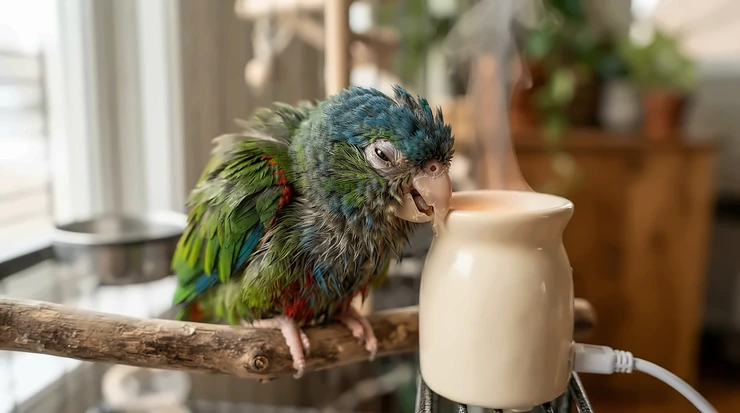
What is steam inhalation for birds with colds? It means exposing a poorly bird to warm, moist air, usually a steamy bathroom, so mucus loosens and dry airways soften. It is a comfort measure, not a cure. Any bird showing sneezing and nasal discharge still needs an avian vet.
Birds are built differently from us. Their lungs work with a network of air sacs, a design covered in this overview of bird anatomy, and it makes them unusually sensitive to what they breathe in. A mist that soothes a human can irritate a budgie. Steam that is a touch too hot can scald. That is why steam inhalation for birds with colds deserves more care than the average forum thread suggests.
Then there is the word “cold”. What owners call a cold is often an upper respiratory infection. Veterinary sources list bacteria such as Klebsiella, Proteus, chlamydophila and Pasteurella, plus fungal problems like aspergillosis, among the usual suspects. None of these clear up because the bathroom smells of shower gel.
So this guide treats steam as one tool in a bigger kit: gentle warmth, protection from chills, a calm hospital cage, and prompt professional help.
A note on method. This article is built from manufacturer documentation, veterinary guidance and the review information publicly available at the time of research. No product here was hands-on tested by the author. Where review data is thin, we say so. Prices are indicative ranges only, so check current price before buying.
Quick Comparison: 7 Ways to Build a Warm Recovery Environment
Before the deep dive, here is the shortlist at a glance. The table covers the full spectrum, from a dedicated recovery cabinet to a humble heated perch.
| Product | Type | Heat Control | Best For |
|---|---|---|---|
| Brinsea TLC-40 Eco Series II | Recovery cabinet | Digital, with alarms | Brinsea TLC-40 Eco Series II suits larger birds and multi-bird homes |
| Brinsea TLC-30 Eco | Compact recovery cabinet | Analogue dial | Brinsea TLC-30 Eco suits one or two small birds |
| Vision Bird Cage Model M01 | Small cage | None built in | Vision Bird Cage Model M01 suits a dedicated hospital cage on a budget |
| PetTemp Snuggle-Up Bird Cage Warmer Panel | Panel heater | Thermostatic | PetTemp Snuggle-Up Bird Cage Warmer Panel suits budgies, cockatiels, lovebirds |
| SYSAI Bird Warmer | Compact panel | Two settings | SYSAI Bird Warmer suits small cages needing adjustable warmth |
| K&H Snuggle-Up Bird Heater | Small panel | Low voltage | K&H Snuggle-Up Bird Heater suits finches, canaries and budgies |
| K&H Thermo-Perch | Heated perch | Low voltage | K&H Thermo-Perch suits mild chills as a supplement |
Looking at the table, the Brinsea TLC-40 Eco Series II is the only option that pairs digital control with alarms and humidity support. The panels and perches do one job, warmth, at a fraction of the cost. Budget buyers should note that a panel alone does nothing about draughts or air quality, which is why the sections below matter as much as the shopping list.
💬 Just one click — help others make better buying decisions too!😊
Top 7 Warming and Recovery Products for Birds With Colds: Expert Analysis
1. Brinsea TLC-40 Eco Series II — digital control with a built-in water reservoir
The standout here is the water reservoir, which raises humidity inside the chamber. It is the nearest a commercial unit gets to a hands-off cousin of steam inhalation for birds with colds. It is gentle humidity, not hot steam, and it does not deliver medicine.
On paper, the specification is strong. The manufacturer lists digital temperature control and read-out, high and low temperature alarms, an air filtration system aimed at airborne bacteria and fungi, washable filters, and an antimicrobial treatment built into the cabinet. The alarms matter more than they sound. A thermostat that fails at 3am is exactly the scenario a poorly bird cannot survive, and an alarm turns a disaster into an inconvenience. The unit is also described as made in Britain with a three-year warranty, though warranty terms may differ by retailer.
This is a rescue-grade tool. It suits breeders, rehabbers, multi-bird households and owners of larger parrots whose vet has recommended a controlled cabinet. For a single budgie with a mild sniffle, it is overkill.
Review sentiment is hard to verify. The retailer listings found at the time of research show only a handful of ratings, all positive, which is too small a pool to draw conclusions. Claims that breeders and wildlife carers rely on the range come from the manufacturer, not independent reviewers.
Pros:
- ✅ Digital temperature control with high and low alarms
- ✅ Water reservoir supports humidity in the chamber
- ✅ Filtered air and easy-clean antimicrobial cabinet
Cons:
- ❌ Expensive compared with panels and cage conversions
- ❌ Larger footprint than a simple hospital cage
Expect roughly £650-£800 at the time of research, though prices may vary. It is a sound long-term investment for frequent carers and poor value for one-off use.
2. Brinsea TLC-30 Eco — compact, portable and simple to run
The standout is the compact, carry-handle design. It can be popped on a sideboard in the quietest room of the house.
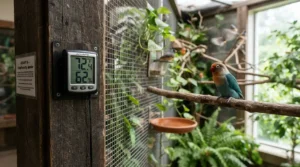
The manufacturer lists a simple dial for temperature, a glass thermometer visible through the clear door, quiet low-speed fans, and 12-volt operation through a mains adaptor. Internal dimensions are roughly 30 x 30 x 28 cm (12 x 12 x 11 inches), and units can be stacked two high. In practice, the quiet fans reduce disturbance, which matters because stress is the enemy of a recovering bird. The glass thermometer is a handy sanity check, though you still need to read it.
This model suits one or two small birds: a budgie, a cockatiel or a finch pair. Based on the spec comparison, it gives most of the benefit of the larger unit for a lot less money, but with two trade-offs. There is no temperature alarm, and the water reservoir belongs to the larger models.
Reviews are thin. Retailer pages show a small number of five-star ratings, which is encouraging but statistically meaningless. No genuine negative themes could be verified.
Pros:
- ✅ Portable with a carry handle
- ✅ Quiet, low-speed fans limit disturbance
- ✅ Simple dial control with visible thermometer
Cons:
- ❌ No temperature alarm on the Eco version
- ❌ Too small for larger parrots
Expect roughly £250-£330 at the time of research, so check current price. It is good value for small-bird keepers who want a proper cabinet without the premium.
3. Vision Bird Cage Model M01 — budget dedicated hospital cage
The standout is its role as a dedicated hospital cage for poorly birds. A roundup site recommends it for a single budgie or as a recovery space, noting it is unsuitable for several birds.
Here is the honest limitation: no verified dimensions or materials could be confirmed for this write-up, so check the listing. What can be said is how to judge any cage for this job. Veterinary guidance says a hospital cage should have smooth sides so the bird stays low, shallow food and water dishes on the floor, and surfaces that clean and disinfect easily. Measure the Vision Bird Cage Model M01 against that list before buying.
The cage has no heating of its own. Pair it with a thermostat controlled heating panel, and it becomes a flexible recovery set-up for far less than a cabinet. A small cage also limits climbing and falling for a weak bird, which is a quiet advantage.
Review evidence is limited to a single roundup, not aggregated customer reviews, so treat the praise as one editorial opinion.
Pros:
- ✅ Suits a single bird as a hospital cage
- ✅ Described as a mess-free, beginner-friendly design
- ✅ Leaves budget for a separate thermostat panel
Cons:
- ❌ Not suitable for housing multiple birds
- ❌ No built-in heating or humidity control
Pricing sits in the budget bracket, and prices may vary, so check current price. It is excellent value if you add a quality heater.
4. PetTemp Snuggle-Up Bird Cage Warmer Panel — safety-listed, thermostatic panel
The standout is its combination of thermostatic control and overheat protection on a cage-mounted panel.
The listing details a 12-volt, 12-watt panel measuring about 9.4 x 6.5 inches (roughly 24 x 16 cm), with a stainless steel cord guard, four mounting points and a chew-resistant cord. Low voltage matters because the mains stays outside the cage. A cord guard matters because budgies chew, and a chewed cord is the classic way a heater becomes a hazard.
An independent buyer’s guide names it best overall for parakeets, cockatiels and lovebirds in a cool room. The same guide notes the panel is large for a small budgie cage and offers no heated perch. Here is what to weigh: if your bird’s cage is cramped, the panel may crowd the perches.
UK buyers should check two things. The safety listing mentioned (MET) is a North American mark, so look for UKCA or CE marking and a UK-compatible plug or adaptor on the Amazon UK listing.
Aggregated customer reviews could not be verified for UK listings, so none are summarised here.
Pros:
- ✅ Thermostatic control with overheat protection
- ✅ Armoured cord guard resists chewing
- ✅ Multiple mounting points for flexible placement
Cons:
- ❌ Bulky for small budgie cages
- ❌ Panel only, with no heated perch
Expect roughly £20-£35 at the time of research. It is solid value if the safety marks and plug check out.
5. SYSAI Bird Warmer — compact panel with adjustable settings
The standout is the choice of two temperature settings on a small plate.
The buyer’s guide lists a roughly 4 x 6 inch (10 x 15 cm) panel with a metal anti-bite cover on the cord, suited to parakeets, cockatiels and conures. Two settings are genuinely useful because a poorly bird’s needs change. A fluffed, sleepy patient may need more warmth on day one and less as it perks up. Note that retailer listings show conflicting wattage claims, so verify the rating on your listing before relying on it.
What the spec sheet won’t tell you is how warm the cage air becomes. A panel warms what touches or sits near it, not the room. Use a thermometer at perch height and treat the panel as a warm spot, not a radiator.
Aggregated reviews could not be verified, so no sentiment is claimed.
Pros:
- ✅ Two temperature settings suit changing needs
- ✅ Compact size fits smaller cages
- ✅ Metal cover protects the cord from chewing
Cons:
- ❌ Conflicting wattage claims across listings
- ❌ Little independent review data to lean on
Expect roughly £15-£30 at the time of research, and prices may vary. It is decent value for small cages, provided you confirm the specification.
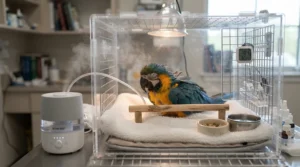
6. K&H Snuggle-Up Bird Heater — small, low-voltage warming panel
The standout is its small footprint. The small version is described as a 5 x 3 inch (13 x 8 cm) low-voltage panel for finches, canaries and budgies.
Small is good news for a tiny hospital cage, where a larger panel would take over the floor. Low voltage reduces the electrical risk if a determined beak finds the cord. The trade-off is limited reach. A panel this size warms a patch, not the cage, so a bird that wants to huddle against it will be fine, and one that wants to spread out may not.
Who is it for? Small birds, mild chills and owners who want a gentle supplement to a draught-proofed cage. It is not a standalone answer for a seriously ill bird. Heating in those cases is a conversation to have with your vet.
Brand-specific review data for the UK could not be verified, so check the listing for current feedback.
Pros:
- ✅ Small enough for compact hospital cages
- ✅ Low-voltage design limits electrical risk
- ✅ Suits finches, canaries and budgies
Cons:
- ❌ Warms a patch rather than the cage
- ❌ UK adaptor compatibility needs checking
Expect roughly £15-£25 at the time of research. It is good value as a low-risk supplement.
7. K&H Thermo-Perch — heated perch for cold feet
The standout is a heated perch, which warms feet rather than the whole bird.
The small version is listed at about 1 x 10.5 inches (roughly 2.5 x 27 cm) and 12 volts. Warm feet are comforting for a mildly chilled bird that still perches happily. But here is the catch. Veterinary guidance for seriously unwell birds is to let them stay low, with food and water in shallow dishes on the floor. A bird too weak to perch gains nothing from a heated perch.
That makes the K&H Thermo-Perch a supplement, best used in the convalescent stage when your bird is perching again and a vet has cleared it. It will not replace ambient warmth, and it will not do anything for steam inhalation for birds with colds. Think of it as a hot-water bottle for toes.
Verified customer-review summaries could not be found, so none are given here.
Pros:
- ✅ Warms feet where a bird actually sits
- ✅ Low-voltage design suits small cages
- ✅ Useful during the convalescent stage
Cons:
- ❌ Useless for birds too weak to perch
- ❌ Does not warm the cage air
Expect roughly £15-£25 at the time of research, and prices may vary. It is cheap, but only worth it for the right stage of recovery.
Top 7 Comparison at a Glance
| Product | Heat Type | Control | Size or Notes | Price Range | Best For |
|---|---|---|---|---|---|
| Brinsea TLC-40 Eco Series II | Cabinet | Digital, alarms | Water reservoir, filtered air | £650-£800 | Larger birds, rescuers |
| Brinsea TLC-30 Eco | Cabinet | Analogue dial | About 30 x 30 x 28 cm | £250-£330 | One or two small birds |
| Vision Bird Cage Model M01 | None | None | Check listing | Budget | Dedicated hospital cage |
| PetTemp Snuggle-Up Bird Cage Warmer Panel | Panel | Thermostatic | About 24 x 16 cm, 12V | £20-£35 | Budgies, cockatiels |
| SYSAI Bird Warmer | Panel | Two settings | About 10 x 15 cm | £15-£30 | Small cages |
| K&H Snuggle-Up Bird Heater | Panel | Low voltage | About 13 x 8 cm | £15-£25 | Finches, canaries |
| K&H Thermo-Perch | Heated perch | Low voltage | About 27 cm perch | £15-£25 | Convalescing perchers |
The table shows a clear split. The two cabinets deliver controlled warmth and humidity, but at ten times the cost of a panel. For most single-bird homes, a hospital cage plus a thermostatic panel is the sweet spot, with the Brinsea TLC-30 Eco as the step up if you want a proper enclosed unit. The K&H Thermo-Perch is the optional extra rather than the foundation.
✨ Don’t Miss These Recovery Essentials!
🔍 Take your bird’s recovery up a level with these carefully selected products. Click on any highlighted item to check current pricing and availability. A calm, warm, draught-free space gives your feathered patient the best possible chance while you wait for the vet!
How to Set Up a Hospital Cage for Poorly Birds, Step by Step
A hospital cage for poorly birds is a small, calm, clean and warm space. It is not a prison, and it is not a fancy gadget. Veterinary guidance suggests creating one at home when a bird is very ill, with details to be tailored by your vet. One exotic-pet practice’s home-care guidance is a handy template.
Step 1: Pick the container. Small birds can be housed in a glass tank or a small cage with smooth sides. Smooth sides stop a weak bird from climbing and falling. A larger bird may need something bigger, such as a dog crate.
Step 2: Lay the floor. Use plain paper towel or similar that is easy to change and lets you inspect droppings. Fine dusty substrates can irritate already sore airways.
Step 3: Add shallow dishes. Food and water go on the floor where a weak bird can reach them without climbing.
Step 4: Add warmth. The same guidance suggests roughly 29-32°C (85-90°F) is generally acceptable, varying with the bird’s condition. Ask your vet for a target. Warm only part of the space so the bird can move away from the heat if it overheats.
Step 5: Check the temperature at bird level. A thermometer at perch height is more honest than the thermostat on the wall.
Step 6: Keep it quiet. Place the cage in a calm room, away from the television, other pets and heavy traffic.
Step 7: Log everything. Note droppings, appetite and breathing. Your vet will thank you.
Common mistakes in the first 30 days include overheating, over-handling, and leaving the bird in a hospital cage without telling the vet it is there.
A Safe Steam Session at Home: The Bathroom Method
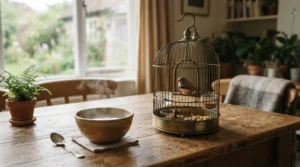
Most advice for steam inhalation for birds with colds boils down to one idea: let the bird sit in a steamy room, never in the steam itself. Keepers commonly suggest running a hot shower to fill the bathroom with warm vapour while the bird is in a carrier or cage outside the direct spray. Some owners report that this seems to ease laboured breathing while waiting for a vet appointment. That is anecdote, not clinical evidence, so treat it as a comfort measure only.
Before you start:
- Call your vet first if the bird is breathing with its beak open, tail bobbing or gasping. That is an emergency, not a spa day.
- Remove the bird’s food bowls and any hazards from the carrier.
During the session:
- Run the hot shower with the door closed until the room is warm and misty.
- Turn the water off or keep the bird well away from the spray. Scalding steam and direct water are the dangers.
- Place the bird in a carrier or small cage on a dry surface, away from the shower.
- Stay in the room and watch. If your bird seems distressed, open the door and stop.
- Keep sessions short. A few minutes is a reasonable start, and your vet can advise on timing.
After the session:
Dry any damp feathers gently and return your bird to a warm, draught-free hospital cage. Going from steamy air into a cold room is the classic way to undo any benefit.
Avoid hot bowls of water placed next to the cage, which carry burn and spill risks. A warm, wet towel over the cage is sometimes suggested, but it cools quickly, restricts airflow and invites mould, so it is hard to recommend.
Problem to Solution: Sneezing, Draughts and Fluffed-Up Birds
Problem 1: Your bird sneezes occasionally but seems bright. Occasional sneezing is often harmless, as dust, dry air and cleaning products can all trigger it. Check the environment first, then call your vet if it continues or is joined by other symptoms.
Problem 2: Your bird is fluffed up and sleepy. Fluffing is a classic sign that a bird is cold or unwell, and birds hide illness until they are quite poorly. Provide gentle warmth, such as a PetTemp Snuggle-Up Bird Cage Warmer Panel in a quiet cage, and ring the vet the same day.
Problem 3: The cage sits in a draughty spot. Move it away from windows, doors and radiators first. Then partially cover the cage on the windy sides. See the dedicated draught section below.
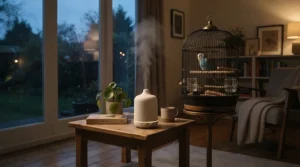
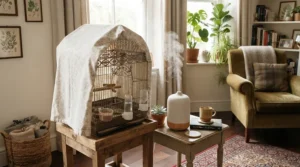
Problem 4: You need steam but have no bathroom handy. A room humidifier placed a safe distance away may help dry air, though verify the model is safe for use around birds and never add oils or scents.
Problem 5: Your bird has crusty or wet nostrils. That is a vet job. Nasal discharge is generally considered a sign of infection, so avoid home remedies that delay treatment.
How to Choose a Warm Recovery Environment
Choosing equipment for a warm recovery environment is easier with a short checklist. Work through these steps in order.
- Confirm the diagnosis path first. Equipment supports care. It does not replace a vet visit.
- Match the size to the bird. A Brinsea TLC-30 Eco suits one or two small birds. Larger parrots need bigger enclosures.
- Prioritise thermostat controlled heating. Without it, you are guessing, and a bird cannot tell you it is too hot.
- Look for safety marks. In the UK, check for UKCA or CE marking and a UK-compatible plug.
- Check cord protection. A chewable cord is a hazard. Metal guards or low voltage are real advantages.
- Think about cleaning. Smooth, wipeable surfaces beat anything fiddly.
- Count your budget honestly. A cage plus a panel often beats a cabinet unless you will use it repeatedly.
The reasoning matters more than the product. A cheap heater in a draughty cage fails, and a sensible set-up built around a Vision Bird Cage Model M01 and a thermostatic panel can work well.
Sneezing and Nasal Discharge: When It Is a Cold and When It Is an Emergency
Sneezing and nasal discharge are the signs that most often send owners hunting for steam inhalation for birds with colds. The problem is that they can mean anything from a dusty seed mix to a serious infection.
Occasional sneezing clears dust and feather debris, and dry air, smoke, perfume and cleaning sprays can all trigger it. Persistent sneezing with discharge is different. Birds tend to hide illness until they are seriously unwell, and a bird that looks “a bit off” may already be struggling.
Common warning signs include lethargy, fluffed feathers, reduced appetite, changed droppings and breathing effort. Voice change can also be an early red flag, according to keepers who have been through it.
Veterinary commentary underlines why diagnosis matters. A veterinary trade report notes that bacterial and fungal pneumonias, aspergillosis and severe respiratory distress are still seen, and that aspergillosis can go undetected for months before a bird suddenly shows open-mouthed breathing. Those are conditions that steam alone cannot fix.
Treat open-mouthed breathing, tail bobbing, gasping or collapse as an emergency. Ring an avian or exotics vet immediately, and keep the bird warm and calm while you travel.
Cold Draught Protection for Bird Cage: Keeping Chills Out
Good cold draught protection for bird cage placement is the cheapest recovery aid on this list. It costs nothing and it works around the clock.
Start with position. Keep the cage away from windows, external doors and radiators. Draughts come from gaps you can feel with the back of your hand, so test the spot at cage height.
Add partial cover. A breathable cover over the windy sides of the cage reduces airflow without sealing the bird in. Leave part of the front open. Heavy, airtight covers risk poor ventilation, which is exactly what sore airways do not need.
Mind the heat sources. Never place the cage directly beside a radiator or heater. Dry heat is itself an irritant, and winter air can already leave birds more vulnerable to respiratory trouble.
Use the hospital cage for the hard work. A small, enclosed space is easier to draught-proof than a large flight cage, which is another argument for a dedicated hospital cage.
Avoid fumes. Non-stick cookware, aerosols, scented candles and oil diffusers are widely regarded as hazards for birds. If you are unsure about a product, leave it out of the room.
Healthy birds are generally comfortable at the temperatures people are, and too much heat is its own problem. The aim is steady, draught-free comfort, not a sauna.

Thermostat Controlled Heating: What Actually Matters
Thermostat controlled heating separates a safe recovery aid from a gamble. A heater without a thermostat can overshoot, and a bird in a small space cannot always escape.
Control type. Analogue dials, as on the Brinsea TLC-30 Eco, are simple and reliable but need checking. Digital controls and alarms, as on the Brinsea TLC-40 Eco Series II, tell you when something drifts. Panels such as the PetTemp Snuggle-Up Bird Cage Warmer Panel use built-in thermostats and overheat protection.
Gradient, not blanket heat. Warm one part of the space only. The bird should be able to move away from the heat if it feels too warm. Panting or wings held away from the body are signs of overheating.
Measure where the bird sits. A thermometer at perch or floor level beats guessing. Aim for the range your vet recommends, which for hospital cages is often described as roughly 29-32°C, depending on the condition.
Low voltage and cord safety. Low-voltage panels and armoured cords reduce risk. The SYSAI Bird Warmer and K&H Snuggle-Up Bird Heater both lean on this design thinking.
Check before you trust. Test any heater for a few hours before the bird goes in, and keep checking. Equipment can fail, so build in a backup plan, especially overnight.
Steam Inhalation vs Nebulisation vs Humidifiers
Not all moist-air methods are equal. This comparison clarifies what each does and where it fits.
| Method | What It Does | Main Risk | Best For |
|---|---|---|---|
| Steamy bathroom | Warm, humid air for comfort | Chilling afterwards, scalds | Short-term comfort while awaiting a vet |
| Vet nebulisation | Delivers medicine as fine mist | Needs vet guidance | Diagnosed respiratory disease |
| Room humidifier | Raises ambient humidity | Mould, unsafe additives | Dry winter air |
| Recovery cabinet humidity | Gentle humidity in a warm space | Cost | Repeated or serious cases |
Nebulisation is a veterinary tool, used to deliver certain medications, typically antibiotics or antifungals, directly to the respiratory tract, and it can also hydrate the mucous membranes. A veterinary resource describes this clearly, and it is the reason a vet may ask you to buy a nebuliser, as happens with other small pets. Home steam is a gentler cousin with no medicine in it.
So which should you choose? If your bird is already diagnosed, follow the vet’s plan. If you are waiting for an appointment, a short bathroom session and a warm hospital cage are reasonable comfort measures. The cabinet route makes sense if you expect repeated use. A wild-bird rescue in the UK has publicly described using short nebuliser courses for a chick with mild breathing symptoms after a veterinary check, which shows the approach is professional care, not DIY.
Common Mistakes When Using Steam and Heat for Poorly Birds
Mistake 1: Skipping the vet. The biggest error is treating a sick bird at home and delaying diagnosis. Nasal discharge generally needs veterinary attention, and bacterial or fungal infections will not respond to steam.
Mistake 2: Using steam that is too hot. Scalds happen quickly. Keep the bird out of direct steam and never place it near a kettle or bowl of boiling water.
Mistake 3: Going from steamy to cold. Moving a damp bird into a draughty room undoes the benefit. Return it to a warm, draught-free space immediately.
Mistake 4: Adding oils and scents. Aromatic oils and fragrances are widely considered risky around birds, whose airways are delicate. Plain steam is as far as you should go without vet approval.
Mistake 5: Overheating the cage. Heat should be gentle and gradual, with a cooler area to retreat to.
Mistake 6: Over-handling. Frequent handling stresses a sick bird. Minimise it.
Mistake 7: Trusting a single source. Forum anecdotes can help you ask better questions, but they are not a diagnosis. Use them to prepare for the vet, not to replace one.
Long-Term Cost and Maintenance
Let us do the sums honestly. A hospital cage plus a thermostatic panel is the cheapest sensible set-up, with a budget cage, such as the Vision Bird Cage Model M01, and a panel such as the K&H Snuggle-Up Bird Heater often costing well under the price of a cabinet. The Brinsea TLC-30 Eco sits in the middle, while the Brinsea TLC-40 Eco Series II is the premium investment.
Cost per use. If you expect one illness every few years, a cabinet is expensive per use. If you breed, rescue or keep several birds, a unit used many times a year becomes good value. The listed three-year warranty on Brinsea units also helps, though check what your retailer offers.
Running costs. Low-voltage panels draw very little power, and cabinets draw more but are designed for steady operation. Exact running costs depend on your tariff and room temperature.
Maintenance. Cabinets need regular cleaning, and washable filters, as listed for the larger Brinsea units, should be cleaned on a routine schedule, with replacement sets available from the manufacturer. Panels need wiping and a check of cords for chew damage. Replace any heater with a damaged cord immediately.
Storage. Keep your recovery kit together, so it is ready when needed, because illness rarely strikes at a convenient time.
Safety, Hygiene and Psittacosis: What UK Keepers Should Know
A sick bird is also a hygiene issue. Psittacosis, caused by Chlamydia psittaci, can pass from birds to people. UK public health guidance, published on GOV.UK, explains that birds may carry the organism without signs, or show sleepiness, shivering, weight loss, breathing problems and diarrhoea. An older Public Health England notice reported that around 25 to 50 laboratory-confirmed cases occurred each year in England and Wales, and that transmission can happen through feather dust, dried droppings or respiratory secretions. Check the GOV.UK page for current guidance.
Practical hygiene.
- Wash your hands after handling birds, cages and droppings.
- Clean the hospital cage gently, avoiding dust clouds. Damp-wipe rather than sweeping dry.
- Keep sick birds separate from healthy ones.
- If you develop flu-like symptoms after bird contact, tell your GP and mention the exposure.
Equipment safety. Look for UKCA or CE marking on electrical equipment, use low-voltage or armoured-cord designs where possible, and never leave a heater unattended with a chewing bird without a safe design.
Emergency plan. Know where your nearest avian or exotics vet is, and keep their number handy. For breathing difficulty, ring first, then travel.
FAQ
❓ Is steam inhalation for birds with colds safe at home?
❓ What is the best hospital cage for poorly birds on a budget?
❓ How warm should a warm recovery environment be?
❓ Can I use a heated perch instead of a cage heater?
❓ Do cage covers help with cold draught protection for bird cage setups?
Conclusion
Steam inhalation for birds with colds is best understood as comfort care, not treatment. A steamy bathroom session, used briefly and carefully, may ease a stuffy bird while you arrange a vet visit. It will not clear a bacterial or fungal infection, and it never replaces a diagnosis.
What does help is the boring stuff done well: a draught-free spot, a small and clean hospital cage, steady and thermostat controlled heating, and a calm environment. On that front, the Brinsea TLC-30 Eco is the sensible step up for small birds, the Brinsea TLC-40 Eco Series II is the investment for serious or repeated use, and a Vision Bird Cage Model M01 with a PetTemp Snuggle-Up Bird Cage Warmer Panel is the budget route that still ticks the main boxes. The SYSAI Bird Warmer, K&H Snuggle-Up Bird Heater and K&H Thermo-Perch are useful supplements for the right bird at the right stage.
Check current prices and UK safety markings before buying, and keep your vet’s number close. Sneezing and nasal discharge are a signal to act, not a reason to wait.
✨ Ready to build a safe, warm recovery space?
🐦 Click on any highlighted product above to check current pricing and availability, and give your poorly bird the calm, cosy start it needs.
Recommended for You
- Air Sac Mite Treatment For Canaries: 7 Best Fixes (2026)
- Aspergillosis Prevention For Pet Parrots: 7 Essential Picks (2026)
- Acrylic Bird Bath For Aviary: 7 Best Picks & Costly Mistakes (2026)
Disclaimer: This article contains affiliate links. As an Amazon Associate, I earn from qualifying purchases. If you purchase products through these links, we may earn a small commission at no additional cost to you.
✨ Found this helpful? Share it with your friends! 💬🤗
