In This Article
Your parrot lives in a small slice of your home and breathes every cubic centimetre of it. That’s why aspergillosis prevention for pet parrots starts with air, not medicine. Aspergillus fungi turn up in soil, compost, damp walls and the forgotten dregs of a seed bag. Every bird inhales a few spores daily. Trouble starts when the dose climbs or the bird’s defences dip.
According to the Merck Veterinary Manual’s pet owner guide to lung and airway disorders, aspergillosis is the most common fungal infection in birds. It comes in two forms: a severe short-term version in young or newly imported birds, and a slower chronic version in older captive ones. The manual names contaminated food, water and nesting material in poorly ventilated rooms as sources of concentrated spores. Stress, poor nutrition and a weakened immune system then tip the balance. Avian rescue groups often single out African greys, Amazons and Pionus as especially prone.
The encouraging part? The disease isn’t passed from bird to bird, and most of the risk sits in your hands. How you store seed, which bedding you choose and how clean the air is all matter. This guide covers the lot, from HEPA filtration and fungal spores to mould free seed storage for parrots and dust free bird bedding.
A quick note on method: I haven’t kept any of these products in a bird room. Every verdict below rests on published specifications, independent reviews and the themes owners report, and where reviews are thin, I say so. None of this replaces an avian vet. If your bird is tail-bobbing, gasping or has gone unusually quiet, call one today.
Quick Comparison: 7 Picks for Aspergillosis Prevention for Pet Parrots at a Glance
| Product | Category | Key Spec | Price Range | Best For |
|---|---|---|---|---|
| Levoit Core 300 | HEPA purifier | H13 HEPA, around 20 m², 24–50 dB | Around £90–£150 | Small bird rooms on a budget |
| Blueair Blue Max 3250i | HEPA purifier | 239 m³/h CADR, up to 48 m², 18–46 dB | Around £160–£200 | Medium rooms, noise-sensitive birds |
| Dyson Purifier Big+Quiet Formaldehyde | HEPA purifier | Sealed H13, up to 100 m² | Around £850–£950 | Multi-bird homes, open-plan living |
| Gamma2 Gamma Seal Lid | Seed storage | Screw-top airtight lid for 12-inch bucket openings | Around £10–£20 (lid only) | Bulk buyers who open the tub daily |
| Gardman Wild Bird Seed Storage Tin | Seed storage | Metal tin, air-tight lid, 15 kg capacity | Around £20 | Tidy kitchen shelves, multi-bird homes |
| Prevue Hendryx Parrot Cage Liner Sheets | Bedding | 20 sheets, 45.7 × 50.8 cm | Around £10 | Daily-change routines |
| Back 2 Nature Small Animal Paper Bedding | Bedding | 99% recycled paper pellets | Under £10 for smaller bags | Careful, supervised use only |
Looking at the table, the three purifiers solve one problem (airborne particles). The storage and bedding picks solve a different one, which is stopping spores from being made in the first place. For most households, the cheapest and most important wins are in the middle rows, and the Levoit Core 300 or Blueair Blue Max 3250i then handles whatever floats through the air. The Dyson Purifier Big+Quiet Formaldehyde is a specialist buy for large spaces, not a default.
💬 Just one click — help others make better buying decisions too!😊
Top 7 Products for Aspergillosis Prevention for Pet Parrots: Expert Analysis
1. Levoit Core 300 — best budget HEPA for small bird rooms
The Levoit Core 300 gives a small bird room a genuine H13 True HEPA filter without premium-machine money.
It uses a three-stage setup of pre-filter, H13 True HEPA and activated carbon. It’s rated for roughly 20 m², about a spare bedroom, with a CADR of around 143 CFM (roughly 240 m³/h). In practice, a typical spare-room aviary gets its air cycled several times an hour. That’s what you want when the aim is to stop fungal spores settling on perches, bowls and feathers. Noise is listed at 24–50 dB, so the lowest setting is gentle enough for a roosting bird.
Based on the spec comparison, this is a sensible starting point for one parrot or a pair of smaller birds. The catch is headroom. Add a feather-shedding cockatoo or a bigger room and you’ll live on the top fan speed, where it’s louder. Reviewers are split: Real Homes called it a hard-working budget option, while a US Tom’s Guide test found its measured performance underwhelming and its fan noisy for its size. Treat it as a solid entry-level unit, not a miracle.
Pros:
- ✅ Genuine H13 True HEPA at entry-level cost
- ✅ Compact footprint of roughly 22 × 22 × 36 cm
- ✅ Very quiet on the lowest setting
Cons:
- ❌ Limited to rooms of roughly 20 m²
- ❌ Louder at high speed, according to some reviewers
Expect around £90–£150 (check current price). It’s good value for single-bird homes and small rooms.
2. Blueair Blue Max 3250i — whisper-quiet speed for medium rooms
Quiet matters when your “customer” startles at a creaking fridge door, and the Blueair Blue Max 3250i runs at 18–46 dB.
A CADR of 239 m³/h and a 48 m² rating mean it can turn over a large room roughly twice an hour. Blueair’s HEPASilent design combines mechanical filtration with an electrostatic charge. The brand claims it removes 99.97% of particles down to 0.1 microns. For you, that means fine feather dust and spore-carrying particulate should be pulled from the air quickly. In Expert Reviews’ spray test, it cleared a small room from a high particle peak to a low one in just over two minutes.
Here’s what to weigh: the electrostatic element is the one detail bird owners should query. I couldn’t find an ozone-emission figure in the sources I reviewed. Ask Blueair for its ozone test statement before buying, and trial the unit in another room first. Expert Reviews and Ideal Home both describe it as an effective, quiet all-rounder. I found no verified owner-review set specific to bird rooms.
Pros:
- ✅ Very low noise in night mode
- ✅ Fast clean-air delivery for the price
- ✅ Filter-life reminders through the app
Cons:
- ❌ Electrostatic element deserves an ozone query
- ❌ Smart features wasted on plug-and-play buyers
Expect around £160–£200 (check current price). It’s strong value for medium rooms, provided the ozone question is answered.
3. Dyson Purifier Big+Quiet Formaldehyde — sealed H13 power for big spaces
The Dyson Purifier Big+Quiet Formaldehyde is built for spaces a typical bird room will never fill.
It’s rated for up to 100 m² and seals the whole machine to H13 standard, so air can’t bypass the filter. It adds activated carbon and a catalytic filter, and projects air over 10 metres. On a practical level, that suits a converted garage aviary or an open-plan home where the parrot’s play stand sits beside the sofa. Dyson says the HEPA filter lasts around five years, far longer than the six to twelve months typical in this category.
Honestly, most owners don’t need this much machine. Tech Advisor warns that it moves a lot of air in a smaller room, so keep it well away from cages and never aim it at the bird. Expert Reviews calls it very quiet but priced like a premium product, and says its worth depends on how much you value the design and the brand. Dyson’s own on-board sensors for particles, VOCs and humidity are a useful bonus for monitoring a damp room.
Pros:
- ✅ Fully sealed H13 filtration
- ✅ Covers up to 100 m²
- ✅ HEPA filter rated for years, not months
Cons:
- ❌ Premium price tag, around £850–£950
- ❌ Strong airflow can be overkill in small rooms
It’s a high upfront cost (check current price), but a sensible long-term pick for multi-bird households with large rooms.
4. Gamma2 Gamma Seal Lid — cheapest route to airtight seed buckets
Mould free seed storage for parrots needs a container that seals every single time you open it. That’s the Gamma2 Gamma Seal Lid‘s whole job.
It’s a two-piece system: a snap-on collar fits a standard bucket rim, then a threaded lid with a rubber O-ring spins on and off. It’s made from BPA-free, food-grade HDPE and fits buckets with a roughly 12-inch opening, so measure yours first. In practice, that gives you a tub that’s easy to open daily yet properly sealed between meals.
Our analytical take: this suits anyone who buys seed in sacks and decants it. The key point is that sealing doesn’t fix damp seed. Only fill the bucket with seed you’ve checked is dry and fresh. Customer reviews on retailer pages consistently describe a tight seal, with some noting the first fit takes effort. I couldn’t verify UK-specific review volumes, and the lid is made in the USA, so check UK stock.
Pros:
- ✅ Airtight, pest-resistant seal on the bucket
- ✅ Spin-off lid makes daily scooping easy
- ✅ Food-grade, BPA-free plastic
Cons:
- ❌ Initial fit can be stiff
- ❌ Bucket must be bought separately
Expect around £10–£20 for the lid (check current price). It’s excellent value if you already own a food-safe bucket.
5. Gardman Wild Bird Seed Storage Tin — tidy metal tin for kitchen shelves
The Gardman Wild Bird Seed Storage Tin is a heavy-duty metal tin with an air-tight lid, built to keep contents dry and clear of vermin.
It holds up to 15 kg and measures roughly 37 cm high and 36 cm across, with steel handles and a hook for hanging a scoop. In real terms, that’s a lot of tin. A single African grey could take months to eat 15 kg, and old seed is precisely what you don’t want. Most households should fill it with smaller sacks and top up often.
Here’s what the listing won’t tell you: the tin is better suited to a multi-bird home, or to anyone buying a couple of months’ worth for a flock. Metal also resists chewing rodents and doesn’t hold smells the way some plastics do. I found no verified review set for parrot use, and one UK stockist listed it as unavailable at the time of research, so availability is worth checking before you plan around it.
Pros:
- ✅ Sturdy metal build resists pests
- ✅ Air-tight lid with scoop hook
- ✅ Looks tidy on a kitchen shelf
Cons:
- ❌ Oversized for a single-parrot household
- ❌ Stock can be patchy at retailers
Expect around £20 (check current price). It’s decent value for flocks, less so for solo birds.
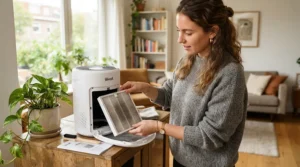
6. Prevue Hendryx Parrot Cage Liner Sheets — daily-change paper liners
Dust free bird bedding often boils down to one humble material: paper. The Prevue Hendryx Parrot Cage Liner Sheets package it neatly.
Each pack holds 20 quilted sheets measuring 45.7 × 50.8 cm. They have a leak-proof base layer, are designed to sit beneath the grille, and fix in place with adhesive corner tabs. The white, ink-free surface also makes droppings easy to inspect, which is useful when a change in colour or volume is often your earliest warning of illness. You can also cut them down to fit smaller cages.
Our analytical take: liners only help if you change them often. UK retailer Parrot Essentials suggests every two to three days at least, and many owners change daily. The sheets aren’t free, so cost per week matters, and plain newspaper or kitchen roll is a budget alternative. I found no verified review set for this exact pack, so I can’t summarise owner sentiment.
Pros:
- ✅ Leak-proof base keeps moisture in
- ✅ White ink-free surface aids health checks
- ✅ Cuttable to fit different cages
Cons:
- ❌ Running costs add up if you change daily
- ❌ Not a substitute for washing the tray
Expect around £10 per pack (check current price). It’s good value for health-monitoring convenience.
7. Back 2 Nature Small Animal Paper Bedding — practically dust free pellets, use with caution
The Back 2 Nature Small Animal Paper Bedding is made from 99% recycled paper pellets and is marketed as practically dust free.
The pellets absorb moisture and odour without additives, and FibreCycle, the manufacturer, says used pellets can go on the garden as mulch. That sounds ideal. But the real-world meaning is more nuanced: this is a small-animal product, not a parrot-specific one. Some avian specialists advise against paper pellet or pulp bedding for parrots altogether, because you can’t easily see or remove soiled patches and damp pellets can hold spores.
This is the pick with the biggest asterisk. If you use it, restrict it to an aviary floor or under a grille, spot-clean daily and discard any damp patch immediately. Ask your avian vet first. I found no verified avian-specific reviews, so treat this as a considered option for experienced owners, not a default.
Pros:
- ✅ Very low dust, according to the manufacturer
- ✅ Absorbs moisture and odour without additives
- ✅ Used pellets can be composted as mulch
Cons:
- ❌ Some avian specialists advise against pellet bedding
- ❌ Hard to spot-clean compared with sheets
Expect under £10 for smaller bags (check current price). Value is conditional on your setup and your vet’s view.
What Is Aspergillosis Prevention for Pet Parrots?
Aspergillosis prevention for pet parrots is the set of habits and equipment that keep airborne fungal spores low in a bird’s living space. It combines clean, dry food storage, low-dust bedding, good ventilation, HEPA filtration, regular cleaning and a nutritious diet, so the bird’s respiratory system and immune defences are never overwhelmed.
Why does it matter so much for parrots? Birds move air through a one-way system of lungs and air sacs, so inhaled spores can lodge deep inside. The PetMD veterinary overview describes spores settling in the air sacs, and it notes that the airways can also be involved. Early treatment with antifungal drugs can work, but symptoms often mimic other respiratory diseases, so a vet’s diagnosis is essential. Merck also links long-term malnutrition, especially vitamin A deficiency, with weaker respiratory defences, so diet is part of prevention too.
In short, the strategy is layered: fewer spores made, fewer spores floating, and a stronger bird breathing them.
How to Choose a Spore Reducing Air Purifier for Bird Room
Picking a spore reducing air purifier for bird room use is simpler than the marketing suggests. Work through these steps in order:
- Insist on true HEPA (H13 or better). Mechanical filtration is the one technology that removes particles without adding anything to the air.
- Rule out ozone and ioniser modes. Ozone is a lung irritant, and aviculturists have linked ioniser use to bird deaths. If a mode can’t be switched off, skip the machine.
- Match coverage to your room. Check the m² rating and CADR. A 10 m² room is fine with a small unit, but a 25 m² aviary room needs more headroom.
- Check noise at the lowest speed. Birds stress easily, so aim for sleep-mode figures in the low 20s dB.
- Plan the position. Place it near, not directly beside, the cage, with airflow never aimed at the bird.
- Price the filters. A cheap unit with expensive filters is a false economy.
| Model | Coverage | Noise | Filtration | Reviewer Verdict | Best For |
|---|---|---|---|---|---|
| Levoit Core 300 | Around 20 m² | 24–50 dB | H13 HEPA + carbon | Mixed: budget-friendly but modest in some tests | Small rooms |
| Blueair Blue Max 3250i | Up to 48 m² | 18–46 dB | HEPASilent (mechanical + electrostatic) | Effective, quiet all-rounder | Medium rooms |
| Dyson Purifier Big+Quiet Formaldehyde | Up to 100 m² | Around 37–57 dB (tested) | Sealed H13 + carbon + catalytic | Powerful but pricey | Large spaces |
Weighing the table, the Levoit Core 300 suits tight budgets, but the Blueair Blue Max 3250i gives you more room-size headroom and quieter operation. The Dyson Purifier Big+Quiet Formaldehyde only makes sense once your space justifies it.
HEPA Filtration for Bird Rooms: What It Catches and What It Misses
HEPA filtration is a standard, not a brand. According to Wikipedia’s overview of HEPA, common standards require removal of at least 99.95% (ISO and European standards) or 99.97% (US standards) of particles at the hardest-to-catch size. For a bird room, that means fine dust, feather debris and spore-carrying particulate are drawn from the air and trapped in the filter, rather than recirculated.
Fungal spores are typically a few microns across, comfortably within HEPA’s strongest range. That’s why a true HEPA machine is the right tool for reducing airborne spores. But here’s the catch: it only treats air that passes through it. It won’t clean spores already sitting in seed, on damp tray liners or in a mouldy corner. It’s a supporting actor, not the star.
The practical rules are simple:
- Run the unit continuously, because spore levels climb quickly when you switch it off.
- Keep the intake clear of perches and curtains.
- Replace filters on the maker’s schedule, since a clogged filter moves less air.
Think of HEPA filtration as the safety net under your cleaning routine, not a replacement for it.
Mould Free Seed Storage for Parrots: What Actually Works
Seed is the likeliest place for fungal spores to bloom, so mould free seed storage for parrots deserves real attention. A 2025 pilot study of grain-based parrot feeds on the Polish market, published via the FAO’s AGRIS database, found Aspergillus colonies in 16 of 22 samples tested. The authors stress it’s preliminary and from one market, yet it’s a sobering reminder not to assume a sealed bag equals a safe bag.
Advice on containers is split. UK bird-care guides recommend cool, dark, dry, airtight storage, with seed mixes keeping up to about six months. Some suppliers prefer breathable mesh bags because trapped moisture can encourage mould. Reconciling the two is simple: airtight only works with genuinely dry seed, bought in small quantities and checked on arrival for damp or visible mould.
| Storage Method | Moisture Risk | Pest Protection | Best For |
|---|---|---|---|
| Original paper bag, left open | High | Poor | Nobody |
| Gamma Seal Lid on a food-grade bucket | Low if seed is dry | Excellent | Bulk buyers, daily scoopers |
| Gardman Storage Tin | Low if seed is dry | Excellent | Multi-bird homes |
| Small sealed tub, bought often | Lowest | Good | Single-parrot homes |
Reading the table, the Gamma Seal Lid and Gardman Storage Tin both beat an open bag, but only when the seed itself is dry. For a single parrot, small, frequent purchases in a modest tub often beat any bulk container.
Dust Free Bird Bedding: What to Use and What to Skip
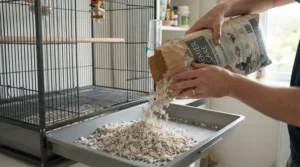
Dust free bird bedding sounds like a product category. In practice, it’s mostly a habit. Avian specialists overwhelmingly recommend plain paper under the grille, because you can see what’s happening, remove soiled patches and replace the lot quickly. Parrot Essentials suggests changing bedding every two to three days or as needed, and many keepers do it daily.
Paper pellets and pulp bedding are different. Some avian retailers advise against them for parrots because soiled areas hide in the pellets and damp spots can stay damp. That’s a mismatch for the Back 2 Nature Small Animal Paper Bedding, which is designed for small mammals. It may still suit an aviary floor, but only with vet agreement and daily spot-cleaning.
Reaching for the Prevue Hendryx Parrot Cage Liner Sheets (or plain paper) keeps things low-dust and easy to inspect. Whatever you choose, store paper somewhere dry, because stacks left in damp corners can grow their own microbes. And remember that powder-down species such as cockatoos and African greys shed fine dust of their own, so even perfect bedding needs a HEPA unit alongside it.
Fungal Spores at Home: A Problem → Solution Guide
Most outbreaks of fungal spores trace back to a handful of fixable problems. Here are the usual suspects:
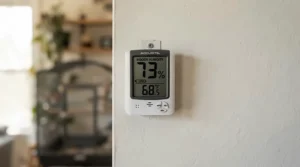
Problem 1: A damp room. Steamy kitchens and bathrooms are mould nurseries. Solution: Keep the bird room ventilated, wipe condensation and consider a cheap hygrometer. A commonly cited indoor target is roughly 40–60% relative humidity.
Problem 2: Stale food and water dishes. Wet food left out feeds fungi. Solution: Remove fresh food after a few hours, and wash dishes in hot soapy water daily.
Problem 3: Seed stored badly. Solution: Use a sealed container such as the Gamma Seal Lid or Gardman Storage Tin, buy small amounts and bin anything damp or musty.
Problem 4: Old or damp bedding and foraging materials. Solution: Use fresh paper such as the Prevue Liner Sheets, and store shredded paper for toys dry and briefly.
Problem 5: Airborne reservoirs. Even a clean room has floating dust. Solution: Run a HEPA unit such as the Levoit Core 300, and place it so airflow never hits the cage directly.
Tackle them in that order. Source control first, filtration second.
Your First 30 Days: A Setup and Maintenance Schedule
Rolling out aspergillosis prevention for pet parrots works best as a staged plan, not a weekend panic.
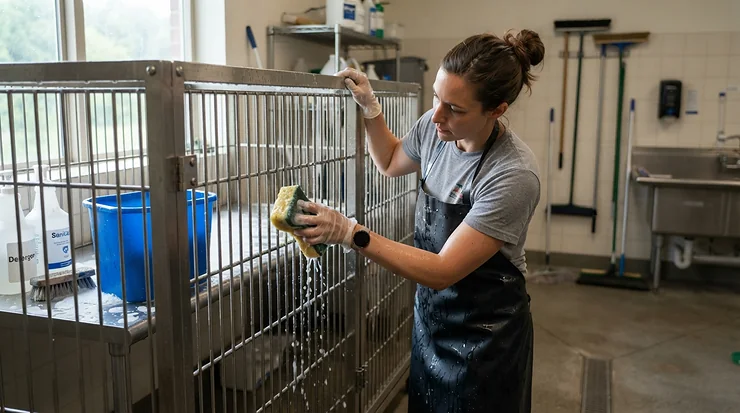
Days 1–3: Audit. Check every seed bag and treat dubious ones as lost. Wash all dishes, perches and toys. Look for damp patches on walls and ceilings.
Days 4–7: Storage and bedding. Decant fresh seed into a sealed container such as the Gamma Seal Lid bucket. Switch to paper liners and set a daily change.
Week 2: Air. Position your purifier at head height for a perched bird, a metre or two from the cage, with the outlet pointing away. Run it on a low speed for a few days so your bird can adjust.
Weeks 3–4: Routine. Wash the cage tray weekly, check seed freshness and make a note of when filters need replacing. Book a routine avian vet visit if your bird hasn’t had one lately.
The most common first-month mistake is changing everything at once. Introduce new equipment gradually, and watch your bird’s behaviour and breathing at each step.
Real-World Scenarios: Matching the Kit to Your Home
Here are three typical profiles, each with a budget, a room and a routine.
The student with a conure in a rented room (tight budget). The room is small, money is tight, and cooking happens next door. A Levoit Core 300, plain newspaper or paper liners and a small sealed tub for seed keep costs low. Ventilate daily and avoid scented anything.
The family with an African grey in the lounge (moderate budget). African greys are among the species vets call more prone, and a shared living space means more dust and cooking fumes. A Blueair Blue Max 3250i (after checking the ozone statement), Prevue Hendryx Parrot Cage Liner Sheets changed daily, and a Gardman Storage Tin for decanted seed make a sensible kit.
The rescue or multi-bird home in a converted outbuilding (higher budget). Many birds mean heavy dust and large volumes of food. A Dyson Purifier Big+Quiet Formaldehyde covers the area, while Gamma Seal Lid buckets handle bulk seed. Damp is the big enemy in outbuildings, so monitor humidity and ventilate.
Notice the pattern: the cheapest wins (dry storage, fresh paper, ventilation) appear in every profile. Only the purifier changes.
Common Mistakes in Aspergillosis Prevention for Pet Parrots
Even careful owners slip up. Watch for these:
- Relying on a purifier alone. A Levoit Core 300 can’t fix a bucket of damp seed. Source control comes first.
- Buying ionisers or “air sanitisers”. Ozone-producing devices are linked to bird deaths. Stick to mechanical HEPA filtration.
- Buying seed in bulk. Fresh beats cheap. Large sacks sit open for months, and old seed is where spores multiply.
- Sealing damp seed. An airtight lid doesn’t dry anything out. Check seed on arrival and bin suspect batches.
- Ignoring the first signs. Fluffed-up posture, tail-bobbing, open-mouth breathing, weight loss and a changed voice all warrant a vet. Merck notes that sudden death can occur in severe cases.
- Skipping nutrition. Vitamin A-poor, seed-only diets weaken defences. Ask your vet about pellets and fresh vegetables.
The common thread is false reassurance. A gadget feels like action, but dry food and fresh bedding do more work.
Long-Term Cost & Maintenance
Cost per year matters more than the sticker price. Here’s a rough view (check current prices and manufacturers’ filter schedules):
| Item | Upfront Range | Ongoing Cost | Value Verdict |
|---|---|---|---|
| Levoit Core 300 | Around £90–£150 | Periodic replacement filters | Best for small rooms |
| Blueair Blue Max 3250i | Around £160–£200 | Filter replacement with app reminders | Best mid-range balance |
| Dyson Purifier Big+Quiet Formaldehyde | Around £850–£950 | HEPA rated around five years; other filters sooner | Costly, but low filter churn |
| Gamma Seal Lid | Around £10–£20 | Almost nothing | Excellent value |
| Prevue Hendryx Parrot Cage Liner Sheets | Around £10 per pack | Packs replaced regularly | Good for monitoring |
Weighing it up, spreading the Dyson Purifier Big+Quiet Formaldehyde‘s upfront cost over its rated five-year HEPA life works out at roughly £170–£190 a year in hardware. That’s far above a Levoit Core 300‘s annual hardware cost, though filters add to both. The seed and bedding picks are cheap, so they should never be the place you economise.
For independent testing context, Which?’s air purifier buying guide is worth reading, as the consumer group has tested more than 100 models for effectiveness, noise and running costs.
Safety Guide: Ozone, Ionisers, Non-Stick Fumes and Scents
A bird room should have nothing in the air except air. Here’s a practical checklist:
- Avoid ozone and ionisation. The US Environmental Protection Agency and American Lung Association caution against indoor ozone generators, and aviculturists have reported bird deaths linked to ionisers. Some UV “sanitising” functions can also produce ozone, so check specifications carefully.
- Skip scented products. Candles, plug-in air fresheners, aerosols and essential oil diffusers add irritants. Some purifiers include a diffuser feature, so leave it off or choose a model without one.
- Be wary of non-stick fumes. Overheated PTFE-coated cookware is widely warned against by avian vets, so keep birds well away from the kitchen.
- Look for UKCA or CE marking. Electrical appliances sold in Great Britain should carry the correct conformity marks.
- Never aim airflow at the bird. Position purifiers nearby, not pointed at the cage.
If you’re unsure about a feature, ask the manufacturer in writing for its ozone and emissions statement. Responsible brands will answer.
FAQ
❓ Is a HEPA air purifier enough for aspergillosis prevention for pet parrots?
❓ How often should I replace HEPA filters in a bird room?
❓ Which size air purifier does a parrot room need?
❓ Do airtight containers stop parrot seed going mouldy?
❓ How much does it cost to set up a mould-safe bird room?
Conclusion
Effective aspergillosis prevention for pet parrots isn’t one purchase. It’s a system. Dry, fresh seed in a sealed container comes first, then clean paper bedding changed often, then a quiet HEPA purifier running in the background, then a nutritious diet and regular vet visits. Skip any layer and the others have to work harder.
If your budget is tight, start with storage and bedding. A Gamma Seal Lid or Gardman Storage Tin and Prevue Hendryx Parrot Cage Liner Sheets cost very little and attack the problem at its source. Add a Levoit Core 300 for small rooms or a Blueair Blue Max 3250i for larger ones (after confirming the ozone statement). Reserve the Dyson Purifier Big+Quiet Formaldehyde for big, multi-bird spaces where its capacity is actually used. Treat the Back 2 Nature Small Animal Paper Bedding as a cautious, vet-approved option rather than a default.
This guide offers general information, not veterinary advice. If your parrot shows laboured breathing, tail-bobbing, weight loss or lethargy, see an avian vet promptly. Early diagnosis is your best defence.
Recommended for You
- Acrylic Bird Bath For Aviary: 7 Best Picks & Costly Mistakes (2026)
- Bath Perch For Budgies: 7 Best Picks For UK Cages (2026)
- Fine Mist Sprayer For Parrots: 7 Best Picks For UK Owners (2026)
Disclaimer: This article contains affiliate links. As an Amazon Associate, I earn from qualifying purchases. If you purchase products through these links, we may earn a small commission at no additional cost to you.
✨ Found this helpful? Share it with your friends! 💬🤗
