
In This Article
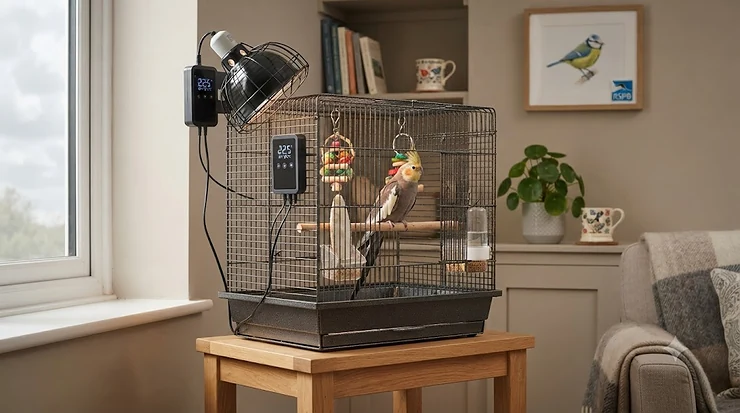
Winter in a British flat is a different beast to the rainforest canopy most parrots evolved in, and a thermostat heat lamp for bird cage setups is often the only thing standing between a cosy budgie and a shivering one. Central heating gets switched off overnight, draughts creep under doors, and a sick or elderly bird can go downhill fast once its body has to burn extra energy just to stay warm. A basic heat bulb solves half the problem — it adds warmth — but without a thermostat doing the thinking, you’re gambling on guesswork and hoping the cage doesn’t turn into a sauna while you’re at work.
What is a thermostat heat lamp for a bird cage? In short, it’s a heating bulb or panel wired through (or paired with) a temperature-sensing controller that switches or dims the heat automatically to hold a set range, rather than blasting constant, unregulated warmth. …species sensitive to light pollution at night… reptile keepers have used this exact principle for decades, and UK bird owners — particularly those with rescue budgies, unwell cockatiels, or hand-reared chicks — have quietly borrowed the technology because keeping a bird’s cage away from radiators and draughts, plus retaining heat, is core RSPCA winter bird care guidance. This guide covers seven genuinely available options, from simple plug-in panels to proper dimming thermostats, so you can pick the right level of control for your flock without overpaying or under-protecting.
Quick Comparison Table
| Product | Type | Wattage | Best For |
|---|---|---|---|
| K&H Pet Products Snuggle-Up Bird Warmer | Radiant panel | 7-10W | Budget, single small-medium bird |
| SYSAI Bird Cage Heater with Intelligent Thermostat | All-in-one bulb unit | 50W | Cockatiels, budget thermostatic control |
| MANON ROSA Thermostatic Socket + Ceramic Bulbs | Socket + bulb kit | 25-100W | Lightless heating, larger cages |
| Hamiledyi Ceramic Heat Lamp with Lampshade | Bulb + guard | Up to 100W | Adjustable dial, multi-bird setups |
| HabiStat Classic Pro Dimming Thermostat | Component thermostat | Up to 450W | Precision, sick-bay recovery cages |
| Exo Terra Dimming Pulse Thermostat (Day/Night) | Component thermostat | Varies by bulb | Aviaries, day/night cycling |
| Microclimate EVO Connected 2 | Smart digital thermostat | Up to 300W | App monitoring, multiple birds/cages |
Looking across the table, there’s a clear split between all-in-one bird-specific heaters (the K&H Pet Products Snuggle-Up Bird Warmer, SYSAI Bird Cage Heater with Intelligent Thermostat) that plug in and go, and component systems (HabiStat Classic Pro Dimming Thermostat, Exo Terra Dimming Pulse Thermostat, Microclimate EVO Connected 2) borrowed from the reptile-keeping world, where you choose your own bulb and thermostat separately for finer control. Budget buyers gravitate toward the panel-style units, while anyone nursing a sick or elderly bird through a UK winter will likely get more consistent, calibrated warmth from a proper dimming or digital thermostat.
💬 Just one click — help others make better buying decisions too!😊
Top 7 Thermostat Heat Lamps for Bird Cages: Expert Analysis
1. K&H Pet Products Snuggle-Up Bird Warmer — lowest-fuss thermostatic panel
The K&H Pet Products Snuggle-Up Bird Warmer is the option most UK owners stumble on first, and it earns its reputation through sheer simplicity. It’s a 12-volt radiant heating panel, not a bulb, that clips to the outside of the cage bars so your bird can perch against it or wander away as it pleases. Running at roughly 7-10W depending on size, it’s thermostatically controlled to hover around a bird-safe range rather than staying permanently hot, which matters because the unit has no manual dial for you to fiddle with — it simply does its job in the background. Based on the spec comparison with pricier component systems, this is the trade-off: you get safety and simplicity, not adjustability, so it suits owners who want a “set and forget” solution rather than fine-tuned control for a specific species or illness. Reviewers on the product’s own Q&A consistently note it uses harmless low-voltage electricity and that the cord sits outside the cage, out of beak’s reach, though several UK buyers flag that — being an imported product — you’ll need a proper UK three-pin adapter and possibly a USB power source depending on which size you buy, which caught a few people off guard. What most buyers overlook is that this panel radiates warmth rather than heating the whole cage, so it’s genuinely a “cuddle up” supplement rather than a room-temperature replacement for a seriously chilled bird.
Pros:
- ✅ Genuinely low-voltage and safe to the touch
- ✅ Cord routed outside the cage, away from curious beaks
- ✅ No settings to get wrong — thermostat does the work
Cons:
- ❌ Needs a UK adapter as it’s an imported product
- ❌ Fixed thermostat range, no manual adjustment
Expect to pay in the £25-£35 range depending on size; at the time of research, it represents solid value for owners who want reliable background warmth without any setup hassle.
2. SYSAI Bird Cage Heater with Intelligent Thermostat — budget all-in-one bulb unit
The SYSAI Bird Cage Heater with Intelligent Thermostat takes a different route: a 50W red heating bulb housed in a cool-touch shell with a built-in thermostat and overheat protection baked in. Unlike the K&H panel, this unit genuinely functions as a lamp — it throws a low red glow while heating — which some owners deliberately choose because it doubles as a night-light for a nervous bird, while others prefer a lightless option to avoid disturbing sleep cycles. What most buyers overlook about this model is that “intelligent thermostat” here means an internal safety cutoff rather than a dial you set to a specific degree, so it’s closer to a smart on/off switch than the proportional dimming you’d get from a dedicated reptile-style thermostat. Aggregated listings for SYSAI’s range consistently highlight the anti-bite power cord protector as a standout feature for parrot owners, since chewed cords are a genuine fire risk with any plug-in heater. Based on the spec sheet, the cool-touch shell and 24/7 reliable heating claim make this a sensible pick for cockatiels or conures rather than tiny finches, who may find 50W too intense in a small enclosure without careful positioning away from the perch.
Pros:
- ✅ Built-in overheat protection and cool-touch shell
- ✅ Anti-bite cord protector reduces chew-fire risk
- ✅ Runs continuously without manual monitoring
Cons:
- ❌ No adjustable temperature dial, fixed cutoff only
- ❌ Red glow may not suit birds needing total darkness
At around £20-£30, the SYSAI Bird Cage Heater with Intelligent Thermostat sits firmly in budget territory and represents reasonable value for a single cockatiel-sized cage, though it’s worth checking current stock and reviews before buying since availability can shift.
3. MANON ROSA Thermostatic Socket with Ceramic Bulbs — true lightless thermostat-and-lamp combo
If you want the literal combination implied by the phrase “thermostat heat lamp,” the MANON ROSA Thermostatic Socket with Ceramic Bulbs is arguably the most honest match. It’s a thermostatic E27 socket sold with two non-light-emitting ceramic bulbs (typically 25W and 50W, or 50W and 100W pairs), meaning you screw in the wattage appropriate to your cage size and the socket’s thermostat regulates how hard that bulb works. Ceramic emitters produce infrared heat without visible light, so they won’t mess with a bird’s day/night rhythm the way a glowing red bulb can — a genuinely useful distinction for species sensitive to light pollution at night. Here’s what to weigh: because this is a socket-plus-bulb kit rather than a sealed unit, you’re responsible for sourcing (or checking it includes) a proper lamp holder and guard to keep feathers and curious beaks away from the ceramic element, which gets seriously hot even though it doesn’t glow. Reviewers on similar MANON ROSA listings describe it as effective winter kit for parakeets and small parrots, with the main recurring theme being that buyers who skip a bulb guard risk their bird brushing against a genuinely hot surface — the thermostat controls duty cycle, not surface temperature at the point of contact.
Pros:
- ✅ No light emitted, so sleep cycles stay undisturbed
- ✅ Two bulb wattages let you scale to cage size
- ✅ Ceramic emitters last far longer than glass heat bulbs
Cons:
- ❌ Requires a separate guard to prevent contact burns
- ❌ More assembly than a plug-and-play panel
Priced in the £30-£45 bracket including bulbs, it’s mid-range value that rewards owners willing to add a proper guard rather than using it bare.
4. Hamiledyi Ceramic Heat Lamp with Lampshade — adjustable dial for multi-bird setups
The Hamiledyi Ceramic Heat Lamp with Lampshade pairs a ceramic heat bulb (rated up to 100W) with a metal lampshade that both directs the heat downward and acts as a physical guard, plus a manually adjustable temperature dial rather than a fixed cutoff. This matters in practice: a single cockatiel and a busy aviary with six budgies need very different heat outputs, and being able to wind the dial down for a small cage or up for a larger, draughtier one gives you flexibility the sealed bird-specific units simply don’t offer. On paper this means more control, but it also means more responsibility — you, not an automatic thermostat curve, are deciding where the dial sits, so it suits owners comfortable checking a thermometer rather than trusting a black-box “intelligent” claim. Reviewers on comparable Hamiledyi ceramic lamp listings often mention the anti-scald guard as the deciding factor over cheaper alternatives, since several competing ceramic lamps ship with no shielding at all. The spec sheet won’t tell you this, but reptile and bird keepers who’ve used 100W ceramic emitters in small rooms report that positioning matters enormously — mount it too close to a perch and even a “moderate” dial setting can run hot.
Pros:
- ✅ Metal lampshade doubles as heat guard and reflector
- ✅ Manually adjustable, so output scales to cage size
- ✅ Ceramic element gives long service life, no bulb glow
Cons:
- ❌ Manual dial means no automatic temperature correction
- ❌ 100W is excessive for a single small bird if misjudged
Expect a price in the £25-£40 range depending on wattage bundle; it’s good value for multi-bird households, less so for a lone finch that needs gentler heat.
5. HabiStat Classic Pro Dimming Thermostat — precision UK-brand thermostat for serious setups
For owners who want proper proportional control rather than a simple on/off cutoff, the HabiStat Classic Pro Dimming Thermostat is the step up. Rather than switching a bulb fully on and off — which stresses the bulb’s filament and can cause visible temperature swings — a dimming thermostat continuously varies the power supplied, much like a household light dimmer, holding the cage at a far steadier temperature. Rated to handle up to 450 watts, it’s genuinely overpowered for a single budgie cage, but that headroom means the same unit can serve a small aviary or be repurposed for a larger species down the line. Here’s what to weigh: this is a UK-manufactured component, sold with a probe you position inside the cage and a separate heat bulb and holder you buy to match, so total setup cost and effort exceed any all-in-one panel. Reviewers and reptile-keeping forums that have used HabiStat’s dimming range for years consistently rate the temperature stability highly, and the brand backs the unit with a 12-month guarantee, which is longer reassurance than most bird-specific imports offer. What most buyers overlook is that this thermostat is explicitly designed for light-emitting heat sources, unlike basic on/off mat thermostats, which makes it one of the few controllers genuinely built to pair safely with a basking-style heat bulb.
Pros:
- ✅ True dimming action gives smooth, stable temperatures
- ✅ UK brand with 12-month guarantee and UK support
- ✅ Handles up to 450W, room to scale for bigger setups
Cons:
- ❌ Sold separately from the bulb and holder, more setup
- ❌ Overkill wattage for a single small bird’s cage
At around £40-£55 for the thermostat alone (plus a basking bulb from roughly £5-£10), total spend lands mid-to-premium, but the accuracy justifies it for recovery cages or multi-bird aviaries.
6. Exo Terra Dimming Pulse Thermostat with Day/Night Timer — built-in day/night cycling
The Exo Terra Dimming Pulse Thermostat with Day/Night Timer brings something none of the bird-specific units offer out of the box: a genuine day/night temperature differential, so the cage can run slightly warmer during active hours and cooler overnight, mimicking a more natural cycle. Originally built for reptile terrariums, its pulse-proportional technology varies the heat bulb’s output smoothly rather than snapping it on and off, which — much like the HabiStat unit — protects bulb lifespan and avoids the jarring temperature spikes a basic on/off thermostat produces. Based on the spec comparison, the day/night timer is the standout feature for anyone housing birds in a room without natural light cues, such as a utility room or an isolation cage for an unwell parrot, where the thermostat itself can enforce a healthier rhythm. What the spec sheet won’t tell you, but reptile-keeping forums note repeatedly, is that the probe and mounting hardware are designed around glass terrarium walls, so bird owners typically need a bit of DIY improvisation — cable ties or a small bracket — to mount the probe securely inside wire cage bars. It’s a widely stocked, well-established brand on Amazon UK, which counts for something when you’re relying on a thermostat for a vulnerable animal’s safety.
Pros:
- ✅ Genuine day/night temperature cycling built in
- ✅ Pulse-proportional dimming protects bulb lifespan
- ✅ Well-established brand with wide UK availability
Cons:
- ❌ Probe mounting designed for terrariums, needs adapting
- ❌ Pricier than most bird-specific alternatives
Typically priced in the £45-£65 range, it’s a strong mid-premium pick for owners prioritising a natural light-and-heat cycle over pure simplicity.
7. Microclimate EVO Connected 2 — app-connected precision for multiple cages
Sitting at the top of this list, the Microclimate EVO Connected 2 is a fully digital thermostat with smartphone connectivity, letting you monitor and adjust cage temperature remotely and receive alerts if readings drift outside your set range. For anyone managing several cages — a breeder, a rescue, or simply a household with multiple sensitive birds — the ability to check every enclosure’s temperature from one app rather than physically walking round with a thermometer is a genuine workflow improvement, not just a gimmick. Dual output on some configurations means one unit can technically manage two heat sources, which changes the cost calculation if you’re heating more than one cage, since a single premium thermostat can replace two cheaper ones. On paper this means real-world time savings and earlier warning of a failing bulb or a stuck cage door letting in a draught, both of which matter enormously for a bird that can decline within hours of getting cold. Here’s what to weigh: the setup involves connecting the unit to home wifi, and forum discussion around similar smart thermostats suggests initial pairing can be fiddly for less tech-confident owners, though most report it’s a one-time hassle rather than an ongoing issue.
Pros:
- ✅ Remote app monitoring and temperature alerts
- ✅ Dual output can manage two cages from one unit
- ✅ Genuinely precise digital calibration, not a rough dial
Cons:
- ❌ Premium price for a single small bird’s cage
- ❌ Wifi setup can be fiddly on first use
Priced in the £130-£160 range, this is firmly a premium purchase best justified by multiple cages or a bird with serious health needs rather than a single healthy budgie.
Setting Up Your Thermostat Heat Lamp: The First 30 Days
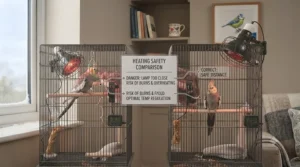
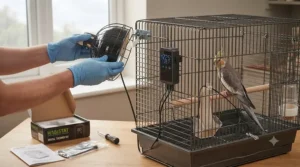
Getting a thermostat heat lamp for bird cage running safely isn’t just a case of plugging it in and walking away, especially in the first month while you’re both learning the equipment. Start by positioning the heat source at one end of the cage rather than centring it — this creates a thermal gradient so your bird can move toward the warmth or away from it, which is exactly how the K&H Pet Products Snuggle-Up Bird Warmer‘s panel design and any properly mounted heat lamp should work. Use a separate digital thermometer with a probe placed at perch height, not cage-floor height, for the first week, and cross-check it against whatever the thermostat itself reports — small discrepancies are normal, large ones suggest a probe positioning problem. Avoid the common mistake of setting the target temperature too high out of anxiety; birds that are too warm pant, hold their wings away from their bodies, and become lethargic, which is just as much a welfare concern as being cold. Check the cord and bulb housing daily for the first week for any warmth in places that shouldn’t be warm, and weekly thereafter. Finally, resist covering the heated end of the cage with fabric to “trap” warmth — this can create dangerously concentrated hot spots and blocks the visual escape route your bird needs to self-regulate.
Real-World Scenarios: Matching the Heat Lamp to Your Bird
Consider three genuinely different households. First, a single healthy budgie in a well-insulated flat with central heating that only dips overnight — here, the SYSAI Bird Cage Heater with Intelligent Thermostat or the K&H Pet Products Snuggle-Up Bird Warmer covers the gap perfectly without overcomplicating things; you’re bridging a few degrees for a few hours, not running a full heating system. Second, an owner nursing an elderly African grey recovering from illness in a draughty Victorian terrace, where the vet has recommended keeping the bird notably warmer than usual for an extended recovery period — this is exactly the scenario where the HabiStat Classic Pro Dimming Thermostat or Exo Terra Dimming Pulse Thermostat with Day/Night Timer earns its higher price, since stable, accurately calibrated heat over weeks matters more than upfront cost. Third, a small-scale breeder or rescue with four or five cages spread across a converted outbuilding, where physically checking every thermometer twice a day isn’t practical — the Microclimate EVO Connected 2‘s remote monitoring turns a logistical headache into a five-minute phone check, and its dual output can trim the number of separate units needed.
Problem → Solution: Common Bird-Heating Issues
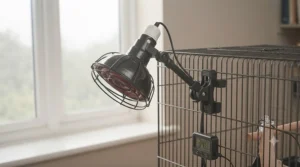
Three problems come up again and again in UK bird-keeping forums. First, the bird avoids the heated area entirely — usually because the lamp is positioned too centrally with no cooler escape route, so move it to one end and re-test. Second, the cage feels warm to your hand but the bird still fluffs up and shivers — often the probe is reading room air rather than perch-level air, so reposition the sensor closer to where the bird actually sits. Third, and most serious, the thermostat seems to be running constantly without ever cutting out — this usually signals either an undersized heater for the room’s ambient temperature or a genuine thermostat fault, and in either case the fix is to upgrade wattage or swap the unit rather than let it run flat-out unmonitored, since a thermostat stuck permanently “on” has effectively stopped being a thermostat at all.
What Is a Thermostatic Heat Lamp for Birds?
A thermostatic heat lamp for birds is any heat-emitting bulb, panel, or ceramic emitter wired through a temperature-sensing controller that automatically raises, lowers, or cuts power to hold the cage within a set range, rather than a plain heat lamp that simply stays on at full output until unplugged. The distinction matters because a plain bulb left running overnight in a small room can push temperatures well past what’s comfortable, while a properly calibrated thermostat corrects for that automatically. This is the feature that separates a genuinely useful piece of avian welfare kit from a fire-risk space heater with feathers nearby.
How to Choose a Thermostat Heat Lamp for Bird Cage
- Match wattage to cage and room size — a 7-10W panel suits a single small bird in a warm room; a 50-100W unit suits larger cages or colder rooms.
- Decide light or lightless — a glowing bulb like the SYSAI Bird Cage Heater with Intelligent Thermostat can double as a night-light, while ceramic emitters like those in the MANON ROSA Thermostatic Socket avoid disturbing sleep.
- Check the control type — simple on/off cutoffs are cheaper but cause temperature swings; dimming thermostats like the HabiStat Classic Pro Dimming Thermostat hold steadier heat.
- Prioritise a proper guard — any bare bulb setup needs a cage or shade to prevent burns, as with the Hamiledyi Ceramic Heat Lamp with Lampshade.
- Consider multi-cage needs — households with several birds benefit from remote monitoring, which only the Microclimate EVO Connected 2 offers here.
- Factor in cord safety — anti-bite protected cords matter enormously for parrots and larger hookbills prone to chewing.
- Check UK plug compatibility — several imported bird-specific heaters need an adapter, so confirm before buying.
Thermostatic Heat Lamp for Birds vs Traditional Heat Lamp
A traditional heat lamp with no thermostat is cheaper upfront and simpler to understand, but it puts the entire burden of monitoring on you, continuously, for as long as it’s plugged in. A thermostatic heat lamp for birds, by contrast, does that monitoring automatically, correcting for a warming room, a draught, or a bulb running slightly hotter than expected. The trade-off is cost and, with dimming or digital units like the Exo Terra Dimming Pulse Thermostat with Day/Night Timer, a modest setup learning curve. For anything beyond very occasional, closely supervised use, the automatic correction of a genuine thermostat is worth the extra spend — an unmonitored heat lamp left running through a working day is a real overheating risk, not a hypothetical one.
Common Mistakes When Buying a Thermostatic Heat Lamp for Birds
The single most common mistake is buying based on wattage alone without checking whether the unit has genuine thermostatic control or just a basic on/off switch marketed loosely as “smart.” A second frequent error is skipping a physical guard on bare-bulb setups, assuming the thermostat alone prevents contact burns — it regulates duty cycle, not surface temperature at any given moment. A third is placing the thermostat’s probe too far from where the bird actually perches, which means the unit is technically working perfectly while still delivering the wrong temperature to the bird itself.
Automatic Heat Lamp Bird Cage Setups: Overheating Risk and Safety
An automatic heat lamp bird cage setup removes a lot of guesswork, but automation isn’t the same as zero risk, and overheating risk remains the single most serious concern with any plug-in bird heater. Per UK fire and rescue service electrical safety guidance, warning signs of an electrical fault include discoloured casing or cables, scorch marks around a plug or socket, and a smell of hot plastic near an appliance…
Temperature-Controlled Bird Heat Lamp Choices for Specific Situations
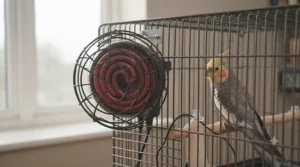
A temperature-controlled bird heat lamp earns its keep most clearly with three groups: sick birds, very young chicks, and elderly birds…Unwell birds often need supplementary heat specifically because illness disrupts normal thermoregulation, and avian vets consulted by the World Parrot Trust note that a healthy parrot can tolerate cooler temperatures reasonably well thanks to down feather insulation, but a sick bird genuinely does need to be kept warmer during recovery…. Hand-reared chicks need markedly more precise, gradually reducing heat as they feather up, making a fine, adjustable thermostat considerably safer than guesswork. Elderly birds, similarly, often benefit from a slightly warmer baseline environment than a healthy adult of the same species, and a temperature-controlled setup lets you nudge that baseline up by a few degrees without constant manual supervision.
Consistent Recovery Temperature: Why Stability Matters More Than Peak Heat
For a bird recovering from illness or injury, a consistent recovery temperature matters considerably more than hitting a specific peak number, because repeated swings between too-hot and too-cold force the body to keep readjusting rather than simply resting and healing. This is precisely why dimming and digital thermostats — the HabiStat Classic Pro Dimming Thermostat, Exo Terra Dimming Pulse Thermostat, and Microclimate EVO Connected 2 among the seven picks here — tend to outperform basic on/off units for recovery cages specifically, since proportional control avoids the sharp cycling that on/off switching produces. In practice, this means checking your chosen unit holds temperature within a narrow band (ideally a degree or two either side of target) over several hours, not just that it eventually settles somewhere in the right ballpark.
Thermostat Calibration: Getting Accurate Readings
Thermostat calibration is the step most owners skip, and it’s the reason two identical-looking setups can produce noticeably different real-world temperatures. Before trusting any new thermostat with a bird’s wellbeing, run it for 24 hours with an independent digital thermometer placed at perch height, and compare the two readings — a gap of more than one or two degrees suggests the thermostat’s own sensor is misreading, either from poor probe placement or a manufacturing tolerance issue. Recalibrate or reposition the probe if needed, and repeat this check every few months, since probes can drift slightly over long-term use, particularly on cheaper on/off units without the digital precision of something like the Microclimate EVO Connected 2.
Long-Term Cost & Maintenance
Upfront price only tells part of the story. A budget panel like the K&H Pet Products Snuggle-Up Bird Warmer costs little to buy and, running at just 7-10W, adds almost nothing to your electricity bill over a winter. A 100W unit like the Hamiledyi Ceramic Heat Lamp with Lampshade, run continuously through a cold snap, costs noticeably more to operate — worth factoring in if you’re heating for months rather than days. Ceramic emitters generally outlast glass heat bulbs by a wide margin, which offsets some of the higher upfront cost of kits like the MANON ROSA Thermostatic Socket with Ceramic Bulbs. Component thermostats such as the HabiStat Classic Pro Dimming Thermostat also tend to carry longer guarantees than sealed bird-specific units, meaning a faulty unit within the warranty period is a straightforward replacement rather than a written-off purchase.
Safety, Regulations, and Compliance Guide
Any electrical heating product sold in Great Britain should carry either a CE or UKCA conformity mark, confirming it meets recognised safety standards for electrical and electronic equipment. The UKCA marking is the conformity marking used for products being placed on the market in Great Britain, applying to England, Scotland and Wales, and current rules allow businesses the flexibility to use either UKCA or CE marking on qualifying products, so seeing either isn’t itself a red flag — but seeing neither, on an unbranded import, is worth pausing over. Beyond the mark itself, always check that any bare-bulb setup includes or is fitted with a physical guard, use a socket that isn’t shared with other high-draw appliances, and never leave a newly installed heat lamp completely unsupervised for its first full day of use.
✨ Don’t Miss These Exclusive Deals!
🔍 Take your bird’s winter comfort to the next level with these carefully selected thermostat heat lamps. Click on any highlighted item to check current pricing and availability. These setups help you create a genuinely safe, warm winter your feathered family will love!
Frequently Asked Questions
❓ How do I know if my bird's cage is too warm with a thermostat heat lamp for bird cage installed?
❓ Can I use a reptile thermostat on a normal bird cage?
❓ Is a thermostatic heat lamp for birds safe to leave on overnight?
❓ What temperature should a temperature-controlled bird heat lamp be set to?
❓ How often should I check thermostat calibration on my heat lamp?
Conclusion
A thermostat heat lamp for bird cage setup isn’t an indulgence for most UK bird owners — it’s genuinely protective kit for the months when central heating can’t be relied on around the clock. Budget panels like the K&H Pet Products Snuggle-Up Bird Warmer and SYSAI Bird Cage Heater with Intelligent Thermostat cover the basics well for a single healthy bird in a reasonably warm home, while lightless combos such as the MANON ROSA Thermostatic Socket with Ceramic Bulbs and the adjustable Hamiledyi Ceramic Heat Lamp with Lampshade suit owners wanting more control over output and light exposure. For anything involving recovery, illness, or multiple cages, the precision of the HabiStat Classic Pro Dimming Thermostat, Exo Terra Dimming Pulse Thermostat with Day/Night Timer, or the app-connected Microclimate EVO Connected 2 earns its higher price through consistent recovery temperature and far less guesswork. Whichever you choose, the fundamentals stay the same: guard the bulb, check the cord, calibrate the probe, and watch your bird’s behaviour as closely as the dial.
Recommended for You
- Heat Lamp Bulb For Sick Budgie: 7 Safe Picks For UK Owners (2026)
- Brooder Cage For Sick Parrot: 7 Best UK Picks (2026)
- Top Rated Bird Nebuliser Kit Under £50: 7 Best Picks (2026)
Disclaimer: This article contains affiliate links. As an Amazon Associate, I earn from qualifying purchases. If you purchase products through these links, we may earn a small commission at no additional cost to you.
✨ Found this helpful? Share it with your friends! 💬🤗
