
In This Article
Picture the scene. It’s 6.45 a.m., and your budgie, usually a pocket-sized tornado of chatter, is hunched on the lowest perch like a feathered tennis ball. Eyes half closed. Silent. If that sounds familiar, pause here and phone an avian vet, because small birds can slide downhill in hours, not days.
While you wait for that appointment, warmth is the most useful thing you can offer. Vets writing for the bird-care resource Lafeber advise keeping a sick-acting budgie warm at around 85°F (roughly 29°C), quiet and stress-free, with food and water within easy reach. That’s where a heat lamp bulb for sick budgie care earns its place on the shopping list, provided you choose the right one.
Here’s the catch. The wrong heat lamp bulb for sick budgie recovery can do more harm than the chill it’s meant to fix. Coated bulbs can release toxic fumes, an overpowered bulb can overheat a bird that can’t escape, and an unguarded fitting is a fire risk.
So this guide does more than list products. It compares seven real options sold on Amazon UK: four ceramic bulbs, plus the fixture, thermostat and thermometer that make them safe to use. Along the way it covers bulb wattage safety, the correct recovery temperature and how to read fluffed-up budgie signs.
A quick, honest note: I’m not a vet, and nothing here replaces one. Think of this as the well-researched friend who helps you set up the heat while the professionals handle the diagnosis.
Quick Comparison: Heat Lamp Bulb for Sick Budgie Options at a Glance
| Product | Type | Power / Range | Best For |
|---|---|---|---|
| Zoo Med Nano Ceramic Heat Emitter | Ceramic bulb | 25W (40W also made) | Small hospital cages, gentle top-up |
| Exo Terra Ceramic Heat Emitter | Ceramic bulb | 40W–250W range; 60W typical | All-round use with a matching fixture |
| Komodo White Ceramic Heat Emitter | Ceramic bulb | 60W (higher sizes exist) | Budget-conscious owners |
| Habistat Black Magic Ceramic Heater | Ceramic bulb | 60W–250W range | Larger cages and chillier rooms |
| Exo Terra Porcelain Wire Light | Guarded fixture | Rated up to 150W | Safely holding any ceramic bulb |
| Habistat Pulse Thermostat (High Range) | Thermostat | 26–40°C, 600W max | Holding a steady recovery temperature |
| ThermoPro TP50 | Thermometer / hygrometer | −50°C to 70°C | Checking the real temperature at the perch |
Looking at the table, the bulbs are only half the story. The Exo Terra Porcelain Wire Light, the Habistat Pulse Thermostat and the ThermoPro TP50 are what turn a hot object into a controlled, measurable heat source. If your budget is tight, spend it on the fixture, thermostat and thermometer first, and choose the cheaper bulb such as the Komodo White Ceramic Heat Emitter.
💬 Just one click — help others make better buying decisions too!😊
Top 7 Heat Lamp Bulb for Sick Budgie Picks: Expert Analysis
Four of these picks are bulbs and three are the safety kit around them. I’ve included both because a bulb on its own is a poor answer to a poorly bird. Ratings and price ranges reflect Amazon UK listings at the time of research and may change, so check current prices before buying.
1. Zoo Med Nano Ceramic Heat Emitter (25W) — gentlest boost for a small hospital cage
The Zoo Med Nano is the smallest, quietest way into supplemental heat, which suits a compact hospital cage.
Zoo Med sells it in 25W (model CE-25N) and 40W versions. It’s a solid porcelain element with a standard E27 screw fitting, and it gives off no visible light. In practice, that makes it behave like a warm radiator rather than a lamp: your budgie can rest in darkness at 2 a.m. while the air near the perch stays gently lifted. Zoo Med quotes a life of up to five years, though buyers report a wider range.
Based on the spec comparison, 25W suits a small cage in a room that’s already reasonably mild. It won’t rescue a cold conservatory. Here’s what to weigh: this emitter is designed for nano reptile tanks, so treat it as a top-up rather than a furnace. Use it as a ceramic heat bulb for small birds only alongside a thermostat and a separate thermometer.
Review sentiment: on Amazon UK it averaged 4.5 out of 5 from 247 ratings at the time of research. One UK buyer said running it 24 hours a day raised the temperature just enough for their needs, while a three-star reviewer reported it lasting only five months.
Pros:
- ✅ Tiny 25W draw keeps running costs low
- ✅ No visible light, so night-time rest isn’t disturbed
- ✅ Strong rating across 247 Amazon UK ratings
Cons:
- ❌ May be too weak for cool rooms or bigger cages
- ❌ Lifespan reports range from months to years
Price range: expect a modest outlay, typically under £20 (check current price). For a small cage in a mild room, the value is strong.
2. Exo Terra Ceramic Heat Emitter — the all-rounder with a matching fixture
The Exo Terra Ceramic Heat Emitter is the name most UK reptile keepers reach for, and that familiarity helps when you’re shopping in a hurry.
It’s a solid ceramic element producing long-wave infrared heat with no visible light, sold in 40W, 60W, 100W, 150W and 250W sizes. The manufacturer says to use it with its own wire-guard fixture and a thermostat, which is what you want around a poorly bird. The radiant warmth lifts the air and surfaces near the cage, so your budgie can shuffle closer or further away instead of being blasted from every side.
What most buyers overlook is that wattage isn’t destiny. One reviewer found the 40W held only about 22°C in their enclosure and upgraded to 60W, which then ran below full power on a thermostat. Another said the 60W raised temperatures by just a couple of degrees. For a heat lamp bulb for sick budgie use, that variability is the case for a 60W bulb plus a thermostat: headroom without runaway heat.
Review sentiment: the 60W listing averaged 4.3 out of 5 from 84 ratings on Amazon UK. Buyers praise steady heat and low running costs. The recurring complaint is price, with some calling it expensive for a lump of ceramic.
Pros:
- ✅ Solid ceramic, no light, suited to 24-hour use
- ✅ Five wattage options for different set-ups
- ✅ Designed to pair with a matching guarded fixture
Cons:
- ❌ Pricier than unbranded emitters
- ❌ Lower wattages may under-deliver in cool rooms
Price range: roughly £25–£30 for the 60W at the time of research (check current price). Good value if it saves you mismatching a fixture, less so if you’re chasing the cheapest bulb.
3. Komodo White Ceramic Heat Emitter (60W) — best budget-friendly ceramic bulb
The Komodo White Ceramic Heat Emitter is the sensible pick when money is tight and you still want a proper ceramic bulb rather than a coated lamp.
Komodo describes it as a radiant, sun-like heat source with no visible light, suitable for 24-hour use and longer-lasting than conventional basking bulbs. At 60W it hits the same sweet spot as the Exo Terra Ceramic Heat Emitter, enough to warm a single small cage when paired with a thermostat, without the excess of the 150W and 200W sizes.
The honest caveat is durability. On Amazon UK the 60W has a lovely 4.8 out of 5, but that’s from only seven ratings, too small a pool to trust on its own. The higher-wattage Komodo sizes score lower (about 3.1 out of 5 for the 150W and 2.9 for the 200W), with several UK reviewers reporting bulbs that failed within weeks. For a sick bird, a bulb dying at 3 a.m. is a genuine risk, so buy a spare.
Reviewers who were happy mostly mention quick heat-up and good value for money. If you run a heat bulb for budgie cage duty on a tight budget, this is where I’d start.
Pros:
- ✅ Lowest price of the branded ceramic bulbs here
- ✅ 60W size suits a single small cage
- ✅ No visible light for undisturbed rest
Cons:
- ❌ Very small review pool for the 60W size
- ❌ Higher wattages attract durability complaints
Price range: around £12–£16 for the 60W at the time of research (check current price). Excellent value, provided you keep a spare.
4. Habistat Black Magic Ceramic Heater — bigger-cage option with UK-brand controller pairing
The Habistat Black Magic Ceramic Heater suits owners with a larger cage or a properly cold room, and it slots neatly into the UK-brand Habistat ecosystem.
It comes in 60W, 100W, 150W and 250W versions with an E27 fitting, and it replaced the older Pearlco range. Habistat recommends pairing it with its pulse proportional thermostat, and it warns that ceramic lamps get very hot, so you need a correctly rated E27 ceramic lamp holder. The 250W version measures around 12.5 cm across, so a guard has to be big enough and rated for it. A budgie hospital cage rarely needs that much.
On the spec sheet, I’d only look at this for a big flight cage or a chilly room, and I’d start at 60W or 100W. If you’re using a Habistat Black Magic bulb as a ceramic heat bulb for small birds, let the thermostat do the work and resist the temptation to over-size.
Review sentiment: I couldn’t verify enough Amazon UK reviews to summarise fairly. The listings I checked carried very few, so read the current reviews yourself rather than trusting a star average.
Pros:
- ✅ Four wattages from 60W to 250W
- ✅ Designed to work with Habistat pulse thermostats
- ✅ Solid ceramic, no light emitted
Cons:
- ❌ Larger bulbs need a bigger, correctly rated guard
- ❌ Few verifiable Amazon UK reviews
Price range: varies by wattage, so check current price for the 60W or 100W size. Worth it mainly if your set-up is bigger than a standard budgie cage.
5. Exo Terra Porcelain Wire Light (Small) — fixture built for ceramic emitters
The Exo Terra Porcelain Wire Light is the unglamorous hero here, because where the bulb sits matters as much as which bulb it is.
It has a heat-resistant porcelain socket and a wire guard, plus an on/off switch, hanger and clamp. The Amazon UK listing rates it for up to 150W. Exo Terra states that wire lights are the only lamps meeting all safety rules for its ceramic emitters. It also excludes ceramic emitters from its aluminium dome fixtures, which are rated only for ordinary incandescent and compact fluorescent bulbs. In other words, the cheap reflector dome on your shelf is the wrong home for a ceramic bulb.
Analytically, this is the piece that supports bulb wattage safety. A socket that can’t handle the heat is how fires start, and a guard keeps curious beaks, feathers and fabric away from a very hot surface. Mount it beside the cage on a stand or shelf, never inside.
Review sentiment: 4.4 out of 5 from 165 ratings on Amazon UK. One buyer said the mounting bracket wasn’t included, so check what’s in the box.
Pros:
- ✅ Porcelain socket and wire guard suit ceramic emitters
- ✅ Includes switch, hanger and clamp
- ✅ 4.4 out of 5 across 165 ratings
Cons:
- ❌ Costs more than some of the bulbs it holds
- ❌ Mounting bracket may be a separate purchase
Price range: around £30–£35 at the time of research (check current price). It’s the part I’d least like to skimp on.

6. Habistat Pulse Thermostat (High Range, 600W) — holds the correct recovery temperature steadily
The Habistat Pulse Thermostat is what stops your heat lamp bulb for sick budgie set-up from swinging between too warm and too cool.
A basic thermostat switches the heater fully on, then fully off. A pulse proportional model sends power in rapid pulses to match what’s needed, so the temperature stays steady instead of see-sawing. The High Range version covers 26–40°C, which brackets the roughly 29–32°C most sources suggest for a sick budgie. Its 600W capacity handles the bulbs here comfortably, and Habistat’s own page cites a five-year guarantee (confirm for the exact model you buy).
Two cautions. First, it’s built for non-light-emitting heat sources such as ceramic bulbs, and pulsing a glowing bulb causes flicker and shortens its life. Second, treat the dial as a guide and verify with a separate thermometer.
Review sentiment: 4.4 out of 5 from 118 Amazon UK ratings, with 74% giving five stars. One buyer said it would probably pay for itself within a year compared with running a ceramic bulb flat out.
Pros:
- ✅ 26–40°C range covers recovery-temperature needs
- ✅ Pulsing power avoids on/off temperature swings
- ✅ 4.4 out of 5 across 118 ratings
Cons:
- ❌ Costs more than the bulb it controls
- ❌ Not suitable for light-emitting heat bulbs
Price range: roughly £40–£60 (check current price). The newer Classic Pro version adds alarms and a wider range, but it had only a handful of Amazon UK ratings at the time of research.
7. ThermoPro TP50 — cheap second opinion on the real temperature
The ThermoPro TP50 costs less than a takeaway coffee and tells you what the thermostat dial can’t: the actual temperature and humidity where your budgie is sitting.
It measures −50°C to 70°C, lists accuracy of about ±1°F, and refreshes every few seconds. It’s small, runs on an AAA battery and has no backlight. In practice, it’s your reality check. If the dial says 30°C and the ThermoPro TP50 says 26°C at perch height, you’ve found the problem before your bird did. It also shows humidity, useful because heated rooms can get dry.
Review sentiment: the Amazon listing I could verify averages 4.6 out of 5 from well over 100,000 ratings (UK figures may differ). One UK buyer found it within 0.4°C of their home thermostat, while a critical reviewer reported the display failing after a few months.
Keep it outside the cage, beside the bars at perch height, because budgies chew everything.
Pros:
- ✅ Reads temperature and humidity together
- ✅ Very high rating across a huge review pool
- ✅ Compact and battery-powered
Cons:
- ❌ No backlight for night-time checks
- ❌ Some reports of displays fading after months
Price range: under £10 (check current price). It’s the best-value item on this list.
Head-to-Head: How the Seven Compare
| Product | Role | Price Range (check current price) | Amazon UK Rating at Research | Best For |
|---|---|---|---|---|
| Zoo Med Nano Ceramic Heat Emitter | Bulb | Under £20 | 4.5/5 (247) | Small cages, mild rooms |
| Exo Terra Ceramic Heat Emitter (60W) | Bulb | Roughly £25–£30 | 4.3/5 (84) | All-round use |
| Komodo White Ceramic Heat Emitter (60W) | Bulb | Around £12–£16 | 4.8/5 (7) | Tight budgets |
| Habistat Black Magic Ceramic Heater | Bulb | Varies by wattage | Too few to judge | Larger cages |
| Exo Terra Porcelain Wire Light | Fixture | Around £30–£35 | 4.4/5 (165) | Safe mounting |
| Habistat Pulse Thermostat (High Range) | Controller | Roughly £40–£60 | 4.4/5 (118) | Steady temperature |
| ThermoPro TP50 | Monitor | Under £10 | 4.6/5 (large sample) | Verifying real temperature |
The Exo Terra Ceramic Heat Emitter and the Komodo White Ceramic Heat Emitter are broadly interchangeable at 60W, so the choice comes down to price against brand familiarity. The Zoo Med Nano wins for small cages in mild rooms, while the Habistat Black Magic only makes sense for bigger set-ups. The three support items matter more than which 60W bulb you pick, because they decide whether the heat is controlled.
✨ Ready to Warm Things Up Safely?
🔍 Take your recovery set-up to the next level with these carefully selected products. Click on any highlighted item to check current pricing and availability. A guarded fixture, a thermostat and a trusted thermometer will help you give your little patient the calm, steady warmth it needs.
Heat Bulb for Budgie Cage: Step-by-Step Setup Guide
Buying the right kit is half the job. Here’s a sensible order of play for a heat bulb for budgie cage duty, based on the vet-sourced advice covered in this guide.
- Call the avian vet first. Then move the cage to a quiet, draught-free room, away from the kitchen. Lafeber also advises separating the sick bird from other birds.
- Mount the fixture beside the cage, never inside. Heat one side and leave the other side cooler, so your budgie can choose. Vets often suggest covering about half the cage with a light blanket. Keep fabric well clear of the bulb and guard.
- Wire it through the thermostat. Fit the bulb with everything unplugged, then connect the Exo Terra Porcelain Wire Light to the Habistat Pulse Thermostat. Route the probe near the perch but out of beak reach.
- Set the target, then verify. Start around 29–30°C. Check the ThermoPro TP50 after 30–60 minutes and adjust in small steps.
- Watch the bird. Sleek, tight feathers, wings held away from the body or panting mean it’s too hot.
- Make life easy. Lower the perches and put food and water close.
- Keep notes. Jot down temperatures, droppings and appetite for the vet.
Common mistakes in the first days include cranking the heat “to be safe”, trusting the dial without a thermometer, and forgetting a spare bulb.
Which Setup Fits Your Situation? Three Owner Scenarios
Real life rarely matches a spec sheet, so here are three profiles and the kit I’d match to each.
The renter with one budgie and a tight budget. Your room sits around 18–19°C and the cage is small. Prioritise the essentials: a Komodo White Ceramic Heat Emitter, the Exo Terra Porcelain Wire Light and a ThermoPro TP50. If money allows, add the Habistat Pulse Thermostat. If you can only afford three items, buy the fixture, thermometer and thermostat before splashing out on a premium bulb.
The owner of a pair in a chilly older house. Overnight temperatures dip near 16°C, and you must isolate the poorly bird in a separate hospital cage. Here a 60W Exo Terra Ceramic Heat Emitter on the Habistat Pulse Thermostat gives the headroom to reach the target. A spare bulb is non-negotiable.
The keeper of a large flight cage. A big cage needs more output, so a Habistat Black Magic at 100W may be justified, but only with a correctly rated guard and a thermostat. Better still, ask your vet about moving the bird to a smaller hospital enclosure, which is far easier to heat safely.
Common Problems With a Heat Lamp Bulb for Sick Budgie Set-Ups (and Fixes)
Even a well-chosen heat lamp bulb for sick budgie use can misbehave. These are the usual culprits.
- The bird pants or holds its wings away from its body. It’s too warm. Lower the thermostat, move the heat source further away or give more shade.
- The bird stays low and still despite warmth. Warmth isn’t fixing it. Ring the vet again, especially with tail bobbing or open-mouth breathing.
- The temperature swings. A basic on/off controller may be to blame. Switch to a pulse proportional thermostat like the Habistat Pulse Thermostat, and remember it isn’t for light-emitting bulbs.
- The bulb dies overnight. Ceramics can fail, and some buyers report early failures. Keep a spare, plus a fallback plan such as a warm, draught-free room.
What Is a Heat Lamp Bulb for Sick Budgie?
A heat lamp bulb for sick budgie is a supplemental radiant heat source, usually a ceramic heat emitter or infrared bulb in a protected fitting, positioned beside the cage to lift the temperature around a poorly bird to roughly 29–32°C. It helps an unwell budgie save energy while you arrange veterinary care.
Budgies run hot, with a body temperature around 105°F (about 40–41°C), so a room that feels comfortable to you can feel cold to a bird that’s ill. Fluffing the feathers traps air as insulation, but it burns energy the bird can’t spare. External heat takes that burden away. It doesn’t treat the illness, but it can give the bird’s body a better chance of coping until treatment starts.
The word “lamp” causes confusion. Some heat sources glow and shine light, while ceramic emitters don’t. That difference matters a great deal for sleep, safety and which controller you need, as later sections explain.
Fluffed-Up Budgie Signs: Cold, Sleepy or Genuinely Ill?
Not every puffed-up bird is dying. Budgies fluff to nap, to preen and to cope with a chill. The trick is context, and fluffed-up budgie signs only mean something alongside everything else the bird is doing.
Probably just cold:
- The room is below about 18°C, or the morning was chilly
- The feet feel cool
- Normal behaviour returns within an hour of warming, according to one UK owner’s guide
Phone the avian vet now:
- Tail bobbing, open-mouth breathing or clicking sounds
- Sitting on the cage floor
- Not eating for around 12 hours or more
- Watery or sharply changed droppings, or discharge from the eyes or nostrils
- Still fluffed up and quiet after warming
Several vet-authored sources make the same point: birds hide illness until they’re quite poorly. So don’t wait to see if the heat “cures” persistent fluffed-up budgie signs. Use the heat to support the bird on the way to the vet.
Budgie Warmth for Illness: Why Heat Helps and Where It Stops
Budgie warmth for illness is about energy economics. A sick bird spends a big share of its limited energy just staying warm. Supply the heat externally and more of that energy is left for fighting the problem and for basic functions like breathing. That’s why vets so often mention warmth in the same breath as rest and quiet.
But heat has limits. It won’t fix an infection, replace fluids or cure a blockage. It can also mask deterioration if you use it as a reason to delay calling the vet.
There are practical details too. Sick birds need rest, and one bird-hospital guide suggests a red light for night-time warmth and normal daylight in the day to encourage eating and allow monitoring. A ceramic bulb gives you the warmth without any light, which simplifies things. Always give the bird a way out: heat on one side, a cooler retreat on the other. Budgie warmth for illness should be a choice the bird can make.
Correct Recovery Temperature: The Number You’re Aiming For
Sources cluster around a target, though not perfectly. Lafeber cites about 85°F (roughly 29°C). A UK pet-shop guide suggests around 30°C near the bird, and other veterinary advice ranges from the mid-80s up to about 95°F for sick birds. So the correct recovery temperature is best treated as roughly 29–32°C (85–90°F) at perch level, adjusted for the individual bird and your vet’s advice.
| Zone | Temperature at Perch | What You’ll See |
|---|---|---|
| Too cool | Under about 26°C | Fluffed feathers, huddling, lethargy |
| Target | About 29–32°C | Calmer posture, easier resting |
| Too hot | Above about 32–35°C | Panting, wings held out, sleek feathers |
The table is a guide, not a prescription. Individual birds vary, and only your vet can say what suits yours. Measure at perch height with a real thermometer and adjust slowly, because a bird that’s too warm can’t leave. Once your vet is happy, reduce the heat gradually rather than switching it off, so the bird eases back to normal room temperature.
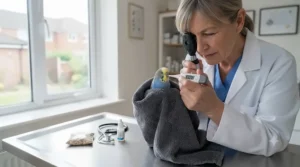
Ceramic Heat Bulb for Small Birds vs Traditional Heat Lamps
Traditional heat lamps are basically incandescent bulbs built to make heat rather than light, as the Wikipedia entry on infrared heaters explains. A ceramic heat bulb for small birds works differently: a solid ceramic element radiates infrared heat without producing visible light.
For a sick budgie, that difference matters. Ceramic emitters can run around the clock without disturbing rest, and they have no glass envelope or coating to worry about. Glowing lamps offer visible warmth but shine light into the bird’s eyes, and some are coated in ways that can be dangerous, as the wattage safety section explains.
| Option | Light Output | Main Risk | Best For |
|---|---|---|---|
| Ceramic heat emitter | None | Very hot surface, needs guarded fixture | 24-hour warmth for small cages |
| Standard infrared or red heat lamp | Visible glow | Coated bulbs can release toxic fumes | Rarely; check coating first |
| Heating pad under half the cage | None | Uneven warmth, chewing risk | Gentle supplementary warmth |
| Room heater beside the cage | None | Drying air, draughts, fan blasts | Warming a whole room |
Looking at the table, the ceramic emitter is the most controllable option for round-the-clock warmth. It needs a proper fixture and a thermostat, though. Heating pads and room heaters are useful backup, but they’re harder to fine-tune. If you go for a traditional lamp, check the bulb isn’t coated and be cautious about anything labelled shatter-resistant.
Bulb Wattage Safety: How Many Watts Is Too Many?
Bulb wattage safety comes down to four things: the bulb’s coating, the bulb’s power, the fitting’s rating and the controller’s capacity.
Coating first. PTFE, better known as Teflon, is sometimes used to coat heat lamp bulbs. When overheated it releases fumes that are highly toxic to birds. Cornell University’s veterinary college describes ducks found dead about 12 hours after a PTFE-coated heat lamp was installed. It also notes a budgerigar study where nine minutes or more of exposure to PTFE pyrolysis products caused clinical signs and death in 97% of the birds. Solid ceramic emitters have no non-stick coating to break down.
Then power. Sources vary. Some vet Q&A mentions 75–100W bulbs placed beside the cage, but the right wattage depends on room temperature, cage size and distance. On the spec comparison, I’d start at 25–60W on a thermostat and only step up if the perch thermometer won’t reach the target. At typical tariffs of roughly 25–30p per kWh (check yours), a 60W bulb running flat out costs roughly 35–45p a day, and a thermostat cuts that.
Fixture and controller. Never exceed the fitting’s rating. The Exo Terra Porcelain Wire Light is rated for 150W on its Amazon UK listing, and the Habistat Pulse Thermostat handles up to 600W. Total wattage must stay within both. Plug into a socket you trust, keep cables tidy and unplug during handling.
How to Choose a Heat Lamp Bulb for Sick Budgie
Choosing a heat lamp bulb for sick budgie recovery is easier with a checklist.
- Insist on no coating. Choose solid ceramic. Avoid anything opaque, hazy or labelled shatter-resistant.
- Pick the lowest wattage that works. Start at 25–60W, use a thermostat and step up only if needed.
- Match the fixture. Use a porcelain socket with a guard, rated above the bulb. A dome reflector designed for ordinary bulbs is the wrong home for a ceramic emitter.
- Choose the right thermostat. Pulse proportional suits ceramic emitters. Light-emitting bulbs need a dimming type instead.
- Add a separate thermometer. Trust measurement at perch height, not the dial.
- Buy a spare bulb. Reviews show early failures happen.
- Check the voltage and marking. Buy 230V versions with a UK plug and UKCA or CE marking. One Amazon UK technical table I saw listed 110V, probably a data quirk, but confirm before buying.
FAQ
❓ Can I leave a ceramic heat bulb for small birds on all night?
❓ Is a red heat lamp bulb safe for a budgie?
❓ Do I need a thermostat with a heat bulb for budgie cage use?
❓ Where can I buy a ceramic heat bulb for small birds in the UK?
❓ How long should the heat stay on after my budgie recovers?
Conclusion
A poorly budgie needs three things fast: a vet, quiet and warmth. The right heat lamp bulb for sick budgie care handles the third one, but only when it’s paired with a guarded fixture, a thermostat and an honest thermometer.
To recap the essentials:
- Choose solid ceramic and avoid coated or shatter-resistant bulbs
- Start at a low wattage and let the thermostat trim it
- Aim for roughly 29–32°C at perch level and watch for panting
- Treat persistent fluffed-up budgie signs as a reason to call the vet, not to wait
If you’re starting from scratch, the Komodo White Ceramic Heat Emitter, Exo Terra Porcelain Wire Light, Habistat Pulse Thermostat and ThermoPro TP50 make a sensible, safety-first core. Swap in the Exo Terra Ceramic Heat Emitter or Zoo Med Nano depending on your cage and room. The Habistat Black Magic is for larger set-ups. For a UK-focused symptom checklist to keep beside the cage, see Omlet’s budgie disease symptoms guide.
Recommended for You
- Brooder Cage For Sick Parrot: 7 Best UK Picks (2026)
- Top Rated Bird Nebuliser Kit Under £50: 7 Best Picks (2026)
- Buy Bird Hospital Cage: 7 Best UK Picks for Sick Parrots (2026)
Disclaimer: This article contains affiliate links. As an Amazon Associate, I earn from qualifying purchases. If you purchase products through these links, we may earn a small commission at no additional cost to you.
✨ Found this helpful? Share it with your friends! 💬🤗
